
PVC Tarpaulin Truck Side Curtain: Specs & Procurement Guide
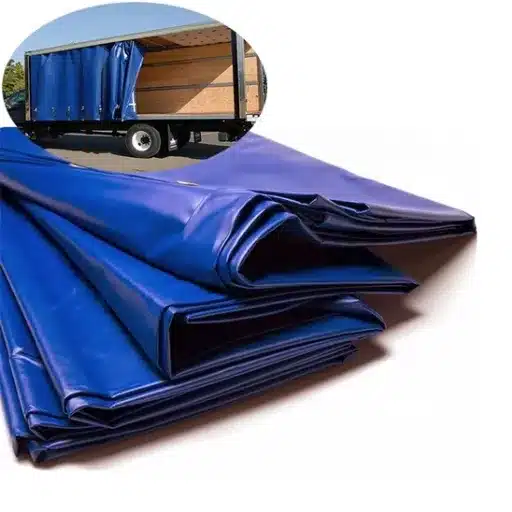
A PVC tarpaulin truck side curtain is an engineered protective fabric system manufactured from high-tenacity polyester base cloth coated with virgin-grade PVC, designed to enclose curtain-sider trailers while withstanding tensile stress, UV degradation, and driving rain across every logistics route. For fleet operators and procurement managers, specifying the correct material directly determines cargo security, regulatory compliance, and total cost of ownership over the vehicle lifecycle.
When Marcus Chen reviewed his fleet maintenance logs for Q1 2026, he noticed a costly pattern. Three curtain failures in four weeks. Each incident cost his operation eight hours of unplanned downtime, one cargo exposure claim, and a frustrated customer. The root cause was not driver handling or rail damage. It was the material specification. Marcus had sourced 650gsm polyethylene curtains to minimize unit cost. In practice, that decision doubled his annual curtain expenditure.
You already know that material failure in fleet operations is a business problem, not a product inconvenience. This guide provides the exact specifications, compliance standards, and maintenance protocols you need to evaluate, specify, and procure truck side curtain systems that protect your operation. We will examine material science, certification requirements, custom manufacturing options, and fleet economics — grounded in the data procurement teams require to make defensible decisions. Get in touch with LY TRUSTLINK to discuss your custom PVC coated fabric requirements and receive tailored production solutions.
Key Takeaways
- 900gsm PVC tarpaulin with high-tenacity polyester base delivers the tensile strength required for heavy logistics routes and high-wind exposure.
- NFPA 701 and DIN 4102-B1 compliance documentation removes procurement approval friction and satisfies insurance requirements.
- Proper tensioning and quarterly inspection protocols can extend curtain service life from 3 years to 6 or more.
- Custom OEM manufacturing accommodates non-standard trailer dimensions, reinforced stress points, and fleet branding without compromise.
- Total cost of ownership analysis consistently favors premium material specification over lowest unit price when downtime and replacement cycles are included.
What Is a PVC Tarpaulin Truck Side Curtain?
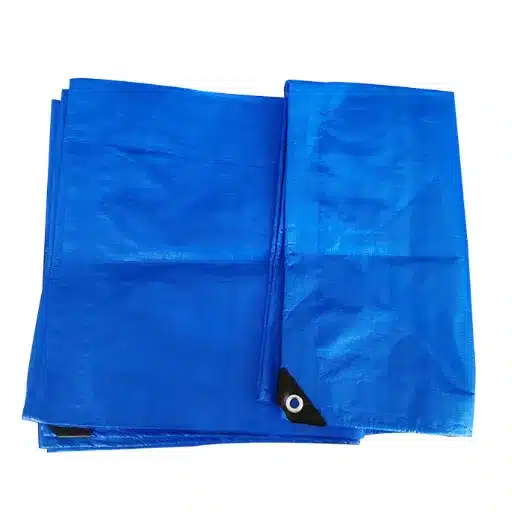
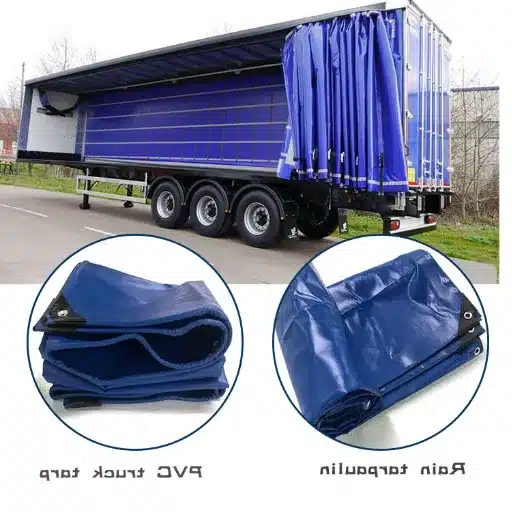
A truck side curtain is a retractable fabric enclosure system mounted on curtain-sider trailers, allowing side loading and unloading while protecting cargo from weather, road debris, and unauthorized access during transit. The curtain material itself is the critical component that determines system performance, longevity, and operational risk.
PVC tarpaulin truck side curtains are manufactured from a woven high-tenacity polyester base fabric that receives a dual-sided coating of virgin polyvinyl chloride (PVC). The polyester scrim provides structural integrity and dimensional stability under mechanical load. The PVC coating delivers waterproofing, UV resistance, chemical stability, and abrasion protection. This composite construction outperforms standard polyethylene alternatives in every metric that matters for commercial logistics: tensile strength, tear resistance, seam integrity, and service life.
Unlike flatbed tarps or heavy duty lumber tarps, which are deployed and removed per load, side curtains remain integrated with the trailer rail system. They are tensioned along vertical and horizontal axes, rolled and unrolled repeatedly, and subjected to sustained wind flap at highway speeds. These operational demands require a material engineered specifically for dynamic flexural stress and long-term environmental exposure.
For logistics operators, the specification decision is straightforward in principle and consequential in practice. The wrong material increases replacement frequency, raises fuel consumption through wind drag from loose fabric, and exposes cargo to water infiltration that standard polyethylene cannot reliably prevent. Whether you need PVC coated fabrics for truck covers, tents, tarpaulins, or outdoor products, LY TRUSTLINK is ready to support your business with reliable manufacturing expertise.
Material Specifications: What Procurement Should Demand
Procurement teams evaluating truck curtain replacement material or specifying new fleet builds should request documented performance data across four core categories: base fabric, coating compound, fabric weight, and mechanical strength.
Base Fabric Requirements
The structural backbone of any PVC coated fabric for transport is the woven base cloth. High-tenacity polyester yarn is the industry standard for curtain-sider applications because it combines exceptional strength-to-weight ratio with resistance to stretch and creep under sustained load. Procurement should verify that the supplier uses filament polyester rather than spun yarn, and that the weave pattern is a plain or panama weave optimized for coating adhesion and tear resistance.
Denier ratings for truck side curtain base fabrics typically range from 1,000D to 1,500D. Higher denier counts increase abrasion resistance and structural rigidity but add weight. For standard European curtain-sider applications, 1,000D to 1,200D provides the optimal balance of strength and handling characteristics.
Coating Technology
The PVC coating compound determines waterproofing performance, UV stability, and cold-weather flexibility. Virgin-grade PVC resin should be specified explicitly. Recycled or regrind compounds may reduce unit cost, but they introduce batch-to-batch variability in plasticizer distribution, filler content, and molecular weight. That variability translates directly to inconsistent performance in the field.
Premium curtain formulations incorporate UV stabilizers and absorbers homogenized during the calendering or spreading process. These additives prevent photochemical degradation of the polymer chains, which otherwise leads to surface chalking, embrittlement, and premature cracking. For fleets operating in high-sun regions, UV-stabilized virgin PVC is not optional. It is a specification requirement.
GSM Selection Guide
Fabric weight, measured in grams per square meter (GSM), is the most commonly referenced specification for truck side curtain tarp systems. It correlates closely with durability, but it is not the only metric that matters.
| GSM Range | Typical Tensile Strength (Warp) | Recommended Application |
|---|---|---|
| 500–650 gsm | 1,500–1,800 N/5cm | Light-duty urban distribution, low-speed routes, minimal wind exposure |
| 700–850 gsm | 2,000–2,500 N/5cm | Standard European curtain-sider operations, mixed highway and urban |
| 900+ gsm | 2,800–3,500 N/5cm | Heavy logistics, high-wind corridors, abrasive cargo, extreme climates |
Selecting the correct GSM depends on three operational factors: route environment, cargo type, and expected service life. A regional distribution fleet operating at moderate speeds on sheltered routes may achieve acceptable performance at 650gsm. A long-haul fleet traversing exposed highways or operating in monsoon seasons requires 850gsm minimum to manage wind flap stress and water ingress risk.
Tensile and Tear Resistance Benchmarks
Tensile strength measures the force required to pull the fabric apart along its warp and weft axes. For truck side curtains, warp tensile strength should exceed 2,000 N/5cm for standard applications and 2,800 N/5cm for heavy-duty routes. Weft strength should be within 80–90% of warp values, indicating a balanced weave that resists tearing in both directions.
Tear resistance, measured via the trapezoid or tongue tear method, indicates how the fabric behaves once a cut or puncture occurs. High tear resistance prevents a small rail snag or cargo corner from propagating into a curtain-wide failure. Procurement should request tear resistance values of 250 N or higher for mission-critical fleet applications.
Want the exact spec sheet for your route profile? Download our truck curtain technical specifications or talk to an engineer about your fleet requirements.
Certifications & Compliance Standards
Compliance documentation is often the deciding factor in procurement approvals, particularly for fleets serving regulated industries or operating under strict insurance requirements. Truck side curtains must meet specific fire safety and performance standards depending on the market and cargo category.
NFPA 701 Fire Retardancy
NFPA 701 is the standard fire test method for flame propagation of textiles and films. For truck side curtains, NFPA 701 compliance certifies that the material will not contribute significantly to fire spread in the event of a cab fire, cargo combustion, or roadside incident. This certification is mandatory for certain hazardous cargo classifications and is increasingly specified by major fleet operators as a baseline safety requirement.
Procurement teams should verify that the manufacturer provides current NFPA 701 test reports with batch-specific data, not blanket marketing claims. At LY TRUSTLINK, NFPA 701 fire retardant tarpaulin formulations are tested per procedure at third-party laboratories, with certificates of compliance available for every production run.
DIN 4102-B1 for European Fleet Compliance
European operators and OEM trailer builders should specify DIN 4102-B1 classification, which certifies that the material is difficult to ignite and exhibits low flame spread. B1 classification is required for many German and Austrian fleet registrations and is recognized across EU member states as evidence of material safety.
UV Resistance and Weathering Performance
While UV resistance is often treated as a secondary specification, it directly determines functional service life. ASTM G154 accelerated weathering tests provide objective data on how coating formulations perform under simulated solar radiation, thermal cycling, and moisture exposure. Procurement should request UV degradation test data showing tensile strength retention after 1,000+ hours of accelerated exposure.
Making Compliance Easy
Missing or expired certifications create procurement delays and can disqualify suppliers entirely. When evaluating custom truck tarpaulins or standard curtain specifications, request a compliance packet upfront. The right supply chain partner delivers documentation as standard practice, not upon special request.
Custom vs. Standard: Sizing and Configuration
Truck side curtains are not one-size-fits-all products. Trailer dimensions vary by manufacturer, region, and application. Fleet branding requirements add another layer of specification complexity.
Standard Dimensions
European curtain-sider trailers commonly utilize curtains with widths of 2,480mm to 2,550mm and drops of 2,500mm to 2,700mm, depending on trailer deck height and rail configuration. North American specifications differ, with wider trailers requiring broader curtain panels. Procurement should confirm that the supplier stocks or can produce the exact width, drop, and overlap dimensions required for the specific trailer fleet.
Custom Manufacturing Options
Non-standard trailers, specialized cargo profiles, and branded fleet wraps all demand custom capability. A true OEM and ODM fabric manufacturing partner can accommodate:
- Non-standard dimensions for specialty trailers, rail cars, or intermodal containers
- Reinforced stress points at high-wear locations: bottom corners, center seams, and slide rail interfaces
- Custom eyelet spacing and reinforcement for unusual rail hardware or tensioning systems
- Fleet color matching and logo integration for corporate identity requirements
- Dual-compound coatings combining UV resistance on the exterior face with anti-abrasion treatment on the cargo-facing side
Prototype samples for custom curtain configurations are typically available within 2–3 weeks. Production lead times are confirmed at order, with batch consistency guaranteed through automated coating line control and multi-point quality inspection.
Have a non-standard trailer or fleet branding requirement? Start your custom order with our engineering team and receive prototype samples confirmed to your exact specifications.
Installation, Tension & Maintenance Best Practices
Even premium material specifications fail prematurely when installation is sloppy or maintenance is neglected. Proper handling protocols protect your investment and extend curtain service life.
Tensioning and Rail Compatibility
Side curtains must be tensioned evenly along both vertical and horizontal axes to prevent wind flap, which is the primary driver of mechanical fatigue. Uneven tension concentrates stress at individual anchor points, accelerating eyelet tear-out and seam failure. When installing new curtains, verify rail compatibility — slide hardware, tensioning buckles, and locking mechanisms vary by trailer manufacturer and must interface cleanly with the curtain edge reinforcement.
Cleaning Protocol
PVC coated fabric for transport should be cleaned quarterly, or more frequently in high-dust or chemical-exposure environments. Use a mild detergent solution and soft-bristle brush. Avoid petroleum-based solvents, which attack the PVC plasticizer matrix and cause surface tackiness or cracking. Rinse thoroughly and allow curtains to dry completely before rolling to prevent mildew growth on the cargo-facing surface.
Inspection Checklist
Elena Voss, maintenance supervisor at a mid-sized distribution firm in Rotterdam, implemented a quarterly curtain inspection protocol after a preventable failure delayed a time-sensitive pharmaceutical delivery. Her checklist covers five points:
- Seam integrity: Visually inspect all horizontal and vertical seams for separation or delamination
- Coating condition: Look for surface cracking, chalking, or punctures that expose the base fabric
- Eyelet and reinforcement: Check for elongation, tearing, or corrosion at all anchor points
- Tension system: Verify that buckles, straps, and slide rails operate smoothly and maintain even tension
- Contamination: Remove accumulated road salt, chemicals, or organic matter that degrade the coating
Since implementing this protocol, Elena has extended her fleet’s average curtain replacement interval from 3.2 years to 5.8 years. The 15 minutes per trailer per quarter has saved her operation thousands in unplanned replacement costs.
Repair vs. Replace Decision Matrix
Small punctures or localized tears can often be repaired using PVC patch kits and hot-air welding, provided the base fabric is intact. However, curtains exhibiting widespread coating degradation, multiple seam failures, or structural stretching should be replaced entirely. Repairing a curtain that has reached end-of-life simply defers the failure to a more inconvenient moment.
Truck Side Curtains in Fleet Operations: Performance & Economics
Material specification decisions should be evaluated through the lens of total cost of ownership, not purchase price alone. The economics of truck side curtain tarp systems include acquisition cost, installation labor, maintenance overhead, replacement cycles, and the operational cost of unplanned failures.
Failure Modes and Operational Consequences
Curtain failure in transit creates a cascade of operational problems. Water infiltration damages cargo, generating claims and eroding customer trust. Wind intrusion from a compromised curtain increases fuel consumption by disrupting aerodynamic flow around the trailer. A complete curtain blowout forces an unscheduled stop, delays delivery commitments, and may require emergency roadside repair at premium labor rates.
Total Cost of Ownership Analysis
David Okonkwo, procurement director for a West African logistics fleet, ran the numbers after switching from 650gsm commodity curtains to 900gsm engineered PVC tarpaulin truck side curtains. The unit cost increase was 35%. The replacement interval doubled from 2.5 years to 5+ years. Unplanned downtime events dropped by 80%. When David modeled fuel efficiency, cargo claim reduction, and maintenance labor, the premium specification delivered a 22% total cost reduction over the vehicle lifecycle.
David’s experience illustrates a principle that holds across climates and routes: in your operation, a curtain failure is never just a curtain failure. It is a delayed delivery, a damaged relationship, and an unplanned expense.
Weather Exposure and Route-Specific Performance
Curtain performance varies significantly by operating environment. Southern routes with intense UV exposure accelerate coating degradation unless UV-stabilized formulations are specified. Northern routes with freeze-thaw cycling demand cold-crack-resistant plasticizers that maintain flexibility below -20°C. Coastal routes expose curtains to salt spray, which corrodes metal hardware and can degrade certain coating compounds over time.
Specifying curtains without accounting for route-specific environmental stress is a common source of premature failure. The right supply chain partner asks about your routes before recommending a specification.
Cargo Security and Theft Deterrence
A properly tensioned, intact side curtain provides a visible barrier that deters opportunistic theft during stops. Curtain systems integrated with locking hardware and tamper-evident seals add a layer of cargo security that flatbed operations cannot match. For high-value cargo categories, the curtain system is part of the security architecture, not merely weather protection.
Conclusion
Specifying a PVC tarpaulin truck side curtain is an engineering decision with operational consequences. The right material — high-tenacity polyester base, virgin-grade PVC coating, correct GSM for the application, and certified compliance documentation — protects cargo, reduces downtime, and lowers total cost of ownership. The wrong material creates a recurring maintenance burden that drains resources and introduces risk.
Procurement teams should demand specifications backed by test data, certifications validated by third-party laboratories, and a supplier relationship oriented around long-term fleet performance. Every production batch should be tested for tensile strength, tear resistance, and seam integrity before shipment. Every custom requirement should be met with engineering support from concept to certified delivery.
At LY TRUSTLINK, we engineer protective fabrics that safeguard assets across transportation, construction, agriculture, and industrial sectors worldwide. We are more than a vendor — we are a reliable link in your supply chain.
Ready to specify curtains that match your operational demands? Request a custom quote for your fleet, download our full truck curtain spec sheet, or order prototype samples to evaluate material performance before committing to volume production.