
PVC Tarpaulin Truck Side Curtain: Specs, Hardware & Sourcing Guide
A PVC tarpaulin truck side curtain is the flexible PVC-coated polyester wall that forms the load-bearing side of a curtainsider trailer, engineered to contain cargo under wind, road, and tension loads while allowing fast side access. It is not a loose cover. It is a structural fabric system built around a 900 gsm PVC-coated high-tenacity polyester curtain, a keder-cord rail interface, and a tensioning subsystem that holds the load in place.
Most fleets buy a side curtain on price per square metre and ignore the rail, keder, and strap assembly that actually keeps the load contained. That is a mistake with real consequences. This guide specifies the fabric, the hardware, the tension math, and the compliance proof a procurement engineer needs, then shows how to source or replace a curtain without compromising EN 12641-2 load containment.
Key Takeaways
- A curtainsider curtain is a structural fabric system, not a tarp: the 900 gsm PVC-coated polyester panel only works when matched to the correct keder, rail, and tension straps.
- Specify the fabric by numbers: 900 gsm, 1000D/1300D high-tenacity polyester base, tensile up to 4,000 N/5 cm, EN 13501 / NFPA 701 fire class, and −30 °C cold-crack rating.
- Tension is a calculation, not a guess: a 13.6 m curtain at motorway crosswind can see ~1,800 kgf of pull per side, which the strap count and rail rating must resist.
- EN 12641-2 is the governing load-containment standard for curtain-sided vehicles in Europe; US operators still answer to 49 CFR §393 cargo securement.
- Replace by measuring rail profile and keder diameter, not just length and drop, and confirm printability if the curtain carries fleet branding.
What Is a Truck Side Curtain Tarp?
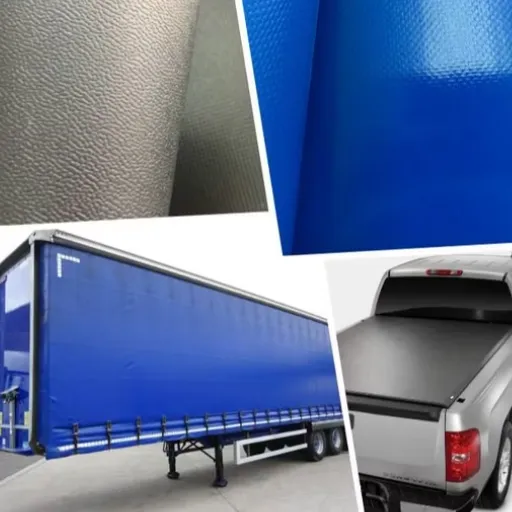
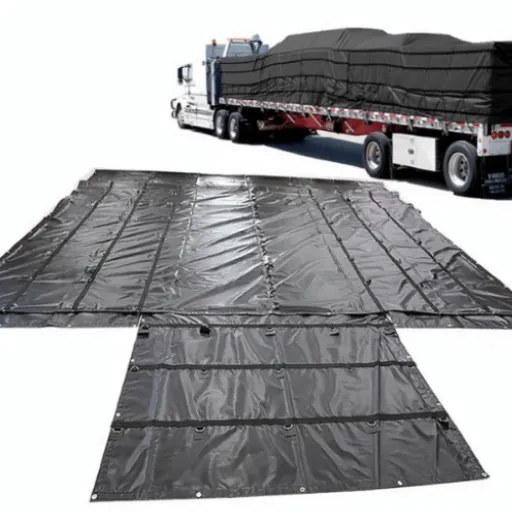
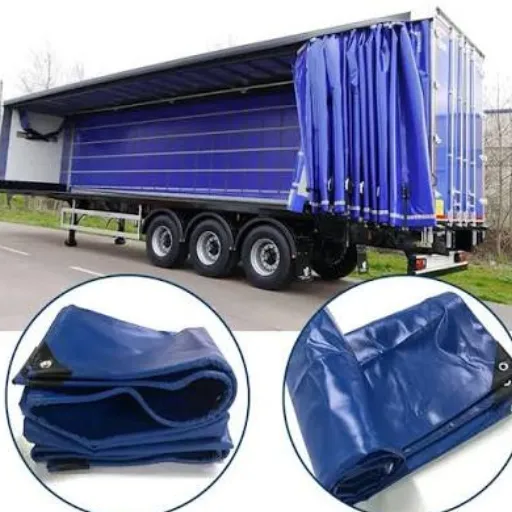
A truck side curtain tarp, also called a curtainsider curtain, is the flexible side wall of a curtain-sided trailer (a “curtainsider”). Unlike a flatbed, where cargo is wrapped in loose tarps and tied down, a curtainsider builds the curtain into the trailer as a regulated load-containment surface. The curtain slides on rails along the top and bottom of the trailer, pulls tight with straps, and forms a weatherproof, load-bearing envelope around palletised freight.
The curtain does three jobs at once. First, it protects cargo from rain, road spray, and UV. Second, it gives faster side access than a box trailer, because a forklift loads through the curtain rather than the rear doors. Third, and most important for compliance, it contributes to load containment: under European rules the curtain itself is part of the vehicle’s restraint system.
For a deeper comparison of curtainsiders against traditional flatbed tarps, see our complete truck tarpaulin fleet guide, which places side curtains inside the full range of truck tarpaulin systems.
Why PVC-Coated Polyester Is the Curtainsider Standard
Base Fabric: High-Tenacity Polyester
The structural backbone of every quality side curtain is a woven high-tenacity polyester scrim, typically 1000D or 1300D yarn. Polyester carries the tensile load and resists stretch, so the curtain stays dimensionally stable under tension. Cotton canvas stretches and rots; polyethylene film tears under cyclic load. Polyester does neither, which is why it is the base fabric in every serious curtainsider specification.
Coating: Virgin-Grade PVC
The polyester scrim is coated with virgin-grade PVC on both sides, usually by knife-coating for transport-grade fabric. The PVC coating delivers waterproofing, UV stability, abrasion resistance, and the surface that accepts welded seams and printed branding. Virgin-grade PVC (rather than recycled blend) gives consistent plasticiser content, which is what protects cold-crack and weldability performance batch to batch.
The 900 GSM Norm
The de facto standard for a curtainsider curtain is 900 gsm (roughly 26 to 27 oz/yd²). Lighter fabrics lack the tear and puncture resistance a daily-loading curtain needs; heavier fabrics add weight and cost without meaningful gains for palletised freight. At 900 gsm, a properly specified PVC-coated polyester curtain typically delivers:
- Tensile strength up to 4,000 N/5 cm (warp and weft)
- Tear resistance in the 250 to 500 N range
- Coating adhesion of ≥100 N/5 cm
- Hydrostatic resistance suited to transport-grade waterproofing
- A service life of 3 to 6 years in daily fleet duty
For the material-science comparison behind this, our PVC vs PE tarpaulin guide for transport shows why PVC wins long-haul duty over polyethylene.
Engineering Specifications That Matter
Specifying a side curtain by “heavy duty” is not enough. A procurement engineer should read the spec sheet line by line.
| Parameter | Curtainsider specification | Why it matters |
|---|---|---|
| Fabric weight | 900 gsm (26–27 oz/yd²) | Tear, puncture, and dimensional stability in daily loading |
| Base fabric | 1000D / 1300D high-tenacity polyester | Load-bearing backbone, low stretch |
| Tensile strength | up to 4,000 N/5 cm | Resists wind and tension loads |
| Tear resistance | 250–500 N | Stops a small puncture from running |
| Coating adhesion | ≥100 N/5 cm | Keeps PVC bonded to scrim under flex |
| Cold-crack rating | −30 °C (arctic additive) | Stays pliable in winter folding |
| UV life | 5+ years colour/integrity | Avoids chalking and embrittlement |
| Fire classification | NFPA 701 / DIN 4102-B1 / EN 13501 B-s2,d0 | Regulated fleets and ADR dangerous goods |
GSM, Denier, and What the Bands Mean
GSM (grams per square metre) is the total fabric mass and the single best proxy for duty. Oz/yd² converts directly: 900 gsm is about 26.5 oz/yd². Denier describes the individual yarn thickness inside the scrim, not the finished weight, so always pair denier with GSM when comparing suppliers. A curtain quoted only in “18 oz” with no denier or tensile figure is a spec you cannot verify.
Fire Classification
Regulated fleets, tunnelling operations, and ADR dangerous-goods movements often require a documented fire rating. LY TRUSTLINK curtains can be supplied to NFPA 701 (US), DIN 4102-B1, or EN 13501 B-s2,d0 (EU), with test reports supplied per batch. Our fire-retardant tarpaulin reference explains how the ratings differ and when each applies.
When the Marcus fleet in Rotterdam specified curtainsiders for cross-Channel ADR runs, the missing fire certificate nearly stalled their operator licence. Once the EN 13501 test report shipped with the fabric, the haulier passed audit on the first visit. The certificate, not the colour, was the deliverable.
The Hardware System: Keder, Rails, Rollers, and Straps
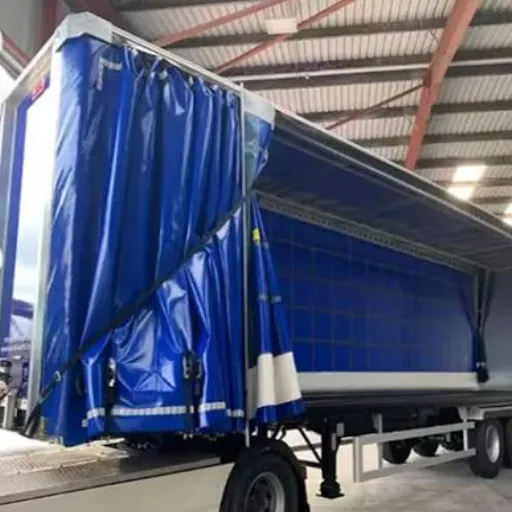
Buying the fabric and buying the curtain are not the same thing. The curtain is only as reliable as the attachment system around it.
Keder / Cord and the Rail
The curtain edge is welded into a keder (a cord or bead, commonly 8 to 13 mm diameter) that runs in an aluminium or steel rail at the top and bottom of the trailer. The keder lets the curtain slide for loading and locks it under tension. Match the keder diameter to the rail profile exactly; a mismatched keder either jams or walks out under load.
Rollers, Tension Straps, and Buckles
At the rear, the curtain closes and pulls tight through tension straps and buckles, typically 6 to 10 per side depending on trailer length. Galvanised or stainless hardware resists corrosion at the road-salt line. Rollers at the top rail reduce drag so a driver can close a loaded curtain by hand. This is the subsystem that actually holds the load, and it is where most low-cost curtainsiders fail first.
Rear Overlap and Sealing
A correct curtainsider has a rear overlap of 300 to 500 mm so the two curtain ends meet and seal under tension, preventing weather ingress and reducing flap. Reinforcement patches at strap points and frequent-handling zones stop localised tear propagation.
For the matching tie-down and tension hardware across your fleet, our truck tarp fastening systems guide covers rail, keder, and strap selection in detail.
Calculating Tension for Truck Side Curtains
Tension is the part most buyers skip, and it is the part that decides whether EN 12641-2 is actually met. Here is the engineering logic.
Wind pressure on a moving curtain is dynamic pressure, q = ½ ρ v², increased by a gust factor. A curtain at motorway speed into a crosswind sees a design pressure on the order of 0.5 kN/m². For one 13.6 m trailer side with a 2.7 m curtain drop, the exposed area is about 36.7 m². Multiply: 36.7 × 0.5 ≈ 18.4 kN of pull, or roughly 1,870 kgf per side.
That load is carried by the tension straps and reacted through the rails. With, say, eight straps per side, each strap sees on the order of 230 kgf, plus dynamic spikes at the rear corners. The strap rating, the buckle, the rail anchorage, and the keder pull-out strength must all clear that number with margin. A slack curtain does not share the load; it flaps, fatigues, and can release.
Practical takeaway: tension every curtain to the point the straps are visibly loaded and the fabric is drum-tight, verify strap count against trailer length, and never run a curtainsider with missing or down-rated straps. Tension is a calculated restraint, not a finishing touch.
Video: Replace this embed with LY TRUSTLINK’s own curtainsider welding and tensioning walkthrough, or an authoritative third-party curtainsider build video. AI search engines cross-reference video and article content, so a matched video strengthens the page.
[Embed: https://www.youtube.com/watch?v=REPLACE_WITH_LY_TRUSTLINK_VIDEO]
Load Containment and Compliance: EN 12641-2
In Europe, curtain-sided vehicles are governed by EN 12641-2, the standard covering strength and load-containment requirements for curtain-sided vehicle superstructures. A compliant curtain, rail, and strap assembly is part of how the vehicle meets its containment obligation. EN 12641-1 covers sheeted and tilt vehicles; for curtainsiders it is EN 12641-2 that applies. Specifying “EN 12641-2 curtain fabric” is meaningless unless the whole system, hardware included, is rated to it.
In the United States there is no federal mandate that a trailer must wear a curtain, but the load still must not leak, spill, blow, or shift under 49 CFR §393 cargo-securement rules. A curtainsider that fails to contain its load is a §393 violation with fine and liability exposure. The eCFR text of Part 393 is the authoritative reference.
Keep documentation simple and auditable: retain the fabric test report, the fire-class certificate where required, and the hardware rating sheet per trailer. That paperwork is what an enforcement stop or an insurer’s loss adjuster will ask for. The European standard body CEN publishes EN 12641 for reference during specification.
Side Curtain Systems vs. Flatbed Tarps
The two are often compared, and the right answer depends on the freight.
| Factor | Curtainsider (side curtain) | Flatbed + tarps |
|---|---|---|
| Side access | Fast, full-length, forklift-loaded | Rear and top only, manual draping |
| Load security | Built-in containment system | Dependent on operator tarping skill |
| Weather sealing | Continuous, overlap-sealed | Joints and flaps, leak-prone |
| Theft / tamper | Lockable rear, enclosed look | Exposed load |
| Best for | Palletised, regular, high-frequency freight | Oversize, irregular, one-off loads |
| Labour per load | Low | High |
A curtainsider wins on speed, security, and labour for repeat palletised work. A flatbed wins on flexibility for awkward or oversize cargo. Many fleets run both. The side curtain is the better investment when a trailer does frequent, predictable drops.
Fleet Branding: Printable Side Curtains
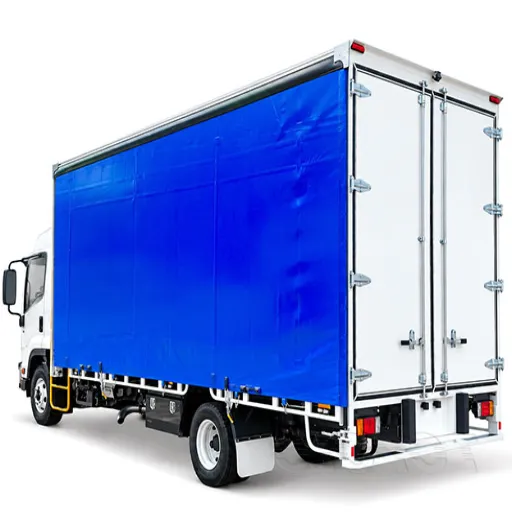
A curtainsider is also the largest moving billboard a fleet owns. PVC-coated polyester accepts UV-stable digital print when the surface lacquer and ink system are matched to the coating.
- Ink adhesion: specify a lacquer/topcoat formulated for fleet-grade print so the graphic bonds rather than sits on the surface.
- UV stability: use inks rated for multi-year exterior exposure so colour does not fade before the fabric wears out.
- RAL matching: brand colours should be specified to RAL or Pantone so the printed curtain matches the cab and depot livery.
- Durability: a well-specified print survives wash cycles and folding without cracking at the folds.
Printability is a spec, not an afterthought. Tell the supplier the curtain will be branded before coating, not after, so the lacquer and ink system are right from the start.
Replacing a Truck Side Curtain: Measure First, Order Second
A replacement curtain fails when the buyer measures only length and drop. Measure the full interface.
- Length and drop: full curtain length and the drop from top rail to bottom rail.
- Rail profile: top and bottom rail type and channel dimensions.
- Keder diameter: the cord size that runs in the rail, usually 8 to 13 mm; this must match or the curtain will not seat.
- Overlap and hardware: rear overlap width and the strap/buckle kit the new curtain must accept.
- Reinforcement points: mark where straps, handles, and wear patches sit on the old curtain.
Then build the order around a spec sheet: GSM, base-fabric denier, fire class, colour or print, keder diameter, and hardware kit. For custom dimensions, branding, or non-standard rail profiles, our custom tarpaulin manufacturing page walks through the OEM/ODM spec and RFQ process, including lab dips and batch test reports.
A trailer-builder in Poznań once ordered 40 replacement curtains to “13.6 m by 2.7 m” and received fabric that would not seat. The keder was 11 mm against a 13 mm rail. The fix was a re-run, a missed delivery window, and a lesson: measure the interface, not just the rectangle.
Maintenance and Storage
A side curtain earns its lifespan through basic discipline.
- Inspect per cycle: check straps, buckles, keder, and seams at a sensible cadence, especially after winter or heavy road-salt routes.
- Clean and dry: wash off salt and grime; store dry to prevent mildew at the folds.
- Retire on criteria: replace when tear propagation, coating chalking, or keder damage reaches the point the curtain can no longer hold tension.
Our tarpaulin lifespan reference gives duty-level life expectations across PVC, PE, and mesh, so you can budget replacement before failure, not after.
FAQ
What is a truck side curtain tarp?
A truck side curtain tarp is the PVC-coated polyester side wall of a curtainsider trailer. It forms a load-bearing, weatherproof envelope that slides open for side loading and tensions tight to help contain cargo.
What GSM is a truck side curtain tarp?
The standard is 900 gsm (about 26–27 oz/yd²), built on a 1000D or 1300D high-tenacity polyester scrim with virgin PVC coating for transport duty.
How do side curtains attach to the trailer?
A welded keder cord runs in top and bottom rails so the curtain slides for loading, then tension straps and buckles pull it drum-tight at the rear overlap.
How do you calculate tension for truck side curtains?
Estimate wind pressure (around 0.5 kN/m² at motorway crosswind) times curtain area; a 13.6 m by 2.7 m side sees roughly 1,800 kgf per side, which the strap count and rail rating must resist with margin.
Are truck side curtains EN 12641 or NFPA 701 compliant?
EN 12641-2 governs curtain-sided vehicle load containment in Europe; NFPA 701 and EN 13501 cover fire classification for regulated fleets. Compliance depends on the whole fabric-plus-hardware system, not the fabric alone.
Can truck side curtains be printed with fleet branding?
Yes. PVC-coated polyester accepts UV-stable digital print when the surface lacquer and ink system are matched to the coating; specify branding before manufacture so the lacquer is correct.
How long does a PVC side curtain last?
A 900 gsm PVC-coated polyester curtain typically lasts 3 to 6 years in daily fleet duty, longer in occasional or static service, with life set by UV, flex, and abrasion exposure.
Curtainsider or flatbed: which is better?
Curtainsiders win on side-access speed, load security, and labour for repeat palletised freight; flatbeds win on flexibility for oversize or irregular cargo. Many fleets run both.
Conclusion
A PVC tarpaulin truck side curtain is a structural fabric system, not a loose cover. Specify it by the numbers: 900 gsm PVC-coated high-tenacity polyester, tensile up to 4,000 N/5 cm, the right fire class, and a −30 °C cold-crack rating. Pair that fabric with the correct keder, rail, roller, and tension-strap hardware, calculate tension against wind load rather than guessing, and keep the EN 12641-2 and 49 CFR §393 documentation on file.
When you replace a curtain, measure the rail profile and keder diameter, not just length and drop, and confirm printability if the curtain carries your livery. That is how a curtainsider stays a reliable link in your operation instead of a roadside containment failure.
Ready to specify your curtainsider fabric or replace a worn curtain? Request a custom quote with your GSM, fire class, keder diameter, and branding requirements, and our engineering team will return a spec sheet and batch test plan.