
Heavy Duty Truck Tarpaulin: PVC Specs & Test Guide
A heavy duty truck tarpaulin is a PVC-coated polyester cover defined by measured strength, not weight alone: typically 750 GSM and above, a 1000D or heavier base fabric, at least 2,800 N/5 cm tensile strength, 280 N tear resistance, and 100 N/5 cm coating adhesion, each confirmed by a test report that names its method. If a supplier can’t produce those figures, the cover is not heavy duty. It is simply heavy.
“Heavy duty” is the most abused label in this category. Two covers can both be advertised at 900 GSM and still differ threefold in tear strength. One survives five winters on a lumber route; the other fails at the grommets in eighteen months, and the purchase orders looked identical.
You already know the cheapest cover is rarely the cheapest to run. The harder problem is proving which quote is better when every supplier publishes a different subset of numbers. This guide to truck tarpaulin specifications defines the thresholds, names the test behind each one, maps failures to the clauses that prevent them, and ends with an RFQ checklist you can send to any supplier.
For trailer sizing and replacement planning, see our complete truck tarpaulin fleet guide.
Key Takeaways
- Heavy duty starts at roughly 750 GSM with a 1000D or heavier base fabric; 900 GSM alone doesn’t guarantee it.
- Five numbers decide field life: tensile, tear, adhesion, cold-crack temperature, and UV retention. Ask for all five with their test methods.
- Test methods are not interchangeable. ISO 4674-1, ISO 4674-2, and DIN 53363 produce different tear values from the same fabric.
- Seam strength should reach at least 80% of parent-fabric strength; most failures start at a seam, hem, or grommet.
- A specification without a batch test report is a claim, not a control. Require reports per lot and retain samples.
What Is a Heavy Duty Truck Tarpaulin?
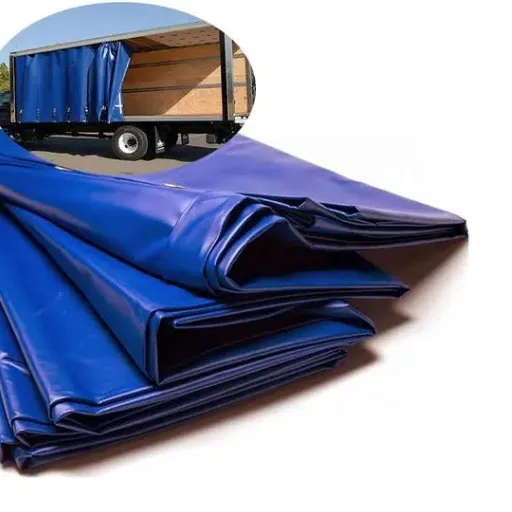
A heavy duty truck tarpaulin is a coated fabric cover engineered for daily road service, defined by mass per area, base-fabric construction, tensile strength, tear resistance, and coating adhesion. It is specified by duty class and verified by test report, not by the word “heavy” on a product listing.
Duty class is a purchasing decision; marketing language is not. Suppliers use “heavy duty,” “premium,” and “reinforced” loosely, and none carries a measurable meaning. GSM carries a partial meaning: it tells you how much material is in a square meter, not how it performs under load.
Light commercial covers run 400 to 550 GSM, general fleet covers 550 to 750, daily-service truck tarpaulins 750 to 900, and severe duty for mining and aggregate 900 to 1,100, with specialty constructions above that. Most fleets need more than one grade. A mixed operation might run 650 GSM on box-truck covers, 750 to 900 on heavy duty lumber tarps, and 1,000 or more on dump trailers. Buying everything at the top wastes money on weight, freight, and crew fatigue; buying at the bottom shortens replacement cycles.
If you already have a supplier spec sheet, send it over and we will review it against the thresholds below. Request a specification review.
What Qualifies as Heavy Duty? GSM, Denier & Construction Thresholds
GSM and oz/yd²: conversion and duty bands
GSM means grams per square meter. To convert from ounces per square yard, multiply by 33.906: an 18 oz cover is roughly 610 GSM, 22 oz is about 746 GSM, and 900 GSM is about 26.5 oz.
GSM measures mass per area, not thickness or strength. Two fabrics at the same GSM can differ in thickness, tear resistance, and service life depending on yarn denier, weave, coating add-on, and formulation.
| Service tier | GSM | Base fabric (typical) | Tensile (N/5 cm) | Tear (N) | Adhesion (N/5 cm) | Typical use |
|---|---|---|---|---|---|---|
| Light / regional | 400–550 | 500D–1000D | 1,800–2,500 | 150–250 | ≥60 | Occasional covers, light freight |
| Medium / general fleet | 550–750 | 1000D × 1000D, 20 × 20 | 2,200–3,000 | 220–320 | ≥80 | General flatbed freight |
| Heavy / daily fleet | 750–900 | 1000D × 1000D or 1000D × 1300D | 2,800–3,800 | 280–450 | ≥100 | Lumber, steel, curtain-side |
| Severe / mining and aggregate | 900–1,100 | 1300D or 1000D × 1300D | 3,500–4,500+ | 400–600+ | ≥120 | Dump, aggregate, mining |
| Specialty | 1,100–1,500 | 1300D+, Panama weave | 4,000+ | 600+ | ≥120 | Extreme abrasion, containment |
Treat these as benchmarks, not universal pass/fail limits. The supplier must state its test method and acceptance limit. A 900 GSM cover that fails at 200 N tear is not heavy duty.
Base fabric denier and weave
Denier is yarn linear density: the mass in grams of 9,000 meters of yarn. A 1000D yarn is generally stronger than 500D, but thread count and weave matter too.
The standard heavy-duty base is 1000D × 1000D at 20 × 20, meaning 20 yarns per inch in warp and weft. Higher tear specifications move to 1000D × 1300D or 1300D × 1300D, and specialty covers may use 2000D. At 900 GSM, a Panama weave (a basket construction) is often quoted as 30 × 30, adding mass and abrasion resistance.
Trade designations are not standardized. “20 × 20” may mean per inch or per 10 cm, and Panama constructions count yarn groups rather than single ends. Confirm yarn count, direction, and unit in writing.
Coating method and add-on
PVC tarpaulins are knife-coated, where PVC paste is spread onto the polyester base and fused, or laminated, where pre-formed film is bonded under heat and pressure. Both produce good covers but differ in adhesion, hand, and repairability.
Coating add-on is the number most buyers forget. Ask for coating mass in g/m², sides coated, and whether a topcoat handles UV and dirt. Vinyl is the coating; polyester is the base. “PVC coated fabric truck tarpaulin” and “PVC coated polyester tarpaulin” describe the same construction.
Thickness and mass
Thickness follows from GSM, formulation, and coating structure. Truck covers generally run 0.40 mm to 0.90 mm: 18 oz around 0.47 mm, 22 oz 0.50 to 0.70 mm, and 900 GSM 0.69 to 0.80 mm.
To estimate finished weight, multiply area in square meters by GSM and divide by 1,000. A 6 m × 12 m cover in 900 GSM weighs about 64.8 kg before hardware. That matters for handling, freight, and crew safety, and it is one reason over-specifying has a cost.
An illustrative composite: a regional fleet procurement lead we will call Dana received two quotes, both labeled 900 GSM. The first used 1000D × 1000D with 85 N/5 cm adhesion and 50 cm grommet spacing. The second used 1000D × 1300D with 110 N/5 cm adhesion, double-sided coating, and reinforced hems.
On a windy winter route, the second outlasted the first by more than two replacement cycles. Dana did not buy a heavier tarp. She bought a better-specified one at the same nominal weight.
The Seven Specifications That Define a Heavy-Duty Truck Tarp
Seven numbers, roughly in the order they cause failures, separate a genuine heavy-duty truck tarpaulin from a commodity cover. Each belongs on the supplier’s datasheet with a value, a unit, and a test method.
| Property | Heavy-duty inquiry criterion | Unit | Why it matters |
|---|---|---|---|
| Tensile strength | ≥2,800 | N/5 cm, warp and weft | Resists tension from tie-downs and wind load |
| Tear resistance | ≥280 | N | Stops small cuts from propagating |
| Coating adhesion | ≥100 | N/5 cm | Prevents delamination at flex points |
| Hydrostatic resistance | ≥3,000 | mmH₂O | Keeps water out under ponding and driven rain |
| Cold-crack / low-temp bend | Pass at −30 °C, −40 °C for cold routes | °C | Prevents brittle fracture when folded |
| UV aging | 1,000–2,000 h with ≥70–80% retention | hours, % | Predicts chalking and strength loss |
| Seam strength | ≥80% of parent fabric | N/50 mm or % | Controls whether the seam fails first |
Tensile strength
Tensile strength measures the pulling force a fabric withstands before rupture, reported separately for warp and weft. Daily-service covers should reach 2,800 N/5 cm in both directions; severe duty reaches 3,500 to 4,500. See our guide to tensile strength testing for how the values are generated.
Tear resistance
Tear resistance measures the force required to propagate an existing cut, and it is often more predictive of field life than tensile strength. Covers rarely fail from a clean pull; they fail from a nick at a grommet, a snag on a stake pocket, or a crease that cracks. Heavy duty should reach 280 N, severe duty 400 N or more. Our guide to how tear resistance is tested covers test geometry.
Coating adhesion
Adhesion measures how firmly the PVC coating bonds to the polyester base. Low adhesion shows up as delamination at folds, peeling at cut edges, and coating loss where the cover flexes against a rail. Standard truck grade is often 80 N/5 cm; heavy duty should reach 100 N/5 cm. Coating adhesion loss is one of the least diagnosed failure mechanisms in fleet covers.
Hydrostatic resistance
Hydrostatic resistance measures the water pressure a fabric withstands before water passes through. Truck-grade covers commonly specify 3,000 mmH₂O or higher, about 29 kPa. Some heavyweight constructions are quoted at 200 kPa, roughly a 20-meter water column. These are different test scales, so ask which method and specimen area produced the number.
Cold-crack and low-temperature flexibility
Cold-crack testing bends a specimen at a controlled low temperature and records whether it cracks. A pass at −30 °C suits temperate routes; northern winters call for −40 °C cold-flex performance, tested on the finished assembly rather than roll goods. Our cold-crack performance page explains the difference between a lab pass and a service guarantee.
UV aging
UV exposure breaks down polymer chains, causing chalking, color fade, stiffening, and strength loss. Accelerated weathering is reported in hours, but the useful figure is retention at the end: 1,000 to 2,000 hours with at least 70% to 80% tensile and tear retention is a common heavy-duty criterion. High-altitude applications may specify 3,000 hours. See UV degradation and resistance.
Seam strength
Seam strength is measured on the finished cover, not the roll. Target at least 80% of parent-fabric strength; a seam at 55% effectively reduces the entire panel to that value. Our seam failure analysis covers the weld parameters that hold up in service.
Test Methods and Acceptance Criteria: How to Verify Supplier Claims
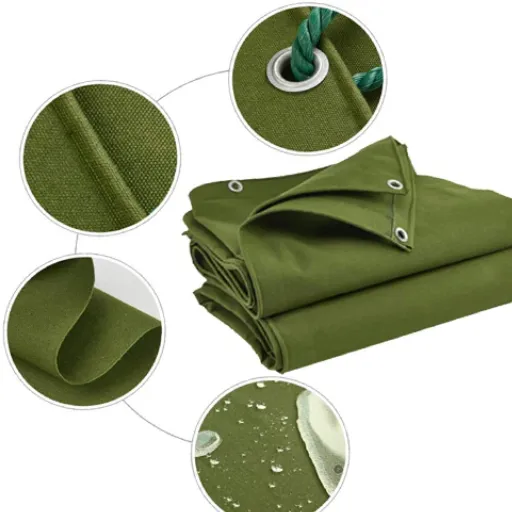
A number without a method is a rumor. The same fabric can produce 300 N under one tear method and 180 N under another, and both reports will be honest.
| Property | Test method | Unit | Heavy-duty inquiry criterion | What to request |
|---|---|---|---|---|
| Tensile strength | ISO 1421:2016; ASTM D751 | N/5 cm or N/50 mm | ≥2,800 N/5 cm each direction | Method, direction, conditioning, batch result |
| Tear resistance | ISO 4674-1:2016; ISO 4674-2:2021; DIN 53363 | N | ≥280 N, method stated | Exact part and method; never compare across methods |
| Coating adhesion | ISO 2411:2024 | N/5 cm | ≥100 N/5 cm | Specimen width, peel direction, batch result |
| Cold crack / low-temp bend | ASTM D2136-19(2026); ISO 4675:2017; ISO 4646:2022 | Pass/fail at °C | Pass at −30 °C; −40 °C for cold routes | Temperature, conditioning, finished-assembly trial |
| UV aging | ASTM G154; ISO 4892-3 | Hours plus retention % | 1,000–2,000 h with ≥70–80% retention | Lamp type, cycle, irradiance, retention data |
| Hydrostatic resistance | ISO 811; ASTM D751 | mmH₂O or kPa | ≥3,000 mmH₂O, method stated | Method, specimen area, result |
| Seam strength | ASTM D751 (seam methods); ISO 13935-2, scope caveat | N/50 mm or % of parent | ≥80% of parent-fabric strength | Weld parameters, seam type, finished sample |
| Fire retardancy | NFPA 701; DIN 4102 B1/B2; EN 13501-1 | Pass/class | Market-dependent | Certificate, test report, formulation |
| Mass per area | ISO 2286-2 or equivalent | g/m² | Specified GSM ±5% | Measured mass, tolerance, roll record |
Confirm current editions; the report should cite the edition used.
Tensile strength: ISO 1421 and ASTM D751
ISO 1421 defines tensile strength and elongation at break for coated fabrics. ASTM D751 covers grab and strip methods. Values are reported in newtons per 5 cm or 50 mm, with warp and weft listed separately, on conditioned specimens.
Tear resistance: ISO 4674-1, ISO 4674-2 and DIN 53363
ISO 4674-1 covers constant-rate tear methods, typically a tongue tear. ISO 4674-2 uses a ballistic pendulum. DIN 53363 uses a trapezoidal specimen. They load the fabric differently and don’t produce interchangeable results.
When a supplier quotes “tear strength 350 N,” ask which method, part, and direction.
Coating adhesion: ISO 2411
ISO 2411 specifies coating adhesion for coated fabrics. Results depend on specimen width and peel direction, so the report must state both. Adhesion and peel strength are related but not identical.
Cold crack: ASTM D2136, ISO 4675 and ISO 4646
ASTM D2136 covers low-temperature bend testing. ISO 4675 defines a low-temperature bend method, and ISO 4646 a low-temperature impact method. All three answer a pass/fail question at a stated temperature, but none guarantees a finished cover will perform there, because folds, hems, and hardware concentrate stress.
UV aging: ASTM G154 and ISO 4892-3
ASTM G154 and ISO 4892-3 both use fluorescent UV lamps. The report should state lamp type, irradiance, cycle, total hours, and strength retention. Hours without a retention criterion are meaningless: a 2,000-hour test retaining 90% beats a 3,000-hour test retaining 60%.
Hydrostatic resistance: ISO 811 and ASTM D751
ISO 811 measures resistance to water penetration under increasing hydrostatic pressure. Results appear as mmH₂O or kPa, and the conversion matters: 1 kPa equals about 102 mmH₂O. A claim of 3,000 mm and a claim of 200 kPa are not the same performance level.
Seam strength: ASTM D751 and ISO 13935-2
ASTM D751, sections 71 to 76, is the reference method for seam strength on coated fabrics. ISO 13935-2 uses a grab method, but its scope states it is normally not intended for coated fabrics, so cite it only when a spec calls for it. A seam is usually the weakest link, so express the criterion as a percentage of parent-fabric strength. Our guide to tarpaulin welding covers the parameters that hold up in service.
Fire retardancy: NFPA 701, DIN 4102 and EN 13501-1
Fire performance is usually driven by the cargo or the customer’s insurer. NFPA 701 is the common US reference; DIN 4102 B1/B2 and EN 13501-1 serve European buyers. Ask for the certificate, the test report, and the formulation it covers, because flame-retardant additive packages don’t transfer between constructions. Our fire-retardant tarpaulin guide covers the documentation to request.
How to read a test report
Six checks catch most misread reports:
- Method edition. A 2016 result can’t be presented as a 2024 result.
- Direction. Warp and weft must both appear, not an average.
- Conditioning. Standard atmosphere conditioning should be stated.
- Specimen geometry. Width, shape, and test speed affect the number.
- Pass/fail against a stated limit. A raw number without a criterion is not verification.
- Batch traceability. The report should match the lot or roll numbers on delivery.
Retain a pre-production and a production sample from the first order, and for safety-critical orders use an independent lab that receives the sample from you. Compare the production sample against its batch report before approving the lot. Request a sample and batch report.
Heavy-Duty Failure Modes and How to Specify Against Them
Most truck tarpaulin failures are predictable, and each maps to a specification clause and a field check.
| Failure mode | Root cause | Spec clause | Field check |
|---|---|---|---|
| Grommet tear-out | Point load, thin hem, wide spacing | Edge reinforcement, 50 cm spacing, D-rings | Pull-test a corner; inspect hem layers |
| Seam peel / delamination | Low adhesion, poor weld parameters | Adhesion ≥100 N/5 cm, seam ≥80% parent | Flex the seam; look for whitening |
| Cold crack | Brittle formulation, stress at folds | Pass at −40 °C, finished-assembly trial | Fold a cold sample; inspect for cracks |
| UV chalking / stiffening | Insufficient stabilizer package | 1,000–2,000 h with ≥70–80% retention | Compare hand and color to a retained sample |
| Abrasion at corners and edges | Rubbing on rails, stakes, load | Wear panels, rope-reinforced hem | Inspect after the first month |
| Wind-flap fatigue | Loose fit, wrong size, poor tension | Correct sizing, reinforced tie points | Check flap at highway speed |
| Plasticizer migration | Formulation or contact compatibility | Formulation disclosure, compatibility test | Look for tackiness and staining |
Grommet tear-out is the most common field failure and the easiest to prevent. Use 50 cm spacing rather than 100 cm on highway and high-wind routes, and a rope-reinforced hem rather than a single folded edge. Our guides to edge reinforcement and grommet spacing cover the hardware.
Seam peel traces back to adhesion or weld parameters. A seam that whitens when flexed is already losing coating bond. Specify adhesion at 100 N/5 cm or higher, and require a weld trial on the production line rather than a lab coupon. Scrim and mesh reinforcement adds dimensional stability in high-flex areas.
Cold crack deserves its own warning. An illustrative composite: a maintenance supervisor we will call Ray approved a cover that passed a −30 °C bend test on roll goods. In a January cold snap, the cover was folded at a corner and cracked along the fold.
The lab result was accurate; the finished assembly was never tested. The fix was a −40 °C formulation plus a finished-cover fold trial, not a heavier GSM.
The remaining mechanisms follow the same logic: each has a measurable specification and a field symptom. If a supplier can’t connect the symptom to a clause, they are selling fabric, not engineering. Our tarpaulin failure analysis library covers additional mechanisms.
Matching GSM and Construction to Cargo, Route and Platform
Grade selection starts with the load, route, and handling cycle. Heavier is not automatically better: a 900 GSM cover weighs about 38% more than a 650 GSM cover of the same dimensions, affecting handling, crew fatigue, and freight.
| Application | Recommended GSM | Construction notes |
|---|---|---|
| General freight, regional routes | 550–650 | 1000D × 1000D, 20 × 20, single or double coated |
| Flatbed lumber | 750–900 | 1000D × 1300D, reinforced hems, 50 cm grommets |
| Steel and coil | 650–750 | Abrasion-resistant coating, wear panels |
| Dump and aggregate | 600–750 | Cold-flexible, easy-clean topcoat |
| Curtain-side trailers | 750–900 | High adhesion, dimensional stability |
| Mining and severe duty | 900–1,100+ | 1300D base, heavy coating, reinforced edges |
Side curtains versus flatbed tarps
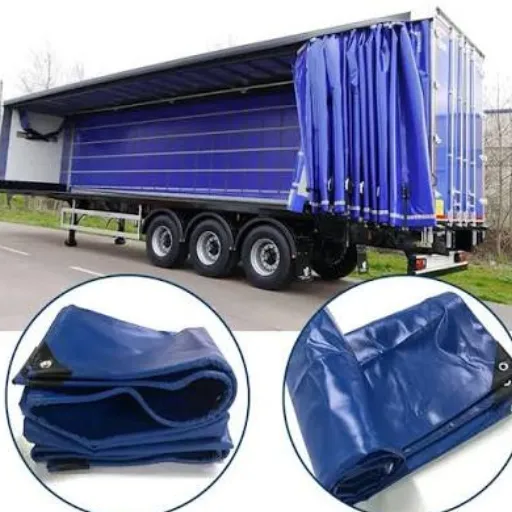
These are two different engineering problems, not two sizes of the same product. A heavy duty flatbed tarp is tensioned over a load and exposed to wind flap, abrasion, and repeated manual handling. A side curtain is a vertical panel on hardware, so it sees flex fatigue at the top rail, abrasion along the bottom edge, and adhesion stress at every fold.
Side curtains benefit more from adhesion and dimensional stability; flatbed tarps benefit more from tear resistance and edge reinforcement. For hardware and replacement economics, see our guide to PVC tarpaulin truck side curtains.
Cargo-securement rules also shape the specification. In the US, 49 CFR Part 393 sets the baseline for tiedowns and covers; state and commodity rules vary.
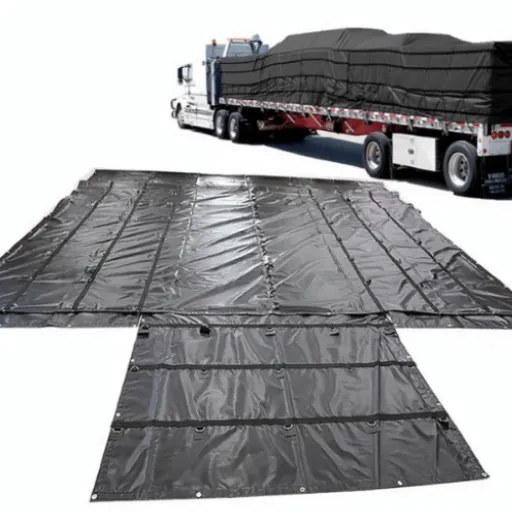
Field technique matters too. An over-tensioned cover fatigues at the grommets; an under-tensioned one flaps and abrades itself. This walkthrough shows the basics of tarping a flatbed load:
PVC coated fabric versus PE, canvas and mesh
PVC-coated polyester is the default truck tarp material for daily service because it combines high tear resistance, weldable seams, and predictable UV performance. Polyethylene is lighter and cheaper, with a service life measured in months rather than years. Canvas is breathable and repairable but heavy and water-absorbent. Coated mesh trades water resistance for airflow.
Our PVC versus PE tarpaulin comparison covers the full trade-off, and our guide to base fabric and coating specifications covers the construction options. For most fleets, the decision is not PVC versus PE. It is which PVC construction matches the route.
How Long Does a Heavy-Duty Truck Tarpaulin Last?
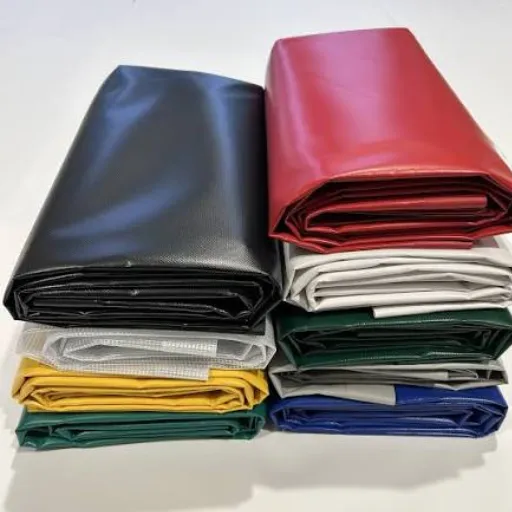
A heavy-duty PVC truck tarpaulin typically lasts five to ten years in daily fleet service when specification, fabrication, and handling are correct. Standard PVC runs three to five years, polyethylene one to two, canvas two to five, and coated mesh three to seven.
| Cover type | Typical service life | Main limiting factor |
|---|---|---|
| Standard PVC, 550–700 GSM | 3–5 years | UV and abrasion |
| Heavy-duty PVC, 750–900 GSM | 5–10 years | Seam and grommet wear |
| Premium or severe-duty PVC, 900+ GSM | 7–10+ years | Handling damage, high-altitude UV |
| Polyethylene | 1–2 years | UV embrittlement, tear propagation |
| Canvas | 2–5 years | Water absorption, rot, weight |
| Coated mesh | 3–7 years | UV, abrasion at attachment points |
Lab data and field life differ. A UV test predicts relative performance under controlled conditions; it doesn’t account for loading-dock abrasion, chemical exposure, or a driver who drags the cover across gravel. Route severity and handling discipline often move service life more than a one-step GSM change. Our guide to how long truck tarpaulins last covers maintenance triggers and inspection intervals.
What a heavy-duty truck tarp fleet really costs
Unit price is the least useful cost metric here. Budget cost per year of service instead: purchase price divided by expected life, adjusted for repair and handling labor.
| Specification tier | Relative cost per m² | Relative service life | Relative cost per year |
|---|---|---|---|
| Commodity PVC, 550–650 GSM | 1.0× | 1.0× | 1.0× |
| Heavy-duty PVC, 750–900 GSM | 1.3–1.6× | 1.7–2.5× | 0.6–0.8× |
| Premium or severe-duty PVC | 1.6–2.2× | 2.0–3.0× | 0.6–0.9× |
| Polyethylene | 0.4–0.6× | 0.2–0.4× | 1.2–2.0× |
The index is illustrative, not a price list. Confirm current pricing with LY TRUSTLINK sales; resin costs, coating add-on, hardware, and order quantity move the actual number. An illustrative composite: a distributor we will call Marta replaced her lowest-bid habit with a spec-based RFQ and a cost-per-year model. Her unit price rose, her annual replacement spend fell, and mid-route failures during harvest season stopped.
The Heavy-Duty Truck Tarpaulin RFQ Checklist
A specification is only useful if it reaches the supplier in a form they can quote against. Include these ten items in every RFQ.
- Duty class. Light, medium, heavy, severe, or specialty, with the intended application.
- Cargo type. Lumber, steel, coil, aggregate, palletized freight, or mixed.
- Route and climate. Temperature range, UV exposure, coastal salt, chemical contact.
- GSM and base fabric. Nominal GSM ±5%, denier, yarn count, weave, and direction.
- Coating method and add-on. Knife-coated or laminated, one or two sides, coating mass in g/m².
- Strength and environmental performance. Tensile, tear, and adhesion, plus cold-crack temperature, UV hours and retention, and fire standard, each with the required test method.
- Seam, hem, and hardware. Seam type and target strength, hem reinforcement, grommet spacing.
- Finished dimensions and tolerances. Including tie-down overlap and any cutouts.
- Test documentation. Batch report, sample retention, third-party option, certificates.
- Commercial terms. MOQ, lead time, packaging, labeling, and inspection terms.
For custom dimensions, hardware placement, and fabrication tolerances, our engineering team can quote directly from your completed RFQ.
Frequently Asked Questions
What GSM is a heavy duty truck tarpaulin?
Heavy duty starts at roughly 750 GSM and runs to about 900 GSM for daily fleet service, or 900 to 1,100 for severe duty. Below 750 GSM, a cover can be well made but belongs in the medium-duty class.
How thick is a heavy duty truck tarp?
Most heavy-duty truck tarpaulins measure 0.50 mm to 0.80 mm; a 900 GSM cover typically lands between 0.69 and 0.80 mm. Compare GSM, denier, tensile, and tear values rather than thickness.
Is 900 GSM always better than 650 GSM?
No. A 900 GSM truck tarpaulin with a weak base and low adhesion can fail sooner than a 750 GSM cover built on 1000D × 1300D with 110 N/5 cm adhesion. Weight shows how much material is present, not how well it is arranged.
What is the strongest tarp material for trucks?
PVC-coated high-tenacity polyester is the strongest practical option for daily truck service, especially at 1000D or heavier with double-sided coating and reinforced seams. Neoprene-coated nylon excels in specialty flex applications; polyethylene and canvas trail PVC on tear and UV.
How long does a heavy duty truck tarpaulin last?
Plan on five to ten years for a well-specified heavy-duty PVC cover in daily service, and three to five years for standard PVC. Route severity, UV, handling, and maintenance move that range more than a single GSM step.
What is the difference between 18 oz and 22 oz truck tarps?
Eighteen ounces per square yard is about 610 GSM; 22 oz is about 746 GSM. The 22 oz construction is about 22% heavier and usually medium-to-heavy. It resists tear and abrasion better, but check denier and adhesion before assuming it is stronger.
What drives heavy duty truck tarp price?
Price depends on GSM, denier, coating add-on, dimensions, hardware, quantity, and freight. Expect heavy-duty PVC to cost 1.3 to 1.6 times a commodity 550–650 GSM cover per square meter, with a service life 1.7 to 2.5 times longer.
What size tarpaulin do I need for a flatbed?
A common rule is trailer width plus twice the load height plus tie-down overlap. For a 2.5 m wide trailer with a 2.5 m load, that is about 7.5 m before overlap, so an 8 m wide cover is a reasonable start.
How do I verify tensile and tear claims?
Ask for a batch test report stating the method and edition, direction, conditioning, and result. Compare like with like: ISO 4674-1, ISO 4674-2, and DIN 53363 tear values are not interchangeable. Retain a sample; for high-value orders, use an independent lab.
Can a heavy duty truck tarpaulin be repaired?
Yes. PVC-coated covers can be welded or patched, and a proper repair usually restores most of the original strength. Repair early: a small nick is cheap to fix, while a propagating tear can write off the panel.
Conclusion
A heavy duty truck tarpaulin is a specification, not a slogan. Covers that survive daily service share five traits: at least 750 GSM on a 1000D-or-heavier base, tensile strength around 2,800 N/5 cm, tear resistance of 280 N or more, adhesion of 100 N/5 cm, and a seam that reaches at least 80% of parent-fabric strength.
Weight alone will not tell you whether a quote meets that standard. Test methods will. Ask for the method, the edition, the direction, and the batch result behind every number, then compare suppliers on the same basis. Size the cover to the cargo and route; over-specifying adds weight and cost without adding service life.
If you are consolidating suppliers or replacing a failed batch, start with the RFQ checklist above. Send it to us with your route profile and dimensions, and our engineering team will return a specification review, a material recommendation, and a sample with the matching test report. Request a heavy-duty truck tarpaulin quote.