
Truck Tarpaulin Guide: Fleet Specs, Types & Sourcing
The right truck tarpaulin for a fleet is a PVC-coated high-tenacity polyester cover in the 550–750 GSM range for general freight, moving to 750–900 GSM for lumber, steel, and curtain-side duty. That specification, not the lowest unit price, is what keeps cargo dry, inspections clean, and replacement cycles predictable.
A tarp failure is never just a tarp failure. It is a soaked load, a rejected delivery, a roadside citation, and a truck sitting idle while procurement finds a replacement.
Consider an illustrative fleet we will call Elena’s: 60 tractors, 120 flatbed covers, and a procurement team under pressure to cut consumable costs. Elena switched the fleet from PVC to the cheapest polyethylene covers she could source. The up-front saving looked obvious.
One winter later, more than 40 percent of those covers had torn at the grommets or gone brittle in the cold. Replacing them twice a year cost more than the premium PVC specification she had rejected. The lesson was not that cheap tarps are bad. It was that the fleet had been buying a price per piece when it should have been buying a cost per year of service.
Most fleets already know they need a truck tarpaulin. Fewer know how to read the specification sheet, match GSM to cargo, document compliance, or calculate what a tarp actually costs over five years. This guide gives you those four tools.
We will cover the truck tarpaulin types used across flatbed, dump, and curtain-side operations; the materials and test numbers that separate engineered fabric from commodity sheeting; a cargo-to-specification decision matrix; the US federal cargo securement framework; a total-cost-of-ownership model; and an OEM sourcing checklist you can put in front of a supplier.
LY TRUSTLINK manufactures coated technical fabrics for transport, construction, agriculture, marine, and industrial applications. We write this as a specification guide for procurement teams, not as a product catalog.
Key Takeaways
- Match GSM to duty, not to habit. General freight runs well at 550–650 GSM; lumber, steel, and curtain-side fleets should specify 750–900 GSM. Two fabrics at the same GSM can still differ in denier, weave, adhesion, and UV life.
- PVC-coated high-tenacity polyester is the long-haul default. PE covers cost less up front but typically last 1–2 years outdoors; PVC covers commonly deliver 3–6 years in daily fleet duty and longer in occasional use.
- Federal rules set a performance standard, not a universal tarp mandate. 49 CFR §393.100 requires cargo to be secured against leaking, spilling, blowing, falling, and shifting. A tarp is one way to meet that standard, and state or local rules may add specific tarp requirements.
- Sizing is a formula, not a guess. Finished width equals trailer width plus twice the load height plus tie-down overlap. For an 8.5 ft trailer with an 8 ft load, that points to roughly 24 ft of tarp width with an 8 ft drop.
- The cheapest cover is rarely the lowest-cost cover. A five-year model that includes purchase price, replacement labor, and downtime usually favors a heavier PVC specification, even at a 2–3× higher unit price.
If you are standardizing a fleet this season, request a specification review from our technical team before you issue the purchase order.
What Is a Truck Tarpaulin?

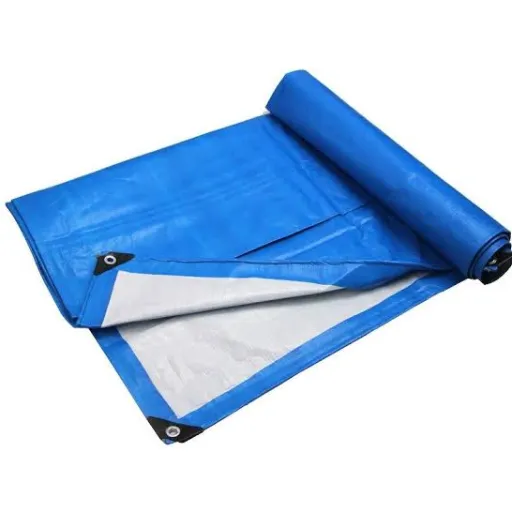
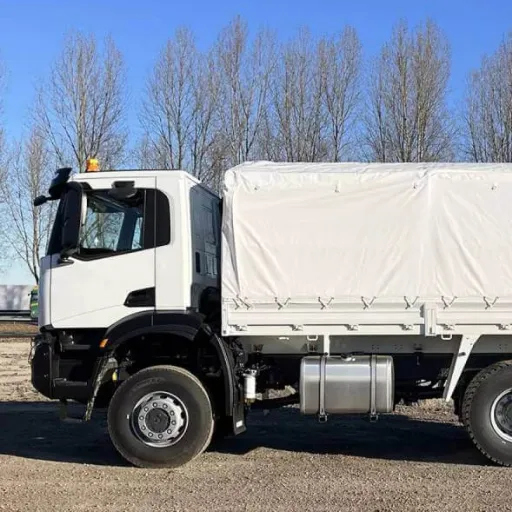
A truck tarpaulin is an engineered fabric cover used to protect and contain cargo on flatbed trailers, dump trucks, curtain-side trailers, and other commercial vehicles. It is typically a high-tenacity polyester scrim coated with PVC, polyethylene, or polyurethane, finished with reinforced hems, grommets, D-rings, and straps that attach to the vehicle or its covering system.
The cover does four jobs at once:
- Weather protection. Blocks rain, snow, dust, and UV exposure.
- Containment. Holds loose material so it cannot blow or fall from the vehicle.
- Theft deterrence. Removes easy access to the load.
- Compliance support. Helps the operator meet cargo securement obligations.
Truck tarpaulins are used with several covering systems:
- Roll-off systems deploy a cover from front to back over containers and open-top bodies.
- Swing systems use arms to position the cover over tall or awkward loads.
- Flip systems flip a cover over the load from the side or front.
- Electric systems automate covering and uncovering to reduce manual labor and climbing risk.
- Side curtains replace a loose tarp with tensioned panels on a curtain-side trailer, allowing lateral access to palletized freight.
The truck tarpaulin fabric must match the system. A cover with the wrong panel width or grommet spacing will flap, chafe, and fail early even if the base material is excellent. That’s why truck tarp fastening and hardware systems belong in the specification conversation from day one.
Types of Truck Tarpaulins
There is no universal truck tarpaulin. The cargo, trailer, and covering system determine the cut, the drop, the reinforcement, and the hardware. The table below summarizes the main types.
| Type | Typical use | Common sizes and features | Material note |
|---|---|---|---|
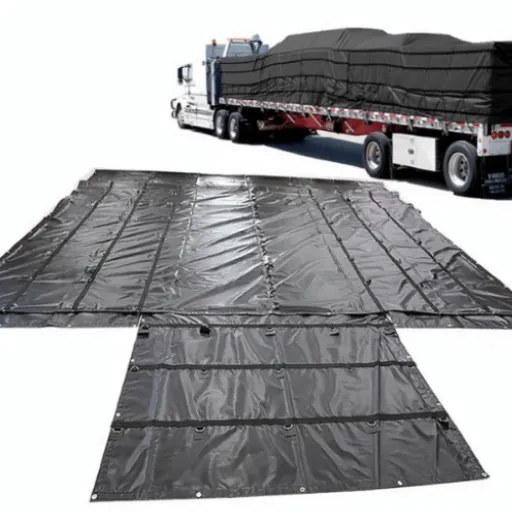
| Flatbed tarp | General flatbed freight, machinery, mixed loads | Sized to trailer and load; 4–10 ft drops depending on load height | 550–750 GSM PVC for general freight; heavier for abrasive loads |
| Lumber tarp | Lumber, plywood, building materials, tall rectangular loads | Often 20×27, 24×27, 24×28, or 20×28 ft; 4–8 ft drops; end flaps cover corners | 750–900 GSM PVC; reinforced corners and high-abrasion panels |
| Steel tarp | Sheet steel, rod, pipe, cable, low-profile machinery | Often 16×20, 16×24, or 16×27 ft; typically 4 ft drop; usually no end flaps | 650–750 GSM PVC; high tear and puncture resistance |
| Coil tarp or coil bag | Steel or aluminum coils and other round loads | Fitted rounded cover, commonly 4–7 ft wide by 4–8 ft long | 650–900 GSM PVC with reinforced contact points |
| Dump and roll-off tarp | Aggregate, asphalt, sand, waste, construction debris | Sized to the body; often paired with manual, semi-automatic, or electric systems | 600–750 GSM PVC; abrasion-resistant coating |
| Mesh tarp | Sand, gravel, aggregate, agricultural loads that need airflow | Standard and heavy-duty mesh; often 14 oz or heavier | PVC-coated mesh; not a waterproof cover |
| Side curtain | Palletized freight on curtain-side trailers | Panel widths and drops matched to trailer hardware; European widths commonly 2,480–2,550 mm | 900+ GSM PVC for daily fleet duty; tensioned and buckled |
Flatbed Tarps
Flatbed truck tarps are the broadest category. They protect cargo from weather and road spray, but they also experience the highest wind load because they are exposed on all sides. A flatbed tarp needs a reinforced hem, correctly spaced grommets, and enough drop to wrap the load without leaving exposed edges that catch air.
Lumber Tarps
Lumber tarps are the largest covers in common fleet use. They need end flaps to cover the corners of a tall rectangular load, and they need abrasion resistance where the cover contacts stacked boards and metal banding. A 4 ft drop suits a low load; an 8 ft drop suits a tall load. Using an undersized drop exposes the top corners and invites water ingress.
Steel Tarps
Steel tarps are smaller and flatter than lumber tarps because steel loads are usually low profile. They typically have a 4 ft drop and no end flaps. The critical properties are tear strength and puncture resistance at the corners and edges where steel banding and sharp profiles contact the fabric.
Coil Tarps and Coil Bags
Round coils need a fitted cover, not a draped rectangle. A coil bag or fitted coil tarp minimizes excess material that would otherwise flap at highway speed and abrade against the coil edge. Reinforcement at the contact points matters more than raw GSM alone.
Dump and Roll-Off Tarps
Dump truck covers are sized to the body and paired with a covering system. Aggregate and asphalt hauling puts the fabric under constant abrasion, so the coating and base fabric need to resist scuffing as well as tearing. State and local rules often require these loads to be covered, which makes documentation and inspection part of the specification.
Mesh Tarps
Mesh covers allow air to pass through, which reduces wind load on lightweight aggregate and agricultural loads. They are not waterproof and should not be specified where cargo protection from rain is the primary requirement. The decision between mesh and solid is a ventilation and weight decision, not a durability shortcut.
Side Curtains
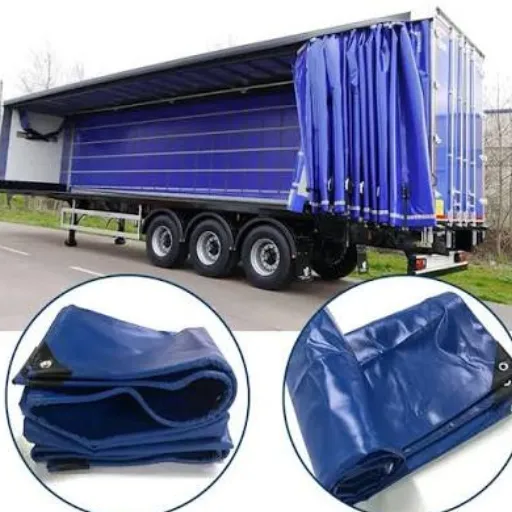
Side curtains are tensioned fabric panels on a curtain-side trailer. They allow forklift access from the side, reduce load-securing labor, and protect palletized freight from weather. Daily fleet duty calls for a heavier, dimensionally stable PVC, typically in the 900 GSM range and above, with reinforced wear points and hardware matched to the trailer. For the full specification and procurement process, see our PVC tarpaulin truck side curtain guide.
Truck Tarpaulin Materials: PVC, PE, PU, Canvas, and Mesh
Material choice determines waterproofing, service life, repairability, and cost per year. The table below compares the five families a fleet is most likely to evaluate.
| Material | Typical weight | Waterproofing | Expected outdoor life | Weldable | Best use |
|---|---|---|---|---|---|
| PVC-coated polyester | 450–900+ GSM | Fully waterproof | 3–6 years daily fleet duty; 5–10 years occasional or static use | Yes, heat or RF welded | Long-haul, flatbed, lumber, steel, side curtains, custom covers |
| Polyethylene (PE) | 160–250 GSM | Waterproof when new; seams can leak | 1–2 years under continuous exposure; UV life often 6–24 months | No; stitched or taped seams | Seasonal, temporary, budget, short-trip coverage |
| PU-coated fabric | Lighter than PVC at equal strength | Waterproof | Varies; good low-temperature flex and abrasion resistance | Yes, heat or RF welded | Lightweight covers, cold-weather flexibility, heat-resistant specialty covers |
| Canvas | Varies; cotton or polyester | Breathable; not waterproof unless treated | Varies; absorbs water and can mildew | Sewn | Breathable niche applications, not wet cargo protection |
| PVC-coated mesh | Often 14 oz and heavier | Not waterproof; airflow | Varies with coating and UV package | Yes, depending on construction | Aggregate, sand, agricultural loads requiring ventilation |
PVC-coated polyester dominates truck tarpaulin duty for three reasons. The polyester scrim carries tensile and tear load. The PVC coating provides a continuous waterproof barrier.
The third reason is seamability. The finished fabric can be heat welded into a seam that is stronger and more watertight than stitching. A stitched PE seam creates needle holes; a welded PVC seam does not.
The trade-off is weight and up-front cost. A 650 GSM PVC cover is heavier to handle than a 200 GSM PE cover, and it costs more per square meter. That premium is justified when the cover is used daily, when cargo damage is expensive, and when replacement labor and downtime are real costs rather than accounting afterthoughts.
For a full side-by-side analysis, see our PVC vs PE tarpaulin comparison. For the waterproofing construction itself, see waterproof tarpaulin materials and construction.
Truck Tarpaulin Engineering Specifications
A truck tarpaulin quote that says “heavy-duty PVC” is not a specification. A heavy-duty truck tarpaulin is defined by test data, not by a label. These are the numbers that determine whether the fabric will survive your duty cycle.
GSM and oz/yd²
GSM means grams per square meter. Oz/yd² is the imperial equivalent. The conversion is straightforward:
1 oz/yd² ≈ 33.9 GSM
Common conversions:
| oz/yd² | Approximate GSM | Typical duty |
|---|---|---|
| 14 oz | 475 GSM | Light-duty flatbed, temporary coverage |
| 18 oz | 610 GSM | Medium-duty general freight |
| 22 oz | 746 GSM | Heavy-duty flatbed, lumber, curtain-side |
| 26.5 oz | 900 GSM | Severe duty, side curtains, abrasive cargo |
GSM is a starting point, not a guarantee. Two 650 GSM fabrics can differ in base-fabric denier, weave density, coating adhesion, and UV stabilization. That’s why the next four numbers matter.
Base Fabric Denier and Weave
Denier describes the linear density of the yarn. A 1000D high-tenacity polyester scrim is common in medium and heavy truck covers. A 1300D scrim appears in heavier specifications, particularly where tear strength and dimensional stability matter. Weave density (for example, 18×18 or 20×20) affects how tightly the yarns interlock and how the coating bonds to the scrim.
High-tenacity polyester is preferred over standard polyester because it retains more strength after flexing, abrasion, and weathering. The base fabric is the structural backbone; the coating protects it.
Tensile Strength and Tear Resistance
Tensile strength is measured in newtons per 5 cm (N/5 cm) in warp and weft directions. Tear resistance is measured in newtons and describes how well the fabric resists a tear propagating from a nick or grommet hole.
Representative industry ranges:
- 650 GSM PVC: tensile around 2,500/2,500 N/5 cm or higher; tear around 250 N and above.
- 700 GSM with 1300D scrim: tensile up to roughly 3,700/2,800 N/5 cm; tear around 350–425 N.
- 900 GSM heavy-duty: tensile up to roughly 4,000/4,000 N/5 cm; tear around 500 N.
Specify both warp and weft values. A cover with strong warp but weak weft will fail across the width. For a deeper explanation, see tensile strength in technical fabrics.
Coating Adhesion and Hydrostatic Pressure
Coating adhesion, usually stated in N/5 cm, describes how strongly the PVC layer bonds to the scrim. A common minimum for truck-grade fabric is 100 N/5 cm. Poor adhesion leads to delamination, especially after flexing, heat exposure, and moisture ingress.
Hydrostatic pressure describes resistance to water penetration under pressure. A coated PVC truck fabric should comfortably exceed 3,000 mm water column. This matters for standing water on a slack cover and for wind-driven rain at highway speed.
Temperature Range, Cold Crack, and UV Aging
PVC truck covers commonly operate from about −30 °C to +70 °C. Below the cold-crack threshold, the plasticizer system stiffens and the fabric can crack when folded or handled. If your routes regularly see below −20 °C, specify a cold-crack-resistant formulation and confirm the test method with the supplier. See cold-crack performance.
UV exposure degrades the polymer and plasticizer system over time. Accelerated weathering tests such as ASTM G154 and ISO 4892 estimate how a formulation will perform after equivalent outdoor exposure. Ask for the test hours and the retained tensile and tear values, not just a claim that the fabric is “UV stabilized.” Our UV resistance guide explains the test methods and what the numbers mean.
How to Read a Supplier Spec Sheet
A complete truck tarpaulin specification should state:
- Total weight in GSM and oz/yd², with a tolerance.
- Base fabric composition, denier, yarn count, and weave.
- Coating type and coating weight per side.
- Tensile strength in warp and weft, N/5 cm.
- Tear resistance in warp and weft, N.
- Coating adhesion, N/5 cm.
- Hydrostatic pressure, mm.
- Operating temperature range and cold-crack temperature.
- UV test method and hours, with retained performance.
- Seam method, seam strength, and hardware specification.
If a supplier can’t provide these values, the quote is a price, not a specification.
Choosing the Right Truck Tarpaulin by Cargo Type
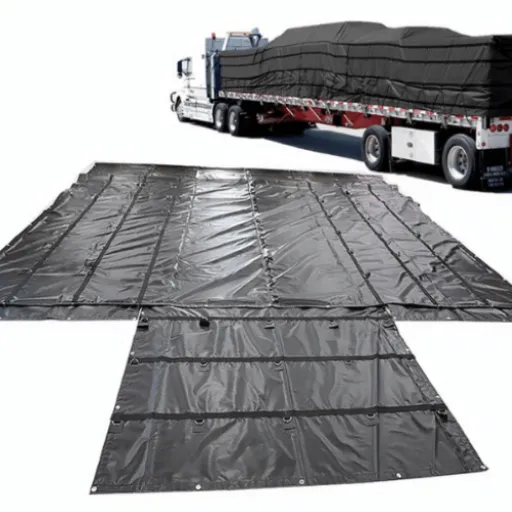
The fastest way to specify a truck tarpaulin is to start with the cargo, then work backward to GSM, base fabric, closure, and hardware.
| Cargo | Recommended GSM | Base fabric | Closure and hardware | Primary risk |
|---|---|---|---|---|
| General freight, palletized goods | 550–650 GSM | 1000D high-tenacity polyester | Grommets every 50–100 cm; straps or buckles | Wind flapping and seam abrasion |
| Flatbed lumber | 750–900 GSM | 1000D–1300D polyester | Reinforced hem, end flaps, D-rings, 50 cm grommet spacing | Corner exposure and edge tearing |
| Steel sheet, rod, pipe | 650–750 GSM | 1000D high-tenacity polyester | 4 ft drop, reinforced corners, no end flaps | Puncture and tear at sharp edges |
| Steel or aluminum coils | 650–900 GSM | 1000D–1300D polyester | Fitted coil bag or tarp, reinforced contact points | Abrasion and water pooling |
| Aggregate, sand, asphalt | 600–750 GSM | 1000D polyester | System-compatible panel, reinforced mounting points | Abrasion and load containment |
| Curtain-side palletized freight | 750–900+ GSM | 1000D–1300D polyester | Tensioned panels, buckles, rollers, reinforced wear points | Tension loss and panel flutter |
| Extreme cold or high-UV routes | 750–900 GSM | 1000D–1300D polyester | Cold-crack and UV-stabilized formulation; 50 cm grommet spacing | Cold cracking and UV embrittlement |
The Flatbed Sizing Formula
Truck tarp sizes follow a formula, not a catalog habit. Finished tarp width is not the same as trailer width. Use this formula:
Finished width = trailer width + (2 × load height) + tie-down overlap
For a metric example: a 2.5 m trailer with a 4 m load height and 1.5 m of total overlap needs about 8 m of finished width. For an imperial example: an 8.5 ft trailer with an 8 ft load needs about 24.5 ft of width before overlap, which is why a 24 ft tarp with an 8 ft drop is a common pairing.
Two more rules prevent truck tarpaulin sizing errors:
- Measure cut size versus finished size. Hemming, welding, and hardware reduce the usable dimension by roughly 3–6 percent. Specify finished size.
- Confirm seam placement and roll width. A seam that lands on a high-wear corner will fail earlier than a seam placed on a flat panel.
Grommet spacing is part of the sizing decision. The common range is 50–100 cm, with 50 cm preferred for highway and high-wind use. Brass grommets resist corrosion better than untreated steel. For installation detail, see grommet spacing and installation best practices.
In one illustrative maintenance review, a fleet we will call Marcus’s had standardized on 100 cm grommet spacing to reduce hardware cost. The covers lasted one season before the first grommet tore out in high wind. Moving to 50 cm spacing, rope-reinforced hems, and corner patches raised the unit cost by a small margin but eliminated the repeat failures. The specification change paid for itself before the next replacement cycle.
DOT and FMCSA Cargo Securement: What Fleet Managers Must Know
US federal rules don’t require every commercial vehicle to carry a tarp. They require the cargo to stay on the vehicle.
49 CFR §393.100 establishes the general performance standard: cargo must be loaded and secured to prevent it from leaking, spilling, blowing, or falling from the vehicle, and to prevent shifting that would affect stability or maneuverability. A truck tarpaulin is one way to meet that standard for weather-sensitive or lightweight loads. It isn’t a substitute for proper tiedowns.
The same part of the regulation sets minimum tiedown requirements. As a working rule, plan for at least one tiedown for every 10 feet of cargo length, and confirm the aggregate working load limit requirement in §393.110. The exact count depends on the commodity and the securement method, so verify the current rule text before finalizing an inspection checklist.
State and local rules add specifics. Many jurisdictions require covers on sand, gravel, dirt, mulch, and similar loose materials. Some require covers on waste hauling. A fleet operating across state lines should build a route-based compliance matrix rather than assuming the federal rule is the whole story.
A practical compliance file for each tarp specification should include:
- The fabric specification sheet with GSM, tensile, tear, and adhesion values.
- The seam method and seam strength test result.
- Fire-retardancy documentation if the cargo or route requires it, such as NFPA 701 compliance.
- UV and cold-crack test data for the route climate.
- A batch test report or certificate of conformance.
- The installation and inspection procedure used by the fleet.
Authoritative references: 49 CFR Part 393 on eCFR, FMCSA cargo securement guidance, NFPA 701, ASTM test standards, and ISO standards. For flame-retardant options, see fire-retardant tarpaulin.
Side Curtains vs. Flatbed Truck Tarpaulins
Side curtains and flatbed truck tarpaulins solve the same weather-protection problem in different ways. The right choice depends on load type, access frequency, and labor model.
| Factor | Side curtain | Flatbed tarp |
|---|---|---|
| Loading access | Full lateral access with panels opened or removed | Load must be covered and uncovered from the deck |
| Labor | Lower per stop for palletized freight | Higher manual handling, especially in wind |
| Load security | Tensioned panels contain the load; hardware must be maintained | Tiedowns and tarp tension do the work |
| Weather sealing | Good when panels and hardware are maintained | Good when sized and tensioned correctly |
| Damage risk | Panel and roller hardware wear; forklift contact risk | Abrasion and grommet tear-out risk |
| Best fit | Palletized, high-frequency multi-stop routes | Lumber, steel, machinery, irregular loads |
| Up-front cost | Higher trailer and fabric cost | Lower trailer cost; cover replacement is ongoing |
A side-curtain trailer usually wins on labor and access for palletized freight. A flatbed tarp usually wins on flexibility and lower trailer cost for lumber, steel, and oversized loads. Some fleets run both and standardize fabric across the two so that specification, inspection, and spare inventory stay consistent.
The fabric decision is similar in both cases: a 900+ GSM PVC with high-tenacity polyester scrim, UV stabilization, and reinforced wear points. The difference is the hardware and the tensioning system. Our truck side curtain specification guide covers panel widths, tensioning, and procurement in detail.
Total Cost of Ownership: Price per Square Meter vs Cost per Year
Unit price is the least useful number in a truck tarpaulin procurement decision. The useful number is cost per year of service, including replacement labor and downtime.
The truck tarpaulin cost table below is an illustrative model, not a quote. It uses representative factory-direct ranges and must be replaced with current LY TRUSTLINK pricing and your own labor rates before it is used in a business case.
| Item | 200 GSM PE cover | 650 GSM PVC cover | 900 GSM PVC cover |
|---|---|---|---|
| Indicative material cost | ~$0.30/m² | ~$1.00/m² | ~$1.50–2.00/m² |
| Expected service life, daily outdoor use | 1–2 years | 3–6 years | 5–8 years |
| Replacement cycles in 5 years | 3–5 | 1–2 | 1 |
| Labor per replacement | Same per event, but more events | Lower frequency | Lowest frequency |
| Downtime risk | Higher | Medium | Low |
| Five-year material cost index | 100 | ~110–170 | ~100–130 |
The exact crossover depends on cover size, route severity, and labor cost. But the pattern is consistent: a PE cover that costs one-third as much but lasts one-quarter as long is not cheaper. It simply moves the cost from procurement to maintenance.
Add the costs that rarely appear in a tarp quote:
- Labor to remove, replace, and dispose of covers. A two-person crew spending an hour per cover per replacement adds up across a fleet.
- Downtime. A truck waiting for a replacement cover is not earning.
- Cargo claims. A failed cover that lets water into a load can cost far more than the cover itself.
- Compliance exposure. A missing or damaged cover on a regulated load can trigger a citation.
- Inventory complexity. More frequent replacement means more SKUs, more storage, and more administrative work.
For lifespan data by material and duty cycle, see our tarpaulin lifespan guide. For a quote based on your actual route profile, request a fleet specification review.
Custom Truck Tarps: OEM and ODM Sourcing Checklist
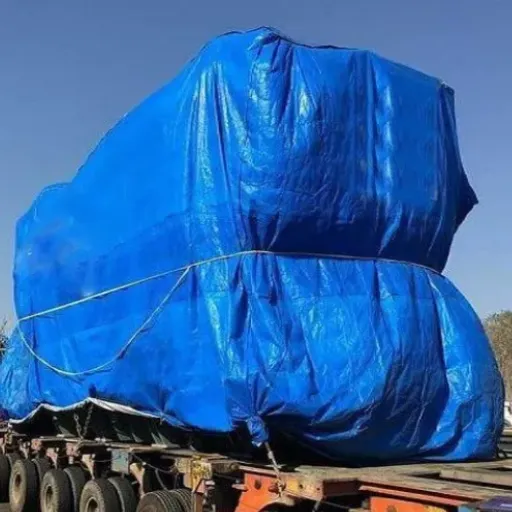
Standard truck tarpaulin sizes cover a lot of freight, but fleets with mixed trailers, branding requirements, or non-standard loads usually need custom covers. A good custom program is a specification exercise, not a catalog order.
Bring these fields to a supplier:
- Finished dimensions for length, width, and drop, with a note on cut-versus-finished tolerance.
- GSM and oz/yd² with an acceptable tolerance.
- Base fabric composition, denier, and weave.
- Coating type and coating weight per side.
- Color and branding requirements, including RAL matching and print method.
- Hardware specification: grommet type, spacing, D-rings, buckles, webbing, and reinforcement patches.
- Seam method and seam placement constraints.
- Compliance documentation required: fire retardancy, UV test hours, cold-crack data, batch reports.
- Packaging and labeling requirements for fleet inventory.
- MOQ, sample lead time, production lead time, and warranty terms.
Ask the supplier four questions before approving a sample:
- Can you provide the full spec sheet and a batch test report, not just a product brochure?
- What is your roll width, and where will seams fall on my finished cover?
- What is the sample and production lead time for my specification?
- What changes in the specification if my route climate or cargo changes?
A custom cover should arrive with a specification sheet that matches the purchase order. If the only document is an invoice, the fleet has no baseline for the next order or for a warranty claim.
For capability and quote details, see custom tarpaulin manufacturing.
Maintenance, Repair, and Storage
A truck tarpaulin degrades faster from poor care than from normal wear. The goal is to keep the coating intact, the seams dry, and the hardware functional.
Inspection cadence. Inspect truck tarpaulin covers at every pre-trip check for cuts, grommet elongation, seam separation, and coating cracks. Perform a deeper inspection quarterly, including the underside and the contact points.
Cleaning. Wash with mild soap and water. Avoid aggressive solvents and high-pressure jets that can force water under the coating edge. Rinse and dry fully before folding.
Drying and storage. Store covers dry and off the floor. Damp storage is the fastest route to mildew and coating degradation. Fold rather than stuff, and avoid sharp creases in the same place every time.
Repair. Small PVC tears can be patched or heat welded. A welded repair restores both strength and waterproofing; a taped repair is a temporary field fix. Repair immediately, because a small nick propagates under wind load. See tarpaulin maintenance and tarpaulin repair for procedures.
Retirement criteria. Retire a cover when the coating cracks through to the scrim, when the fabric feels sticky or leaves a residue, when seams separate across a panel, or when grommet tear-outs can no longer be reinforced. A retired cover that is still “mostly intact” is a cargo claim waiting to happen.
Fleet Procurement Checklist
Use this checklist to compare truck tarpaulin suppliers on the same basis:
- Duty cycle defined: cargo type, route length, climate, load frequency, and highway speed.
- GSM and oz/yd² specified with tolerance.
- Base fabric denier and weave specified.
- Tensile, tear, adhesion, and hydrostatic values requested in writing.
- Temperature range and cold-crack data requested for the route climate.
- UV test method and hours requested.
- Seam method and seam strength specified.
- Grommet type, spacing, and reinforcement specified.
- Compliance documentation list agreed, including NFPA 701 where required.
- Batch test report and certificate of conformance required at delivery.
- Sample approved against the written specification, not against a photo.
- MOQ, lead time, warranty, and replacement-part availability confirmed.
- Total cost of ownership modeled over the expected service life.
A supplier that can answer all thirteen items is a supply chain partner. A supplier that can answer only the price is a transaction.
Frequently Asked Questions
What is a truck tarpaulin?
A truck tarpaulin is an engineered fabric cover used to protect and contain cargo on commercial vehicles. It is usually a high-tenacity polyester scrim coated with PVC, PE, or PU, finished with reinforced hems, grommets, D-rings, and straps. It blocks weather, contains loose material, deters theft, and helps meet cargo securement requirements.
What is the best material for a truck tarpaulin?
PVC-coated high-tenacity polyester is the best general-purpose material for daily truck tarpaulin duty. It is waterproof, heat weldable, repairable, and typically delivers 3–6 years of outdoor service. PE is suitable for seasonal or budget use, PU suits lightweight or heat-resistant applications, canvas is for breathable niches, and mesh is for loads that need airflow.
What GSM is best for a truck tarpaulin?
General freight usually performs well at 550–650 GSM. Lumber, steel, and curtain-side duty call for 750–900 GSM. Extreme or abrasive applications may require 900+ GSM. GSM alone is not enough: confirm denier, weave, tensile, tear, adhesion, and UV stabilization.
How long does a PVC truck tarp last?
A PVC truck tarpaulin commonly lasts 3–6 years in daily fleet duty and 5–10 years in occasional or static use. Actual life depends on UV exposure, route climate, abrasion, tensioning, and care. PE covers typically last 1–2 years under continuous outdoor exposure.
How much does a truck tarpaulin cost?
Factory-direct PVC truck tarpaulin generally ranges from about 0.80to0.80to2.50 per square meter depending on GSM, base fabric, additives, hardware, and order volume. Retail and small-quantity purchases cost more. Compare cost per year of service, not price per square meter alone.
What size tarp do I need for a flatbed?
Use finished width = trailer width + (2 × load height) + tie-down overlap. An 8.5 ft trailer with an 8 ft load needs roughly 24.5 ft of width before overlap, which is why a 24 ft tarp with an 8 ft drop is common. Measure cut size versus finished size and confirm seam placement.
Are truck tarps required by DOT?
Federal rules do not universally mandate tarps. 49 CFR §393.100 requires cargo to be secured against leaking, spilling, blowing, falling, and shifting. A tarp can help meet that standard. Many state and local jurisdictions require covers for sand, gravel, dirt, mulch, and similar loads.
What is the difference between a lumber tarp and a steel tarp?
A lumber tarp is larger, typically has end flaps, and uses a 4–8 ft drop to cover tall rectangular loads. A steel tarp is smaller, usually has a 4 ft drop, and typically has no end flaps because steel loads are low profile. Both need reinforced corners and high tear strength.
Can a truck tarpaulin be repaired?
Yes. PVC covers can be patched or heat welded. A welded repair restores strength and waterproofing; a taped repair is a temporary field fix.
Repair small tears immediately because they propagate under wind load. Retire the cover when the coating cracks through to the scrim or seams separate across a panel.
What is a truck side curtain tarp?
A truck side curtain tarp is a tensioned PVC panel system on a curtain-side trailer. It provides lateral access for forklifts, protects palletized freight from weather, and reduces load-securing labor. Daily fleet duty usually calls for 900+ GSM PVC with reinforced wear points and hardware matched to the trailer.
Conclusion
A truck tarpaulin is a specification decision before it is a purchasing decision. The fleet that defines its duty cycle, matches GSM and base fabric to the cargo, documents compliance, and models cost per year will outperform the fleet that buys on unit price alone.
Five takeaways to carry into your next procurement cycle:
- Start with the cargo and route, then choose GSM, denier, coating, and hardware.
- Demand the full spec sheet and batch test report, including tensile, tear, adhesion, temperature, and UV data.
- Size with the formula, not by habit, and confirm finished dimensions and seam placement.
- Treat compliance as a documentation deliverable, not a marketing claim.
- Model total cost of ownership across replacement labor, downtime, and cargo risk.
If you are standardizing covers across a fleet, our engineering team can review your route profile, cargo mix, and current specification, then recommend a fabric and hardware package that holds up in service. Request a custom quote and specification review, or start with the truck side curtain specification guide if your fleet runs curtain-side trailers.
The right truck tarpaulin is the one you can install, inspect, and trust without a second thought. That is the standard we build to.