
What Are Airbags Made Of? Fabric, Coatings & Inflators
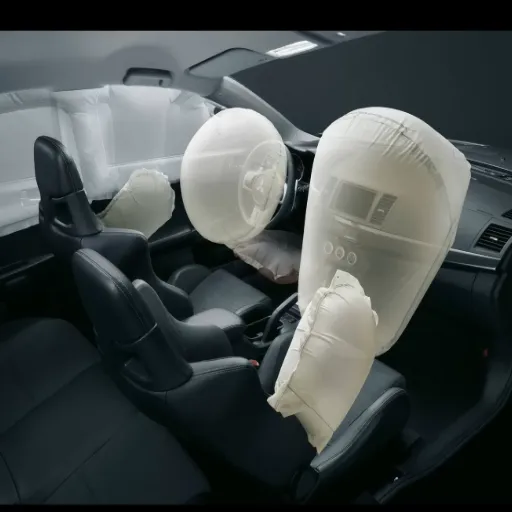
Automotive airbags are made from high-tenacity woven nylon 6.6 fabric, heat-resistant silicone or neoprene coatings, and a compact metal gas generator that releases nitrogen or argon to inflate the bag in 20–40 milliseconds. Every component is engineered to survive extreme heat, rapid expansion, and years of folded storage without degrading.
Here is the part most people miss: the fabric has to perform two opposite jobs at once. It must be strong enough to contain a controlled explosion, yet flexible enough to fold into a steering-wheel hub the size of a softball. Get either property wrong, and the airbag ruptures, deploys too slowly, or tears at the seams.
In this guide, we break down the exact materials inside an airbag system, why engineers specify them, and what procurement teams should look for when sourcing airbag fabric for OEM or aftermarket applications.
Key Takeaways
- Airbag cushions are usually woven from high-tenacity nylon 6.6 yarns ranging from 420D to 840D.
- Silicone coatings dominate coated airbag fabric because they withstand 300–500°C inflator gases and control gas permeability.
- Modern inflators use guanidine nitrate or stored inert gas instead of older sodium azide propellants.
- One-piece woven (OPW) airbags reduce seam failure points and are increasingly used for side curtains.
- Automotive airbag fabric must pass FMVSS 208, ECE R94/R95, ISO 12097, and IATF 16949 qualification.
What Are Airbags Made Of? The Short Answer

An airbag module contains three main material systems:
- The fabric cushion: High-tenacity woven nylon 6.6, sometimes nylon 6 or polyester, with optional silicone, neoprene, or polyurethane coatings.
- The coating or finish: Applied to reduce air permeability, protect against hot gas, and improve folding behavior.
- The inflator assembly: A stainless steel or aluminum canister containing propellant, igniter, filter, and gas-generating chemistry.
Beyond those three systems, the module includes talcum powder or corn starch to prevent the folded fabric from sticking to itself, plus high-strength sewing thread or woven seams to hold the cushion together during deployment. Talk to LY TRUSTLINK for high-performance airbag fabrics tailored to your requirements.
The Airbag Fabric Shell: Why Nylon 6.6 Leads
Nylon 6.6 accounts for roughly 90% of global airbag fabric usage, according to industry market analysis. The reason is simple: it survives deployment conditions that would melt or tear most other textiles.
Nylon 6.6 has a melting point of 256–265°C, well above the 215–220°C melting point of nylon 6. That gap matters because inflator gases can briefly reach 300–500°C. During those milliseconds, the fabric must soften without failing.
The material also delivers the right combination of tensile strength, tear resistance, and controlled elongation. Typical high-tenacity nylon 6.6 airbag yarn measures 7.9–9.5 grams per denier, with elongation at break between 25% and 40%. That controlled stretch absorbs deployment energy instead of transferring it directly to the occupant.
Nylon 6.6 vs. Nylon 6 vs. Polyester vs. Kevlar
| Material | Melting Point | Tensile Strength | Best Use Case |
|---|---|---|---|
| Nylon 6.6 | 256–265°C | 7.9–9.5 g/denier | Driver/passenger frontal airbags |
| Nylon 6 | 215–220°C | 7.0–8.5 g/denier | Side-impact and curtain airbags |
| Polyester (PET) | 250–260°C | Lower elongation | Specialty applications requiring low moisture absorption |
| Kevlar aramid | 500°C+ | Very high | High-performance or external airbags |
Polyester offers better dimensional stability in humid conditions, but its lower elongation makes it less forgiving during the rapid energy transfer of deployment. Kevlar handles heat exceptionally well, yet its stiffness and cost make it impractical for standard passenger airbags.
Fabric Construction: Denier, Weave, and Weight
Airbag fabric is typically woven in a tight plain weave from multifilament yarns. Common constructions include:
- 420D–630D nylon 6.6: Passenger and curtain airbags where packability matters.
- 630D–840D nylon 6.6: Driver-side airbags that concentrate stress in a smaller volume.
- 1880D nylon 6.6: Heavy-duty side-impact airbags requiring higher tear resistance.
Fabric weight generally falls between 180 and 300 g/m². Air permeability targets for coated fabrics can be as low as 0.000015–0.000108 L/m²/s, ensuring the cushion retains gas long enough to protect the occupant.
For procurement teams, specifying the right airbag cloth starts with matching denier and weave to the airbag type. The wrong construction creates either excessive bulk or insufficient strength.
One-Piece Woven vs. Sewn Airbags
Traditional airbags are cut from woven fabric and sewn together. Each seam is a potential failure point. One-piece woven (OPW) airbags are produced on specialized looms that create the cushion shape in a single fabric piece, eliminating many seams.
OPW designs are especially common in side-curtain airbags because the long, narrow shape would require dozens of seams if cut and sewn. Fewer seams mean fewer opportunities for gas leakage or tearing under load.
Airbag Coatings: Silicone, Neoprene, and Uncoated Designs
Coatings serve three purposes on airbag fabric: thermal protection, gas retention, and controlled folding. Silicone now dominates the market, holding an estimated 70%+ share of coated airbag fabric, because it remains flexible across temperature extremes and bonds well to nylon 6.6.
Coating weights typically range from 40 to 80 g/m². Thicker coatings improve heat resistance but add weight and reduce packability. Engineers balance these trade-offs based on the airbag position and inflator design.
Silicone Coating
Silicone coatings withstand the brief but intense heat of deployment while maintaining low air permeability. They also age well, retaining flexibility over a 10–15-year vehicle life. For procurement teams, silicone-coated nylon 6,6 airbag fabric is the default specification for most frontal and side-impact applications.
Neoprene and Polyurethane
Neoprene was widely used in earlier airbag generations and still appears in some designs. Polyurethane coatings offer lower cost and lighter weight but generally cannot match silicone’s thermal endurance. TPU coatings appear in specialty applications such as medical airbags where airtightness and flexibility are prioritized over extreme heat resistance.
Uncoated and Low-Permeability Fabrics
Some modern airbags use uncoated fabric woven so tightly that gas permeability stays within specification without any coating. This approach reduces weight, simplifies recycling, and improves packability. The trade-off is a narrower processing window during manufacturing.
| Coating Type | Heat Resistance | Weight | Cost | Best Application |
|---|---|---|---|---|
| Silicone | Excellent | Medium | Medium | Standard automotive airbags |
| Neoprene | Good | Medium | Medium | Legacy or specialty designs |
| Polyurethane | Moderate | Low | Low | Cost-sensitive or medical applications |
| Uncoated | Depends on weave | Lowest | Lowest | Lightweight, recyclable designs |
When LY TRUSTLINK engineers work with OEM clients on custom airbag fabric, coating selection is one of the first specifications we lock down. The coating must match the inflator temperature, the deployment geometry, and the end-of-life requirements. Connect with LY TRUSTLINK for precision airbag fabrics and consistent manufacturing support.
The Inflator: Propellants, Gas, and Housing
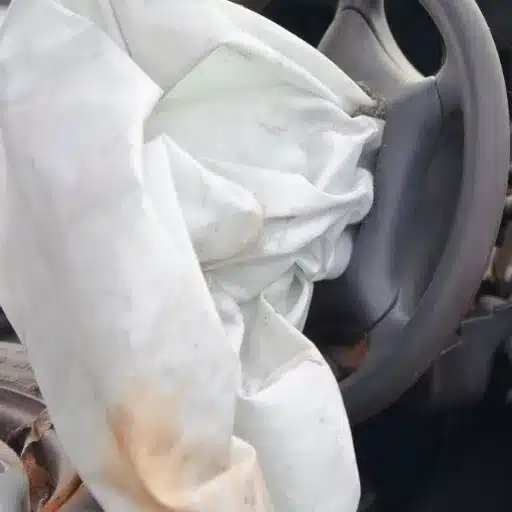
The fabric cushion is only half the system. The inflator must generate enough gas, fast enough, without producing temperatures or particles that damage the fabric or harm the occupant.
Pyrotechnic Inflators
Older airbags used sodium azide (NaN₃) mixed with potassium nitrate and silicon dioxide. The reaction produced nitrogen gas rapidly. Sodium azide is effective but toxic, so most modern systems have switched to propellants based on guanidine nitrate with a copper nitrate oxidizer. These compounds generate nitrogen with fewer hazardous byproducts.
Hybrid and Stored-Gas Inflators
Hybrid inflators combine a small pyrotechnic charge with stored compressed gas, usually argon or nitrogen. Stored-gas inflators release pre-pressurized gas through a burst disc. Side-curtain airbags often use stored gas because it produces cooler inflation temperatures, reducing thermal stress on the fabric.
Housing and Filter Materials
The inflator housing is typically stamped stainless steel or cast aluminum. Inside, a ceramic or stainless steel mesh filter cools the gas and traps solid particles before they reach the fabric cushion. The housing must contain pressures that can exceed several thousand psi during the brief deployment event.
How Airbag Fabric Is Manufactured
Manufacturing airbag fabric requires tighter process control than typical industrial textiles because variation in weight, permeability, or coating thickness changes deployment dynamics.
The process generally follows five steps:
- Yarn preparation: High-tenacity nylon 6.6 filaments are drawn and twisted to achieve the target denier and tenacity.
- Weaving: Plain or ripstop weaves are produced on high-speed looms with consistent thread counts, often 25–50 ends per inch.
- Coating and calendering: Silicone or alternative coatings are applied and cured to precise weight and permeability targets.
- Cutting and sewing or OPW weaving: Panels are cut and sewn, or the entire cushion is woven as one piece.
- Folding and module assembly: The fabric is folded with talcum powder or corn starch to prevent sticking, then packed into the module cover.
At LY TRUSTLINK, every production lot is tested for tensile strength, tear resistance, coating adhesion, and air permeability before shipment. Consistent batch-to-batch performance is non-negotiable for airbag suppliers because a single out-of-spec roll can compromise thousands of modules.
Testing and Standards That Govern Airbag Materials
Airbag fabric testing goes far beyond basic tensile checks. OEMs and Tier 1 suppliers require documented compliance with multiple standards:
- FMVSS 208: The U. S. Federal Motor Vehicle Safety Standard for occupant crash protection.
- ECE R94/R95: European regulations for front and side-impact protection.
- ISO 12097: Road vehicle airbag components test methods.
- SAE J2181: Inflator performance testing guidelines.
- IATF 16949: Automotive quality management certification required of most suppliers.
- PPAP documentation: Production part approval process records submitted to OEMs.
Mechanical tests include tensile strength per ISO 13934.1, tear strength per ISO 13937.2, and air permeability measurement. Deployment tests verify that the cushion inflates within the required time and pressure window across temperature extremes from -35°C to 85°C.
Airbag Types and Their Material Demands
Different airbag positions place different demands on fabric and coatings.
Driver Frontal Airbags
Driver airbags are small, round, and deploy from the steering wheel. The fabric sees the highest stress concentration in the smallest volume, so heavier deniers (630D–840D) and robust silicone coatings are common.
Passenger Frontal Airbags
Passenger airbags are larger and deploy from the dashboard. The larger area distributes force, allowing lighter fabric (420D–630D) while still meeting strength requirements.
Side Curtain and Side-Impact Airbags
Side curtains are long and narrow, often spanning the full length of the vehicle interior. OPW construction is preferred because continuous woven panels eliminate longitudinal seams. Some designs use stored-gas inflators to reduce thermal load.
Knee, External, and Pedestrian Airbags
Emerging airbag types protect knees, pedestrians, or external collision zones. These designs use heavier fabrics and specialized coatings because deployment geometry is less predictable and the fabric may be exposed to road debris or weather.
Sustainability and End-of-Life Considerations
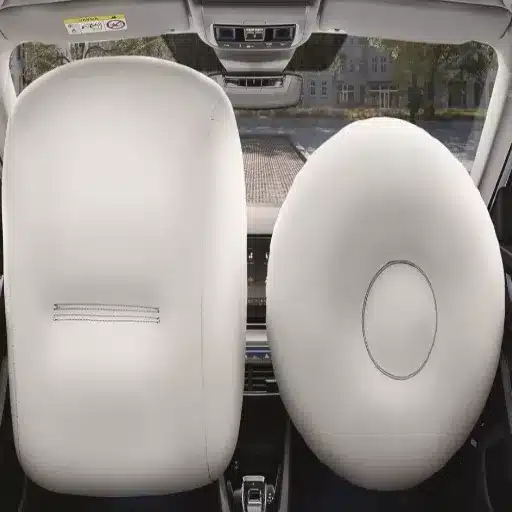
Recycling airbags is difficult. Silicone-coated nylon 6.6 cannot be mechanically separated in most recycling streams, so end-of-life airbags often go to landfill or incineration. According to life-cycle assessments, the fabric and inflator housing make up the majority of an airbag module’s environmental impact.
The industry is responding in three ways:
- Design-for-recycling: Using single-polymer or separable coating systems that simplify material recovery.
- Uncoated fabrics: Reducing coating mass lowers environmental burden and can improve recyclability.
- Water-based coatings: Some manufacturers are testing water-based alternatives to solvent-borne silicone coatings.
For procurement teams focused on sustainability, specifying uncoated or separable-coating fabrics is increasingly viable for applications where performance requirements allow it.
Frequently Asked Questions
What fabric is used in automobile airbags?
Most automobile airbags use high-tenacity woven nylon 6.6 because of its strength, heat resistance, and controlled elongation. Some designs use nylon 6, polyester, or Kevlar for specific applications.
Are airbags made of plastic?
The airbag cushion is made from synthetic polymer fibers, not solid plastic. The module cover and some chute components are often polypropylene or thermoplastic elastomers.
What gas fills an airbag?
Airbags are filled primarily with nitrogen. Some systems use compressed nitrogen, argon, or argon-helium mixtures, especially in side-curtain designs.
What chemicals are inside an airbag?
Modern airbags commonly use guanidine nitrate with a copper nitrate oxidizer. Older systems used sodium azide. The reaction produces nitrogen gas and small amounts of particulates.
Why are airbags coated?
Coatings protect the fabric from hot inflator gases, reduce gas leakage, and improve durability. Silicone is the most common coating because of its thermal stability.
Are modern airbags toxic?
Modern airbags are less toxic than older sodium azide systems, but the powder released during deployment can irritate skin and lungs. The powder is typically talcum powder or corn starch used during assembly.
What holds the airbag propellant?
The propellant is contained in a metal inflator canister made of stainless steel or aluminum. A ceramic or metal mesh filter cools and cleans the gas before it enters the cushion.
Conclusion
What airbags are made of is more than a curiosity. The choice of nylon 6.6 fabric, silicone coating, and inflator chemistry directly determines whether the system deploys correctly in a collision or fails under stress.
For procurement managers and engineers, the specification process matters as much as the material itself. Denier, weave, coating weight, permeability, and certification documentation separate a reliable supplier from a commodity vendor.
At LY TRUSTLINK, we manufacture airbag fabric, airbag cloth, and nylon 6,6 airbag materials for OEM and industrial clients who cannot afford batch-to-batch variation. If you are qualifying a new airbag fabric supplier, request a sample order or talk to our engineering team about your exact denier, coating, and certification requirements.
Sources: