
OPW Airbag Fabric Procurement Guide: Specs & Suppliers
The most expensive mistake in sourcing OPW airbag fabric is not the unit price. It is discovering at PPAP submission that your supplier cannot hold the permeability window your module design demands. Procurement teams who treat airbag fabric like a commodity roll learn quickly that one-piece woven construction is an engineered safety component, not a standard textile purchase.
You already know the stakes. A delayed qualification resets a vehicle program by 12 to 24 months. A failed lot can trigger a recall that costs far more than the fabric itself. This OPW airbag fabric procurement guide gives you the specification, qualification, and total-cost framework you need to source one-piece woven airbag fabric with confidence. Talk to LY TRUSTLINK for high-performance airbag fabrics tailored to your requirements.
Key Takeaways
- OPW airbag fabric is a seamless, jacquard-woven safety component that eliminates sewn seams and is essential for side-curtain and rollover-protection airbags.
- Procurement teams should specify material, mechanical, coating, and test-standard requirements before supplier discussions begin.
- Supplier qualification typically requires IATF 16949 certification, PPAP submission, on-site audits, and 12–24 months from first sample to production approval.
- Total cost of ownership includes unit price, waste reduction, labor savings, long-term price-down agreements, and dual-sourcing geography.
- Leading OPW fabric suppliers include Hyosung/GST, Toray, Toyobo, Teijin, and Kolon; Asia-Pacific supplies roughly 55–65% of global manufacturing capacity.
What Is OPW Airbag Fabric?

OPW stands for one-piece woven. Instead of weaving a flat sheet and then cutting and sewing it into a bag shape, OPW technology weaves the entire airbag cushion as a single three-dimensional textile on a specialized jacquard loom. In other words, one piece woven airbag fabric is produced as a shaped blank rather than an assembled product. Upper and lower fabric layers, internal chambers, and X-tethers are formed in one continuous process.
This matters because seams are the weakest leak path in an airbag. In a rollover event, a side-curtain airbag must remain inflated for five seconds or more. A cut-and-sew bag relies on peripheral stitching to hold that pressure. An OPW bag has no peripheral seams, so gas retention is more consistent and the inflated geometry is controlled by woven tethers rather than seam tension.
The construction also changes the economics of module assembly. Because the bag shape is woven in, OPW can reduce sewing steps by up to 40% and material waste by roughly 15% compared with traditional cut-and-sew production. Those savings accrue to the Tier-1 module integrator, which is why OPW has become the dominant technology for curtain and side airbags.
For a broader view of how this segment fits into the overall industry, see our complete analysis of the airbag textile market.
OPW vs. Cut-and-Sew at a Glance
| Factor | OPW (One-Piece Woven) | Cut-and-Sew |
|---|---|---|
| Seams | Seamless, woven structure | Multiple sewn edges |
| Gas retention | Superior, consistent permeability | Limited by seam quality |
| Labor | Lower, highly automated | Higher, sewing-intensive |
| Material waste | ~15% lower | Higher cutting losses |
| Weight | Lighter, no seam bulk | Heavier seam construction |
| Best application | Curtain, side, rollover airbags | Driver and passenger front airbags |
| Design flexibility | Dependent on loom pattern | Easier to modify for prototypes |
The video below illustrates how jacquard weaving transforms yarn into a shaped airbag blank, including the multi-layer weaving and tether integration that distinguish OPW construction from cut-and-sew methods.
OPW Airbag Fabric Specifications Buyers Should Demand
Procurement managers often receive quotes that look comparable until they compare the spec sheets. Before you ask for pricing, define what you are buying. The specification should cover base material, mechanical properties, coating, and test standards.
Material Standards
The majority of OPW airbag fabric is woven from high-tenacity nylon 6,6 filament yarn, typically in the 420D to 630D range. Nylon 6,6 dominates because it combines high tensile strength with the thermal stability needed to survive hot-gas inflation. For more detail on yarn and coating chemistry, see our guide on what airbag fabric is made of. According to industry estimates, nylon 6,6 accounts for roughly 75–80% of airbag fabric volume.
Polyester (PET) is the fastest-growing alternative. It offers lower moisture absorption and can be more cost-effective for certain curtain and knee-airbag designs. Recycled PET options, such as Hyosung’s EcoAir® line, are also gaining traction as OEMs tighten sustainability targets.
When you request a quote, specify:
- Yarn type and denier
- Filament count and tenacity
- Whether virgin or recycled feedstock is required
- Lot-to-lot consistency requirements for critical mechanical properties
Mechanical Properties
The fabric must perform under biaxial stress in milliseconds. The key properties to specify are tensile strength, tear strength, burst strength, and air permeability. Exact targets vary by airbag design, but typical ranges provide a useful baseline.
| Property | Typical Range | Test Relevance |
|---|---|---|
| Tensile strength | 200–300 N/5cm (flat); 1,600–2,100 N/inch (OPW) | ASTM D5034, ISO 13934-1 |
| Tear strength | >115 N to >150 N depending on OEM spec | ASTM D2261, ISO 13937-1 |
| Burst strength | >60 kg/cm² benchmark | Fabric burst methods |
| Air permeability | <10 m³/m²/min down to tight OEM-specific windows | ASTM D737, GB/T 5453 |
| Basis weight | 200–280 g/m² (±5%) | Weight per unit area |
Permeability is the most critical parameter. It is controlled by weave density, yarn linear density, and coating add-on. If the permeability is too high, the bag deflates before it can protect the occupant. If it is too low, the bag remains rigid and can cause injury. Your module engineering team will define the target window; procurement’s job is to ensure the supplier can hold that window consistently across every roll and every lot.
Coating Requirements
Most OPW airbag fabric receives a silicone coating to control gas permeability and protect the fabric from the heat of the inflator. Silicone dominates more than 70% of the coated airbag fabric market because it remains flexible across a wide temperature range and does not degrade significantly during deployment.
Coating add-on typically ranges from 30 g/m² to 60 g/m², with some designs using up to 95 g/m² in high-heat zones near the inflator. Specify:
- Coating chemistry (silicone, polyurethane, or uncoated/low-coating)
- Add-on weight and tolerance
- Uniformity over the 3D woven structure
- Curing conditions (typically 150–200°C in a continuous oven)
For a deeper technical dive on coating chemistry, refer to our silicone coating for airbag fabric guide.
Regulatory and OEM Test Standards
Airbag fabric is governed by vehicle-level regulations and fabric-level test methods. Your supplier must be able to demonstrate compliance with the relevant protocols for your target markets.
Vehicle-level regulations:
- FMVSS 208 – U.S. occupant crash protection
- ECE R94 / R95 – European front and side-impact protection
- GB 11551 / GB 20071 – Chinese occupant protection standards
Fabric-level test methods:
- ASTM D737 / GB/T 5453 – air permeability
- ASTM D5034 / GB/T 3923.1 – tensile strength and elongation
- ASTM D2261 / ISO 13937-1 – tear strength
- ASTM D4032 – stiffness
- ASTM D1776 – conditioning and shrinkage
When Elena Chen, a procurement director at a Tier-1 module integrator, reviewed a new supplier’s first submission, she noticed the tensile data was reported as a single average rather than by warp and weft direction. Her engineering team rejected the lot. Direction-dependent properties matter in OPW because the weave pattern creates different strength characteristics along the warp and weft axes. From that point forward, Elena required directional test data in every sample report. Contact LY TRUSTLINK for reliable airbag fabric solutions engineered for safety and consistency.
Supplier Qualification Checklist

Qualifying an OPW airbag fabric supplier is not a fast process. The typical timeline from first sample to production approval is 12 to 24 months. Rushing it increases the risk of a field failure, and field failures in airbags do not stay small.
Certifications
Start with the quality management baseline. Any prospective supplier should hold:
- IATF 16949 certification for automotive quality management
- ISO 14001 for environmental management
- Relevant OEM-specific approvals for the markets you serve
IATF 16949 is non-negotiable. Without it, most Tier-1 integrators will not even review a quote.
PPAP Submission
Expect a Production Part Approval Process (PPAP) submission at Level 3 or higher. The submission package should include:
- Design records and material certifications
- Process flow diagram and PFMEA
- Control plan with critical-to-quality characteristics
- Measurement system analysis (MSA)
- Initial process capability studies (Ppk)
- Qualified laboratory documentation
- Appearance approval report if applicable
- Sample production parts
- Master sample
- Checking aids
- Customer-specific requirements
Manufacturing Audit Requirements
Plan for on-site audits covering weaving, coating, cutting, and quality control. Key focus areas include:
- Jacquard loom maintenance and calibration records
- Coating line uniformity controls
- Laser cutting precision and distortion compensation
- Lot traceability from yarn receipt to finished fabric roll
- Statistical process control (SPC) documentation
- Contamination control in the finishing area
Traceability, Lot Control, and SPC
Every roll of airbag fabric must be traceable to the yarn lot, the loom, the coating batch, and the cutting operation. In the event of a quality issue, traceability determines how many vehicles are affected. Your supplier should provide:
- Roll-level identification with barcode or QR traceability
- Yarn lot records for each roll
- Coating batch records
- Inspection data mapped to roll position
- Certificate of conformance with each shipment
Typical Timeline
| Phase | Duration | Key Deliverables |
|---|---|---|
| Initial inquiry and NDA | 2–4 weeks | Capability presentation, preliminary quote |
| Sample development | 4–8 weeks | A-sample fabric, initial test data |
| Design validation | 8–16 weeks | B-sample, directional property validation |
| Process validation | 12–24 weeks | C-sample, PPAP submission |
| Production approval | 4–12 weeks | Run-at-rate, final PPAP approval |
| Total elapsed time | 12–24 months | First production shipment |
Want to discuss whether your current specification is ready for supplier engagement? Talk to our engineering team about your OPW airbag fabric requirements.
Total Cost of Ownership: Beyond Unit Price
Unit price per square meter is the easiest number to compare. It is also the least complete. The total cost of an OPW airbag fabric program includes direct material, conversion savings, quality costs, logistics, and supply-chain risk.
Fabric Cost vs. Module Assembly Savings
OPW fabric usually carries a higher price per square meter than flat-woven fabric because it requires specialized jacquard looms and more complex pattern programming. However, the module assembler saves on cutting, sewing, and inspection labor. For high-volume curtain airbag programs, those downstream savings often offset the higher fabric cost.
Reduced Waste and Labor
The seamless construction reduces material waste by roughly 15% compared with cut-and-sew patterns. It also reduces the number of assembly steps by up to 40%. In a program producing millions of units per year, those efficiencies compound quickly.
Long-Term Agreement Structures
Airbag fabric contracts typically run 3 to 8 years, aligned with the vehicle program life. Annual price-down expectations of 2–4% are common. When you negotiate, model the total program cost, not just the year-one price. A supplier with stable raw-material access and vertical integration may deliver a lower total cost than a supplier with a lower opening quote but higher volatility.
Dual-Sourcing and Geographic Risk
Since the Takata recall, many OEMs and Tier-1 integrators require dual sourcing for critical safety components. A second source adds qualification cost upfront but reduces exposure if one supplier faces a force-majeure event. Consider the geographic distribution of your supply base. Asia-Pacific supplies an estimated 55–65% of global OPW airbag fabric manufacturing capacity, so a single-region strategy carries concentration risk.
Mike Okonkwo, a supply-chain manager for a European module integrator, learned this during the 2021–2022 logistics disruption. His primary source was in Southeast Asia, and lead times stretched from 8 weeks to 22 weeks. After that experience, his team qualified a second source in Eastern Europe. The dual-source premium was modest, but it protected his production line from further disruption.
Market Context: Size, Growth, and Key Suppliers
Understanding the OPW airbag fabric market helps procurement teams anticipate capacity constraints and negotiate from a position of knowledge. Market size estimates vary because analysts define the scope differently, so it is important to distinguish between fabric-only, coated-fabric, module, and system value.
Market Size Ranges
| Scope | 2024/2025 Estimate | 2033/2035 Forecast | CAGR |
|---|---|---|---|
| OPW airbag fabric (narrow, fabric-only) | ~$1.2 billion | ~$2.5 billion (2033) | ~9.5% |
| OPW airbag market (broader, module-inclusive) | $6.50 billion (2024) | $12.71 billion (2035) | 6.28% |
| Total automotive airbag fabric | ~$2.6 billion (2024) | ~$3.5 billion (2031) | ~4.4% |
OPW is the fastest-growing construction type within the broader automotive airbag fabric market, outpacing flat-woven and cut-and-sew alternatives.
Growth Drivers
Several forces are expanding OPW demand:
- Regulatory mandates: Dual front-airbag requirements in markets like India, plus side-impact and rollover protection in Europe and North America
- Rising airbag counts per vehicle: Economy vehicles may carry 2–3 airbags; premium vehicles can carry 8–12
- Curtain-airbag adoption: OPW is the preferred construction for side-curtain designs
- EV lightweighting: Electric vehicle manufacturers value OPW’s lower weight compared with cut-and-sew alternatives
- Sustainability targets: Recycled and low-coating fabrics are gaining procurement attention
For a full breakdown of market dynamics, read our automotive airbag fabric market analysis.
Leading OPW Fabric Manufacturers
The OPW airbag fabric market is moderately concentrated. Key global suppliers include:
- Hyosung Advanced Materials / Global Safety Textiles (GST) – estimated ~32% OPW market share
- Toray Industries – nylon 66 and PET fabrics, advanced recycling programs
- Toyobo – long-established high-tenacity polyester supplier
- Teijin – high-performance fibers and Vietnam joint-venture capacity
- Kolon Industries – Korean producer with integrated weaving and coating
- Milliken & Company, Porcher Industries, HMT, UTT – regional and specialty players
Tier-1 module integrators such as Autoliv, ZF, Joyson Safety Systems, and Toyoda Gosei purchase fabric from these suppliers and assemble the final airbag modules. Autoliv alone holds roughly 40% of the global airbag module market.
Emerging Trends Affecting Procurement
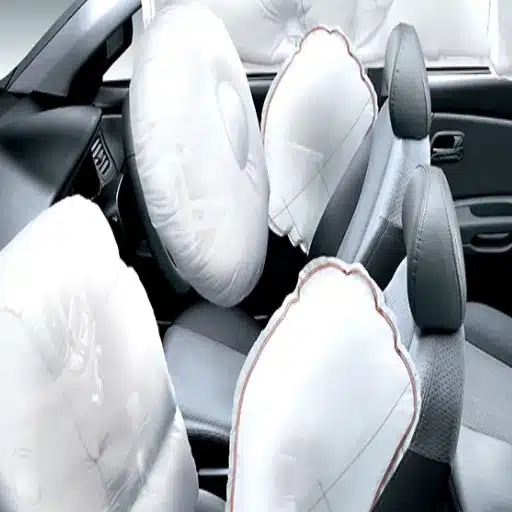
The airbag fabric market is not static. Three trends are changing what procurement teams need to specify and validate.
Lightweighting and Downgauging
OEMs are pushing for lower denier yarns and thinner coatings to reduce weight. Every gram matters in electric vehicles, where range is directly affected by mass. Procurement teams must ensure that lightweighting does not push mechanical properties below the validated safety window.
Sustainable and Recycled Materials
Recycled nylon 6,6 and recycled PET are moving from pilot programs to production requests. Toray announced a nylon 66 depolymerization and recycling breakthrough in early 2025, targeting used automotive airbags as a feedstock. Hyosung offers EcoAir® fabric made from recycled PET. When sustainability is a procurement criterion, specify the recycled-content percentage and the certifications required.
EV and External Pedestrian Airbag Designs
Electric vehicle architectures are creating new airbag locations, including dashboard undersides, roof liners, and exterior pedestrian-protection systems. External airbags face weather, UV, and abrasion requirements that differ from cabin-mounted bags. These applications may require new coating formulations and weave designs.
Contact LY TRUSTLINK to develop durable airbag fabrics for demanding automotive applications.
Common Sourcing Risks and Mitigations
Even qualified suppliers face risks that procurement teams should monitor.
Nylon 66 Feedstock Concentration
Nylon 66 depends on adiponitrile (ADN) feedstock, which has historically been concentrated among a small number of producers. Any disruption in ADN supply ripples through the airbag yarn chain. Mitigation strategies include long-term raw-material agreements and qualification of alternative yarn suppliers.
Silicone-Coating Supply Volatility
Silicone emulsions and catalysts can be affected by energy costs and chemical supply disruptions. If your design relies on a specific coating chemistry, map the coating supply chain two or three tiers deep.
Geopolitical and Logistics Exposure
Asia-Pacific dominates OPW fabric manufacturing. Trade policy changes, port congestion, or regional energy shortages can affect lead times. Regional sourcing strategies and safety stock policies reduce this exposure.
Recycling and End-of-Life Considerations
Airbag fabrics are difficult to recycle because they combine nylon, silicone, and sometimes metals from the inflator. As end-of-life regulations tighten, procurement teams may need to specify mono-material or low-coating designs that are easier to recycle at vehicle end-of-life.
If you are evaluating a new OPW airbag fabric program, our airbag fabric plant cost guide provides additional context on the capital and operating requirements behind the supply base.
Frequently Asked Questions
What is OPW airbag fabric?
OPW airbag fabric is a one-piece woven textile in which the entire airbag cushion, including chambers and tethers, is woven as a single structure on a jacquard loom. It eliminates the peripheral seams found in cut-and-sew airbags and is commonly used for side-curtain and rollover-protection airbags.
How long does OPW airbag fabric supplier qualification take?
Supplier qualification typically takes 12 to 24 months from first sample to production approval. The timeline includes sample development, design validation, process validation, PPAP submission, and final run-at-rate approval.
What standards should OPW airbag fabric meet?
Vehicle-level regulations include FMVSS 208, ECE R94/R95, and GB 11551/GB 20071. Fabric-level test methods include ASTM D737 for air permeability, ASTM D5034 for tensile strength, ASTM D2261 for tear strength, and ASTM D4032 for stiffness.
Who are the largest OPW airbag fabric manufacturers?
Leading suppliers include Hyosung Advanced Materials / Global Safety Textiles (GST), Toray Industries, Toyobo, Teijin, and Kolon Industries. Hyosung/GST is often cited as the OPW market leader with roughly a 32% share.
Why is OPW used for curtain airbags?
Curtain airbags must remain inflated for five seconds or more during a rollover. OPW construction has no peripheral seams, so gas retention is more consistent than cut-and-sew alternatives. Woven X-tethers also help control the inflated shape.
What coating is used on OPW airbag fabric?
Silicone coating is the most common choice, accounting for more than 70% of the coated airbag fabric market. Coating add-on typically ranges from 30 g/m² to 60 g/m² and controls gas permeability while protecting the fabric from hot-gas inflation.
Is OPW airbag fabric more expensive than cut-and-sew fabric?
OPW fabric usually has a higher price per square meter, but it can reduce module assembly steps by up to 40% and material waste by roughly 15%. For high-volume curtain-airbag programs, the downstream savings often offset the higher fabric cost.
Conclusion
Sourcing OPW airbag fabric successfully requires procurement and engineering to agree on the specification before supplier engagement begins. The right supplier is not necessarily the one with the lowest unit price. It is the one that can hold permeability, tear strength, and coating uniformity across every roll for the life of the vehicle program.
Start with a clear specification covering material, mechanical properties, coating, and test standards. Qualify suppliers through IATF 16949, PPAP, and on-site audit. Model total cost of ownership, including downstream assembly savings and supply-chain risk. And monitor the trends that will shape your next sourcing cycle: lightweighting, sustainability, and EV-specific designs.
At LY TRUSTLINK, we understand that an airbag fabric decision is a supply-chain commitment, not a one-time purchase. Our engineering team supports OEM and Tier-1 partners from concept to certified delivery, with transparent specifications and consistent quality across every production batch. Ready to put this OPW airbag fabric procurement guide into action? Contact our engineering team to discuss specifications, qualification timelines, and custom fabric solutions.