
Recycled Airbag Fabric: Materials, Recycling & Market Trends
Recycled airbag fabric is high-performance nylon 6,6 or polyester recovered from decommissioned airbags and production scrap, then reprocessed through mechanical or chemical recycling into new yarn, fabric, resin, or molded parts. It matters because airbag-grade textile is among the most durable materials in a vehicle, yet most of it still ends up incinerated or landfilled. This guide explains how recycled airbag fabric is made, which recycling routes actually work, the regulations now forcing its adoption, and exactly what a buyer must verify before specifying it.
In early 2025, Marco, a purchasing director at a German seating supplier, opened an RFQ that looked ordinary until the compliance section: “Quote recycled-content airbag fabric with documented closed-loop origin.” He had no supplier shortlist, no test data, and a tight deadline. A year later, that request is close to standard across Europe. Understanding the material science behind it is the only way to answer it with confidence.
Agree: Most technical buyers already suspect that “recycled content” in safety textiles is more complicated than swapping one yarn for another. Promise: By the end of this guide, you will know the three recycling routes, what recycled content does to airbag-grade performance, and the regulatory timeline that is reshaping sourcing decisions. Preview: We start with the material itself, move through the recycling challenge and technologies, then cover performance validation, nylon 66 versus polyester, regulations, and a practical sourcing checklist. Talk to LY TRUSTLINK for high-performance airbag fabrics tailored to your requirements.
Key Takeaways
- Recycled airbag fabric comes from two streams: end-of-life airbags (about 2,200 g per scrapped car) and production scrap, together representing roughly 22,000 tonnes of recoverable fabric every year.
- The silicone (PDMS) coating is the core recycling obstacle; removing it without degrading the nylon substrate is the difference between low-value powder and fabric-grade recyclate.
- Three routes exist: mechanical recycling for molded parts, chemical depolymerization back to virgin-quality monomers, and coating-separation methods that enable fabric-to-fabric recycling.
- Autoliv shipped the first 100% recycled polyester airbag cushions in 2024, reporting about 50% lower greenhouse gas emissions at the polymer level with equal safety performance.
- The EU End-of-Life Vehicles Regulation (EU) 2026/1738 enters into force in August 2026 and phases in mandatory recycled content, with 20% of it required to be closed-loop from end-of-life vehicles.
What Is Recycled Airbag Fabric?
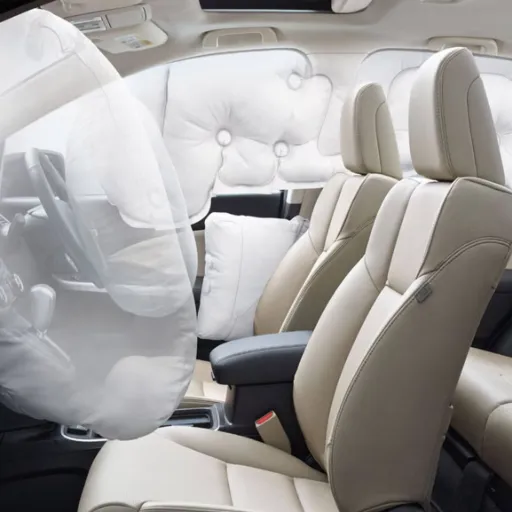
Recycled airbag fabric is reclaimed textile from two distinct sources. The first is post-consumer: airbags removed from end-of-life or scrapped vehicles. The second is post-industrial: production scrap, including cutting waste and off-spec rolls generated during airbag cushion manufacture.
The Two Material Bases: Nylon 6,6 and Polyester
Most airbag fabric is woven from nylon 6,6 (polyamide 66), chosen for its toughness, heat resistance, and ability to survive an explosive deployment where inflator gas can reach 300 to 500 degrees Celsius. A smaller but growing share uses polyester, which offers lower cost and a cleaner path to circularity. Both are coated with a silicone layer that holds the inflation gas long enough to cushion an occupant.
The Scale of the Waste Stream
The resource is not trivial. Each scrapped car contains roughly 2,200 grams of recyclable airbag fabric, which industry analysts estimate could yield nearly 22,000 tonnes of material annually. Japan alone generates about 1,900 tonnes of waste airbags each year from roughly 2.73 million scrapped vehicles. Across Europe, more than 20 million end-of-life vehicles are dismantled annually, producing tens of thousands of tonnes of silicone-coated fabric that is today mostly incinerated or landfilled.
For a technical fabric manufacturer, that waste stream is also a specification problem. The material that ends up in the bin is the same high-tenacity construction that protects occupants in a crash, which is why the push to reclaim it is accelerating. Our full automotive airbag fabric market overview covers the broader supply chain context if you need the bigger picture.
Why Recycled Airbag Fabric Is Hard to Recycle
If recycled airbag fabric were a simple material, it would already be standard. It is not, for three reasons.
The Silicone Coating Problem
The defining obstacle is the polydimethylsiloxane (PDMS) coating. It is crosslinked onto the fabric to control permeability, and it cannot be peeled off like a film. If silicone residue survives into the recyclate, it bonds poorly to the nylon matrix and produces weak mechanical properties and early material failure. Research published in 2025 demonstrates the problem directly: PDMS-coated nylon 6,6 requires a chemical step to cleave the siloxane bonds before the polymer is usable (Wiley, siloxane bond exchange study).
Safety and Logistics Come First
Before any fabric recovery can happen, the inflator must be neutralized. Airbag inflators contain energetic propellants that degrade over time and can ignite during handling. Dedicated shredding systems safely destroy the propellant and recover the steel casing before the fabric ever reaches a recycling line. This is a regulated process, and it is the reason end-of-life airbag recycling has a logistics cost that commodity textile recycling does not.
Performance Requirements Are Extreme
Airbag fabric is engineered for a 20 to 40 millisecond deployment, sustained exposure to combustion gas at several hundred degrees, and a service life of 10 to 15 years in a vehicle interior. Recycled content has to prove it can hold those margins across every batch, not just in a lab sample. That validation burden is real, and it is why the material has been slow to enter safety-critical applications.
Contact LY TRUSTLINK to develop durable airbag fabrics for demanding automotive applications.
How Recycled Airbag Fabric Is Made: Three Technology Routes
The recycling landscape has consolidated around three routes. Each produces a different output grade, and they are not interchangeable.
| Route | How It Works | Output | Best For | Example |
|---|---|---|---|---|
| Mechanical | Shredding, grinding, micronizing into powder or pellets | Recyclate for molded compounds | Engine covers, housings, non-fabric parts | Toyota Tsusho ABSSOLOOP (92% lower CO2 than virgin nylon) |
| Chemical (depolymerization) | Breaking polymer back to monomers, then repolymerizing | Virgin-quality resin and yarn | New airbags, automotive textiles | Toray subcritical water; Asahi Kasei microwave; Samsara Eco enzymatic |
| Coating separation | Removing silicone first, then reclaiming the fabric or polymer | Fabric-grade or resin-grade recyclate | Fabric-to-fabric and high-value reuse | DOMO MOVE 4EARTH; solvent dissolution-precipitation |
Mechanical Recycling: The Volume Option
Mechanical recycling is the most mature and the least expensive. The fabric is chopped, ground, and micronized into powder that can be compounded with virgin polyamide and reinforcing fillers to make molded parts. Toyota Tsusho’s ABSSOLOOP process is a working example, converting airbag production scrap into recycled nylon 6,6 with a reported 92% reduction in CO2 versus virgin production. The limitation is that the silicone coating stays in the recyclate, which keeps the material suited to molded applications rather than high-performance fabric.
Chemical Recycling: Back to Monomers
Chemical recycling breaks nylon 6,6 down into its original monomers, hexamethylenediamine and adipic acid, or polyester into its feedstock, then repolymerizes it into virgin-quality material. This is the route that can genuinely close the loop.
- Toray uses subcritical water to depolymerize nylon 6,6 within minutes, targeting mass production around fiscal 2030 with about half the CO2 of conventional production.
- Asahi Kasei and Microwave Chemical run a joint demonstration using microwave heating (the PlaWave platform) to depolymerize PA66 from airbags and other automotive components at lower energy.
- Samsara Eco operates an enzymatic chemical recycling plant handling nylon 6,6, nylon 6, and PET, including airbag feedstocks.
- SK Chemicals is building a pilot plant for closed-loop airbag recycling that recovers BHET, an intermediate for PET, with the goal of feeding new airbag production.
Coating Separation: The Fabric-Saving Path
The third route removes the silicone first. Academic and industrial methods now include a siloxane bond exchange using a potassium hydroxide catalyst, solvent-based dissolution-precipitation that recovers PA66 at greater than 90% yield, and heat-treatment patents from manufacturers like Toyobo. DOMO Chemicals’ MOVE 4EARTH technology chemically separates the silicone bond from coated airbag waste and offers recycled-content engineering plastics with CO2 reductions of up to 90%.
Which route a supplier chooses tells you what they can actually sell. A mill that only mechanically grinds fabric cannot supply yarn for new airbags. If you are evaluating recycled airbag fabric for a technical application, ask which route produced it and what the input stream was. This is the first filter in our car airbag fabric supplier guide, and it applies to recycled material just as strictly.
Recycled Airbag Fabric in New Airbags: Performance Validation
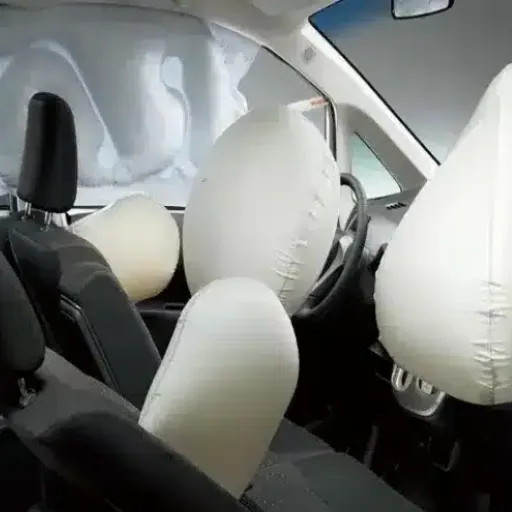
The most demanding test for recycled airbag fabric is going back into an airbag. In June 2024, Autoliv introduced airbag cushions made with 100% recycled polyester yarn, developed with supply chain partners and validated to deliver equal safety functionality to a standard polyester airbag (Autoliv press release). The company reports roughly 50% lower greenhouse gas emissions at the polymer level, supporting its net-zero 2040 target. Autoliv CTO Jordi Lombarte described it as “the first technology to create airbags using 100% recycled polyester fabric.”
That announcement matters because it proves recycled content can pass safety validation. But it also matters for what it does not say: validation took years, required dedicated yarn and fabric development, and involved a supplier chain working to OEM and Tier-1 specifications.
When the R&D team at a Korean materials company first ran recycled PA66 yarn through a production airbag loom, the trial failed on fluff count. The recovered fiber passed tensile and tear testing, but it shed filaments that jammed the weaving process. The fix took months of coating chemistry work rather than fabric engineering, because the silicone residue was the culprit. It is a useful reminder that recycled airbag fabric is not a drop-in substitute. It is a qualified material.
What Validation Actually Requires
For a recycled yarn to be accepted into an airbag cushion, the fabric must pass the same battery of tests as virgin material:
- Tensile strength and tear resistance per the applicable standard
- Gas permeability, since the coating controls inflation
- Burst and deployment simulation at inflator temperatures
- Heat aging and hydrolysis testing covering the 10 to 15 year service life
- Compliance with FMVSS 208 and ISO 12097 where they apply
There is no separate, looser standard for recycled content. If a supplier tells you otherwise, treat it as a red flag.
Ready to evaluate recycled-content fabric against your own specification? Talk to our engineering team about the test data you need to see before approval.
Nylon 66 vs. Polyester: Choosing a Recycled Airbag Feedstock
If you are sourcing recycled airbag fabric, the feedstock question comes up quickly: recycled nylon 6,6 or recycled polyester?
| Property | Recycled Nylon 6,6 | Recycled Polyester (rPET) |
|---|---|---|
| Tenacity | Higher, at typical airbag constructions | Good, with lighter-gauge options |
| Heat resistance | Excellent under deployment gas | Adequate for many applications |
| Moisture sensitivity | Absorbs moisture, must be controlled | Lower absorption |
| Recycling maturity | Monomer routes proven, scaling | Monomer routes (BHET) proven, scaling |
| Cost position | Premium | Lower |
| Circular design fit | Strong | Strongest, supports single-material design |
Nylon 6,6 remains dominant in airbag fabric because of its toughness and heat performance. Recycled nylon 6,6 from monomer routes is the closest to virgin-equivalent. For front and side airbags where fabric strength is critical, recycled nylon 6,6 leads.
Polyester is the fastest-growing segment because it aligns with circular design rules that favor single-material components. For applications where lightweighting and recyclability matter more, rPET is increasingly specified. A detailed property comparison lives on our nylon airbag fabric page if you need the full specification depth.
Regulations Driving Demand for Recycled Airbag Fabric
The market is not moving to recycled airbag fabric on sentiment. It is moving because regulation now requires it.
The EU End-of-Life Vehicles Regulation (EU) 2026/1738
The EU replaced its 20-year-old ELV Directive with a directly applicable regulation that was published in the Official Journal on 24 July 2026 and enters into force on 13 August 2026 (CDX System analysis of the published regulation). The key milestones for textile suppliers:
- New vehicles must contain at least 15% recycled plastic within about six years and 25% within about ten years.
- At least 20% of that recycled content must come from end-of-life vehicles or used parts, the so-called closed-loop requirement.
- Recycled material sourced outside the EU will not count toward mandatory targets until August 2030.
- Chemical recycling can only be counted through a mass balance approach once the Commission adopts a methodology, due by August 2028.
For a Tier-1 safety supplier, that translates directly to RFQs like the one Marco opened. Procurement teams now have to prove recycled content, document closed-loop origin, and maintain the data trail for the Digital Circularity Vehicle Passport expected around 2032.
Other Drivers
Japan now mandates collection of used nylon 6,6 airbags, which has pushed chemical recyclers like Toray and Refinverse into commercial development of recycled nylon 6,6 resin. The European Green Deal and extended producer responsibility rules add pressure on OEMs to design for disassembly and single-material construction. None of these directly dictate that an airbag be recycled into another airbag, but together they create the demand pull for recycled-content automotive textiles.
The wider market confirms the direction. Recycled materials for mobility applications are projected to grow from $2.5 billion in 2022 to $3.9 billion by 2027, a CAGR of 8.6%, faster than the automotive airbag fabric market as a whole, which moves from about $3.25 billion in 2025 toward $4.82 billion by 2034.
Beyond Airbags: Where Recycled Airbag Fabric Goes Next
Recycled airbag fabric has found a second life well beyond the vehicle, and that end-market pull is part of why the supply chain is investing. The same properties that make it excellent for safety textile, tear resistance, flame resistance, light weight, and a clean appearance, make it attractive to designers.
- Apparel and outerwear: Tanboer’s Airbag Recycled N66 Down Jacket won an ISPO Award in 2024 using recycled airbag nylon 6,6.
- Bags and accessories: Brands like Airbo, FREITAG, AIRPAQ, and Pilsok build backpacks and bags from decommissioned airbags, preserving the original folds and seams.
- Footwear: Asics uses airbag nylon remnants from Toyoda Gosei in its Gel-Sonoma 15-50 sneaker, a 2024 Good Design Award winner.
- Automotive fashion: Nio’s Blue Sky Lab has reused nearly 55,000 meters of production waste fabric, including airbags, since 2021.
- Composites: Researchers have used recycled airbag fabric and seatbelt webbing as reinforcement in hybrid carbon-fiber composites, improving impact energy absorption.
For a technical buyer, these applications matter less for themselves than for what they signal: a growing, commercial market for recovered airbag fabric that supports dedicated collection and recycling capacity. As that capacity scales, the economics of recycled airbag fabric improve for everyone, including OEM-grade buyers.
Sourcing Recycled Airbag Fabric: What Buyers Must Verify
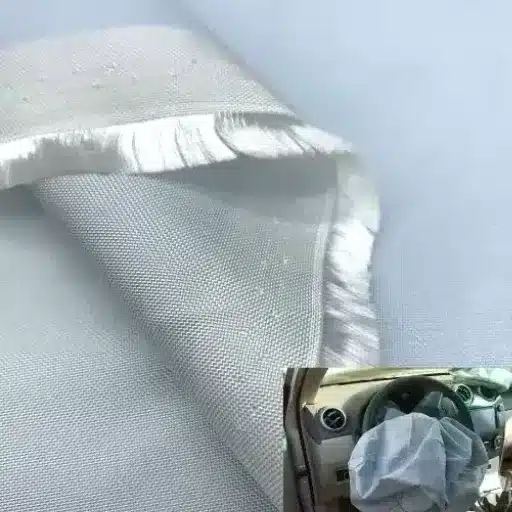
If you are ready to evaluate recycled airbag fabric for your own product line, the checklist below keeps the technical risk manageable. Every claim on this list should be documented, not asserted.
1. Recycled Content and Origin
- What percentage of the recycled content is claimed, and what method verifies it?
- Is the input post-consumer (end-of-life airbags) or post-industrial (production scrap)?
- Is the origin closed-loop, meaning it comes from end-of-life vehicles, as the EU regulation will require?
2. Specification Testing
- Request independent test reports for tensile strength, tear resistance, permeability, burst, and aging.
- Confirm the fabric was tested to the relevant standard, whether that is FMVSS 208, ISO 12097, or your own OEM protocol.
- Ask what coating was used and how the silicone chemistry affects recycled content performance.
3. Supplier Qualification
- Is the mill qualified under IATF 16949 or equivalent automotive quality systems?
- Does the supplier hold batch-to-batch consistency data, or is recycled content delivered as a one-off?
- Can the supplier support dual-sourcing, which most Tier-1 buyers require after the Takata recall reshaped the supply chain?
4. Traceability
- Can the supplier produce a digital record of the material from collection through recycling to the finished roll?
- Does the supplier maintain the data required for a Digital Circularity Vehicle Passport?
The same discipline applies whether you are buying virgin or recycled airbag fabric. In fact, it applies more. Recycled content adds a variable to a safety-critical material, and the manufacturer that controls it transparently is the one worth qualifying.
That is the standard we hold ourselves to at LY TRUSTLINK. Documented test data back every technical fabric specification.
FAQ
Can airbag fabric be recycled into new airbags?
Yes. Autoliv introduced airbag cushions made with 100% recycled polyester in 2024, and chemical recycling routes from Toray, Asahi Kasei, and SK Chemicals aim to recover nylon 6,6 and polyester back to monomer quality for new airbag production. The fabric must still pass the full safety validation battery before it is approved.
Is recycled airbag fabric as strong as virgin fabric?
Recycled airbag fabric can match virgin performance, but only when produced through the right route. Chemical depolymerization back to monomers yields virgin-quality polymer. Mechanical recycling retains the silicone coating and is better suited to molded parts than fabric. Strength is a property to verify with test reports, not assume.
How is the silicone coating removed from airbag fabric?
Methods include siloxane bond exchange using a potassium hydroxide catalyst, solvent-based dissolution-precipitation that recovers PA66 at greater than 90% yield, and proprietary heat-treatment processes. The goal is to remove the crosslinked PDMS coating without degrading the nylon substrate.
What regulations require recycled content in vehicles?
The EU End-of-Life Vehicles Regulation (EU) 2026/1738 requires new vehicles to contain at least 15% recycled plastic within about six years and 25% within about ten years, with at least 20% of that content coming from end-of-life vehicles. Japan also mandates collection of used nylon 6,6 airbags.
How much airbag fabric is wasted each year?
Estimates suggest each scrapped car contains about 2,200 grams of recyclable airbag fabric, amounting to roughly 22,000 tonnes of potentially recoverable material annually. Europe alone dismantles more than 20 million end-of-life vehicles per year.
Who makes airbags from recycled material?
Autoliv has commercialized 100% recycled polyester airbag cushions. Toray, Asahi Kasei, Samsara Eco, SK Chemicals, and Refinverse are developing and scaling chemical recycling for nylon and polyester from airbag waste.
Conclusion
Recycled airbag fabric is moving from niche to necessary. The material is technically difficult to recover because of its silicone coating, but the three recycling routes now exist and several can return it to virgin-quality performance. Autoliv has already shipped 100% recycled polyester airbag cushions.
The EU ELV Regulation (EU) 2026/1738, in force from August 2026, turns recycled content from a sustainability talking point into a compliance requirement. Closed-loop content from end-of-life vehicles is now mandated.
The practical takeaway for buyers is straightforward: recycled airbag fabric is a qualified material, not a commodity substitute. Verify the recycling route, demand independent test data, confirm closed-loop traceability, and qualify suppliers under automotive quality systems. Those four checks separate a dependable recycled-content supplier from one that is simply marketing a claim.
If you are evaluating recycled-content technical fabric for an automotive or industrial application, our engineering team can help you define the specification, review test requirements, and confirm what documentation you need before approval. Request a custom quote or explore the full airbag textile market outlook to see how this shift fits the broader landscape. The suppliers who navigate recycled content with engineering discipline will be the ones OEMs qualify first.