
How to Repair a Bounce House: Costs & When to Replace
Most bounce house damage is repairable, and the question that decides everything is whether the fix is worth it. A puncture in 18 oz commercial PVC is a 15-minute, roughly $25 field patch. A seam split on a lighter 15 oz unit can run $500 or more once you ship it out, which is when you start weighing repair against replacement. So the answer to how to repair a bounce house is not one procedure, it is a decision: match the method to the damage type, then match the decision to the material grade.
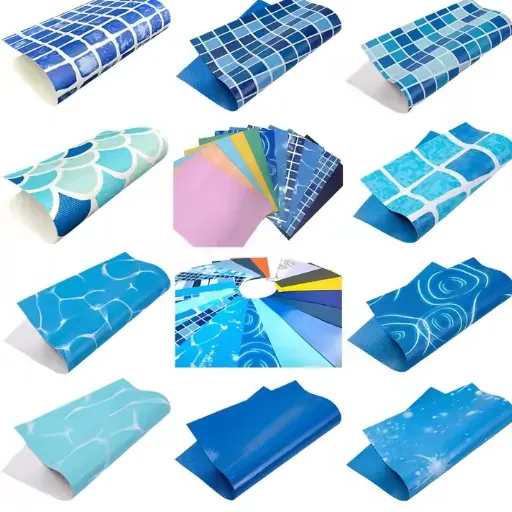
Look this up and you will find a dozen articles showing the same four steps and skipping the part that matters. They do not ask what your unit is made of, and they do not tell you when a repair is throwing good money after bad. We manufacture the PVC fabric these units are built from, so we can give you the version a rental blog cannot: what can be repaired, why the method depends on the material, the kit that works on PVC, the patch and seam procedures, a repair-cost table by grade, and the rule that tells you when to stop.
Key Takeaways
- A puncture in 18 oz commercial PVC is a 15-minute, $25 field patch; round the patch corners, use a vinyl cement like HH-66, and cure 24 hours before inflating again.
- Repair method depends on grade. Heavy 18 oz PVC takes adhesive patches and even field heat welding; light 15 oz and residential nylon or Oxford units often fail again at the same seam.
- Escalate to a professional when a seam separates more than 6 inches on a load-bearing seam, when the floor panel fails, when damage sits near an anchor or blower, or when material is thinning or delaminating.
- Use the 50% rule. If a repair estimate reaches about half the cost of a replacement unit, replace, because the next failure is usually close behind.
- Repair economics are set by grade. A 15 oz unit fails 3 to 5 times more often than 18 oz under equivalent duty, which is why cheap patches on light shells rarely stay cheap.
The Short Answer: Bounce House Repair by Damage Type
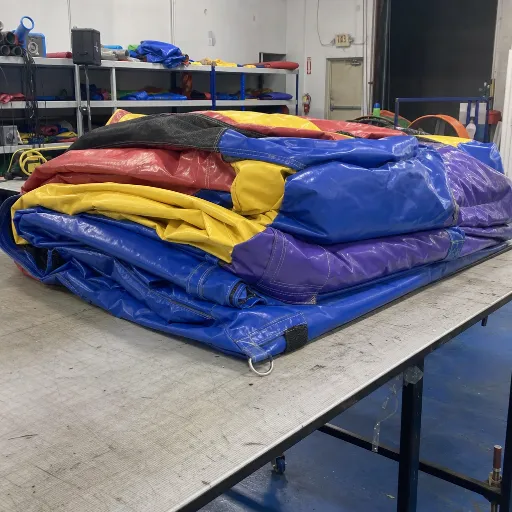
Repairing a bounce house starts with identifying what actually failed. Pinholes under 2 mm take an adhesive dab. Punctures and short tears take a matching-thickness vinyl patch in 10 to 15 minutes. Seam splits and weld failures need either a bonded reinforcement patch or field heat welding, and large load-bearing seam failures generally need a shop. Blown baffles and deformed anchor points are structural and belong with a professional. If a failure is larger than about 6 inches on a seam that carries load, price a replacement before you spend on the fix.
That answers the question for most readers. The rest is the detail behind each line, because the answer depends on the fabric your unit is built from.
Not sure whether your fabric can take a repair at all? Our bounce house fabric guide breaks down the material stack behind every commercial unit.
Why the Repair Method Depends on Your Material
Two bounce houses can look identical and need different repairs, because the fabric underneath sets the rules. Weight, in ounces per square yard (oz), best predicts how well a repair will hold.
18 oz PVC (Commercial Baseline)
Eighteen-ounce PVC is the commercial baseline: a high-tenacity polyester scrim, often 1000D, between thick PVC layers, with seams typically high-frequency (RF) welded rather than stitched. That construction is why a field repair is viable: a patch bonds to solid material rather than a thin skin over stitching, and the unit can take a hot-air weld when a seam needs a permanent fix.
15 oz PVC (Light Commercial)
Fifteen-ounce PVC is lighter, with less coating depth over the scrim. It suits low-frequency rental and indoor events, but it fails more often, and at the seams. A 15 oz unit fails 3 to 5 times more often than 18 oz under equivalent duty, so repairs are not a one-time event: the seam that split once tends to split again, each time costing the same downtime. For a unit already showing repeat failures, the math usually favors replacement. Deciding before you buy? Our 15 oz vs 18 oz PVC vinyl comparison walks through the trade-off.
Nylon and Oxford (Residential)
Residential units use nylon or Oxford cloth with minimal coating. You cannot weld them, and adhesive patches hold poorly with no solid PVC layer to bond to, so kits rely on sewn or taped patches. A residential seam failure is usually a temporary patch toward replacement.
Why the Original Seam Construction Matters
One detail almost no guide mentions decides whether your fix holds: how the unit was built. An RF-welded seam fuses the PVC layers, so a patch bonds to a continuous surface, and a hot-air bonded seam behaves the same way. A stitched seam has needle holes a patch cannot seal, so the repair has to address the stitching. Our seams are RF-welded or hot-air bonded for a watertight, permanent seal rather than stitched.
Repair vs Replace: When a Patch Won’t Hold
You can patch almost anything once. The question is whether it is the right call, and there is a clean way to decide.
The 50% rule: if the repair estimate reaches roughly half the cost of a replacement unit, replace. Bounce house damage rarely arrives alone. Once a unit starts failing, the failures cluster, and a repair that costs half a new unit buys you a few months before the next one.
Escalate to a professional, or start pricing a replacement, when any of these are true:
- A seam has separated more than 6 inches on a load-bearing seam.
- The floor panel, the most heavily loaded surface, has failed.
- Damage sits near an anchor point or the blower connection, where failure is a safety risk.
- The material is thinning or the PVC coating is delaminating from the scrim.
- The same seam has re-separated after two field repairs.
- A baffle has blown, or a D-ring has deformed or torn out.
Anchor damage is not just a repair problem. It is a safety problem, and stretched units fail at exactly those points. Our guide to bounce house safety standards covers the anchorage and material requirements, including the relevant sections of ASTM F2374 and EN 14960.
Managing a fleet? Repeat failures are a signal about grade, not about your repair technique. See what separates commercial-grade bounce house material →
The Right Bounce House Repair Kit: What Actually Works on PVC
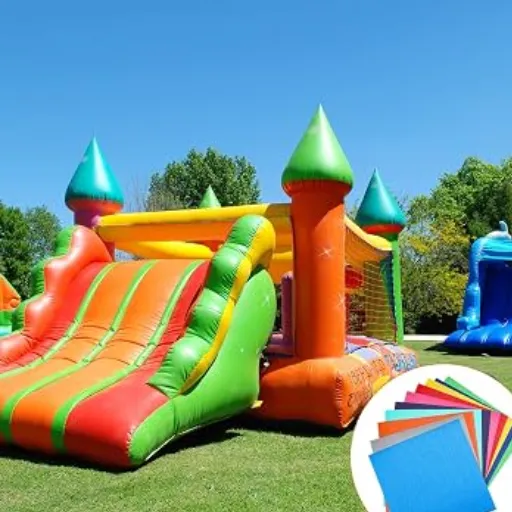
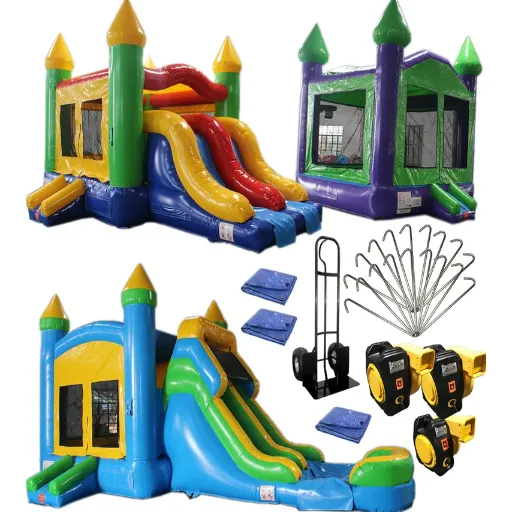
A repair kit only works if it is built for PVC, and that is where most cheap kits fail.
What you need:
- Matching-thickness vinyl patches. Bounce castle PVC is typically 0.45 mm to 0.55 mm. A patch that is much thinner or thicker will not flex with the shell and will peel at the edge.
- Vinyl cement made for PVC, such as HH-66 or SX-69, the industry standards for bonding PVC-coated fabric.
- Surface prep supplies: isopropyl alcohol, a clean lint-free cloth, and fine abrasive.
- Application tools: a roller, weights or clamps, and a heat gun for accelerated cure.
What destroys a repair:
- Super glue, white glue, and hot-melt adhesive. None bond to PVC, and all fail under flex.
- Tapes such as Tear-Aid or Flex Seal used as a final fix. Tape is a stop-gap for a single event, never a permanent repair.
- Patching a wet, dirty, or inflated surface. Contamination under the patch is the number-one cause of field failures.
We say this because we make the material these products must bond to: if the adhesive cannot grip PVC, the patch lifts and you are back where you started.
How to Patch a Puncture or Tear, Step by Step
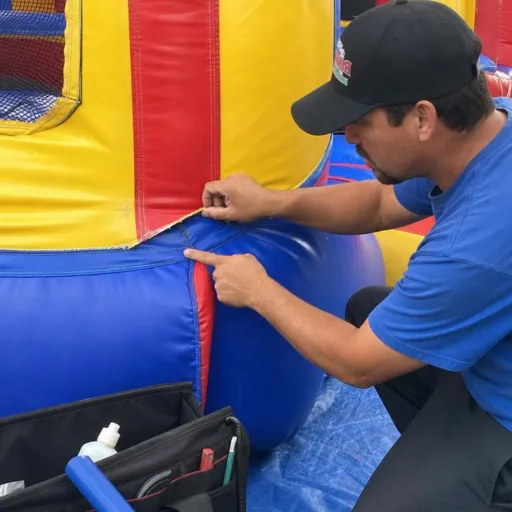
Here is a procedure for a puncture or short tear that holds when followed exactly.
- Find and mark the leak while the unit is inflated. Wipe the suspect area with soapy water and watch for bubbles, or listen for a hiss. Mark the spot before you deflate.
- Deflate the unit unless you are applying a tape stop-gap, which is done on an inflated surface.
- Clean the area with isopropyl alcohol and let it dry. Scuff lightly with fine abrasive if the surface is glossy.
- Cut a patch 1 to 3 inches larger than the damage on every side, then round the corners. Square corners are where patches peel first.
- Apply a thin, even layer of vinyl cement to both the patch and the unit. Let it get tacky for the cure time on the label.
- Press the patch from the center outward, working out trapped air, then roll or weigh it to ensure full contact.
- Cure for 24 hours minimum before inflating. Water-slide units should cure 48 hours. A heat gun at 120 to 150 degrees F shortens the cure to 30 to 45 minutes, but never exceed 180 degrees F on PVC.
- Inflate and re-test with soapy water before putting the unit back into service.
Marcus, a school district maintenance lead, found a 3-inch floor-panel tear in an 18 oz unit two days before a fundraiser. He patched it that afternoon, cured it overnight, and the patch held through the event and three more seasons.
Key point: surface prep is roughly 70 percent of the repair. A perfect patch on a dirty surface fails. A good patch on a clean surface holds for seasons.
Rebuilding rather than repairing? We engineer commercial inflatable fabric to your exact ounce and denier spec, from first sample to volume supply.
How to Repair a Seam Split or Weld Failure
Seam damage is the most common serious failure on light units, and where DIY repairs most often disappoint. Two paths apply, by load.
Field adhesive repair (light load, short split). For a short split on a low-stress seam, clean and dry both faces, apply a bonded reinforcement patch that overlaps the split by at least 3 inches on each side, and clamp or weight it through the full 24-hour cure. Use this only when the split is under 6 inches and not load-bearing.
Heat welding (permanent, load-bearing). A load-bearing seam needs a weld, not a patch. A hot-air welder running at roughly 450 to 550 degrees C fuses the fabric back together, and a completed weld lasts the life of the fabric. A single weld takes 60 to 90 minutes, which is why commercial operators use it: it returns the seam to original strength.
A baffle repair or a split near an anchor usually goes to a shop that can open the structure through the zipper, replace panels, and re-weld, where an estimate can climb toward $600 or more.
If a seam fails twice within one season, that is your signal. The fabric is at the end of its service life, and the guide to how long a bounce house lasts explains how to calculate the remaining cycles before you commit to another repair.
Repair Costs by Damage Type and Material Grade
This table is the one that lets you make the call, and no competitor publishes it on a single axis. Costs reflect typical DIY kit prices and reported professional shop rates.
| Material grade | Damage type | DIY cost | Professional cost | Typical downtime |
|---|---|---|---|---|
| 18 oz PVC (commercial) | Puncture or short tear | $25 kit, 10–15 min | 20–20–150 | Same day |
| 18 oz PVC (commercial) | Load-bearing seam split | Patch possible but discouraged | 60–60–600 (weld) | 1–2 weeks |
| 15 oz PVC (light commercial) | Puncture or tear | 25–25–50 kit | 20–20–150 | Same day |
| 15 oz PVC (light commercial) | Seam split | Often fails again after DIY | 60–60–600, often not worth it | 1–2 weeks |
| Nylon / Oxford (residential) | Tear or seam | 5–5–30 tape or sew kit | Rarely economical | Same day, temporary |
| Any grade | Baffle failure | Not a DIY repair | 100–100–800 | 1–4+ weeks |
| Any grade | Anchor / D-ring damage | Not a DIY repair; safety-critical | Quoted per unit | 1–2 weeks |
Two numbers hide in that table and change the decision. Round-trip freight for a shop repair runs roughly $ 300 to $ 500, which alone can exceed the value of a light unit, and peak-season backlogs run 1 to 4 weeks, downtime no line item captures. Put those together with the 50% rule: a $25 patch on an 18 oz unit is almost always worth it, while a 15 oz unit that ships out, waits in a queue, and returns to split again usually is not.
The 15-Oz False Economy, in Real Numbers
Denise runs a small rental operation and bought three light 15 oz units to stretch her budget. In her second season, one split a load-bearing seam mid-booking. The shop quoted near 400, plus about $ 400, plus about $ 350 in freight, plus a three-week queue during her busiest month. She patched it in the field to finish the season, and it separated again within six weeks.
The next season she replaced with 18 oz units, and her repair costs dropped to occasional $25 patches. The “savings” on lighter fabric cost her a season of downtime and a repair bill that approached the price of a new unit.
The Maintenance Routine That Prevents Repairs
The cheapest repair is the one you never make. A short, disciplined routine turns a two-season unit into a seven-season one.
- Dry the unit completely before storage. Mold can start within 48 hours in a damp folded unit, the most common reason inflatables die early.
- Inspect the seams and floor panel after each use, and catch a small split before it becomes a big one.
- Repair small tears immediately. A $25 field patch on day one prevents a costly load-bearing seam failure later.
- Use a ground tarp on rough surfaces to protect the floor panel.
- Store cool, dark, and dry, out of direct sun, since UV exposure degrades both residential and PVC shells.
- Keep the blower clean and the anchor points sound. A failing anchor is a safety issue, not just a maintenance item.
Frequently Asked Questions
How to repair a bounce house?
Identify the damage type, then match the method. Pinholes take an adhesive dab, punctures and short tears take a vinyl patch with HH-66 or SX-69 cement and a 24-hour cure, and load-bearing seam splits need heat welding or a shop. Anything over 6 inches on a load-bearing seam, or any floor, anchor, or baffle failure, goes to a professional.
How much does it cost to repair a bounce house?
A DIY puncture patch on a commercial unit costs about $25 and takes 10 to 15 minutes. Professional repairs run $20 to $150 for a basic patch, $60 to $600 for a seam, and $100 to $800 for a baffle. Add roughly $300 to $500 for freight if the unit ships.
How to patch a bounce house hole?
Deflate and clean the area with isopropyl alcohol, cut a rounded-corner patch 1 to 3 inches larger than the hole, apply a thin layer of vinyl cement to both surfaces, press from the center out, roll or weight it, then cure 24 hours before inflating.
Do bounce house repair kits actually work?
Yes, on PVC, if the kit uses matching-thickness vinyl patches and a PVC cement such as HH-66 or SX-69. They do not work well on nylon or Oxford residential units, and they fail if you use the wrong adhesive or skip surface prep.
Can you repair a bounce house seam or seam split?
A short split on a low-stress seam can take a bonded reinforcement patch with a 24-hour cure. A load-bearing seam needs heat welding at roughly 450 to 550 degrees C, or a shop repair. If a seam fails twice after two field repairs, replace the unit.
Can you use Flex Seal or duct tape on a bounce house?
Flex Seal and similar tapes can seal a pinhole for a short time, but they are not permanent and lift under flex. Duct tape is not a fabric repair at all. Use tape only to get through an event, then patch properly.
How to repair a bounce house blower or blower tube?
The blower is an electrical part and should be serviced or replaced rather than field-repaired. A torn blower tube or the sleeve where it attaches is a fabric repair: patch it with the same vinyl method, and check that the sleeve is not tearing away from the shell, which is a shop job.
Conclusion: Repair Smarter, Replace at the Right Time
Learning how to repair a bounce house comes down to four decisions. Identify the damage type, so you know whether this is a patch, a weld, or a shop job. Check the material grade, because an 18 oz puncture and a 15 oz seam split have different outcomes. Set the kit right, with matching-thickness vinyl and PVC cement. Then apply the 50% rule, so you replace when a repair is no longer the sensible spend.
Do those four things and you will get more seasons out of every unit at a lower cost per booking. If you are sourcing inflatables, the fabric underneath the design sets the lifespan and the repair economics. Our team engineers PVC inflatable fabric to your exact ounce, denier, and compliance requirements, from first sample to volume supply.
Ready to specify the right fabric? Talk to our engineering team about commercial inflatable fabric → or explore the full bounce house fabric guide for the complete material stack.