
How Long Do Bounce Houses Last? Lifespan Guide by Material
A commercial bounce house made of 18 oz PVC-coated vinyl lasts 5 to 7 years under normal rental use, and up to 10 years with light use and consistent maintenance. Material grade is the single biggest determinant: 15 oz PVC lasts 2 to 3 years, while residential nylon and Oxford units last roughly 6 to 18 months.
Ask the same question in two contexts and you’ll get two answers, because “how long do bounce houses last” carries two meanings. Renters want to know how long a rental runs, usually 4 to 8 hours or overnight. Buyers and rental operators want to know how many years the unit holds up before replacement. This guide answers the second question, with the numbers to plan around.
Elena found out what those numbers are worth the hard way. She runs a 14-unit party rental business in Orlando, and in 2020 she bought six “deals” from a marketplace listing at about 45 percent below her usual cost. The units were fine for one season. By the end of the second, three had seam splits on the jump floor and two were losing air at the floor seams. She replaced the entire batch with 18 oz PVC units from a manufacturer who sent real spec sheets. Five years later, those units are still on her schedule. The “savings” had cost her a season of lost bookings and a stack of refunds.
We manufacture commercial PVC inflatable fabric and test every production batch for tensile strength, tear resistance, and coating adhesion, so lifespan is a subject we measure rather than guess. This guide reconciles the conflicting numbers you’ll find across the internet, breaks down how long each material grade lasts, and shows you how to estimate your unit’s life in use cycles and seasons. For the full construction breakdown behind these lifespans, start with our guide to what bounce houses are made of.
Key Takeaways
- A commercial 18 oz PVC bounce house lasts 5 to 7 years under normal rental use, and up to 10 years with light use and consistent maintenance. Residential nylon units last 6 to 18 months.
- Lifespan tracks material grade: 15 oz PVC lasts 2 to 3 years, 18 oz PVC lasts 5 to 7 years, and 20 oz+ material lasts 6 to 8 years.
- Years are a poor unit of measure. A commercial unit is rated in use cycles, 500 to 2,000+ for quality 18 oz PVC, which you divide by cycles per season to get real service life.
- Cost-per-season math shows why 18 oz is the cheapest material to own: it fails 3 to 4 times less often than 15 oz and patches in the field for under 50insteadofa50insteadofa500 seam rebuild.
- The biggest lifespan killers are storage, moisture, and UV exposure, all within your control. Maintenance routinely extends a unit from 3 seasons to 7 or more.
The Short Answer: How Long Do Bounce Houses Last by Material
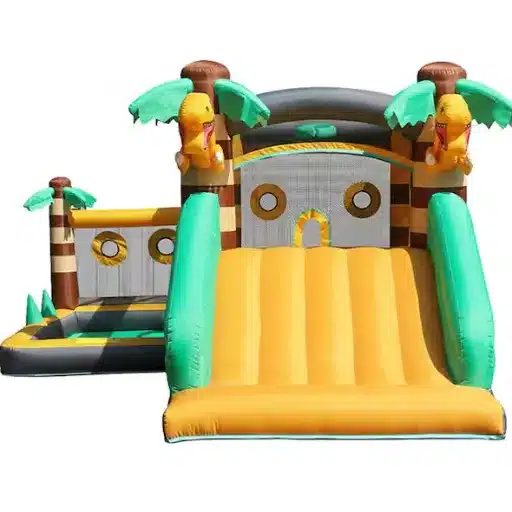
Lifespan tracks material grade almost exactly, because the grade determines the failure points. The table below is the same one our engineering team uses when specifying fabric for inflatable makers and rental operators.
| Material | Construction | Lifespan | Typical Use |
|---|---|---|---|
| Nylon / Oxford cloth | 420D-840D woven | 6 to 18 months | Residential backyard units |
| 15 oz PVC | ~510 gsm, light scrim | 2 to 3 years | Light commercial, promotions |
| 18 oz PVC | 0.55 mm / ~610 gsm, 1000D scrim | 5 to 7 years | Standard commercial, industry baseline |
| 20 oz+ PVC | 0.60 mm+ / ~650-1,000 gsm | 6 to 8 years | Water slides, obstacle courses |
Two things about this table matter more than the numbers themselves.
First, the residential row exists because many buyers compare a $250 backyard unit against a $2,500 commercial unit and assume the difference is brand markup. It’s not. Residential nylon and Oxford fabric is built to a fraction of the duty cycle, which is why those units measure their life in months, not years.
Second, the 18 oz row is the industry baseline for a reason. It sits at the intersection of durability, repairability, and manageable unit weight, and about 90 percent of commercial rental suppliers build around it. For the full comparison between the two most common weights, including the repair data behind the numbers, see our 15 oz vs 18 oz PVC vinyl guide.
Why Lifespan Numbers Disagree So Much
Search “how long do bounce houses last” and you’ll find answers ranging from 3 years to 10 years. Almost all of them are true for a specific combination of material and use. Two variables explain nearly every disagreement.
Material grade sets the ceiling. A 15 oz unit physically can’t last as long as a 20 oz unit under the same conditions, because the lighter fabric tears and stretches faster at the same stress points.
Duty cycle sets where within that ceiling a specific unit lands. The industry generally separates commercial use into three tiers:
- Heavy duty (rental company running units every weekend, year-round): 3 to 5 seasons.
- Moderate duty (schools, churches, community centers, seasonal rental fleets): 5 to 7 years.
- Light duty (indoor family entertainment centers, backup units, occasional events): 7 to 10 years.
A source claiming bounce houses last 10 years is describing a light-duty, well-maintained unit. One claiming 3 years is describing heavy rental abuse with neglected maintenance. Both figures are real; neither applies to your unit until you know your material and duty cycle.
This is also why “years” is the wrong unit of measure. A unit’s life is driven by how many times it is inflated, deflated, dragged, and jumped on, not by the calendar.
Want to know what grade your current material really is? Request a spec sheet from your supplier, check the weight in oz and gsm, and weigh a sample if you can. Our engineering team publishes the thresholds in our commercial bounce house material guide.
What Actually Determines How Long a Bounce House Lasts
Five factors decide where a unit lands in its lifespan range. Understanding each one lets you predict replacement, budget for it, and extend it.
Material Grade and Construction
The fabric is the whole game. A commercial bounce house uses PVC-coated vinyl over a woven polyester scrim, and the specs determine how the material fails. Higher-denier scrims stop tears from spreading. Heavier coatings protect the base cloth and carry the graphics. UV stabilizers and cold-flex plasticizers keep the material pliable in sunlight and cold weather, and quality commercial PVC resists cold cracking down to -40°F.
Construction matters as much as weight. Two fabrics can both be labeled 18 oz and perform completely differently. That is why the spec sheet matters more than the label.
UV and Environmental Exposure
Ultraviolet light is the slow killer of outdoor PVC. Residential nylon degrades noticeably after 200 to 500 hours of sun exposure, which a summer of outdoor use can consume. PVC holds up far longer because UV stabilizers are built into the material, but outdoor storage still shortens life. Units kept indoors or shaded last measurably longer than identical units stored in direct sun.
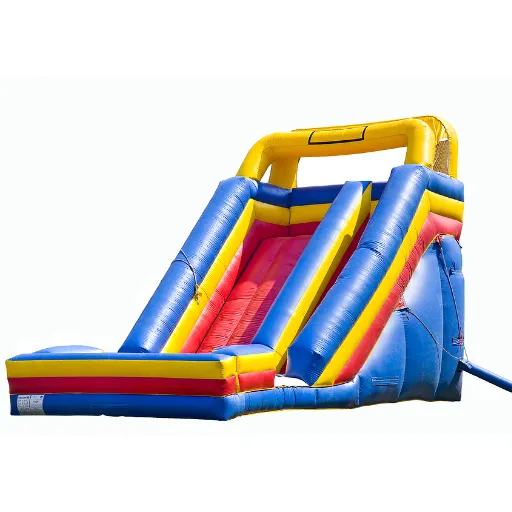
Water and cold matter too. Water slides face chlorine and moisture stress, which is why they run shorter lifespans than dry units and require thorough drying. Extreme cold makes PVC brittle if the plasticizer system isn’t formulated for it, so climate-controlled storage is recommended for winter.
Frequency and Intensity of Use
Every setup and teardown cycle stresses the seams, anchor points, and jump surface. A unit rented out 60 to 180 times a year (5 to 15 rentals per month) wears far faster than one used once a month. The number of jumpers and their weight relative to capacity matters too. Overloading accelerates wear at exactly the stress points that cause structural failure.
Maintenance, Storage, and Repairs
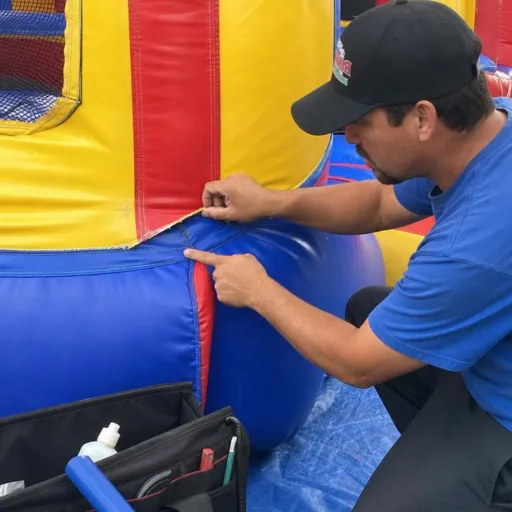
Maintenance is the factor most within your control, and it is the one with the biggest swing. Operators who clean after every event, dry units fully before storage, and patch small tears promptly routinely get 7 or more seasons out of units that neglectful operators retire in 3. The single most common lifespan killer is storing a unit damp, which allows mold and mildew to attack the material from the inside.
Manufacturing Quality
Heat-welded or high-frequency-welded seams form a molecular bond that holds air. Stitched-only seams fail under repeated pressure. Reinforced stress points, load-tested D-rings, and consistent coating thickness all determine whether a unit survives year two, year four, or year seven. Batch quality control matters too, which is why we test every production batch rather than sampling.
Ready to source inflatable castle tarpaulin fabric directly from a manufacturer? Contact us with your requirements and get a customized solution for your next order.
How to Estimate Your Own Bounce House Lifespan
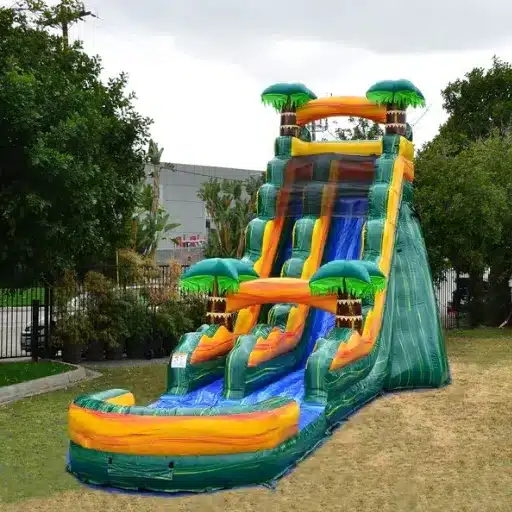
Instead of trusting a year range from a listing, you can estimate your unit’s life from two numbers you can actually measure.
Step 1: Find the use-cycle rating. Commercial-grade 18 oz PVC is rated for roughly 500 to 2,000+ use cycles, and 3,000+ with proper maintenance. Lighter residential material isn’t rated for cycles at all.
Step 2: Divide by your cycles per season. Count how many times your unit actually goes out in a year, then divide the cycle rating by that number.
James runs 12 bounce houses in Ohio with a seasonal business operating about 9 months a year. Each unit goes out roughly 8 times a month, about 72 rentals a year. A quality 18 oz unit rated around 600 cycles gives him about 8 seasons of light duty, dropping toward 5 on heavy peak weekends. His 15 oz units, rated closer to 200 cycles, give him under 3 seasons before major maintenance. That single number is the difference between planning a replacement in three years and in eight.
This framework also explains the “10 year” claims. A backup unit used a handful of times a year, stored indoors, and cleaned after each use can easily exceed a decade because it never accumulates the cycles.
Planning a fleet purchase? The math changes the decision. Our engineering team supplies certified 18 oz and 20 oz PVC inflatable fabric with batch-specific test reports, so you know the cycle rating before you commit. Request a specification sheet.
The Cost of Lifespan: Cost-Per-Season and Total Cost of Ownership
Lifespan only matters because it shows up in your P&L. The right way to compare materials is cost per season, not upfront price.
A 15 oz unit costs less on the invoice but fails sooner and fails more often. Under commercial duty, 15 oz material runs about 12 to 16 repair incidents per 10 units per year, against 3 to 5 for 18 oz and 2 to 4 for 20 oz. Cheaper material also repairs differently: a puncture in 18 oz PVC is a 10 to 15 minute field patch with a kit that costs about $25, while a failure in lighter material often means a re-stitch and re-weld that takes the unit out of service and runs toward $500.
Spread the numbers across five years and the picture is clear. The upfront premium for 18 oz over 15 oz is typically recovered within 18 to 24 months through fewer repairs and lost bookings. The same logic applies at the extreme: a $250 residential unit at one or two seasons costs as much per season as a $2,500 commercial unit that runs five to seven.
Warranties reinforce the point. Commercial equipment carries warranties of 1 to 3 years, while residential units carry 30 to 90 days. That gap reflects the manufacturer’s own expectation of how long the material will last, not marketing.
Signs It’s Time to Retire a Bounce House
Replacement timing is not just a budget decision; it is a safety decision. A unit past its service life becomes a liability the moment it fails under load. Watch for these retirement signals:
- Frequent air leaks that return after patching.
- Excessive patch count concentrated on the jump surface or seams.
- Thinning or see-through material where the coating has worn through.
- Seam separation or delamination at stress points.
- Anchor-point wear or D-ring pull.
- Mold penetration that cleaning can’t remove.
- Permanent discoloration or a stiff, brittle feel to the fabric.
- Loss of structural stability when inflated.
If your unit shows two or more of these, retire it before it fails during an event. Retiring on time protects the kids using it and keeps your operation insurable, which ties directly into the ASTM F2374 design and CPSC safety requirements we cover in our bounce house safety standards guide.
How to Make Your Bounce House Last Longer
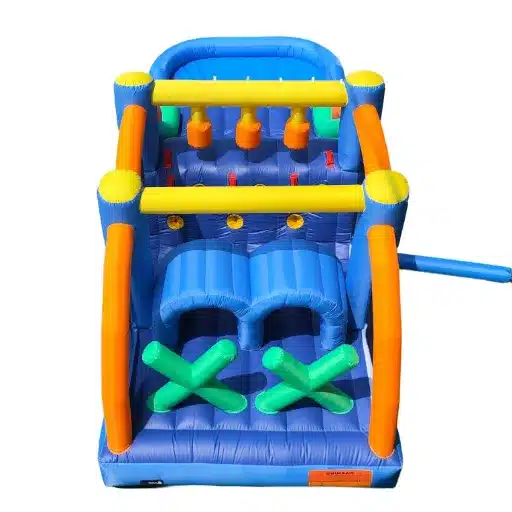
Lifespan is not fixed at the factory. The difference between 3 seasons and 7 seasons is almost entirely maintenance discipline. This is the routine that extends service life in real fleets:
- Clean after every event. A 15 minute wipe-down removes dirt and debris that abrade the material.
- Deep-clean every 8 to 10 events. Inspect seams, anchor points, and the jump surface while you do it.
- Dry fully before storage. Never store a damp unit. Moisture is the number one lifespan killer.
- Store cool, dark, and dry. UV exposure and heat accelerate material breakdown even in storage.
- Use a correctly rated blower. A continuous-duty commercial blower rated for 8+ hours protects the unit; an undersized residential blower overheats and under-pressurizes the fabric.
- Rotate units in your fleet. Spread the heaviest weekend demand across your inventory instead of hammering one unit.
- Patch small tears immediately. A 25fieldpatchdoneondayonepreventsa25fieldpatchdoneondayonepreventsa500 seam rebuild on day sixty.
- Keep a spec sheet and a rental log. Track cycles per unit so you know when each unit approaches its rated life.
Dana, who took over her father’s inflatable rental company in Michigan, was losing units to the same two mistakes every fall: storing them damp and running them with residential blowers. She introduced a drying rack, a check-blower-tag rule, and a cleaning station. Three years later, her units were outlasting her competitors’ identical models by roughly two full seasons. The fix cost less than one replacement unit.
When the numbers say a unit is done, the material you buy next determines whether the cycle repeats. Our engineering team manufactures certified 18 oz and 20 oz PVC inflatable fabric, supports custom weights and coatings, and ships production-line samples before you commit. Talk to an engineer or request a quote on commercial inflatable fabric.
[VIDEO EMBED HERE – Editorial note]
Place a manufacturing or material-demo video here. Preferred: LY TRUSTLINK’s own production footage (coating line, QC tensile testing, or RF welding). Alternative: an authoritative third-party explainer on how commercial inflatable fabric is manufactured or welded. Embed from YouTube with a descriptive title and captions.
How Long Do Bounce Houses Last? Frequently Asked Questions
How long does a commercial bounce house last?
A commercial bounce house made of 18 oz PVC lasts 5 to 7 years under normal rental use, and up to 10 years with light use and consistent maintenance. Heavy weekend-rental duty pushes the lower end to 3 to 5 seasons.
How long do residential bounce houses last?
Residential units made of nylon or Oxford cloth last 6 to 18 months with regular backyard use, and up to 2 to 3 years with light, careful use. They’re not built for rental service.
How many rentals does a bounce house last?
Quality 18 oz PVC is rated for roughly 500 to 2,000+ use cycles, and 3,000+ with proper maintenance. Divide that by your cycles per season to estimate years of service.
How long does an 18 oz bounce house last?
An 18 oz PVC bounce house lasts 5 to 7 years under normal commercial use. An 18 oz unit seeing 30 to 50 rentals per year typically survives 3 to 5 seasons before major maintenance.
How do you make a bounce house last longer?
Clean after every event, dry fully before storage, store in a cool dark space, use a correctly rated blower, and patch small tears immediately. These steps routinely extend service life from 3 seasons to 7 or more.
How long do water slide bounce houses last?
Water slides run shorter than dry units because chlorine and moisture add stress. Plan for 3 to 6 years with regular maintenance and thorough drying after every use.
When should you replace a bounce house?
Replace it when it shows frequent air leaks, seam separation, thinning material, anchor wear, or mold penetration that cleaning can’t remove. Retiring on time protects users and keeps the unit insurable.
Conclusion
How long do bounce houses last? The answer is a range, not a number, and it’s driven by two variables: material grade and duty cycle. Commercial 18 oz PVC lasts 5 to 7 years under normal rental use and up to 10 with light use and consistent care. Residential nylon lasts 6 to 18 months. The rest of the internet’s conflicting figures are just different points within those ranges.
The practical takeaway is to measure in use cycles and cost per season, not calendar years. Get the spec sheet, know your grade, track your cycles, and maintain the material like the asset it is. A unit that earns for seven seasons instead of three is not a small efficiency; it is a different business.
Our engineering team manufactures certified 18 oz and 20 oz PVC inflatable fabric and will send production-line samples and batch test reports before you commit. Start with our bounce house fabric guide or the commercial PVC inflatable fabric range, then request a quote. The material you verify is the material that will still be on your schedule years from now.