
15 oz vs 18 oz PVC Vinyl Bounce House: Which Weight Wins?
For commercial use, 18 oz PVC vinyl is the right weight for a bounce house. It lasts 5-7 years against the 2-3 years of 15 oz material, it costs 25-40% less to own over five years once repairs are counted, and it is the baseline weight commercial rental fleets and insurers expect. 15 oz is the right choice only for light-duty, occasional, or budget-first use, and even then it is the floor, not a savings strategy.
The 15 oz vs 18 oz PVC vinyl bounce house question looks like a simple durability tradeoff. Buyers assume heavier vinyl simply means “more durable,” then pick on price. In practice the two weights are different materials with different scrim construction, tensile and tear ratings, repair profiles, and total cost of ownership. The difference shows up in the rental ledger, not just the spec sheet.
We manufacture commercial PVC inflatable fabric, and we test every production batch for tensile strength, tear resistance, and seam integrity. This guide compares 15 oz and 18 oz in plain numbers, walks through what the choice costs a rental operator over five years, and shows you how to verify you’re getting the weight you paid for. For the full breakdown of fabric construction and grades, start with our bounce house fabric guide.
Key Takeaways
- 18 oz PVC (about 610 gsm, 0.50-0.60 mm) is the commercial baseline and lasts 5-7 years; 15 oz (about 510 gsm) lasts 2-3 years.
- 18 oz fabric carries higher tensile strength (2,200-2,500 N/5cm vs 1,500-1,700 N/5cm) and roughly 60% fewer repair incidents per fleet per year.
- Despite costing about 12% more upfront, 18 oz pays back that premium in 18-24 months and costs 25-40% less over five years once repairs and replacements are included.
- Anything under 500 gsm (about 14.7 oz) is residential-grade material, regardless of how it is labeled; 15 oz sits right at that edge.
- You can verify the real weight by requesting a spec sheet and checking oz/yd², GSM, scrim denier, and third-party test values before you order.
What Do “15 oz” and “18 oz” Mean in Bounce House Vinyl?
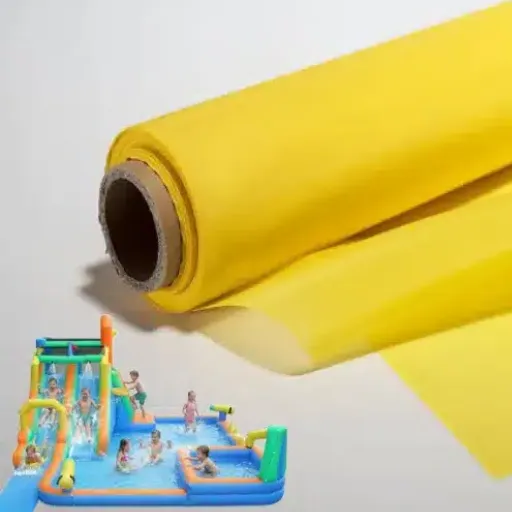
The number on a bounce house spec sheet is a weight per area: ounces per square yard (oz/yd²), which is how commercial PVC-coated tarpaulin has always been quoted in North America. Manufacturers and export markets usually state the same figure in grams per square meter (gsm). The two weights you’re comparing are 15 oz (about 510 gsm) and 18 oz (about 610 gsm). They are not “thick vinyl” and “thin vinyl”; they are two engineered grades with different scrims and different performance envelopes.
| Weight (oz/yd²) | GSM | Approx. thickness | Grade |
|---|---|---|---|
| 15 oz | ~510 gsm | 0.45-0.50 mm | Light commercial / residential-adjacent |
| 18 oz | ~610 gsm | 0.50-0.60 mm | Commercial standard |
| 20 oz | ~650 gsm | 0.60-0.75 mm | Premium commercial |
A useful rule of thumb for buyers: commercial-grade PVC tarpaulin ranges from about 550 to 1,100 gsm (16-32 oz). Anything under 500 gsm is residential-grade material, even when the marketing says “heavy duty” or “commercial grade.” That is the line this whole comparison turns on. 18 oz clears it with margin. 15 oz sits right at the edge, which is why it behaves closer to a residential fabric in commercial rental duty.
For a deeper walk through oz, GSM, and thickness conversions across the full commercial range, see our PVC inflatable fabric specifications guide.
15 oz vs 18 oz PVC Vinyl: Side-by-Side Spec Comparison
The table below is the direct answer to the 15 oz vs 18 oz PVC vinyl bounce house question, with the measured numbers we specify for commercial fabric. These are manufacturer-spec averages for virgin-grade PVC over a high-tenacity polyester scrim; always verify against a supplier’s actual test report.
| Spec | 15 oz PVC (510 gsm) | 18 oz PVC (610 gsm) |
|---|---|---|
| Base scrim | 1000D × 20×20 polyester | 1000D × 23×23 high-tenacity polyester |
| Tensile strength | 1,500-1,700 N/5cm | 2,200-2,500 N/5cm |
| Tear resistance | 180-220 N | 280-320 N |
| Commercial lifespan | 2-3 years | 5-7 years |
| Repair incidents | 12-16 per 10 units / year | 3-5 per 10 units / year |
| Typical repair | Re-stitch + re-weld (unit out of service) | PVC patch (often back same day) |
| Unit weight / handling | Lighter, easier to fold and move | Heavier, 2+ people for setup |
| Upfront material cost | About 12% lower | Commercial industry standard |
| 5-year total cost (fabric + repairs) | Higher (replacement around year 3) | 25-40% lower |
The two weights differ in more than thickness. The 18 oz grade uses a denser 23×23 scrim weave and a heavier PVC coating, which is where the higher tensile and tear values come from. That difference in the load-bearing scrim is why two units that look identical at a glance can fail years apart in service.
If you’re choosing between fabric grades for a specific unit type rather than a whole fleet, the commercial PVC inflatable fabric range page shows the full weight options and how each one is specified.
How Material Weight Affects Your Rental Business
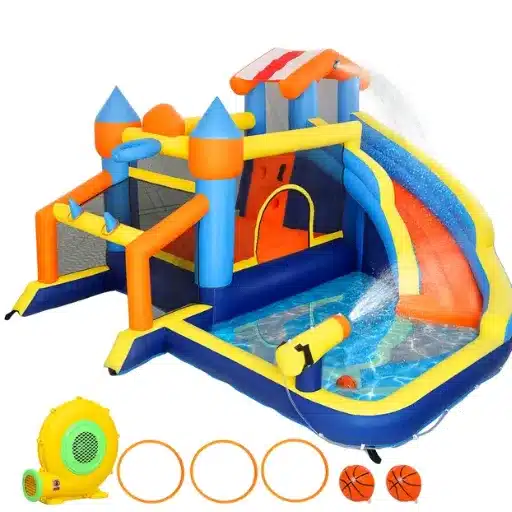
Dana bought two identical combo bounce units for her Columbus rental company in March 2023. One was built from 15 oz PVC, the other from 18 oz, at the same size and layout, and she ran both on the same weekend rotation for three seasons.
By the end of season one, the 15 oz unit had logged four repair events: two seam splits on the jump floor and two tear patches. The 18 oz unit needed one small patch near a D-ring. By the end of season three, the 15 oz unit had been re-stitched and re-welded twice and spent 11 total days out of service. The 18 oz unit had spent two days out of service, both for scheduled maintenance. Dana retired the 15 oz unit going into year four; the 18 oz unit is still on her schedule. That’s the 15 vs 18 oz difference in operational terms, not sales language.
If you are comparing inflatable castle fabric suppliers, contact us to evaluate material performance, customization options, and production costs for your application.
Durability & Lifespan
Lifespan tracks weight closely. Industry repair data across rental fleets shows 15 oz material failing roughly 3-4 times more often than 18 oz, and the failures are the expensive kind: seam splits that take a unit out of service for re-stitching and re-welding. On 18 oz PVC, most repairs are surface patches that can be cured in a day.
The business impact goes beyond the repair bill. A unit that is down on a Saturday is a lost booking, and a seam that fails during an event is a liability exposure. That’s the part of the tradeoff that never shows up on the invoice.
Repair Economics
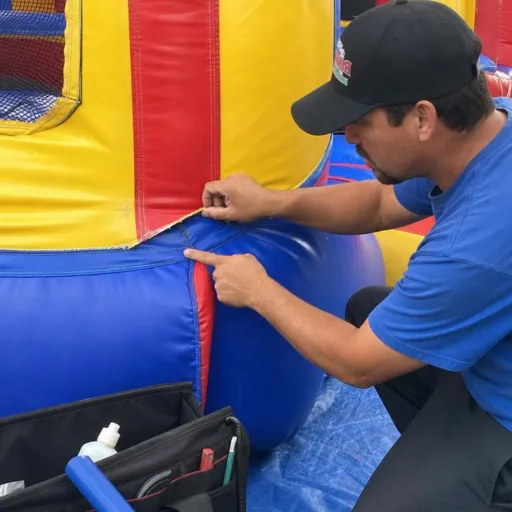
The repair ledger is where 15 oz and 18 oz diverge most sharply. A seam split on 15 oz material typically means a re-stitch plus re-weld, which runs around $500 and takes the unit out of service. A surface tear on 18 oz PVC is usually a patch job at $50 or less, often completed the same day.
Tyler runs a festival rental operation in Texas and keeps a running repair ledger. In 2025 his 15 oz units averaged three times the repair spend per unit of his 18 oz units, and more than half of that was labor and downtime, not materials. Operators who track these numbers end up in the same place: heavier commercial fabric, fewer interruptions.
Unit Weight, Handling & Setup
This is the honest reason to choose 15 oz. The lighter grade folds smaller, stores in less space, and can be handled by one or two people. 18 oz units are heavier, need a crew for setup, and take up more transport and storage capacity. For a fleet that moves units constantly, that handling difference is real and measurable.
The decision is a tradeoff, not a preference. 15 oz wins on logistics; 18 oz wins on every durability and cost metric. Matching the weight to the duty cycle is what separates a smart buyer from a repeat buyer—especially when planning a new inflatable castle product. Contact us to source tarpaulin fabric engineered for repeated inflation, outdoor use, and demanding production conditions.
Total Cost of Ownership
Over five years, 18 oz costs 25-40% less than 15 oz once repairs and the mid-life replacement are included. The 18 oz unit costs roughly 12% more upfront, but that premium is recovered within 18-24 months of commercial operation through fewer repairs, less downtime, and no forced replacement in year three.
Run the math on your own numbers: annual repair spend, average repair cost, and how many weekends a unit is out of service. Most operators find 15 oz looks cheaper for the first year and more expensive by year two. For the full cost model and a worked example, read our guide to how a commercial bounce house is constructed and the factors that drive its lifespan.
When 15 oz PVC Vinyl Is the Right Choice
15 oz is the right material for a specific set of conditions, and being honest about them helps you specify it deliberately rather than accept it accidentally.
- Backyard and occasional use: Units that see a handful of events a year, not a weekly rental rotation.
- One-time events and indoor displays: Short duty cycles where portability and setup speed matter more than years of service.
- Frequent moving: If units are transported and stored constantly, the lighter weight and smaller fold are genuine advantages.
- Budget-constrained purchases: A 15 oz unit can make sense when it’s specified as 15 oz and priced as 15 oz, with the shorter lifespan factored into the decision.
The risk is not choosing 15 oz knowingly. The risk is paying 18 oz prices for material that is really 12-15 oz. If you decide on 15 oz, specify it clearly and make sure the invoice matches the spec sheet.
When 18 oz PVC Vinyl Is Worth the Investment
18 oz is the right choice for any operation where a unit’s job is to earn money on a schedule: commercial rental fleets, festivals, schools, churches, dual-lane slides, and high-traffic venues.
Tie the decision to your own expectations. An 18 oz unit that sees 30-50 rentals a year should survive 3-5 seasons before major maintenance, which keeps it insurable and bankable. Many commercial insurance underwriters look for material in the 18-22 oz range on units used for hire. If a unit’s income depends on it being available every weekend, 18 oz is the floor, not the premium.
When to go heavier: water slide surfaces, high-abrasion zones, and wet/dry units warrant 20 oz (650 gsm, 6-8 year lifespan). High-stress areas such as slide beds and center layers are often reinforced with 22 oz (750 gsm) or 28 oz (950 gsm) panels. If your design calls for those zones, specify the reinforcement as part of the build rather than hoping the base fabric carries the load.
From PVC-coated fabric to customized inflatable castle materials, contact us for tailored fabric options based on strength, flexibility, and weather resistance.
How to Verify You’re Actually Getting 18 oz PVC
A significant share of imported bounce houses is advertised as 18 oz and ships with material closer to 12-15 oz. The weight is measurable, and so is the deception, but only if you ask the right questions before you order. Here is the checklist we give buyers who want to confirm the real spec.
- Request the material spec sheet. It should state weight in oz/yd² and gsm, plus thickness in mm. A weight with no unit is not a spec.
- Check the scrim. Commercial 18 oz uses a 1000D × 23×23 high-tenacity polyester weave. Avoid asymmetric 1000D × 500D weaves, which are weaker in one direction.
- Ask for the test report. Demand measured tensile and tear values from a recognized method such as ASTM D751 or EN ISO 1421, not a marketing claim.
- Confirm fire certification. NFPA 701 or CPAI-84 compliance should come with a certificate number you can trace. See the NFPA standard for the test method.
- Confirm chemical compliance. Lead-free, phthalate-free material meeting CPSIA, REACH, or EN 71-3 is the baseline for children’s equipment.
- Weigh a sample if you can. A roll of material can be weighed in minutes, and the oz/yd² figure follows directly from that.
- Treat “commercial grade” with no numbers as a red flag. The label is meaningless without the data behind it.
Raj learned this the hard way. He ordered 20 units of “18 oz commercial vinyl” from a marketplace supplier and trusted the listing. When a spec sheet finally arrived after three weeks of email, the material was listed at 14.5 oz. The units were not 18 oz, were never going to pass a compliance audit, and had to be replaced before his first season. The verification step would have caught it before the money moved. Our bounce house fabric guide walks through the same checks in detail, and this inflatable spec sheet guide from a fellow manufacturer explains each number on the document.
Safety Standards for Bounce House PVC Material
Material weight supports compliance, and compliance is what keeps a commercial unit legal and insurable. The relevant standards cover structure, flame resistance, and chemical safety.
- ASTM F2374: The US standard for the design, manufacture, operation, and maintenance of inflatable amusement devices. See the ASTM F2374-22 standard for the full scope.
- EN 14960: The European standard for inflatable play equipment.
- NFPA 701: The fire-retardancy test for textiles used in public spaces.
- CPSIA / REACH / EN 71-3: Chemical limits covering lead, phthalates, and other restricted substances.
Weight supports structural compliance because tensile and tear minimums protect against seam rupture at peak load. A 15 oz fabric and an 18 oz fabric can both meet a nominal standard, but the margin between the spec sheet and the field failure is wider on the heavier grade. Buyers should ask for third-party test reports from recognized labs such as SGS, Intertek, or TÜV SÜD, and treat “certified” without a report as a claim, not a fact.
FAQ: 15 oz vs 18 oz PVC Vinyl for Bounce Houses
Is 15 oz or 18 oz vinyl better for bounce houses?
For commercial use, 18 oz vinyl is better: it lasts 5-7 years versus 2-3 years for 15 oz, repairs far less often, and costs 25-40% less over five years including repairs. 15 oz is acceptable only for light-duty, occasional, or budget-first use where portability outweighs durability.
How long does an 18 oz PVC bounce house last?
An 18 oz PVC bounce house typically lasts 5-7 years under regular commercial rental use, compared with 2-3 years for a 15 oz unit and 6-8 years for 20 oz material. Actual lifespan depends on usage frequency, care, and how the unit is stored.
What does “oz” mean in bounce house fabric?
“Oz” is a weight per area: ounces per square yard (oz/yd²), the traditional way commercial PVC-coated tarpaulin is specified. 15 oz is about 510 gsm, and 18 oz is about 610 gsm. Manufacturers outside North America usually quote the same weight in gsm.
How much does bounce house PVC fabric cost?
Commercial PVC inflatable fabric runs roughly $ 6- 8 per square meter for 15 oz, $ 8- 10 for 18 oz, and $10-12 for 20 oz. The heavier weight costs more upfront but lowers total ownership cost through fewer repairs and a longer service life.
Can you repair a 15 oz bounce house?
Yes, but the repairs are more expensive and more frequent. 15 oz material fails about 12-16 times per 10 units per year, and seam splits require re-stitching and re-welding at roughly $500. On 18 oz PVC, most repairs are surface patches costing $50 or less.
Conclusion: 15 oz vs 18 oz PVC Vinyl Bounce House
The 15 oz vs 18 oz PVC vinyl bounce house decision comes down to duty cycle. 18 oz is the commercial baseline: 5-7 year lifespan, far fewer repairs, and 25-40% lower cost over five years. 15 oz is a legitimate light-duty option when portability and upfront price matter more than longevity, provided it is specified honestly and verified on the spec sheet.
Before you buy, verify the weight. Request the spec sheet, check the oz/yd² and GSM, confirm the 1000D scrim, and ask for third-party test values. A supplier who can state those numbers is selling a spec. A supplier who cannot is selling a label.
When you are ready to spec a commercial unit, our engineering team supplies certified 15 oz, 18 oz, and 20 oz PVC inflatable fabric. Start with our commercial PVC inflatable fabric range, or request a sample order and specification sheet. If your design needs a custom weight, coating, or reinforcement, our custom tarpaulin manufacturing team will build to your exact operational requirements. The right weight, specified correctly, is the difference between a unit that earns for years and one that fails on a Saturday morning.