
What Are Bounce Houses Made Of? The Complete Material & Build Guide
Commercial bounce houses are made of PVC tarpaulin: a polyester scrim sandwiched between two layers of PVC coating, weighing about 18 oz (0.55 mm, roughly 610 gsm). Residential units use lighter nylon or Oxford cloth. The material choice decides how long a unit lasts, how safe it stays, and how much it costs to repair.
Marcus found that out the hard way. He bought three “commercial grade” bounce houses from an online marketplace for his new rental business in Phoenix, at half the price the established suppliers quoted. By the third weekend, a seam on the jump floor split open during a five-year-old’s birthday party.
The invoice said 18 oz PVC. The material that failed was closer to 15 oz, and the stitching had carried a load the fabric was never engineered to hold.
The answer to what are bounce houses made of matters more than most buyers realize, because the fabric is the safety system, the product, and the single biggest cost driver rolled into one. We manufacture PVC-coated technical fabrics for inflatable makers, marine suppliers, and industrial buyers in more than a dozen countries. This guide explains the material science in plain numbers, walks through every component, and shows you how to verify what a supplier is actually selling, with the deeper spec detail in our bounce house fabric guide. No fluff, no marketing claims. Just the spec sheet you should have had before your first order.
Key Takeaways
- Commercial bounce houses are made of 18 oz (0.55 mm / ~610 gsm) PVC tarpaulin over a 1000D polyester scrim; anything under 500 gsm labeled “commercial” is really residential-grade material.
- Residential bounce houses are made of nylon or Oxford cloth, which are cheaper and lighter but tear more easily and last only 6-18 months of backyard use.
- PVC is roughly 5x stronger than nylon at the point of tear, and about 90% of commercial suppliers build around PVC vinyl.
- Lifespan tracks material grade: 15 oz lasts 2-3 years, 18 oz lasts 5-7 years, and 20 oz+ lasts 6-8 years.
- You can verify what a bounce house is really made of by requesting a spec sheet and checking weight, denier, weave count, and test reports before you buy.
What Are Bounce Houses Made Of? The Three-Layer Construction
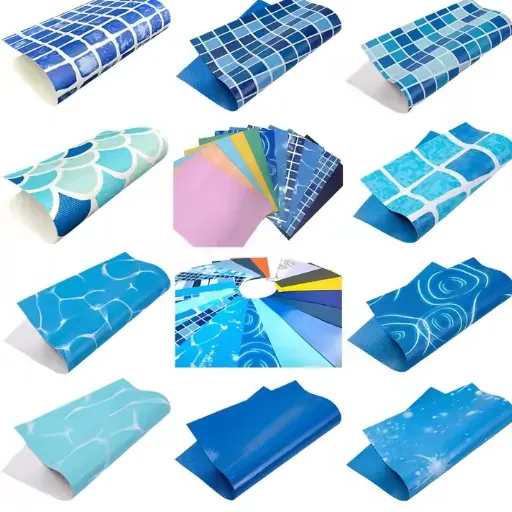
Every commercial bounce house fabric is a composite built from three layers bonded into one material. Understanding this construction answers the core question directly: bounce houses are not made of a single sheet of plastic. They are made of a woven cloth core wrapped in PVC on both sides.
The Polyester Scrim (Load-Bearing Core)
The middle layer is a woven polyester base cloth, called the scrim. This is the load-bearing skeleton: when a tear starts, the scrim stops it from spreading. The scrim is specified by denier and weave count. Denier measures yarn thickness; weave count measures yarns per inch in each direction.
For commercial bounce houses, the industry standard is a 1000D scrim with a 23 x 23 weave. A 1000D x 20 x 20 weave is the minimum we recommend. Premium water slides and obstacle courses move up to 1000D x 30 x 30 or 1100D x 30 x 30.
Cheap units often use a 1000D x 500D asymmetric weave, where the load grid is weaker in one direction. If a supplier can’t tell you the denier and weave count, that is a red flag.
The PVC Coatings (Airtight, Waterproof, Printable)
The scrim is sandwiched between two layers of PVC coating. These outer layers do three jobs: airtightness, waterproofing, and a printable, weldable surface.
The airtight seal lets a blower hold pressure efficiently. Waterproofing matters because the polyester core absorbs moisture on its own. And the printable surface carries the graphics while the weldable surface joins the seams.
The coating also carries the plasticizer system. Standard tarpaulin PVC cracks after hundreds of fold-and-inflate cycles in cold weather. Bounce house fabric uses cold-flexible formulations so the unit survives those cycles without the coating splitting.
Why the Layers Matter
Here is the key insight most buyers miss: two fabrics can both be labeled 18 oz and perform completely differently. A heavy scrim with a thin coating tears differently than a lighter scrim with more coating, even at the same total weight. That is why this article, and our complete manufacturer’s guide to bounce house fabric, always push you to read the full construction details, not just the weight.
Bounce House Materials by Grade
Not all bounce house fabric is the same, and knowing the grades is the fastest way to match a material to a use case. The table below breaks down the four main tiers by weight, lifespan, and intended use.
| Material | Construction | Lifespan | Typical Use | Approx. Cost Signal |
|---|---|---|---|---|
| Nylon / Oxford cloth | 420D-840D woven | 6-18 months | Residential backyard units | Lowest upfront, frequent replacement |
| 15 oz PVC | ~510 gsm, light scrim | 2-3 years | Light commercial, promotions | Low upfront, high repair rate |
| 18 oz PVC | 0.55 mm / ~610 gsm, 1000D | 5-7 years | Standard commercial, industry baseline | Mid upfront, lowest total cost |
| 20 oz+ PVC | 0.60 mm+ / ~650-1,000 gsm | 6-8 years | Water slides, obstacle courses | Highest upfront, heavy duty |
Residential: Nylon and Oxford Cloth
The cheapest bounce houses, the kind sold for backyard birthdays, are made of nylon or Oxford cloth. These fabrics are lighter and cheaper than PVC, which keeps the unit easy to store and the price low.
Priya learned the tradeoff when she bought a $220 backyard unit for her kids. It bounced fine all summer, but by spring the jump floor had a six-inch tear where a neighbor’s son kept landing on his knees. Nylon has no coating layer to weld a patch over cleanly, so a tear like that means a whole new unit.
Commercial: The 18 oz PVC Baseline
Commercial bounce house material is almost always 18 oz PVC tarpaulin. This is the industry baseline because it sits at the sweet spot between durability and manageability. An 18 oz unit is heavy enough to shrug off years of rental abuse, yet light enough for two people to set up. Our engineering team specifies 18 oz PVC over a 1000D scrim as the starting point for rental units, because that is where durability, repairability, and manageable unit weight intersect.
Premium: 20 oz and Up
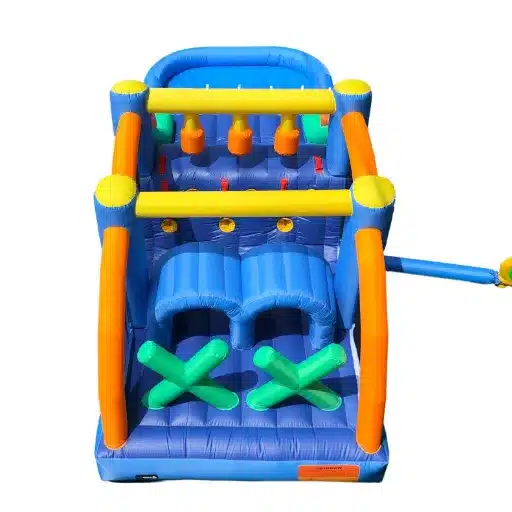
Water slides, obstacle courses, and other high-stress inflatables step up to 20 oz or heavier, up to 30 oz for heavy-load slides. The extra weight buys tear resistance at the cost of units that are harder to transport.
Ready to source inflatable castle tarpaulin fabric directly from a manufacturer? Contact us with your requirements and get a customized solution for your next order.
PVC Tarpaulin vs Nylon vs Oxford: Which Is Better?
For commercial use, PVC tarpaulin wins on nearly every metric that matters. The comparison below shows why about 90% of commercial suppliers build around PVC vinyl.
| Property | PVC Tarpaulin | Nylon | Oxford Cloth |
|---|---|---|---|
| Tear strength | ~5x nylon at point of tear | Moderate | Low |
| Water resistance | Fully waterproof, coated | Absorbs moisture | Absorbs moisture |
| Seam construction | Hot-air + RF welded, airtight | Stitched only | Stitched only |
| Repairability | PVC patch in minutes | Difficult to patch | Difficult to patch |
| UV resistance | Excellent with UV inhibitors | Fair | Poor |
| Cost per setup | ~$3.10 | ~$14.50-22.50 (4.7-7.3x more) | Lowest but fails fastest |
The economics are decisive. Nylon might look cheaper on the invoice, but spread across the setups a unit survives, PVC costs a fraction per event. A PVC unit also repays its upfront price through lower repair bills and fewer replacements, which we quantify below.
If you are comparing PVC against a non-PVC alternative for a specific application, our PVC vs TPU comparison for inflatable fabric covers the other engineered option you might encounter.
Every Component Inside a Bounce House
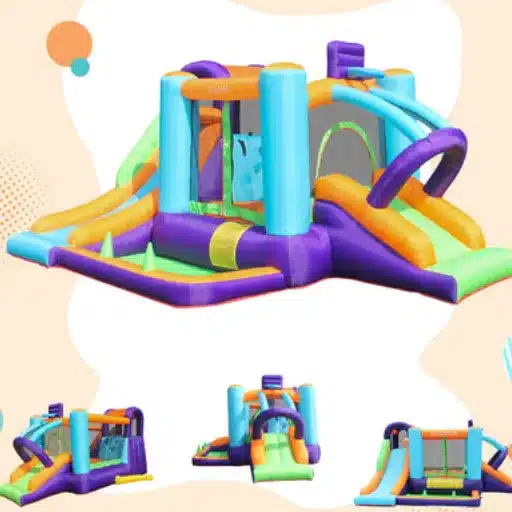
A bounce house is more than a sheet of fabric. A complete unit is a bill of materials, and each component is made from a different material tuned for its job.
- Bounce surface and walls: The same 18 oz PVC tarpaulin as the rest of the unit. The jump floor takes the most abuse, which is why some builders add a wear layer.
- Seams: Double-stitched lap seams, then hot-air welded and high-frequency welded for air retention. Welded beats stitched alone because welding fuses the PVC coatings into one continuous material, while stitching alone leaves needle holes that leak air and pull apart under load.
- Internal baffles: The dividing walls inside the bounce chamber, made from the same 1000D material. They prevent the unit from distorting into a single balloon shape and keep it stable under load.
- Mesh windows: Ripstop netting that lets air escape and parents see inside while keeping fingers out.
- Thread and webbing: Seams are sewn with TEX 90 or TEX 135 bonded polyester thread, chosen for UV and rot resistance. The 2-inch anchor webbing is tested to a 6,000 lb break strength.
- D-rings and anchors: Welded stainless steel D-rings, each pull-tested to a 200 lb minimum, that secure the unit against wind and tipping.
- Blower: The air supply, matched to the unit’s volume. The blower’s CFM rating determines inflation speed and pressure hold.
Ready to source inflatable castle tarpaulin fabric directly from a manufacturer? Contact us with your requirements and get a customized solution for your next order.
How Bounce Houses Are Made (Manufacturing Process)
Understanding the build process explains why material grade is only half the story. Good fabric in careful hands passes every test; the same fabric handled sloppily fails early.
- CAD patterning: The design is drafted in CAD and cut into 40-60 individual panels for a standard bounce house. Large obstacle courses can exceed 200 panels.
- CNC cutting: Panels are cut by CNC machine to ±1 mm, so every piece fits its neighbor.
- Double-stitched seams: Panels are joined with double-stitched lap seams using bonded polyester thread.
- Hot-air welding: Structural seams are sealed with hot-air welding at 480-520°C, fusing the PVC coatings together.
- HF welding: Air-retention seams are sealed with high-frequency welding at 27.12 MHz, creating the airtight bond that stitching cannot provide.
- Baffle installation: Internal baffles are welded in to control airflow and shape.
- Inflation test: The finished unit is inflated and tested. A properly constructed bounce house holds shape with less than 10% pressure loss over 15 minutes with the blower off.
- Printing and QC: Graphics are digitally printed onto the fabric, then a final quality control pass checks every seam, weld, and anchor.
[VIDEO EMBED HERE – Editorial note]
Place a relevant manufacturing or material-demo video here. Preferred: LY TRUSTLINK’s own production footage (coating line, RF welding, or QC testing). Alternative: an authoritative third-party explainer on how inflatable bounce houses are made or how PVC inflatable fabric is welded. Ensure the video is embedded from YouTube with a descriptive title and captions.
Why the Material Choice Matters: Safety, Lifespan & Repairs
The material a bounce house is made of directly drives safety compliance, lifespan, and repair cost. These three outcomes are where grade differences show up in real money.
Safety Standards the Material Must Meet
A bounce house fabric that meets international standards is engineered to do so from the coating formulation up. Look for documentation on these standards before you buy:
- ASTM F2374: The US standard for inflatable amusement devices.
- EN 14960: The European standard for inflatable play equipment.
- NFPA 701: Fire-retardancy testing for textiles used in public spaces.
- CPAI-84: The flame-resistance standard for tents and awnings.
- CPSIA and REACH: Chemical-compliance regulations covering lead, phthalates, and other restricted substances, with limits set by the ASTM and EU frameworks.
Fire resistance is built into the PVC coating, not sprayed on top. A properly formulated coating passes flame testing and holds up to UV exposure. Chemical safety matters just as much, because kids spend hours in direct contact with the fabric. Lead-free and phthalate-free PVC should be a baseline, and the test report should be verifiable, not just claimed.
The 500 GSM Red Line
Here is a practical rule that catches most under-spec units. Commercial-grade PVC tarpaulin ranges from about 550 to 1,100 g/m² (16-32 oz). Anything under 500 gsm is residential-grade material, even if it is labeled “commercial” or “heavy duty.”
If a spec sheet shows 450 gsm but the marketing copy says commercial grade, trust the number, not the label. This inflatable fabric weight guide walks through the same gsm ranges from a manufacturer’s perspective.
Repair Economics
The grade difference shows up in repair incidents, which is the number that hits a rental operator’s bank account. Based on industry repair data across rental fleets:
- 15 oz material: 2-3 year lifespan, roughly 12-16 repair incidents per 10 units per year.
- 18 oz material: 5-7 year lifespan, roughly 3-5 repair incidents per 10 units per year.
- 20 oz material: 6-8 year lifespan, roughly 2-4 repair incidents per 10 units per year.
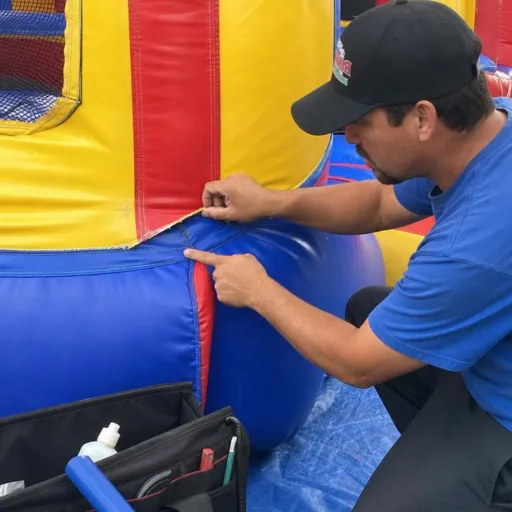
The repair economics favor the heavier fabric. A seam split on 15 oz material means re-stitching and re-welding, plus the lost booking revenue while the unit is down. On 18 oz PVC, many repairs are simple: apply a PVC patch in minutes, let it cure, and the unit is back in service the same day. That is the difference between a 50 fixanda 500 rebuild.
This is where Marcus’s story turns around. After the split weekend, he replaced the fleet with 18 oz PVC units from a supplier who sent real spec sheets. Five years later, those same units were still on his schedule. The three “deals” from the marketplace were gone within one season, replaced by units that paid for themselves many times over.
How to Verify What a Bounce House Is Really Made Of
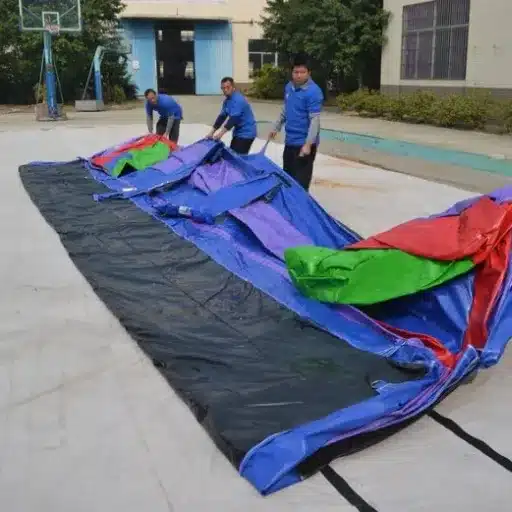
You don’t have to trust a seller’s word, and you shouldn’t. Every claim about what a bounce house is made of should survive a two-minute check of the spec sheet. Here is the checklist we give every buyer:
- Stated weight: Weight in oz/yd² or g/m². Commercial should be 16 oz (550 gsm) or higher; 18 oz is the baseline.
- Scrim details: Denier (1000D minimum for commercial) and weave count (20 x 20 minimum, 23 x 23 standard).
- Coating type: PVC with cold-flex plasticizers, plus UV inhibitors.
- Seam construction: Double-stitched and welded, not stitched only.
- Test values: Tear strength, tensile strength, and flame test numbers, not just “fire resistant.”
- Certifications: ASTM F2374, EN 14960, NFPA 701, CPSIA, and REACH documentation.
Red flags are just as useful. No stated weight means no spec. “Commercial grade” with no data is marketing language.
A supplier who refuses to share test reports has a reason to hide them. And if a unit is labeled 18 oz but the supplier can’t state the scrim construction, treat the weight claim as unverified.
Our PVC inflatable fabric specifications guide breaks down each spec number and test method in detail, so you can read a spec sheet the way an engineer would.
FAQ: What Are Bounce Houses Made Of?
Are bounce houses made of PVC?
Yes, commercial bounce houses are made of PVC tarpaulin, a polyester scrim coated on both sides with PVC, usually 18 oz. Residential backyard units are more likely to be made of nylon or Oxford cloth.
What is the best material for a bounce house?
For commercial use, 18 oz PVC tarpaulin over a 1000D polyester scrim is the best all-around choice, balancing durability, repairability, and manageable weight. For a low-cost backyard unit, heavier Oxford cloth is a reasonable budget choice, with the understanding that it won’t last as long.
How long do bounce houses last?
Lifespan tracks material grade: 15 oz PVC lasts about 2-3 years, 18 oz PVC lasts 5-7 years, and 20 oz+ material lasts 6-8 years. Residential nylon and Oxford units typically last 6-18 months.
Is the material safe for kids?
It is safe when the fabric meets the relevant standards. Demand ASTM F2374 and EN 14960 compliance for structural safety, NFPA 701 or CPAI-84 for flame resistance, and CPSIA and REACH compliance for chemical safety. Lead-free, phthalate-free PVC is the baseline.
How are seams joined in a bounce house?
Seams are double-stitched with bonded polyester thread, then sealed with hot-air welding at 480-520°C and high-frequency welding at 27.12 MHz for air retention. Welding fuses the PVC coatings into one continuous material, which is why welded seams outperform stitched-only seams.
Conclusion: What Are Bounce Houses Made Of?
What are bounce houses made of? Commercial units are made of 18 oz PVC tarpaulin over a 1000D polyester scrim, and residential units are made of lighter nylon or Oxford cloth. The material choice drives everything downstream: whether the unit survives a rental season, whether it passes safety testing, and whether a tear costs 50 or 500 to fix.
Before you buy, ask for the spec sheet and check the numbers against the checklist above. If a supplier can state the weight, denier, weave count, and test values, you know what you’re getting. If they can’t, walk away.
When you’re ready to spec a commercial unit, talk to an engineer. Our team manufactures PVC inflatable fabric in commercial grades from 16 oz to 30 oz, and we’ll help you match the material to your actual duty cycle.
Start with our commercial PVC inflatable fabric range, or reach out about a custom tarpaulin manufacturing project. The right material, specified correctly, is the difference between a unit that earns for years and one that fails on a Saturday morning.