
Lead Free PVC Fabric for Inflatables: CPSIA & REACH Guide
Lead-free PVC fabric for inflatables is PVC-coated polyester formulated without lead-based heat stabilizers or lead-bearing pigments, so it tests under the 100 ppm total lead limit of the US CPSIA and the 0.1 percent lead threshold of the EU REACH restriction. In practice, “lead-free” also means a plasticizer system that keeps eight regulated phthalates at or below 0.1 percent each. That phthalate list is what actually triggers most inflatable product recalls.
We manufacture and batch-test commercial PVC inflatable fabric, and this guide is the compliance briefing we hand to importers, OEM buyers, and rental operators before they order roll goods. You’ll learn what the label “lead-free” really covers, why lead gets into PVC in the first place, the exact limits across US, EU, and California rules, and how to verify a supplier’s claim with a test report instead of a brochure.
Key Takeaways
- Lead-free PVC is about the stabilizer system, not just the pigment: calcium-zinc, organotin, or organic-based stabilizers replace lead compounds in the formulation.
- US CPSIA sets a 100 ppm total lead limit for accessible substrate, 90 ppm for paint, and caps each of 8 regulated phthalates at 0.1 percent (1,000 ppm).
- The EU REACH restriction (Regulation (EU) 2023/923) bans PVC containing 0.1 percent lead by weight from the EU market, in force since November 29, 2024.
- Phthalate exceedances drove 41 percent of CPSC recalls in 2022, and inflatables are a high-risk category because soft PVC relies on plasticizers.
- Never accept a certificate in place of a batch-specific third-party test report from an accredited lab such as SGS, Intertek, or TUV.
What Does “Lead-Free PVC Fabric” Actually Mean?
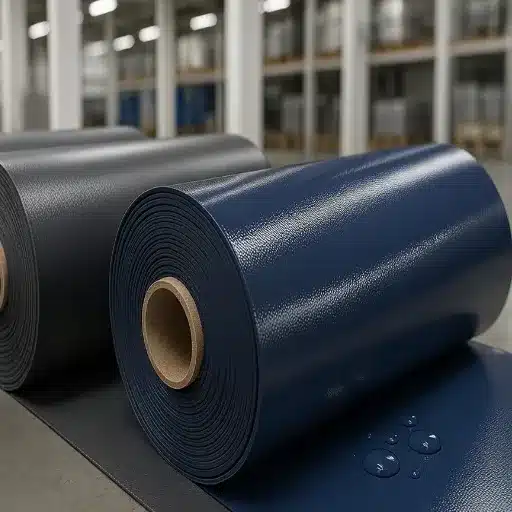
Lead-free PVC fabric is a PVC-coated or PVC-laminated textile in which the polymer formulation uses no lead-based stabilizers, no lead-bearing pigments, and plasticizers that do not introduce regulated heavy metals. The claim is defined by what the finished material measures, not by an ingredient list. A fabric is lead-free in practice when an accredited lab test shows total lead below the regulatory limit for the market it will be sold into.
The reason this matters for inflatables is specific. Bounce houses, inflatable castles, swim rings, and water slides are children’s products in most markets, and children’s products are the one category where lead and phthalate chemistry is legally regulated rather than simply discouraged. When a buyer sees “lead-free PVC” on a supplier’s listing, the question is never whether the phrase is true in spirit. The question is whether the material has been tested against a recognized limit and documented to a batch.
The commercial baseline for the fabric underneath the claim is well established: 18 oz (about 610 gsm) PVC at 0.55 mm over a 1000D high-tenacity polyester scrim, welded into units with heat or high-frequency seams. That material stack is what we cover in detail in our PVC inflatable fabric specifications guide, and it’s the grade a compliant lead-free formulation is built on.
Why Is Lead in PVC in the First Place?
Lead is not a contaminant that occasionally shows up in PVC. For decades it was a deliberate ingredient. Raw PVC resin is thermally unstable: when it is heated during processing, it begins to release hydrogen chloride gas, which accelerates further decomposition, discoloration, and loss of mechanical strength. Heat stabilizers neutralize that reaction.
Lead-based stabilizers such as dibasic lead stearate and lead carboxylates were the industry standard because they were cheap, roughly0.50 to 1.00 per pound at typical loading, and because they delivered long-term thermal stability, in some comparative tests staying intact past 160 minutes at 180°C versus roughly 130 to 140 minutes for early calcium-zinc systems.
The processing advantages explain the history. The health and environmental record explains the phase-out. Lead is a developmental neurotoxin, and its accumulation in children’s bodies from repeated exposure is exactly why children’s products got the strictest limits first. The EU industry voluntarily stopped using lead stabilizers in PVC by 2015. Regulators then closed the gap for imported and recycled material, which is how we ended up with the current restriction landscape.
The replacements are well proven. Calcium-zinc (Ca/Zn) stabilizer systems are now the dominant lead-free choice, valued at $1.34 billion globally in 2024 and projected to reach $1.89 billion by 2032. Organotin and organic-based (OBS) systems cover applications that need different thermal windows. None of these are exotic; they are the standard in every serious inflatable fabric plant, and the engineering trade-off is in the formulation, not the feasibility. Contact us with your requirements and get a customized solution for your next order.
| Stabilizer system | Lead status | Thermal profile | Where it is used |
|---|---|---|---|
| Lead-based (dibasic lead stearate, lead carboxylates) | Banned for children’s products; restricted by REACH | Strong long-term heat stability; the historical benchmark | Legacy products and recycled PVC only |
| Calcium-zinc (Ca/Zn) | Lead-free | Good initial color hold; modern packages close most of the thermal-stability gap | Default for inflatable fabric |
| Organotin | Lead-free | Wide processing window | Formulations needing broader heat tolerance |
| Organic-based (OBS) | Lead-free | Metal-free alternative chemistry | Specialty and high-clarity compounds |
CPSIA Lead & Phthalate Limits: US Compliance for Children’s Products
In the United States, the Consumer Product Safety Improvement Act (CPSIA) governs the chemistry of children’s products, defined as products intended primarily for children 12 and under. Bounce houses and most inflatable play equipment fall squarely in that category. The two numbers that matter are the lead limit and the phthalate limit.
Lead. Total lead in any accessible part of a children’s product must not exceed 100 ppm. Lead in paint or surface coatings is capped at 90 ppm. For an inflatable, “accessible” includes the surfaces a child touches, climbs on, and mouths, which means the fabric itself is the tested component.
Phthalates. Eight phthalates are permanently restricted in children’s toys and child care articles, each capped at 0.1 percent (1,000 ppm): DEHP, DBP, BBP, DINP, DIBP, DPENP, DHEXP, and DCHP. This is an eight-phthalate list, which is why buyers sometimes see “8P” on certification documents. The 0.1 percent limit is per phthalate, not a combined total, and it’s the single most common cause of inflatable recalls.
| Substance | US CPSIA Limit | Test Method |
|---|---|---|
| Total lead (accessible substrate) | 100 ppm | 16 CFR 1303 / CPSC-CH-E1002 |
| Lead in paint / surface coating | 90 ppm | 16 CFR 1303 |
| Each regulated phthalate (8 total) | 0.1% (1,000 ppm) | CPSC-CH-C1001.09.3 |
Compliance is not self-declared. Children’s products must be tested by a CPSC-accepted, ISO/IEC 17025-accredited laboratory, and the importer or manufacturer must issue a Children’s Product Certificate (CPC) that identifies the applicable rules and the test results behind them. Since July 8, 2026, imported CPSC-regulated products must also have their certificates filed electronically through the Automated Commercial Environment; importers who skip the filing face holds at the port of entry. A fabric supplier that cannot produce a batch-specific report tied to a CPC is not offering you compliance, only a label. Send us your specifications and let our team recommend a suitable tarpaulin solution.
REACH & EN 71: EU Compliance and the New Lead-in-PVC Restriction
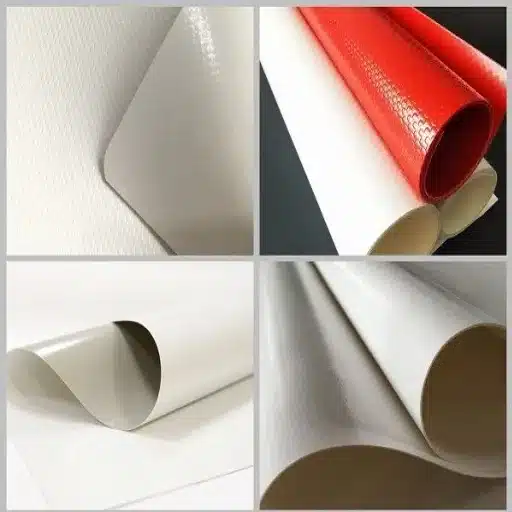
Europe takes a different approach, and it is the approach that changed in late 2024. Under the REACH regulation, the EU adopted Regulation (EU) 2023/923, which amended entry 63 of Annex XVII to ban PVC articles containing lead at or above 0.1 percent by weight of the PVC material from being placed on the EU market. The restriction entered into force on November 29, 2024. It applies to newly manufactured, imported, and recycled PVC alike, with limited transition periods for recovered material.
The practical effect for exporters is direct. If you ship inflatable fabric or finished inflatables into the EU, the PVC in those products must measure below 0.1 percent lead by weight, and you’ll need the test documentation to prove it. Recovered flexible PVC was allowed at up to 1.5 percent lead only until May 28, 2025. Specific articles made with recovered rigid PVC can continue under a narrower exemption until May 28, 2033, provided the lead content stays under 1.5 percent and the article is labeled “contains lead ≥0.1%.” For new, non-recycled material, which is what inflatable fabric should be, the 0.1 percent limit applies immediately.
Chemical compliance in the EU also runs through the toy framework. EN 71-3 sets migration limits for heavy metals, including lead and cadmium, in toy materials, and inflatable play equipment sold in Europe is further covered by EN 14960 for structural safety. The Toy Safety Directive 2009/48/EC is the legal hook that makes those tests enforceable. Between them, REACH for the substance, EN 71-3 for migration, and EN 14960 for the finished unit, a European buyer has a full compliance chain, and every link traces back to the raw material. We explain how those structural standards fit together in our guide to bounce house safety standards.
California Prop 65: The Warning-Label Risk Most Buyers Miss
California’s Proposition 65 is separate from federal CPSIA, and it is the rule that catches operators who assume a CPC is enough. Prop 65 requires businesses to warn consumers before knowingly exposing them to listed chemicals, including lead, at levels above defined safe-harbor thresholds. For a rental operator running inflatables in California, the exposure question is real: a fabric that passes CPSIA’s 100 ppm substrate limit can still, in some product configurations, trigger a Prop 65 warning requirement because the safe-harbor thresholds for lead exposure are calculated differently.
The standard workaround is not a warning label. It’s a material decision. Operators and manufacturers who want to avoid the warning requirement entirely mandate 100 percent lead-free, phthalate-free PVC, typically 0.55 mm commercial grade, so the equipment tests below the thresholds in the first place. They pair that material mandate with a traceable third-party audit trail, storage and cleaning protocols that prevent cross-contamination, and an indemnification clause in the supplier contract that covers legal defense if a material defect ever produces a claim.
The lesson transfers to any compliance-sensitive market. The cheapest way to pass any chemical rule is to specify the compliant material at the start, because retesting, relabeling, or defending a recall after the fact costs multiples of the material premium. If you are sourcing roll goods rather than finished units, our guide to wholesale bounce house fabric walks through what to put on the RFQ so the compliance conversation happens before the order, not after it.
How Lead-Free & Phthalate-Free PVC Is Manufactured
A compliant formulation is built, not declared. This is the part of the industry that marketing pages skip, and it’s the reason two rolls of PVC that look identical can test very differently. There are four levers in the manufacturing process, and a supplier who can name them can usually document them.
Stabilizer system. Calcium-zinc is the default lead-free stabilizer. It provides good initial color hold and weatherability, and modern Ca/Zn packages close most of the thermal-stability gap that older comparisons showed. Organotin and organic-based systems are used where the application demands a wider processing window. The choice determines whether the compound survives the heat of coating, lamination, and high-frequency welding without degrading, which is exactly the failure a stabilizer is meant to prevent.
Plasticizer system. Plasticizers make PVC flexible, and standard flexible PVC uses phthalate plasticizers. The compliant route uses non-phthalate plasticizers such as DOTP (dioctyl terephthalate), or phthalate systems restricted to the permitted list at concentrations under the 0.1 percent cap. This is where the 8P, 6P, and 3P certifications come from: 3P covers DEHP, DBP, and BBP; 6P adds DINP, DIDP, and DNOP; the current US list of 8 adds DIBP, DPENP, DHEXP, and DCHP. A formulation aimed at the full US list targets all eight.
Pigment system. Colorants can carry heavy metals, so compliant fabric uses heavy-metal-free pigments, with compliant suppliers quoting total heavy metals under 100 ppm. The color you specify should not be the ingredient that breaks your test.
Production control. This is the quiet differentiator. A plant that runs standard PVC compound on the same lines as its lead-free product risks cross-contamination, which is why serious manufacturers run lead-free formulations on dedicated or segregated lines and test every batch against the specification. Batch-specific lab testing and full traceability are what turn a formulation claim into a defensible certificate. We run our coating and lamination lines this way, and it is the process our custom fabric manufacturing capability is built around for OEM and ODM projects.
The test methods that back all of this are standardized: CPSC-CH-C1001.09.3 for phthalates in vinyl, 16 CFR 1303 and CPSC-CH-E1002 for lead, EN 71-3 for heavy-metal migration, and ISO 8124 for toy safety where applicable. When a supplier hands you a report, those method numbers on the document tell you the test was run the way the regulator expects.
How to Verify a Supplier’s Lead-Free Claim
A test report is the evidence; a certificate is the summary. The gap between the two is where unverified “lead-free” claims live, and it is the gap this checklist closes.
- Ask for the batch-specific test report, not the certificate. The report should name the exact production batch or lot and show measured values, not just a pass/fail line.
- Check the issuing lab. It should be an accredited third party, such as SGS, Intertek, or TUV, working to ISO/IEC 17025. A manufacturer’s own in-house test is useful, but it isn’t independent verification.
- Read the numbers against the limit. Confirm the measured lead is under 100 ppm and each phthalate species is under 0.1 percent. A report that lists DEHP only, when your market requires all eight, is incomplete.
- Verify the test method and the standard edition. The method numbers should be the ones the regulator recognizes, and the standard referenced should be the current edition for your market.
- Confirm the report maps to the shipment. A report from last year for a different product line does not certify this roll. The lot number on the report should match the lot on the goods.
- Get the retest commitment in writing. Formulation changes, pigment changes, or a new plasticizer supplier can change results. Your contract should require a new test when the formula changes.
The scenario that should make every buyer read this twice is the one we see regularly at trade shows. An importer compares two quotes: $1.80 per square meter for “eco-friendly PVC” with a certificate PDF, and $2.10 per square meter for a documented lead-free lot with batch reports. The cheaper roll often turns out to be standard PVC compound with recycled content, and the “certificate” is a one-page template. By the time the third-party test flags it, the fabric is cut, welded, and on a truck. The $0.30 per square meter saving becomes a full production run thrown away, plus the cost of the recall that follows.
This is also where the material decision and the compliance decision become the same decision. Commercial-grade PVC built on a clean formulation passes the chemistry, welds cleanly, and holds up to a rental duty cycle. The full grade-by-grade breakdown lives in our bounce house fabric guide, and the sourcing mechanics, including MOQs and supplier verification, are covered in our wholesale bounce house fabric guide.
Ready to spec a compliant material for your next order? Our engineering team manufactures certified lead-free, phthalate-free PVC inflatable fabric and will send production-line samples plus batch test reports before you commit. Request a sample order or talk to an engineer about custom formulations.
Lead-Free PVC Fabric FAQ
Is PVC safe for children’s inflatables?
Yes, when the material is formulated and tested to the applicable limits. A fabric that tests below 100 ppm lead and below 0.1 percent for each regulated phthalate is safe for children’s use. The risk isn’t PVC itself but unverified material that exceeds those limits.
How much lead is allowed in children’s products?
Under CPSIA, total lead in an accessible substrate is capped at 100 ppm, and lead in paint or surface coatings at 90 ppm. In the EU, REACH restricts lead in PVC articles to below 0.1 percent by weight.
What is the difference between 3P, 6P, and 8P phthalate-free?
These refer to how many phthalates a formulation is certified against. 3P covers DEHP, DBP, and BBP. 6P adds DINP, DIDP, and DNOP. 8P covers the current US CPSIA list, adding DIBP, DPENP, DHEXP, and DCHP. For US children’s products, target all eight.
Does REACH ban lead in PVC?
Yes. Regulation (EU) 2023/923, in force since November 29, 2024, prohibits placing PVC articles containing 0.1 percent lead by weight or more on the EU market. Recycled flexible PVC was allowed at up to 1.5 percent only until May 28, 2025.
Is lead-free PVC fabric more expensive?
Modestly, at the raw-material level. The cost premium for lead-free stabilizers and non-phthalate plasticizers is small relative to the cost of a failed test, a held shipment, or a recall. Total cost of ownership favors the compliant material.
How do I test PVC fabric for lead?
Use an accredited third-party lab running the recognized methods: 16 CFR 1303 or CPSC-CH-E1002 for lead content, and CPSC-CH-C1001.09.3 for phthalates. Request the report tied to your specific production batch.
What certifications should inflatable fabric have?
For US children’s products, a Children’s Product Certificate backed by third-party testing to CPSIA lead and phthalate limits. For EU export, REACH compliance and EN 71-3 migration testing, plus EN 14960 for the finished unit. Fire retardancy is separate, under NFPA 701 or the equivalent.
Contact us with your requirements and get a customized solution for your next order.
| Market / rule | Lead limit | What it means for inflatable fabric |
|---|---|---|
| US CPSIA (children’s products) | 100 ppm total; 90 ppm in paint | Substrate batch-tested; Children’s Product Certificate required |
| EU REACH, Regulation (EU) 2023/923 | Under 0.1% lead by weight of PVC | PVC articles above the threshold banned from the EU market |
| EU Toy Safety Directive / EN 71-3 | Heavy-metal migration limits | Applies to toys and many inflatable play products |
| California Prop 65 | Warning triggers from exposure thresholds | Specify lead-free material to avoid the warning label |
Conclusion
Lead-free PVC fabric for inflatables is not a marketing category. It’s a formulation decision, a testing decision, and a documentation decision, and each one is verifiable. The material must be built with lead-free stabilizers and plasticizers that keep eight regulated phthalates under 0.1 percent, tested by an accredited lab against the recognized methods, and documented to a specific batch with a report you can read.
The US CPSIA limits are 100 ppm lead and 0.1 percent per phthalate. The EU REACH restriction, in force since November 29, 2024, bans PVC at or above 0.1 percent lead by weight. California’s Prop 65 adds a warning-label layer that the right material specification eliminates entirely.
The pattern across every market is the same: the compliant material is the durable material, and the durable material is the one a dependable supplier can document. Start with our bounce house fabric guide for the full material stack, or go straight to a conversation with our engineering team. We manufacture certified lead-free, phthalate-free PVC inflatable fabric, test every production batch, and provide the batch reports your compliance process needs. Request a sample order or specification sheet, or talk to an engineer about your custom requirements. The material that passes your tests is the material that stays on your schedule.