
PVC Tarpaulin for Water Slides: Specs, Coatings & Care
PVC tarpaulin for water slides is PVC-coated polyester fabric, normally 18 oz (610 gsm) for standard commercial slides and 20 oz (650 gsm) for premium fleets, built with anti-mildew and UV-stabilized coatings and watertight welded seams so it can run in constant water, pool chemicals, and direct sun. A water slide is the only inflatable that works wet all day, and the material decision decides whether it survives one season or eight.
Here’s the problem buyers hit. Search for “pvc tarpaulin for water slides” and you’ll land on product listings that quote gsm and oz in a bullet and call the material “waterproof, anti-mildew.” None of them explains what constant water actually changes in the coating, the seams, or the care routine. Mold is the leading cause of premature retirement in commercial water-slide fleets, and most operators destroy their own fabric in the cleaning step.
We manufacture and batch-test commercial PVC inflatable fabric, so this guide is the wet-use briefing we hand to rental operators, inflatable OEMs, and water-slide importers. By the end you’ll be able to specify the right commercial grade, understand the coatings and welding that keep water out, and run a care protocol that protects a six-to-eight-year investment.
Key Takeaways
- Commercial water slides standardize on 18 oz (610 gsm) at 0.55 mm; premium fleets use 20 oz (650 gsm) at 0.6 mm over a 1000D polyester scrim.
- Wet-use fabric differs from bounce-house PVC in the coating layer: anti-mildew and anti-bacterial additives, UV stabilizers, and chlorine resistance are what survive pool duty.
- ASTM F2374-24 explicitly covers wet-use and wet/dry inflatable amusement devices (Section 1.1.2), so commercial water slides are in scope.
- Mold is the number-one cause of premature retirement, and bleach or pressure washers above about 1200 PSI destroy the fabric faster than use does.
- Grade economics: 20 oz lasts 6-8 years, 18 oz lasts 5-7, and cheap 15 oz residential fabric can be a false economy that fails in 2-3.
What Is PVC Tarpaulin for Water Slides?
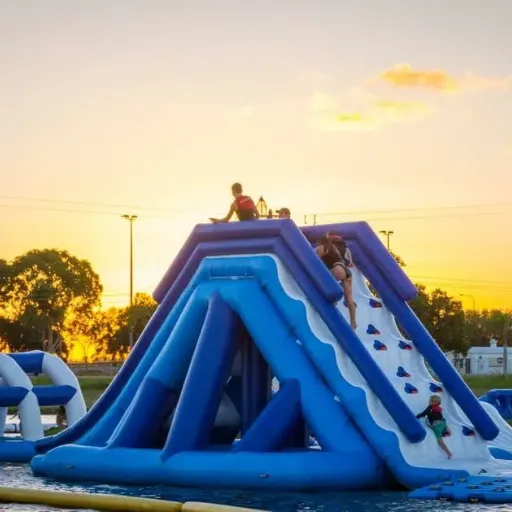
PVC tarpaulin for water slides is a three-layer fabric: a high-tenacity polyester scrim laminated between two layers of flexible PVC. The polyester carries the tensile load, the PVC layers provide waterproofing and surface toughness, and the coating package adds mildew resistance, UV protection, and chemical resistance. Commercial slides use 18 oz (610 gsm) or heavier.
That stack is what separates a water slide from a dry bounce house. A bounce house deals with dry use, friction, and a standing load. A water slide adds four stresses the dry unit never sees: constant water exposure, pool and sanitizer chemicals, sliding contact that scrubs the surface, and the drainage problem of standing water inside a pressurized structure. Each one changes something in the material, and together they change the spec at the coating, the seam, and the care level.
The good news is that the grade underneath is well established. Over 80 percent of commercial inflatable suppliers standardize on reinforced PVC tarpaulin at 0.55 mm or thicker, which is the 18 oz / 610 gsm baseline. If you want the full mechanical spec data for that material, our PVC inflatable fabric specifications guide covers tensile, tear, denier, and the test methods behind the numbers.
What Grade of PVC Tarpaulin Do Water Slides Need?
Take the import that looked right on paper. A rental operator bought 610 gsm tarpaulin for a new fleet of slides because the quote came in 22 percent below the premium supplier’s price. The weight matched the standard commercial spec.
But the material carried no anti-mildew additive, and the unit was built with glued seams instead of welded baffles. By mid-season, mold had rooted into the seams and the operator was running a decontamination shift every week. The grade wasn’t the problem; the missing wet-use layer was.
The first decision is the weight, and it’s worth learning the conversions because listings quote it three ways: ounces per square yard, grams per square meter, and millimeters of thickness. The numbers below are the commercial baseline.
| Nominal weight | GSM | Typical thickness | Typical use |
|---|---|---|---|
| 15 oz | ~510 gsm | 0.4 mm | Residential / light-use slides |
| 18 oz | ~610 gsm | 0.55 mm | Standard commercial slides (the SERP baseline) |
| 20 oz | ~650 gsm | 0.6 mm | Premium commercial fleets, high-use rentals |
| 22 oz+ | ~700-750 gsm | 0.7-0.9 mm | Giant slides, water-park-scale structures |
A quick conversion rule: ounces per square yard times 33.9 gives you grams per square meter. So 18 oz is roughly 610 gsm, 20 oz is roughly 650 gsm, and 15 oz is roughly 510 gsm. When a listing quotes only one unit, this is how you translate it to compare quotes.
Weight maps directly to service life, which is the real cost story.
| Grade | Where it belongs | Realistic lifespan |
|---|---|---|
| 15 oz (510 gsm) | Backyard, occasional weekend use | 2-3 years |
| 18 oz (610 gsm) | Standard commercial rental duty | 5-7 years |
| 20 oz (650 gsm) | Premium rental fleets, high-frequency parks | 6-8 years |
Under the PVC, the scrim is the structural backbone. Most commercial grades use 840D to 1000D high-tenacity polyester, with the heaviest slides running a 1000 x 1300D weave. A typical commercial spec carries tensile strength of 2000-3000 N/5 cm, tear resistance of 300-500 N, a working range of -30 C to +70 C, and more than 100,000 flex cycles. Those are the numbers on a batch test report, and they’re the difference between a fabric that flexes through a season and one that cracks at a cold hinge point.
The 0.4 mm / 500-510 gsm tier is residential-grade. It’s fine for a backyard unit used a few weekends a year, but it’s a false economy for commercial duty. The PVC layer is thin enough that the scrim telegraphs through, the surface wears faster on slide contact, and the fabric reaches end of life in roughly 2-3 years against 5-7 for standard commercial. Priced per season of service, the cheap roll is the expensive roll.
Ready to spec the right grade? Our engineering team will send production-line samples of 610 gsm and 650 gsm commercial fabric with batch test reports before you commit. Request a sample order.
What Makes Water-Slide PVC Different: Coatings & Construction
Every PVC inflatable claims waterproofing. What most listings don’t disclose is the additive package inside the coating, and that package is what decides whether the fabric survives a wet season or turns into a mold colony. This is the wet-use layer, and it’s where the material decision is actually made.
Four additives do the heavy lifting, and each one maps to a failure you’d otherwise see by mid-season. The surface story is the one nobody writes about: a good slide doesn’t have one surface, it has zones.
| Coating / feature | What it does for a water slide |
|---|---|
| Anti-mildew and anti-bacterial additives | Built into the coating, not sprayed on. They inhibit the fungal and bacterial growth that PVC’s surface oils feed. Mildew is the main reason wet units retire early. |
| UV stabilizers | Slow the UV breakdown that causes chalking, stiffening, and cracking. They extend the surface from a one-season timeline to a decade-scale one. |
| Chlorine and chemical resistance | Let the fabric survive pool and sanitizer residue that degrades standard tarp coatings. This chemistry overlaps with the PVC coated fabric family used for pool liners and marine covers. |
| Dual-surface friction engineering | Anti-slip embossing grips on ladders, landings, and climbing surfaces. Smooth, super-slick lanes cut friction for slide speed. Friction coefficient is engineered by zone. |
The coating itself is applied by hot-melt or knife coating. Hot-melt bonding fuses the PVC film to the scrim for strong peel and adhesion values and good airtightness, which is what a pressurized inflatable needs. Knife coating applies a controlled film thickness at production scale. When a supplier can tell you which process it runs and which adhesion test (EN ISO 2411) it measures, that’s a signal the claim is documented. Ready to source inflatable castle tarpaulin fabric directly from a manufacturer? Contact us with your requirements and get a customized solution for your next order.
Seam Welding & Watertight Construction
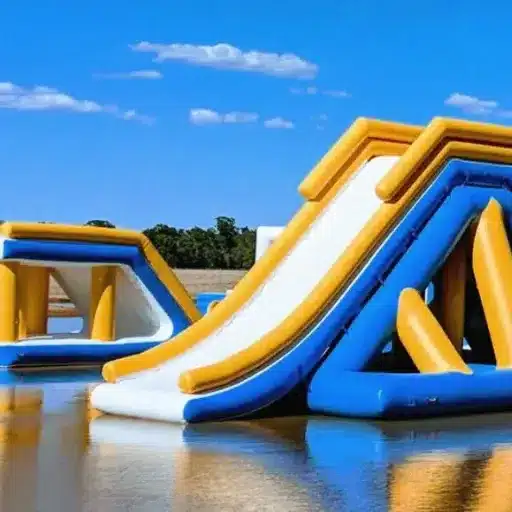
The seam is where water-slide units fail first. Mold roots into seams because seams trap water and soap residue, and a poorly welded seam leaks air, water, or both. The construction standard for commercial inflatables is welding, not gluing.
RF / high-frequency welding. Radio-frequency welding uses electromagnetic energy to heat the PVC molecules and fuse two layers into a molecular bond. It produces a watertight, airtight seam, and it’s the standard for commercial inflatable construction.
Hot-air welding. Hot-air welding melts and bonds the film at the seam line. It’s common in tarpaulin and large-format construction and works well where RF tooling isn’t practical. Both methods beat stitching for waterproofing, because a needle hole is a water path.
Watertight baffles and drainage. Internal baffles divide the air chambers, and properly placed drain ports let operators clear standing water. A unit designed for water has deliberate drainage paths so the fabric doesn’t hold a pool against the seams. This is design engineering, and it’s as important as the fabric weight.
Welded D-rings and anchors. Attachment points are welded, not glued. A glued D-ring in a wet unit is a decontamination hotspot and a failure point under load.
The waterproofing measure is the water column rating, the height of a water column the fabric withstands before leaking. PVC tarpaulin runs above 3000 mm, while uncoated Oxford fabric typically measures 1000-2000 mm. For a slide that carries a standing water film, 3000 mm-plus is the floor, and it comes from the coating and the weld, not the weight label.
Safety Standards & Compliance for Water Slides
Are inflatable water slides safe? Yes, when they’re built and operated to the standard that covers them, and for commercial units that standard is ASTM F2374-24. If you’ve wondered whether your slide falls under a recognized practice, this section is the answer.
ASTM F2374-24. Standard Practice for Design, Manufacture, Operation, and Maintenance of Inflatable Amusement Devices. Its scope explicitly covers land-based inflatable devices designed for dry use, wet use, or a combination of wet/dry use (Section 1.1.2). Water slides are in scope. That means a commercial water slide’s design, seams, anchoring, operation, and maintenance are all governed by a recognized practice, and the wet-use classification is spelled out in the standard itself.
ASTM F2729-18. For consumer and backyard inflatables, the relevant standard is ASTM F2729-18. It’s why the cheap 0.4 mm “water slide fabric” you find online is residential-grade and outside commercial scope. Most listings won’t tell you which standard your slide falls under, and that distinction drives the grade you should buy.
EN 14960 and the chemical layer. In Europe, EN 14960 covers inflatable play equipment, and the EU adds chemical limits through EN 71-3 and REACH. Because water slides are children’s products in most markets, the fabric also has to meet lead and phthalate limits. We walked through that compliance chain in detail in our lead-free PVC fabric guide.
NFPA 701. Flame retardancy in the US runs through NFPA 701 for the fabric itself, separate from the structural standard.
When a supplier tells you a fabric is “commercial grade,” ask which standard the finished unit is built to and whether the wet/dry classification is documented. That’s the difference between a claim and a spec. For the full breakdown of what commercial grade means across the inflatable category, see our guide to commercial grade inflatable material.
How to Care for Water-Slide Fabric (The Mold-Free Protocol)
Here’s the case that should make every operator read this twice. A rental company bought a premium 20 oz fleet and then cleaned it with a pressure washer at 2000 PSI and a chlorine-based cleaner.
After three cleanings, the seams began to delaminate and the graphics were ruined. The material was the best grade money could buy. The cleaning routine killed it.
Mold is the number-one cause of premature retirement in commercial water-slide fleets, and it’s almost always a care failure, not a material failure. One season of improper storage can cut a six-to-eight-year fabric down to two. The good news is that the protocol is simple, if you follow it every time.
Cleaning: do this, not that. The chemistry matters because the wrong cleaner attacks the PVC plasticizer system that keeps the fabric flexible.
| Do | Never |
|---|---|
| pH-neutral soap and clean water | Bleach or chlorine-based cleaners |
| White vinegar diluted 1:4 for mold spots | Pressure washers above roughly 1200 PSI |
| 3% hydrogen peroxide or oxygen bleach | Solvent-based cleaners or abrasive pads |
| Soft cloth or sponge | Rough brushes that abrade the coating |
| Thorough rinse after cleaning | Leaving soap residue to dry on the surface |
White vinegar at a 1:4 dilution kills about 82 percent of mold species without harming PVC plasticizers, which is why it’s the go-to spot treatment. Bleach is the opposite: it destroys plasticizers and can ruin graphics within 2-3 applications. And a pressure washer above about 1200 PSI delaminates welded seams and forces water into sealed areas. If you own a commercial unit, the pressure washer is the fastest way to destroy it.
Drying. Drain every chamber. Re-inflate the unit and run a blower for 2-5 hours with the ports open so air circulates through every seam. Then let it sit in the sun for 2-4 hours. A fold-wet slide is a mold laboratory, and this step is where most fleets are lost.
One operator stored his slides wet in a trailer for the winter. By spring, the interior liners showed black spotting and the fabric had lost most of its tear resistance. The fleet was a write-off at two years old. A blower and a few hours of drying would have protected a six-year investment.
Storage. Store dry, loose-folded (never crease-folded under weight), in a climate-controlled space below 50-60 percent relative humidity, on pallets, under breathable covers. Heat and humidity accelerate every degradation pathway in PVC.
Residual protection. Benzalkonium chloride anti-microbial sprays provide 30-60 days of residual mold inhibition on PVC. They’re a complement to the drying routine, not a replacement, and they give commercial operators a margin of safety between cleanings.
Even with good care, units take damage over a season. When a seam or baffle tears, our guide to how to repair a bounce house covers the welding and patching process that keeps a unit in service instead of sending it to scrap.
Sourcing Water-Slide PVC Tarpaulin: RFQ Checklist
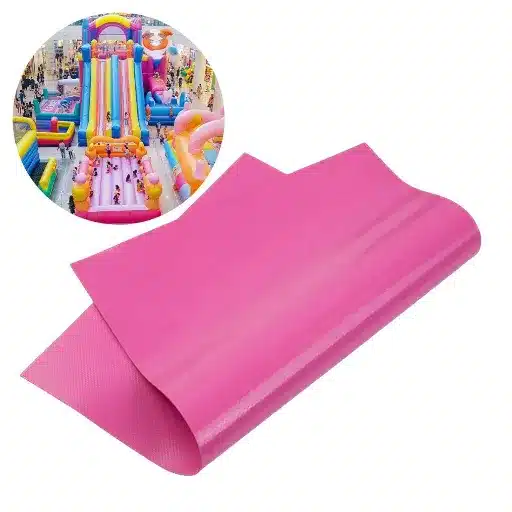
The sourcing conversation should start at the spec, not the brochure. Here’s what to put on an RFQ so every supplier quotes against the same numbers.
- Weight and tolerance. Specify gsm and oz together, for example 610 gsm / 18 oz, with the acceptable tolerance you’ll verify.
- Base fabric. Name the scrim denier, for example 1000D high-tenacity polyester.
- Coating additives. Require anti-mildew, anti-bacterial, UV stabilizers, and chlorine resistance in writing. A supplier that can’t state the additive package can’t document it.
- Surface spec. Define which zones need anti-slip embossing and which need a smooth, slick finish.
- Seam method. Require RF or hot-air welding, welded D-rings, and a baffle and drain layout appropriate to the unit.
- Certifications. List the standards: ASTM F2374-24 wet/dry for commercial units, EN 14960 where applicable, NFPA 701 flame, and EN 71-3 / REACH plus lead and phthalate limits for children’s products.
- Test reports. Require batch-specific, third-party reports with the method numbers cited, not a one-page certificate.
Then verify the claims. Weigh a sample roll and confirm the gsm against the quoted spec. Ask for a batch test report that names the lot and shows measured tensile, tear, and adhesion values. Order a sample before committing to volume. “Commercial grade” is a claim until it’s a documented number.
It also helps to know where water-slide fabric sits in the wider fabric family. It’s a cousin to pool liners and marine PVC on the coating side, and to bounce house fabric on the structural side. Our PVC inflatable fabric specifications guide maps the whole category, and our custom fabric manufacturing capability covers custom weights, coatings, and certifications for OEM and ODM projects.
Ready to talk specifications? Our engineers will walk your duty cycle, recommend a grade and coating package, and send certified samples before you order. Talk to an engineer or request a sample order.
PVC Tarpaulin for Water Slides: FAQ
What material is used for inflatable water slides?
Inflatable water slides are made from PVC tarpaulin, a three-layer fabric of high-tenacity polyester scrim sandwiched between two flexible PVC layers. Commercial slides use 18 oz (610 gsm) or heavier, with anti-mildew and UV-stabilized coatings.
What is the best PVC for water slides?
18 oz (610 gsm) at 0.55 mm is the standard commercial grade. 20 oz (650 gsm) at 0.6 mm is the premium choice for high-use rental fleets. The best grade is the one that matches your duty cycle and your drainage and care plan.
How thick should inflatable water slide PVC be?
Standard commercial water slide PVC is 0.55 mm, which corresponds to 18 oz / 610 gsm. Premium fleets use 0.6 mm (20 oz / 650 gsm). Residential-grade material at 0.4 mm is too thin for commercial duty.
18 oz vs 20 oz PVC for water slides, which is better?
20 oz (650 gsm) is more durable and lasts 6-8 years versus 5-7 for 18 oz, but it’s heavier and adds moisture-trapping surface area. 18 oz is the value standard for most commercial fleets; 20 oz is for premium, high-frequency use.
How many gsm is inflatable water slide material?
Standard commercial water slide material is about 610 gsm (18 oz). Premium is about 650 gsm (20 oz). Light residential material is about 510 gsm (15 oz). The conversion is roughly ounces per square yard times 33.9.
Why does my inflatable water slide smell?
A musty smell is almost always mold or mildew growing in trapped moisture, usually inside seams or creases. Drain, re-inflate with a blower for 2-5 hours, dry in the sun, and treat spots with 1:4 white vinegar. Never use bleach.
Can you use bleach on an inflatable water slide?
No. Bleach and chlorine-based cleaners destroy PVC plasticizers and can ruin graphics within 2-3 applications. Use pH-neutral soap, or white vinegar diluted 1:4 for mold. If you must sanitize, use 3% hydrogen peroxide or oxygen bleach.
Are inflatable water slides safe?
Commercial inflatable water slides are safe when built and operated to ASTM F2374-24, which explicitly covers wet-use and wet/dry inflatable amusement devices. Backyard units fall under ASTM F2729-18. Buy the grade that matches the standard your unit will be classified under.
How long do inflatable water slides last?
With proper care, 20 oz (650 gsm) fabric lasts 6-8 years, 18 oz (610 gsm) lasts 5-7 years, and 15 oz residential fabric lasts 2-3 years. Poor drying or the wrong cleaners can cut any of those figures in half.
How do you keep a water slide from getting moldy?
Dry it completely after every use: drain, run a blower through open ports for 2-5 hours, and air it in the sun. Store loose-folded in a dry space below 50-60 percent relative humidity. Use benzalkonium chloride sprays for 30-60 days of residual mold inhibition.
Conclusion
PVC tarpaulin for water slides is the wet-use edge of the inflatable category, and it’s the material most suppliers don’t explain. The grade (18 oz standard, 20 oz premium), the coating package (anti-mildew, UV, chlorine resistance), the seam construction (welded, watertight, with drainage), and the care protocol (dry every time, no bleach, controlled storage) are what separate a two-season fleet from an eight-season one.
The standards matter too. ASTM F2374-24 covers wet and wet/dry commercial units, and a documented claim beats a brochure every time. When you source, specify the numbers: gsm, denier, coating additives, weld method, and the test reports behind them.
Start with our bounce house fabric guide for the full material stack, or go straight to a conversation with our engineering team. We manufacture commercial PVC inflatable fabric with the coatings and welds that survive wet duty, and we’ll send certified samples and batch reports before you commit. Request a sample or spec sheet or talk to an engineer about your custom requirements. The material that survives your water season is the material that stays on your schedule.