
PVC Coated Fabric: Specifications & Applications Guide
PVC coated fabric is an engineered composite: a high-tenacity woven polyester scrim coated on one or both sides with flexible polyvinyl chloride (PVC), usually finished with a topcoat that adds UV protection and self-cleaning behavior. It is the material behind truck side curtains, warehouse covers, event tents, pool liners, and architectural membranes, and it is available in grades from about 400 gsm for banners to more than 1,200 gsm for permanent roofing. The version you need is decided by the specification, not the label.
Here is the problem spec writers and procurement teams run into. Search for “pvc coated fabric” and you land on marketplace listings that quote a gsm number and call the material “waterproof, UV resistant.” The paywalled market reports give you market size and nothing you can source. Almost no page connects the base fabric denier, the coating weight, and the topcoat to a real application, so buyers cannot tell whether a 610 gsm quote is a bargain or a misfire.
We manufacture and batch-test PVC coated fabric, so this guide is the specification briefing we hand to OEMs, procurement managers, and operations engineers. When a logistics buyer asked us to match a European truck curtain spec at a lower landed cost, the answer was not a cheaper coating. It was a 1000D polyester scrim with a controlled 650 gsm coating, documented batch by batch. That is the level of detail this guide is built to help you specify. By the end you will be able to read a spec sheet like an engineer, choose the right grade for your application, and run a sourcing conversation that gets you a verifiable product. Contact LY TRUSTLINK for reliable PVC coated fabric solutions.
Key Takeaways
- PVC coated fabric is a three-part composite: a polyester scrim that carries the load, a PVC coating that provides waterproofing, and a topcoat that controls UV life and cleanability.
- The specification that matters is five variables acting together: scrim denier, weave count, total gsm, coating weight, and topcoat type.
- Coated fabric is generally heavier and more durable than laminated fabric (typically 18-24 oz vs 10-18 oz) because the liquid PVC bonds chemically into the scrim rather than sitting on top of it.
- Standard UV-stabilized grades last 5-10 years outdoors; premium PVDF-topcoated architectural grades can reach 15-20 years. Budget grades last 3-5.
- On price, the cheap roll is usually the expensive one: a $2.50/m² laminated fabric replaced every two years can cost about $80–$100 per m² over a decade.
What Is PVC Coated Fabric?
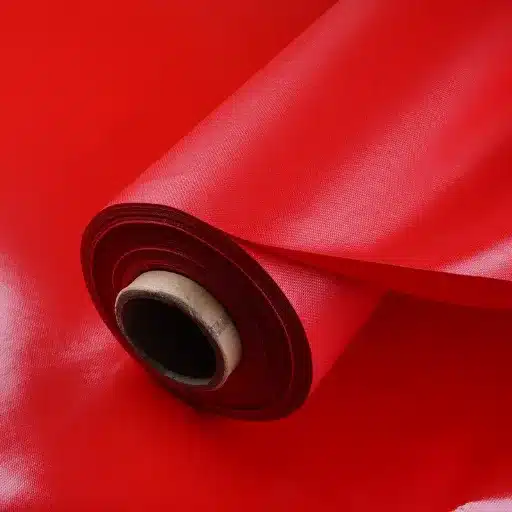
PVC coated fabric is a polyester (or nylon or cotton canvas) base fabric coated with plasticized polyvinyl chloride. The coating is applied to one or both sides by knife coating, hot-melt coating, or lamination, and it is what makes the textile 100 percent waterproof, abrasion resistant, weldable, and available in flame-retardant formulations that meet standards such as NFPA 701 and EN 13501-1.
Think of the fabric in three layers. The woven polyester scrim carries the tensile load; it is what stops a cover from tearing when the wind loads it. The PVC coating is the barrier layer; it provides waterproofing, chemical resistance, and surface toughness. The topcoat, often an acrylic or PVDF lacquer, seals in the plasticizers, slows UV degradation, and gives the surface its cleanability and dirt-shedding behavior.
That three-layer logic explains why two rolls that weigh the same can perform very differently. The weight tells you how much material is there. It does not tell you how that material is distributed between the scrim and the coating, or what additives are inside the PVC. A 650 gsm fabric on a flimsy scrim will fail long before a 650 gsm fabric built on a proper 1000D weave. For the full technical breakdown of the neighboring category built on the same chemistry, our PVC inflatable fabric specifications guide explains the mechanical test data behind coated PVC in inflatable structures.
How PVC Coated Fabric Is Made
The manufacturing route determines most of the difference between cheap and premium material. Here is the sequence on a modern coating line.
First, the scrim is woven from high-tenacity polyester yarn. Yarn denier and thread count set the base strength, so this step decides the tensile and tear numbers the finished fabric will post. Second, the PVC is compounded. The resin is mixed with plasticizers for flexibility, stabilizers for heat and light resistance, UV absorbers, and, where required, flame-retardant additives. Those additives are built into the compound before coating, which is why a genuinely flame-retardant PVC fabric keeps its rating as the surface wears. Third, the coating is applied. Knife-over-roll coating spreads a controlled thickness of liquid PVC onto the fabric, and the assembly passes through an oven that fuses the coating to the scrim. For double-sided fabric, the process repeats on the second face. Finally, a topcoat is applied and the roll is cooled, inspected, and weighed.
Quality control is where a manufacturer separates itself. Every production batch in our facility is checked for total weight, coating adhesion, tensile strength, tear resistance, and color consistency, and the results are tied to the lot number. When a supplier hands you a batch test report that names the lot and shows measured values against the standard method, that is the difference between a claim and a spec. If a supplier cannot describe its compounding and QC line, it cannot document the material it is selling. Get quality PVC coated fabric directly from LY TRUSTLINK.
PVC Coated Fabric Specifications Explained
Reading a spec sheet comes down to five variables. They act together, so changing any one of them shifts the others.
Scrim denier. Denier measures yarn linear density. A 500D scrim suits light covers, while 1000D or 1000 x 1300D suits truck tarpaulins and heavy industrial fabric. Higher denier means more yarn mass per length and higher tensile strength, at the cost of weight and price.
Weave count and structure. Threads per inch and the weave pattern (plain or matt) influence tear propagation and how evenly the coating bonds. A balanced weave distributes load and resists the rips that start at a cut edge.
Total gsm. Grams per square meter is the figure most listings quote. It includes scrim plus coating, so it is the most useful single number for comparing grades, as long as you also verify the scrim underneath.
Coating weight and thickness. Coatings commonly run 13-20 oz per square yard. Thicker coating means better waterproofing, higher hydrostatic head, and longer surface life, but it adds weight and stiffness.
Topcoat type. Acrylic topcoats are standard. PVDF (polyvinylidene fluoride) topcoats add years of UV life and a self-cleaning surface, which is why architectural membranes specify them for 15-20 year design life.
The conversion table below is the one buyers ask for most, because listings quote the same fabric three ways: ounces per square yard, grams per square meter, and millimeters of thickness.
| Nominal weight | GSM | Typical thickness | Typical application |
|---|---|---|---|
| 10-14 oz | ~340-475 gsm | 0.3-0.4 mm | Banners, light temporary covers |
| 16-18 oz | ~540-610 gsm | 0.45-0.55 mm | Event tents, side curtains, standard commercial tarps |
| 18-20 oz | ~610-650 gsm | 0.55-0.6 mm | Truck curtains, scaffold, marine covers |
| 22-26 oz | ~750-880 gsm | 0.7-0.85 mm | Heavy industrial, warehouse doors, roofing |
| 28 oz+ | ~950-1,200+ gsm | 0.9-1.2+ mm | Permanent tensile structures, heavy roofing |
A quick rule: ounces per square yard times 33.9 gives grams per square meter, so 18 oz is roughly 610 gsm and 20 oz is roughly 650 gsm. When two quotes arrive in different units, this is how you compare them on the same scale. Talk to LY TRUSTLINK about your PVC coated fabric needs.
Performance Properties: Waterproofing, Strength, UV & Flame Resistance
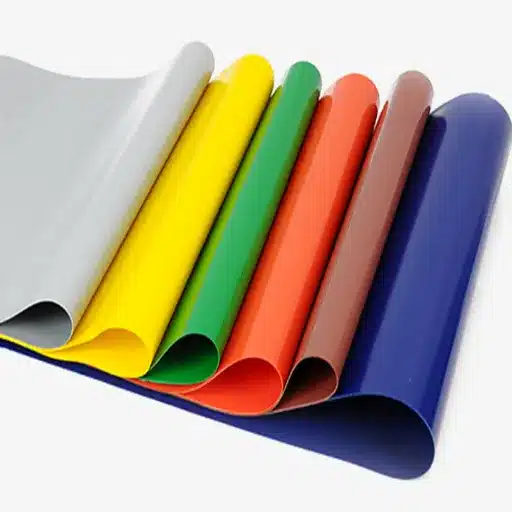
The properties buyers assume are one thing, and the way they are measured is another. Here is what the labels actually mean.
Waterproofing. Coated PVC is impermeable, and manufacturers quote it by hydrostatic head, often above 10,000 mm. The coating provides the barrier, but the assembly is only as waterproof as its seams, which is why welded seams are the standard for anything that must stay dry. A needle hole from stitching is a water path.
Tensile and tear strength. Reported in newtons per 5 centimeters (N/5 cm) under methods such as ASTM D751 or EN ISO 1421. A light banner fabric might post 800-1,200 N/5 cm; a truck or architectural grade can exceed 2,500 N/5 cm. Tear strength, reported separately, is the more relevant number for a cover that will be cut, snagged, or flogged by wind.
UV resistance. UV absorbers in the compound plus the topcoat decide outdoor life. The industry measures this with accelerated weathering such as QUV (ISO 4892-3 / ASTM G154), and higher-grade fabrics are rated for thousands of hours before significant degradation. A fabric built for a 15-year membrane is a different product from a banner grade meant to last a season or two.
Flame retardancy. FR additives go into the PVC compound, not onto the surface. Depending on market and application, coated fabric can be certified to NFPA 701 (US), EN 13501-1 class B-s2,d0 (EU), CPAI-84, or ASTM E84 Class A. A flame-retardant fabric that meets NFPA 701 is a documented, testable product, not a claim.
Temperature and chemical range. Most commercial PVC coated fabric works from about -30 C to +70 C, with cold-flex plasticizers extending the low end for arctic routes. It resists oils, mild acids, and the mildew that attacks fabrics left wet, which is why it dominates outdoor industrial use.
| Grade tier | Typical gsm | Tensile (N/5 cm) | Outdoor lifespan | Common use |
|---|---|---|---|---|
| Banner / light | 400-550 | 800-1,400 | 1-3 years | Banners, temporary shelters |
| Standard commercial | 550-750 | 1,800-2,500 | 5-10 years | Tarps, side curtains, tents |
| Heavy / architectural | 750-1,200+ | 2,500-3,500+ | 10-20 years | Roofing, membranes, industrial |
Ready to compare against a real specification? Our engineers can send production samples with batch test reports that show measured tensile, tear, and adhesion values, not a marketing page. Request a sample or spec sheet and see the numbers for yourself.
PVC Coated Fabric vs Laminated Fabric: What’s the Difference?
This is the question buyers get wrong most often, and the answer is in the manufacturing process. Coated fabric starts as liquid PVC that is spread onto the scrim and fuses into it, so the coating penetrates the yarn and forms a chemical bond across the weave. Laminated fabric starts as a pre-made PVC film that is pressed onto the scrim with heat, so the film and the fabric stay as two distinct layers joined at the surface.
That process difference drives everything downstream. Coated fabric resists delamination, has a smoother cleanable finish on both faces, produces fewer pinholes, and handles repeated folding and cold weather better. Laminated fabric is lighter for a given strength, cheaper to make, and more flexible in color and low minimum runs, which makes it the value choice for banners, seasonal tents, and inflatables where airtightness matters and budget is tight.
| Attribute | Coated fabric | Laminated fabric |
|---|---|---|
| Process | Liquid PVC fused into the scrim | PVC film bonded to the surface |
| Bond | Chemical, penetrates the weave | Surface bond, distinct layers |
| Typical weight | 18-24 oz and up | 10-18 oz |
| Delamination risk | Low | Higher |
| Cold flexibility | Better | Good |
| Cleanability | Smooth, easy | Rougher underside |
| Cost | Higher | Lower |
| Best for | Long-term, heavy-duty, structural | Banners, seasonal, budget, airtight inflatables |
The rule of thumb: if the fabric must survive years of wind, folding, or structural load, specify coated. If it must be light, cheap, and airtight for a seasonal or budget application, laminated can be the right call. We walk through the full engineering decision in our guide to what laminated fabric is and how it compares to coated construction.
PVC Coated Fabric vs Other Coating Types
PVC is the workhorse of coated technical textiles, but it is not the only coating polymer, and the honest guide tells you when each one wins.
PVC. The best value waterproofing for heavy-duty covers. It is weldable, chemical resistant, and the easiest to certify for flame retardancy, which is why it dominates trucking, construction, and agriculture.
Polyurethane (PU). Lighter and more flexible than PVC, with a softer hand and better breathability in microporous forms. It suits apparel, soft goods, and lighter covers, but it is less durable outdoors and more sensitive to UV and hydrolysis.
Silicone. The premium option for extreme temperature and the best UV resistance of the three. Coated on fiberglass it runs from about -60 C to +260 C and is inherently flame resistant, which makes it the spec for high-heat, aerospace, and high-end architectural work, at a significantly higher price.
Polyethylene (PE). The low-cost woven sheet used for tarps. It is far cheaper than PVC but lasts a fraction as long, which is why the total-cost math usually favors PVC for anything meant to survive more than a season. For a direct comparison, our vinyl tarp vs poly tarp guide lays out the five-year economics.
When a spec calls for PVC, the decision is done. When it does not, these distinctions tell you which coating to reach for, and each one has a manufacturing and QC profile worth verifying the same way.
How to Choose PVC Coated Fabric by Application
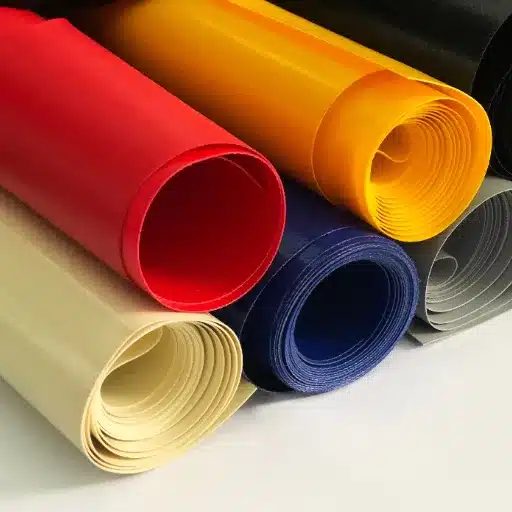
Selection starts with the duty cycle, not the catalog. Four questions narrow the field: how long must the fabric last, what load and weather will it carry, does it need to pass a flame or chemical standard, and what does a failure cost?
Take the scaffold case that makes buyers question the heaviest option. A contractor specified 900 gsm fabric for a scaffold windbreak because heavier seemed safer. The wind load on a solid, heavy sheet tore the fabric and stressed the frame, and the enclosure failed within months. A lighter 600 gsm perforated fabric, engineered to let wind pass through, outlasted it and cost about 20 percent less. Heavier is not automatically better. The correct grade matches the physics of the application.
The table below is a starting point, not a substitute for engineering review. It reflects the ranges we see across commercial applications.
| Application | Typical gsm | Notes |
|---|---|---|
| Flex banners | 350-550 | Short-term, printed surface |
| Bounce houses / inflatables | 450-550 | Airtight, welded seams |
| Scaffold enclosures | 450-650 | Perforated variants for wind load |
| Event tents | 400-650 | Flame-retardant standard in most markets |
| Truck side curtains | 550-750 | Tear strength and cold flex matter |
| Greenhouse / agriculture | 400-750 | UV life critical |
| Marine / boat covers | 650-800 | Salt, UV, and mildew resistance |
| Industrial curtains | 650-900 | Abrasion and chemical duty |
| Long-term roofing | 900-1,200+ | Architectural, often PVDF topcoat |
Two applications deserve a callout because they are easy to under-spec. For trucking and logistics, the fabric is loaded and unloaded constantly, so tear strength, coating adhesion, and cold flexibility matter more than sheer gsm; our guide to waterproof vinyl tarp applications in logistics covers the full set. For blackout and light-control work, whether in event structures or industrial settings, the spec is about opacity and light blocking as much as strength, and that is covered in our blackout tarpaulin engineering guide. When in doubt, specify the duty cycle to your supplier and let the engineering team match the grade to it, rather than guessing from a weight chart.
Certifications & Standards for PVC Coated Fabric
Compliance is what clears a fabric through a procurement department, and the acronyms mean little until you know which standard applies to your use case. This is the plain-language map.
Flame retardancy. In the US, NFPA 701 tests flame propagation of textiles and films, and it is the common requirement for tents, drapes, and covers. In Europe, EN 13501-1 classifies building products, and PVC coated fabric commonly achieves class B-s2,d0 (limited flame spread, low smoke, no flaming droplets). Camping and tent fabric often cites CPAI-84 Class 1, and building panels may need ASTM E84 Class A. The FR additives are part of the PVC compound, so a properly certified fabric keeps its rating as it ages and gets cleaned.
Chemical and safety compliance. REACH (EU) and RoHS restrict hazardous substances, and California Prop 65 requires disclosure of listed chemicals. For children’s products such as inflatables, EN 71-3 limits heavy-metal migration and the fabric must meet lead and phthalate limits. We detail the children’s-product compliance chain in our lead-free PVC fabric guide.
Test methods. The mechanical numbers on a spec sheet come from defined methods. Tensile strength uses ASTM D751 or EN ISO 1421; coating adhesion uses EN ISO 2411; weathering uses ISO 4892-3 or ASTM G154. When a supplier gives you a test report, it should name the method, the standard it is measured against, and the measured value.
The practical habit is to ask for the certificate that matches your end use. A scaffold enclosure in Europe needs the EN classification; a tent sold into the US market needs NFPA 701. When a supplier says “safety certified” without naming the standard, that is not a certification. Demand the specific one your market requires. Partner with LY TRUSTLINK for dependable PVC coated fabric supply.
How Long Does PVC Coated Fabric Last? (Lifespan & Maintenance)
Lifespan is a function of grade, exposure, and care, in that order. A standard UV-stabilized grade lasts about 5-10 years outdoors. A premium PVDF-topcoated architectural grade can reach 15-20 years. A budget grade with minimal UV package is often done in 3-5 years, and indoor use extends any of those figures well beyond the outdoor number.
What kills fabric is more predictable than weather. UV degradation breaks down the polymer and causes chalking and stiffening. Plasticizer loss makes the fabric brittle. Mildew roots into seams and creases where moisture sits. Improper cleaning, especially bleach or a high-pressure washer, attacks the plasticizer system and can destroy a premium fabric faster than years of sun.
Here is the case that should make every maintenance manager read twice. A warehouse operator bought a premium coated fabric curtain system and then pressure-washed the curtains at high pressure with a degreaser to clean them. The cleaning stripped the coating surface and forced water into the seams. Within a year the curtains showed the failure pattern of a fabric twice their age, and the operator replaced them on a maintenance budget that had assumed a five-year life. The fabric was not the problem. The cleaning routine was.
The maintenance protocol is straightforward. Clean with a pH-neutral soap and lukewarm water, using a soft brush or sponge. Never use bleach, solvents, or abrasive pads, and never pressure-wash above a gentle setting, because high pressure loosens welds and forces water into sealed areas. Rinse thoroughly, then dry completely before storage; storing a damp cover is how mildew gets a start. Store rolled rather than crease-folded, in a cool, dry, shaded space. Inspect seams, edges, and any welded joints at least twice a year, and repair small tears promptly with a cleaned patch and hot-air welding before they grow. When a seam does tear, our repair guidance for PVC fabric covers the patching and welding process that keeps industrial fabric in service.
PVC Coated Fabric Price & Total Cost of Ownership
Prices vary with the same variables as performance, which is no accident. Total GSM, scrim denier, coating method, topcoat, certifications, order volume, and PVC resin prices all move the number. In round terms, a budget laminated fabric runs about $2.50 per square meter, a standard coated fabric runs $2.50–$8.00, and a premium knife-coated architectural grade with an FR and PVDF package can exceed $7.00–$8.00.
The total-cost story is where the cheap option usually loses. Here is the arithmetic on 100 square meters over 10 years, which is the comparison a procurement manager should run before choosing on price.
| Option | Price / m2 | Lifespan | Replacements in 10 yrs | Material cost over 10 yrs |
|---|---|---|---|---|
| Budget laminated | $2.50 | 2 years | 4 | $1,250 |
| Premium coated | $7.00 | 10 years | 0 | $700 |
The “cheap” option costs about 80 percent more in material alone, and that excludes the labor to install and remove it four times and the cost of a failure in between. Across an operating fleet the gap widens. Coated PVC curtain systems commonly replace a fraction of their panels over three years while polyethylene fleets cycle through most of theirs. A higher upfront invoice on a coated fabric can be the lower total cost before the third year of continuous use.
For a sourcing-grade view of how gsm, base fabric, and coating drive price, our custom coated fabric manufacturing team will quote against your exact specification. The price to beat is not the lowest quote. It is the cost of the fabric that fails a season early.
Sourcing PVC Coated Fabric: The RFQ Checklist
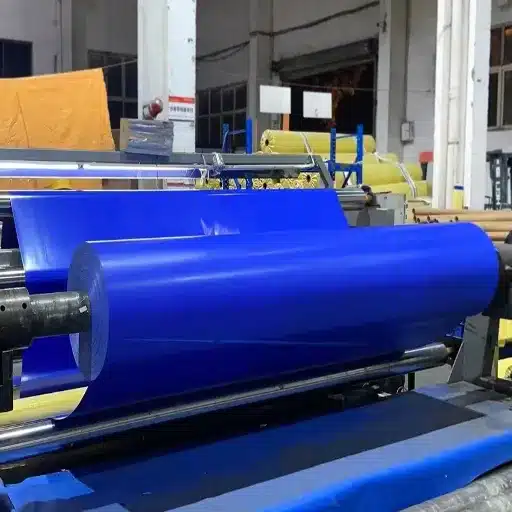
The sourcing conversation should start at the specification, not the brochure. Put these points on every RFQ so suppliers quote against the same numbers.
- Total gsm and tolerance. Specify the number and the tolerance you will verify, for example 650 gsm +/- 5 percent.
- Base fabric. Name the scrim denier and weave, for example 1000D x 1000D high-tenacity polyester.
- Coating weight and method. State the coating weight and whether you require coated or laminated construction.
- Topcoat. Specify acrylic or PVDF, and the UV-life expectation it must support.
- Certifications. List the standards for your market: NFPA 701, EN 13501-1, CPAI-84, ASTM E84, REACH, RoHS, or EN 71-3 where relevant.
- Test reports. Require batch-specific reports that name the method and show measured tensile, tear, and adhesion values.
- Sample before volume. Order a production sample and verify the gsm and hand-feel before committing.
Then verify what you can. Weigh a sample and confirm the gsm. Ask for the batch test report and check that the lot number on the roll matches the lot number on the report. Ask the supplier to describe its compounding and QC line, and treat any answer that cannot name the additive package or the test method as a red flag. For custom weights, coatings, colors, and certifications, our OEM and ODM engineering team builds fabric to your exact specification from concept to batch-tested delivery. Talk to an engineer and the conversation starts from your duty cycle, not our catalog. Contact LY TRUSTLINK for reliable PVC coated fabric solutions.
PVC Coated Fabric: FAQ
What is PVC coated fabric made of?
PVC coated fabric is a base textile, usually high-tenacity woven polyester, coated on one or both sides with plasticized polyvinyl chloride. A topcoat is often added for UV protection and cleanability. Nylon and cotton canvas are used where their specific properties are needed.
Is PVC coated fabric waterproof?
Yes. The PVC coating forms an impermeable barrier, and coated fabric is rated 100 percent waterproof with hydrostatic head values often above 10,000 mm. The seams of the finished assembly must be welded to keep the waterproofing intact, because stitching creates water paths.
How long does PVC coated fabric last?
A standard UV-stabilized grade lasts about 5-10 years outdoors, a premium PVDF-topcoated architectural grade can last 15-20 years, and a budget grade with minimal UV protection is usually done in 3-5 years. Indoor use extends any of those figures.
What is the difference between PVC coated and laminated fabric?
Coated fabric starts as liquid PVC that fuses into the scrim, forming a strong chemical bond. Laminated fabric starts as a pre-made PVC film pressed onto the fabric surface. Coated fabric is generally heavier, more durable, and more delamination resistant; laminated fabric is lighter and cheaper.
What denier polyester is used for PVC coated fabric?
Typical commercial fabrics use 500D, 1000D, or heavier high-tenacity polyester, with heavier weaves such as 1000 x 1300D for truck tarpaulins and structural fabric. Higher denier means higher tensile strength at the cost of weight and price.
Is PVC coated fabric UV resistant?
UV-resistant grades add UV absorbers to the PVC compound and a stabilizing topcoat, and they are tested with accelerated weathering methods such as QUV. Standard grades are rated for years of outdoor life, while premium PVDF-topcoated grades are engineered for 15-20 year architectural life.
Can PVC coated fabric be recycled?
PVC is technically recyclable, but coated fabrics are multi-component materials, so recycling depends on the facility and the construction. Phthalate-free, REACH-compliant formulations and recyclable base fabrics are increasingly available, and longevity is itself a sustainability argument: a fabric that lasts 10 years instead of 2 replaces fewer rolls.
Is PVC coated fabric fire retardant?
Flame-retardant grades are available with FR additives built into the PVC compound, not applied to the surface. They are certified to standards such as NFPA 701, EN 13501-1 (commonly B-s2,d0), CPAI-84, or ASTM E84 Class A, depending on the market and application.
How do you clean and repair PVC coated fabric?
Clean with pH-neutral soap and lukewarm water using a soft brush or sponge. Never use bleach, solvents, or a high-pressure washer. Rinse and dry completely before storage. Repair small tears by cleaning the area and hot-air welding a PVC patch over it.
How much does PVC coated fabric cost?
Budget laminated fabric runs about $2.50 per square meter, standard coated fabric runs $2.50–$8.00, and premium knife-coated architectural-grade fabric can exceed $7.00–$8.00. Over a 10-year total-cost comparison, the premium fabric is often cheaper because it lasts far longer.
Get quality PVC coated fabric directly from LY TRUSTLINK.
Conclusion
PVC coated fabric is a specification family, not a commodity, and the difference between a cover that fails in a season and a membrane that lasts 15 years is written in the scrim, the coating, and the topcoat. Choose the grade by duty cycle, not by the heaviest option on offer. Coated construction beats laminated for durability and delamination resistance; lighter grades win when budget and weight dominate. Demand certifications that match your market, protect the fabric with a maintenance protocol that avoids bleach and high-pressure washing, and evaluate price as total cost over the life of the asset, not per meter.
The fabric that survives your operation is the one you can specify, verify, and document. We manufacture and batch-test coated fabric across the weight and coating range, and we will send certified samples and batch reports before you commit. Request a sample order or talk to an engineer about your custom specification. Specify it once, verify it every batch, and the material earns its place in your supply chain.