
PVC Coated FabricTensile Structures: Specification, Weld Qualification & Compliance
A PVC coated fabric tensile structure is specified by warp and fill tensile strength rather than weight, and it is qualified by documents a fabric order alone cannot supply. Three numbers set the grade. Three documents prove it was the right one. Most purchase orders name the first and assume the second.
The distinction that decides more projects than any other is this: a fire certificate describes a laboratory specimen, while code compliance describes the finished roof assembly. A supplier can sell you the first. Nobody can sell you the second.
Elena manages capital projects for a municipal parks department and put a 14-metre walkway canopy out to tender in the spring. The winning bid arrived with a full binder: an NFPA 701 Method 2 report, UV aging data, a 20-year design life statement, and a fabric weight. In August the building official asked two questions the binder could not answer: which roof-covering classification the assembly carried, and where the specimens affixed to the exterior at the time of manufacture were. The tender had never asked for either, because it had been written against a fabric rather than a structure.
This guide covers what a tensile membrane buyer has to specify and a tarpaulin buyer never does: the arithmetic that turns a load case into the grade you order, the weldability trade behind the topcoat, and the compliance chain that runs past the fabric to the roof. For base construction, the PVC coated fabric specifications guide is the hub. If the material family is still open, PVC, PTFE and ETFE compared settles that first; everything below assumes you have chosen PVC.
Key Takeaways
- Membrane-grade PVC coated fabric is bought by warp and fill tensile strength derived from a load case, not by GSM. Every supplier page publishes a grade ladder; almost none shows the arithmetic that finds your rung.
- An NFPA 701 Method 2 certificate covers a specimen. A permanent fabric roof additionally needs a roof-covering classification to ASTM E108 or ANSI-UL 790, and interiors need ASTM E84 surface-burning data. Different documents, different owners.
- The topcoat is a welding decision. Weldable PVDF alloy seams easily but has the shorter life; 100% PVDF lasts longer but its lacquer must be ground off before every weld.
- Specify seam strength as a percentage of base fabric tensile (70 to 80% is the working target), and demand per-batch weld coupon results traceable to the panel.
- The code imposes two obligations most quotes ignore: confirmatory field-test specimens taken from material affixed at manufacture, and a recurring inspection duty that passes to the owner.
Working on a live membrane specification? Send the span, the load case and the destination market, and our engineering team will return a grade band, a topcoat recommendation and the document list for that combination. Talk to an engineer.
What Changes When PVC Coated Fabric Becomes a Tensile Membrane
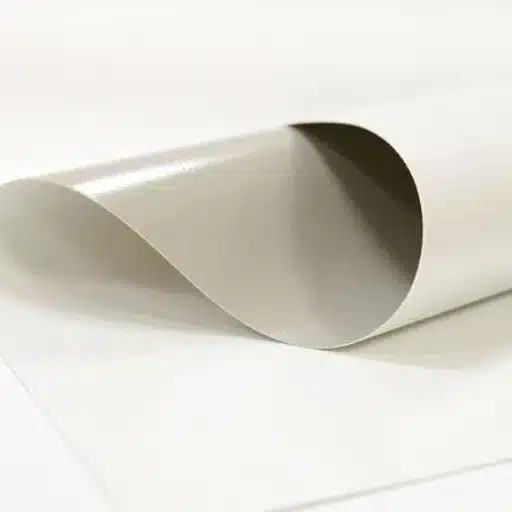
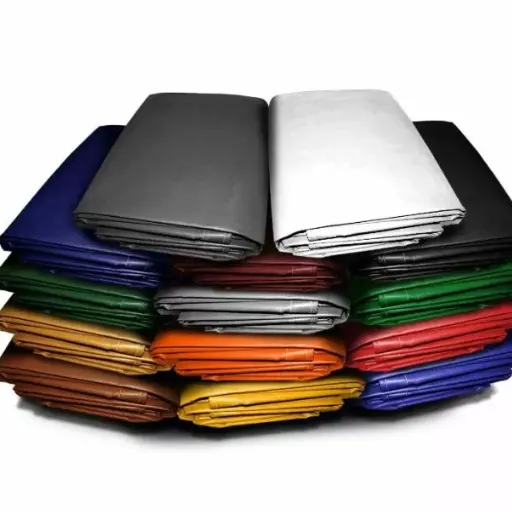
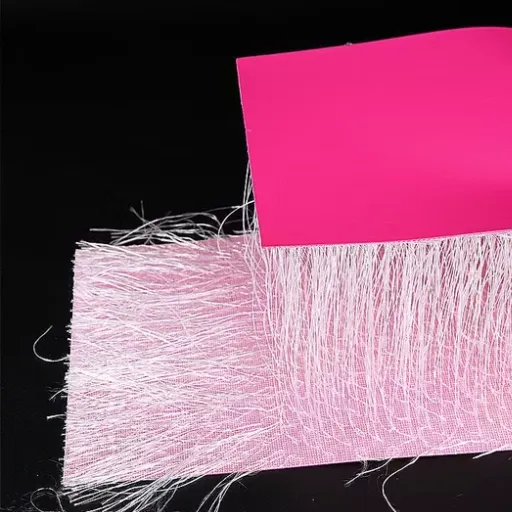
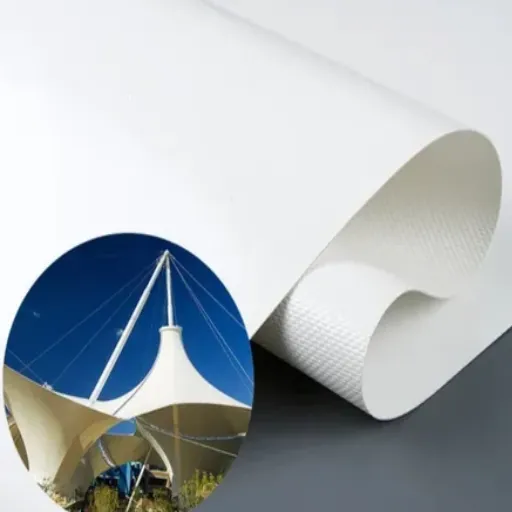
The construction does not change. A tensile membrane is a woven high-tenacity polyester scrim, coated in PVC, finished with a topcoat: the same three-layer build as a truck tarpaulin. What changes is the duty, and the duty changes the questions.
A tarpaulin is bought by weight and covered area. A membrane is bought by tensile strength in warp and fill, by dimensional stability under sustained load, by whether the surface can be welded, and by which fire classification the assembly can achieve. Those four properties cost money in ways weight does not.
| A tarpaulin buyer asks | A membrane buyer has to ask |
|---|---|
| What GSM is it? | What are the warp and fill tensile values, and do they match my load case? |
| Is it waterproof? | What is the coating adhesion, and is the plasticiser system stable over 20 years? |
| Does it weld? | Is the specified topcoat weldable as supplied, or does it need stripping first? |
| What fire certificate does it have? | What roof-covering classification can this assembly achieve? |
| What is the roll size? | What is the roll width, because it sets my seam count and my panel waste? |
Four upgrades separate a membrane grade from a tarpaulin grade: higher-tenacity yarn with a balanced weave; controlled coating add-on and adhesion instead of a minimum thickness; a specified topcoat system rather than a generic finish; and a weld specification with documentation behind it. The ladder itself is covered in PVC membrane specification by GSM; what follows is the part that page does not cover.
The Three Numbers That Set Your Grade
Number one: prestress
A tensioned membrane is not a stretched sheet. It is a surface held under a permanent, engineered tension of roughly 1.5 to 3.5 kN/m, about 150 to 350 kg per metre, in both warp and fill directions at once, so that every part of the surface carries load in two directions (Architen Landrell).
Prestress is what creates the double curvature: a saddle shape, concave in one direction and convex in the other. That shape is the structure. It sheds rain, resists wind uplift, and gives the surface stiffness without a frame behind it.
A flat membrane, or one that loses its prestress, ponds water, drums in the wind, and eventually tears at a corner. A canopy with a puddle in the middle is a prestress failure, not a fabric failure.
Number two: permissible load, and how the ladder gets chosen
Coated structural fabric is commonly quoted around 10 tonnes per metre in warp and fill. Apply a design safety factor of roughly 6 to the maximum design load, which is the figure used in structural membrane practice, and the permissible working load lands in the region of 1.7 t/m. That single relationship is the whole derivation, and it runs in four steps.
| Step | Action | A 14 m walkway canopy |
|---|---|---|
| 1 | Convert the governing load case to a line load per metre of membrane | Snow or wind design pressure 0.9 kN/m² × 6 m mast spacing = 5.4 kN/m |
| 2 | Apply the safety factor to the maximum design load | 5.4 kN/m × 6 ≈ 32 kN/m |
| 3 | Convert to the units on the data sheet (1 m = 100 cm) | 32 kN/m = 32,000 N/m ≈ 1,600 N/5 cm |
| 4 | Compare against the grade ladder and take the first grade that clears it | The lightest architectural grade, ~800 gsm at 3,000/3,000 N/5 cm, clears it with margin |
Step four is the answer almost nobody expects. On a canopy of this size, strength does not select the fabric. The lightest membrane grade is already roughly twice as strong as the arithmetic demands.
What actually chooses the grade is span stiffness, resistance to ponding, wind uplift at the corners, cut-edge detailing, and whether the panels can be handled on site without damage. Strength only becomes the binding constraint on long spans, exposed coastal sites, and structures carrying heavy snow.
Run the arithmetic anyway: it tells you within minutes whether you are buying strength or buying stiffness, which are two different purchases.
Number three: compensation
Fabric is not dimensionally fixed. Under load it stretches, differently in warp and differently in fill. Manufacturers therefore test each roll in a biaxial rig, measuring extension in both thread directions at load ratios taken from the project’s form-finding model. Those measurements become compensation percentages, and the canopy is cut undersize so that it stretches out to the designed geometry when it is finally tensioned.
Two consequences land on the buyer. You cannot order a membrane “cut to size”; the cutting pattern is an engineering output, not a measurement. And compensation is why panel takeoff, offcut allowance and roll width matter commercially: roll width sets how many seams a given covered area needs, and seam count drives both welding labour and the number of joints that can fail. Specify the widest architectural roll your supplier can confirm.
One reassurance, since it comes up in every project review: PVC-polyester does not creep indefinitely under load once it has reached full pretension. The creep risk sits in the pretensioning and the patterning, not in the service life.
Reading the Tensile Membrane Fabric Grade Ladder
The ladder below is the reference point most architectural membrane fabric suppliers publish. It is not a shopping list.
| Grade (gsm) | Typical warp/fill tensile (N/5 cm) | Typical thickness | Typical duty |
|---|---|---|---|
| 650–750 | ~3,000 / 3,000 | 0.5–0.6 mm | Small canopies, awnings, walkway covers |
| 850–950 | ~4,400 / 3,900 | 0.6–0.8 mm | Car park and walkway canopies, entrance structures |
| 1,050–1,250 | ~5,750 / 5,100 | 0.8–0.9 mm | Stadium and arena roofs, larger free spans |
| 1,350–1,800 | ~7,450 / 6,400 and above | 0.9–1.2 mm | Wide-span roofs, high-wind and high-snow sites |
Two fabrics at the same weight can differ enough to change a project’s outcome, and the weight column will never show you why:
- Yarn denier and tenacity. Higher-tenacity yarn carries more load and stretches less at the same weight.
- Weave and warp/fill balance. Plain, panama and basket weaves distribute load differently, and an unbalanced weave is weaker in one direction and will distort.
- Coating add-on versus base weight. A heavier number may be more coating and less scrim. Coating protects; scrim carries load.
- Plasticiser and stabiliser system. This decides how the surface behaves after fifteen years of UV and heat.
- Topcoat. Covered next, because it is a fabrication decision as much as a durability one.
One further line item deserves a place in the specification and rarely gets one: anti-wicking treatment. On a cut edge, water migrates along the yarn bundles into the body of the membrane, carrying moisture past the coating seal. On a coastal or monsoon site, that decides whether a membrane fails at a seam in year eight or not at all. Specify low-wick construction, and specify how cut edges and hems are sealed.
Topcoat Choice Is a Welding Decision
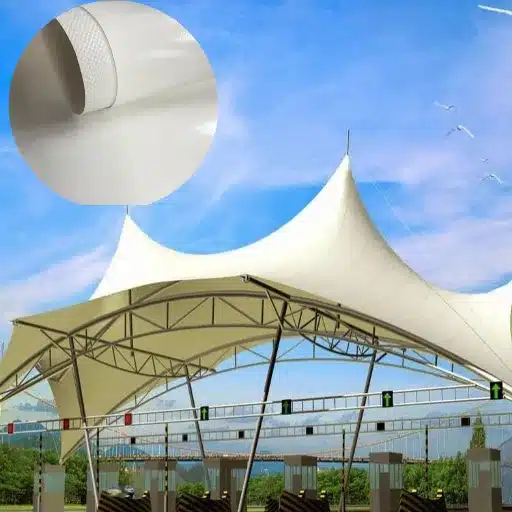
Buyers treat the topcoat as a durability upgrade. It is equally a fabrication constraint, and the trade runs opposite to the one most people expect: the longer the topcoat lasts, the harder it is to weld.
| Topcoat | Service life | Weldability as supplied | Weld preparation | Best suited to |
|---|---|---|---|---|
| Acrylic | ~10–15 years | Straightforward | None | Temporary and short-life structures |
| Weldable PVDF alloy | ~10–15 years | Lap-weldable | None | The practical default for permanent PVC roofs |
| 100% PVDF | ~15–20+ years | Not weldable | Lacquer ground off, or butt-welded joint | Appearance-critical, high-pollution, long-life roofs |
| TiO2 / premium systems | 15–25 years with maintenance | Varies by system | Confirm with the supplier | Severe UV exposure, colour-critical facades |
Weldable PVDF is a PVDF alloy, not pure PVDF. It is formulated so that it can be lap-welded in the condition it is supplied. 100% PVDF is not weldable: the lacquer film has to be mechanically removed along every weld line before the joint can be made, or the panels have to be butt-welded rather than lapped. That is real fabrication labour, it introduces a second process step with its own quality risk, and it has to be priced before the topcoat is chosen rather than after.
Marcus found this out one project too late. He specified 100% PVDF for a coastal shade canopy on the strength of a self-cleaning demonstration, and the quote came back with a fabrication line item he had not budgeted for, because every seam now required grinding the lacquer back before welding. The material was the right answer for the environment. The specification was written without asking the fabricator.
The same logic runs at the end of life. A PVDF surface can be cleaned and re-lacquered to extend appearance life, but re-lacquering changes the weldability of the panels it touches. If you plan to re-lacquer, plan it before the specification is fixed.
Weld Qualification: How the Seam Is Specified and Proved
A membrane rarely fails in the middle of a panel. It fails at a seam, because the coating is at its thinnest there and the stress path is discontinuous at every joint. The seam is also the only part of the material created by a process rather than by a mill, which makes it the only part whose quality is not guaranteed by the roll’s test certificate.
Specify seam strength as a percentage, not a figure. The industry working target is 70 to 80% of the base fabric’s tensile strength. Expressing it as a percentage means the requirement survives a grade change and makes the seam and the fabric directly comparable. An absolute number in N/5 cm tells you nothing once the grade moves.
Do not confuse two different tests. A coating adhesion test measures the bond between the coating and the scrim. A seam peel test and a seam tensile test measure the weld itself. They test different interfaces, they fail in different ways, and buyers frequently request them interchangeably without realising the distinction. If the welding process is defective, coating adhesion results will not reveal it. How coating adhesion is lost covers the first failure mode; this section covers the second.
Fix the geometry and the method in the specification. Overlap width, number of weld passes, and the welding technology (hot-air or high-frequency) all belong in the welding procedure, not in the fabricator’s discretion. Factory welding is the production method. Site welding on a tensioned membrane is a repair capability: useful, necessary, and not a substitute for controlled factory seams.
Treat edges and corners as separate joints. A keder is the welded-in rope or bead that slides into a perimeter extrusion, and the keder weld is itself a joint with its own specification and its own test. Corner reinforcement, cable pockets and clamp plates are where the membrane’s load transfers into the structure, and they are where stress concentrations build.
Then ask for the evidence. Not a summary sheet, but raw per-batch results traceable to the panel they came from, with retained coupons. This is the most useful document a membrane fabricator can hand an engineer, and it is the one buyers most often forget to request. How tensile and coating adhesion tests are run explains what the numbers mean once you have them.
Compliance Is a Property of the Roof, Not the Roll
This is the part of the specification most often written by the wrong party, and the part an authority having jurisdiction will actually examine.
NFPA 701 Method 2 is where compliance starts, not where it ends
NFPA 701 Method 2 measures flame propagation in textiles and films, and membrane structure fabric is required to pass it. It is a specimen test. It describes how a small sample of fabric behaved in a test cabinet. It does not classify a roof, and it says nothing about how a roof assembly performs under external fire exposure.
The classifications the assembly actually needs
- ASTM E108 / ANSI-UL 790, the roof-covering classification. Where the membrane forms the roof, the assembly has to be classified against external fire exposure to the building.
- ASTM E84 / UL 723, surface-burning characteristics, measuring flame spread and smoke developed, where the membrane forms an interior surface.
- ASTM E136, incombustibility, where the construction type requires noncombustible materials. This is the line PTFE commonly clears and PVC generally does not, and it is one of the real reasons a project moves away from PVC.
The code framework
In the United States, membrane structures sit under the International Building Code. IBC §3102 covers membrane structures generally, permanent and temporary, requires structural loads to be determined under Chapter 16 and sets egress requirements under Chapter 10; air-supported structures above a floor-area threshold need automatic emergency deflation. IBC §3103 covers temporary structures, with the sub-180-day threshold and its own permit implications. NFPA 101 §11.10 governs tensioned membrane structures, and §11.11 temporary ones.
The design standard is ASCE/SEI 55-16, Tensile Membrane Structures (ASCE). It carries a scope trap that sellers of inflatable buildings routinely overlook: it applies to frame-supported, air-supported and cable-supported structures, and explicitly does not apply to air-inflated structures such as air-beams. If you are buying an air-inflated structure, ASCE 55-16 is not your standard, whatever the brochure says.
In Europe, CEN/TS 19102:2023, Design of tensioned membrane structures (CEN), gives the limit-state design route with partial factors and the load combinations for prestress, snow, wind and rain. EN 13782, the European safety standard for temporary structures, covers mobile, temporarily erected tents above 50 m², with fire performance demonstrated through EN 13501-1; PVC membrane fabric commonly achieves B-s2,d0, while PTFE reaches A2-s1,d0.
The two obligations nobody quotes for
Confirmatory field tests. Where the authority having jurisdiction requires them, the code anticipates testing of specimens taken from the original material affixed to the exterior of the structure at the time of manufacture. The sample has to exist, has to have aged on the building, and has to be retrievable. That is a packing, labelling and record-keeping requirement, and it must be written into the fabrication and shipping scope.
Inspection. The manufacturer must transmit inspection instructions with the structure. The owner then carries an annual inspection and maintenance duty, plus periodic inspection by a professional engineer, registered architect, or manufacturer-certified individual, commonly at least biennially.
Priya learned that second point from a tender rather than a budget. She manages facilities at a secondary school that replaced a fabric roof over its sports hall, and the project closed with the fabric fully compliant. What it did not carry was a line item for the recurring inspection the owner had just taken on. The membrane was a capital purchase; the inspection is an operating cost that runs for the life of the structure.
| Obligation | Who owns it | Document that proves it | When |
|---|---|---|---|
| Flame propagation of the fabric | Fabric manufacturer | NFPA 701 Method 2 test report | At material supply |
| Roof-covering classification | Engineer and fabricator jointly | ASTM E108 / ANSI-UL 790 classification for the assembly | At design and permitting |
| Interior surface burning | Engineer and fabricator jointly | ASTM E84 / UL 723 report | At design and permitting |
| Incombustibility, where required | Engineer and fabricator jointly | ASTM E136 report | At design and permitting |
| Confirmatory field test | Fabricator supplies, owner retrieves | Retained specimens affixed at manufacture | On request by the AHJ |
| Annual and periodic inspection | Owner | Inspection records, with PE or certified inspector sign-off | Recurring, from handover |
Fabric standards and structure compliance are two different bodies of knowledge. The coated fabric standards guide decodes the tests a fabric has to pass. Everything above is about the building the fabric becomes.
The PVC Coated Fabric Specification and RFQ Pack
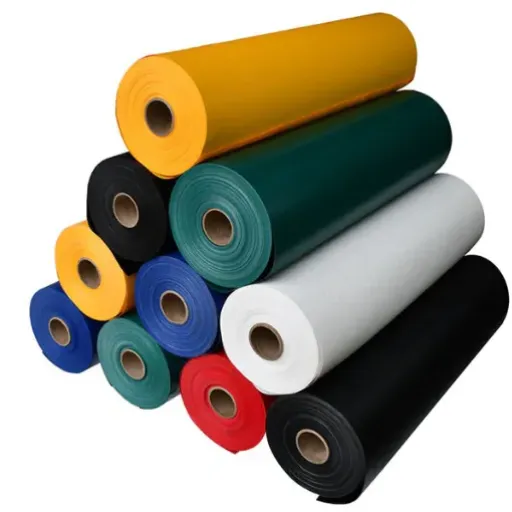
A tensile membrane specification that returns clean, comparable bids has three blocks in it. Missing any one of them produces quotes you cannot compare.
The material specification should state: grade and nominal weight; base fabric denier, yarn tenacity and weave; warp and fill tensile to EN ISO 1421 or ASTM D751; tear strength to EN ISO 4674 or ASTM D4533; coating adhesion; topcoat type and explicitly whether it is weldable as supplied; anti-wicking treatment; required fire classification; colour and light transmission; roll width; and dimensional tolerances.
The qualification block should demand: a per-batch test report with raw data rather than a summary sheet; seam coupon results traceable to the panel; a flame-retardant certificate naming the exact construction and density tested; UV aging data; and cold-crack performance for the destination climate.
The commercial block should fix: minimum order quantity; prototype or sample panel; lead time; panel takeoff and waste allowance; roll-to-panel traceability; and how finished panels are packed, labelled and shipped so they can be identified on site. Confirm traceability early, because it is the difference between a supplier who can answer a question about a specific panel and one who cannot.
If your destination market has its own regime on top of these, and several do, that sits alongside this pack rather than replacing any part of it. Batch quality control is where the per-batch discipline lives.
Frequently Asked Questions
What is the difference between PVC coated fabric and a tensile membrane?
Same three-layer construction, different duty. A tarpaulin is specified by weight and covered area. A PVC architectural membrane grade is specified by warp and fill tensile strength derived from a load case, by dimensional stability, by a topcoat that can be welded, and by the fire classification the finished roof assembly can achieve.
What GSM PVC coated fabric do I need for a tensile structure?
Usually 650 to 1,250 gsm for canopies and roofs, and 1,350 gsm and above for wide spans and exposed sites. Work the derivation first, though. On a small canopy the arithmetic often shows the lightest grade already carries the load, which means stiffness, ponding and handling are choosing your fabric rather than strength.
What is prestress in a tensile membrane structure?
Prestress is the permanent tension held in the membrane in both warp and fill, typically around 1.5 to 3.5 kN/m, roughly 150 to 350 kg per metre. It creates the double curvature that gives the surface its stiffness and its ability to shed rain and resist wind. Lose it, and the membrane ponds and drums.
Can PVDF coated fabric be welded?
Sometimes. Weldable PVDF is a PVDF alloy formulated to lap-weld as supplied, and it is the practical default for permanent PVC roofs. 100% PVDF is not weldable: the lacquer must be ground off along every weld line first, or the joint must be butt-welded instead of lapped.
Does NFPA 701 make my fabric roof code compliant?
No. NFPA 701 Method 2 is a specimen flame-propagation test. A permanent fabric roof additionally needs a roof-covering classification to ASTM E108 or ANSI-UL 790, interiors need ASTM E84 surface-burning data, and noncombustible construction needs ASTM E136. The certificate is necessary and it is not sufficient.
Does a membrane structure need an annual inspection?
Yes. Manufacturer inspection instructions must be transmitted with the structure, and the owner carries an annual inspection and maintenance duty plus a periodic inspection by a professional engineer, registered architect, or manufacturer-certified individual, commonly at least biennially.
How long does a PVC tensile membrane actually last?
Structurally, PVC-polyester can exceed 20 years. The lifespan usually quoted is based on appearance rather than strength, because plasticisers migrate to the surface and the membrane becomes harder to clean. Buyers replace membranes for cosmetics while the load-bearing scrim is still sound, unless the structure is demountable, in which case a fabric used a few weeks a year can plausibly reach 25 to 30 years.
Conclusion
A tensile membrane fabric is the one coated-fabric product where the buyer specifies both a material and the evidence that proves it. Four things decide how that goes.
- Derive the grade, do not buy by weight. Prestress, load case and safety factor give you a required tensile strength. Compare it to the ladder, then ask what is really setting your grade.
- The topcoat is a welding decision. The better the topcoat for durability, the harder it is to fabricate. Price the weld preparation before the topcoat is fixed, not after.
- The seam is a document. Specify it as a percentage of base tensile, keep peel and adhesion tests separate, and demand per-batch coupons traceable to the panel.
- The roof is the regulated object. NFPA 701 covers a specimen. ASTM E108, E84 and E136 cover the building, and the confirmatory field-test and inspection duties run past handover to the owner.
PVC coated fabric for tensile structures rewards buyers who specify it as an engineered assembly rather than a roll of material. That is what our engineering team does all day. Request a specification and qualification pack for your next membrane project, and we will return the grade band, the weld requirements and the compliance matrix your engineer will need in order to defend it.