
Inflatable Advertising Fabric: PVC Specs by Display Type
Inflatable advertising fabric is a coated or woven textile selected by build type, not a single product. Air dancers and blower-fed arches use lightweight woven fabric, usually Oxford. Sealed printed shapes, inflatable billboards and large replicas use PVC-coated polyester or TPU in roughly the 450 to 750 gsm range. The format decides the fabric, and the print and weld process decide whether it survives its first season.
In March 2025, a print shop in Rotterdam quoted a 4 m sealed advertising sphere in 500 gsm PVC. The graphics were sharp. The first seam failed at 18 PSI because the printer had run ink through the weld zone. The reprint, with a 25 mm unprinted margin, held.
You already know that “PVC fabric” isn’t a specification. This guide gives you format-by-format weights. It covers the print and weld rules that keep seams airtight, the fire standards that apply to public venues, and a purchase specification you can send to a mill.
We manufacture PVC and TPU coated fabrics and test production batches, so we have a stake in this argument. We also know where our range stops, and this guide says so where it matters. and we will recommend a weight, weld margin and test plan.
Key Takeaways
- Advertising inflatables split into constant-air, sealed-air and helium-lift builds. Each uses a different fabric class, and one weight can’t serve all three.
- Typical starting ranges: air dancers 80–120 gsm, cold-air arches and tents 200–320 gsm, sealed printed shapes 450–650 gsm, large sealed structures 610–750 gsm.
- UV, solvent and latex inks are the safe route on PVC. Dye sublimation runs at 190–215°C, well above the point where PVC softens, so standard PVC isn’t a sublimation substrate.
- NFPA 701 Method 2 covers fabrics used in banners, tents, tarps and membrane structures. EN 14960-1 covers inflatable play equipment, not advertising inflatables.
- Specify GSM tolerance, coating adhesion, weld peel, pressure hold and print adhesion per lot. A certificate without a lot number doesn’t tell you what is on the roll.
What Inflatable Advertising Fabric Has to Do
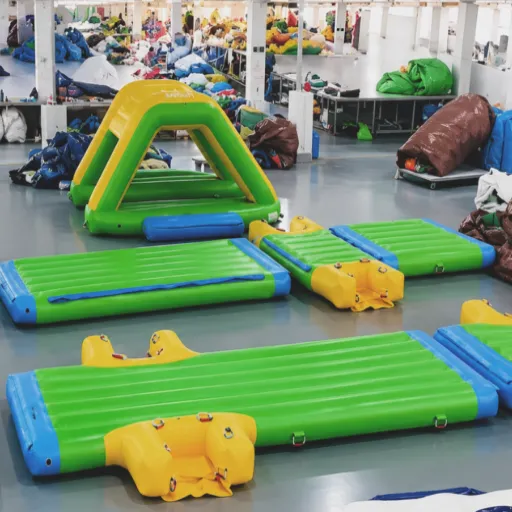
An advertising inflatable has little or no frame. The fabric is the structure. It carries the inflation load, the wind load, the hanging load and the print, and it does those jobs while staying light enough to pack, ship and install.
The phrase inflatable advertising material covers all three build types. The fabric does not.
The format list is longer than most buyers expect. Air dancers, cold-air arches and columns, branded tents, sealed spheres and ground balloons, mascots and custom replicas, inflatable billboards and projection screens, hanging signs, and helium-filled blimps. Each one loads the material differently.
The first decision is how the display stays inflated.
| Build | How it stays up | Fabric requirement | Typical formats |
|---|---|---|---|
| Constant air | A blower runs continuously; seams don’t need to be airtight | Light, flexible, abrasion-resistant, printable | Air dancers, arches, columns, cold-air tents, large sealed-look shapes |
| Sealed air | Inflated once; coating and welded seams must hold pressure | Airtight coated fabric, weldable, low flex fatigue | Spheres, ground balloons, sealed replicas, inflatable billboards |
| Helium lift | Gas lifts the envelope; every gram comes out of the lift budget | Very light film or coated nylon with low gas permeability | Blimps, helium balloons, suspended shapes |
A constant-air arch can be sewn because the blower keeps replacing the air that leaks through the stitches. A sealed sphere can’t. The seam is the pressure boundary, and the coating has to be weldable across its full width.
Format first, material second. That difference explains most material arguments. A buyer who compares a 120 gsm Oxford arch with a 610 gsm PVC sphere isn’t comparing quality. They are comparing two different structures.
The second job is visibility. The fabric has to accept ink, hold color outdoors, and survive handling without the print cracking at the fold. A material that passes a flat-sheet print test can still fail at a welded seam, because the ink and the weld compete for the same surface.
Our covers the coated side of that problem. The rest of this guide is about matching the roll to the format.
Match Advertising Inflatable Fabric Weight to the Format
Weight is the first number most buyers quote, and the least useful on its own. A 500 gsm fabric can be sound for a sealed sign and wrong for a 6 m cold-air arch. Base denier, coating formulation and seam design decide which. Weight isn’t durability.
Use the table as a starting range, then confirm with the maker who will weld the finished item.
| Format | Airflow | Typical fabric | Starting weight | Governing property |
|---|---|---|---|---|
| Air dancer | Constant air | Coated polyester or Oxford | 80–120 gsm | Flex fatigue, print stretch, low weight |
| Cold-air arch, column or tent | Constant air | PVC-coated polyester or 600D Oxford | 200–320 gsm | Abrasion, seam strength, print area |
| Rental-grade arch or tent | Constant air | PVC-coated polyester | 300–500 gsm | Repeated handling and anchoring |
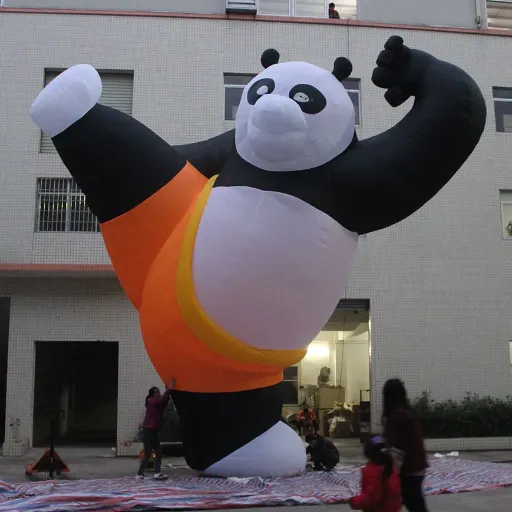
| Sealed printed sphere, mascot or ground balloon | Sealed air | PVC-coated polyester or TPU | 450–650 gsm | Weld strength, air retention, print |
| Inflatable billboard or screen | Sealed air or frame-supported | PVC-coated polyester | 500–650 gsm (0.4–0.6 mm) | Print, wind load, reinforcement |
| Large sealed structure or stage prop | Sealed air | PVC-coated polyester on 1000D base | 610–750 gsm | Tensile, seam, anchoring |
| Helium blimp or balloon | Helium lift | Lightweight PVC film or TPU-coated nylon | 180–250 gsm class | Gas retention, envelope weight |
| Hanging inflatable sign | Frame or low-pressure air | PVC-coated polyester | 300–510 gsm | Print, hang points, wind relief |
Two rows deserve a warning.
The first is helium. A helium blimp isn’t a scaled-down sealed structure. The envelope has to be light enough that the gas can lift the fabric, the valves, the rigging and the payload. Weight is the design constraint, not durability.
Layla, a procurement manager for an event agency in Dubai, specified 650 gsm PVC for a 4 m helium blimp because the heavier roll felt more premium. The envelope area was about 50 m², so the fabric alone weighed roughly 33 kg.
A 4 m sphere holds about 33 m³ of helium, which gives around 37 kg of lift at sea level. After valves, rigging and tolerance, the design had almost nothing left. The project moved to a 220 gsm TPU-coated nylon envelope. The 650 gsm roll became ground-level signage.
The second is the billboard row. Inflatable billboard fabric is a large printed surface with a pressure boundary and a wind load. A 500 gsm roll can be correct, but only if the base fabric, weld width and anchor design match the span. A 500 gsm roll with a light base and a narrow seam isn’t the same product as a 500 gsm roll built for a 6 m span.
Cold air inflatable fabric follows a different logic: the blower supplies the pressure, so the roll can be lighter and more flexible. For sealed advertising shapes, our set out the denier, weave and coating combinations behind those bands.
PVC, Oxford or TPU for Advertising Inflatables
Three material families cover most advertising inflatables. They aren’t interchangeable, and the cheapest one isn’t always the one that costs least in service.
| Property | PVC-coated polyester | Oxford (coated woven polyester or nylon) | TPU-coated fabric |
|---|---|---|---|
| Airtight when welded | Yes | No, not inherently | Yes |
| Typical base | 500D–2,000D polyester | 210D, 420D or 600D | 200D–600D polyester or nylon |
| Typical finished weight | 300–1,500 gsm | 100–330 gsm | 200–600 gsm |
| Joining | High-frequency (HF), hot-air or solvent welding | Sewing, or heat sealing where coating allows | RF or hot-air welding |
| UV, solvent, eco-solvent, latex | Sublimation, UV, screen print | UV, solvent, latex with suitable surface | |
| Cold flex | Good to −30°C with the right formulation | Moderate | Excellent |
| Outdoor life | 3–7+ years depending on grade and care | 1–2 years typical | 5–10 years in premium builds |
| Relative material cost | Mid | Low | High, several times PVC |
| Best advertising use | Sealed shapes, billboards, large structures | Air dancers, cold-air arches, short-run displays | Premium sealed shapes, cold-climate and lightweight builds |
PVC fabric for advertising inflatables is usually a . It is the default for sealed shapes because it welds well, accepts print, and comes in a wide color range.
The weaknesses are weight and plasticizer migration. A cheap formulation stiffens with UV and heat, then cracks at the fold. A UV-stabilized, weld-compatible formulation behaves differently, which is why two rolls at the same GSM can have different service lives.
Oxford is a weave, not a quality grade. A 600D Oxford with a thin PU coating and a 600D Oxford with a heavier PVC coating are both sold as “600D Oxford” and behave nothing alike. Oxford suits constant-air displays because it’s light, packs small and accepts sublimation print. It doesn’t become airtight because the label says “coated.” If the display has to hold air without a blower, Oxford is the wrong starting point.
TPU is the premium route. It is lighter for the same strength, flexes at low temperature without plasticizer migration, and welds into a strong airtight seam. It also costs several times what PVC costs per square metre and demands a tighter weld window.
For a cold-climate installation or a helium-lifted envelope, that trade can be correct. For a ground-level billboard in a mild climate, it usually isn’t.
The practical rule is simple. Constant air, choose Oxford or a light PVC; sealed air, choose PVC or TPU; helium lift, choose the lightest envelope that meets the gas-retention target. Then specify the base and coating, not just the family name.
Our lists the constructions we produce. If your design needs a lead-free or phthalate-free compound, that is a separate specification conversation.
Printing and Welding on Inflatable Advertising Fabric
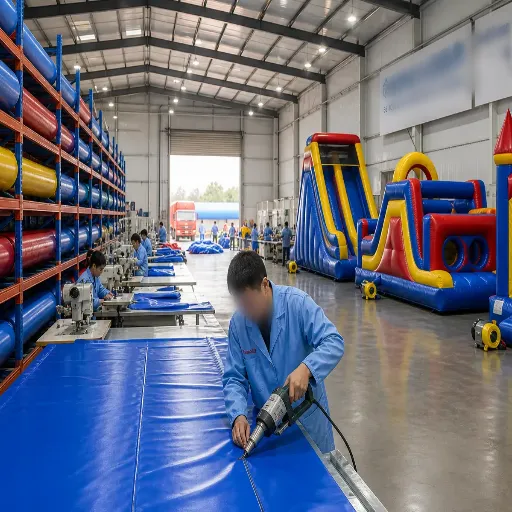
Print and weld are usually bought from different suppliers and specified in different documents, even on one inflatable advertising fabric order. That is where advertising inflatables fail.
A welded seam needs clean, compatible polymer surfaces. UV, solvent and latex inks leave a cured film on the surface. If that film crosses the weld zone, the welder is bonding ink to ink or ink to coating, not coating to coating. The seam can look perfect and fail a peel or pressure test.
Ink is a contaminant at the seam.
The fix is a print file with a weld allowance. Leave 20–30 mm unprinted along every seam, then confirm the exact margin with the welding equipment supplier. The printer needs that instruction before file setup, not after the first roll is printed.
The ink system also has to match the fabric.
- UV-curable ink cures under a lamp at ambient temperature and sits on the surface. It works on PVC-coated fabric, allows white ink on dark rolls, and is the usual choice for promotional tents, arches and balloons.
- Solvent and eco-solvent ink penetrates and dries by evaporation. It is common on banner material and works on PVC, but cure and adhesion need to be verified on the actual roll.
- Latex ink uses heat to coalesce the ink film. It can work on PVC, but the heat history matters, especially on thin coatings.
- Dye sublimation dyes the polyester fiber and needs 190–215°C. Standard PVC softens around 60–80°C and degrades above roughly 150–180°C, so it isn’t a sublimation substrate. Some PVC-coated polyester can accept sublimation dye on the polyester side, but that’s a supplier-specific product. Don’t assume it from the words “PVC coated.”
The Rotterdam failure at the start of this guide is the common version. The printer used a full-bleed file, the welder bonded through the ink, and the seam opened at 18 PSI. The second run left 25 mm unprinted, used the same welder settings, and passed the pressure test.
Test the combination, not the components. Print a coupon on the production roll, weld it on the production machine, and pull it at 180°. The base fabric should tear before the weld separates.
Then inflate a sample chamber to 1.5 times the operating pressure and hold it for 24 hours. Air loss should stay under 5%.
For printed flat banners rather than inflatables, the ink and substrate question changes. Our is built for that job, where the banner is supported by a frame and doesn’t have to hold pressure.
<iframe width=”560″ height=”315″ src=”https://www.youtube-nocookie.com/embed/hWIRsIVuVbw” loading=”lazy” title=”Hot air welding machine for PVC fabric, tents and inflatable boats” frameborder=”0″ allow=”accelerometer; autoplay; clipboard-write; encrypted-media; gyroscope; picture-in-picture; web-share” allowfullscreen></iframe>
Want to test ink and seam together? with your ink system and weld settings, and we will supply a matched sample length.
Fire, UV and Weather: Where Standards Actually Apply
Fire performance is the specification most often written incorrectly. “NFPA 701” on a purchase order isn’t enough. The standard has two methods, and the method changes the specimen, the cabinet and the pass criteria.
NFPA 701 Method 1 covers fabrics and films up to 700 g/m², with exclusions for vinyl-coated blackout linings, plastic films and other material types. Method 2 covers heavier materials and a list of applications that includes awnings, tents, tarps, membrane structures and banners. A 500 gsm printed billboard can therefore fall under Method 2 because of how it’s used, not only because of its weight.
Ask for the method, not the logo. Write the method into the specification, and ask the venue or authority having jurisdiction which edition and method they require. The is the reference to start from.
Europe uses a different vocabulary. DIN 4102 B1/B2 is a German classification. EN 13501-1 is the harmonized reaction-to-fire classification.
M2 is the French class. BS 5867 Part 2 Type B is a British test for fabrics. They aren’t interchangeable, and a report for one doesn’t automatically satisfy another.
One standard that doesn’t belong in an advertising specification is EN 14960-1. It is written for inflatable play equipment used by children 14 and under, where the primary activity is bouncing or sliding.
Advertising inflatables don’t meet that scope. The makes the play-equipment boundary clear. Venues usually ask for a fire test, not a play-equipment certificate.
UV performance is a separate argument. A UV-stabilized coating slows chain scission, but it doesn’t stop print fade. Unlaminated outdoor graphics commonly carry two- to three-year print warranties in vertical exposure. The fabric may still be sound when the graphics are tired, so plan the replacement cycle around the print, not the coating.
Cleaning and storage matter as much as the additive package. Dirt holds moisture and heat, folds crease the coating, and long compression without a release layer can block the print. A display that’s packed wet and stored in a hot container will age faster than the datasheet predicts.
Our covers the test methods and the evidence to request in more detail.
What to Put in an Inflatable Advertising Fabric Specification
An inflatable advertising fabric specification is useful when a mill can quote it without asking what you meant. The table below is a working format.
| Parameter | What to write | Why it matters |
|---|---|---|
| Application | Air dancer, cold-air arch, sealed sphere, billboard, blimp | Sets the airflow and load case |
| Dimensions | Finished size, span, height, anchor points | Determines wind and hang loads |
| Airflow | Constant air, sealed air or helium | Eliminates the wrong material family |
| Fabric type | PVC-coated polyester, Oxford, TPU-coated | Defines weld and print process |
| Base fabric | Denier and weave, e.g. 1000D × 1000D, 23 × 23 | Controls tensile and tear strength |
| Weight | GSM plus tolerance, e.g. 610 gsm ±5% | Coating thickness and weld behavior |
| Coating | Virgin PVC, UV-stabilized, FR additive, lead-free | Service life and compliance |
| Width | Roll width, up to 3.2 m standard or custom | Seam count and material yield |
| UV, solvent, latex; coverage; weld margin | Ink adhesion and seam integrity | |
| Weld | HF or hot air; overlap 20–30 mm | Pressure boundary |
| Fire | Standard and method, e.g. NFPA 701 Method 2 | Venue approval |
| Color | Pantone or RAL target, batch tolerance | Brand consistency |
| Reinforcement | D-rings, straps, valve patch, baffles, wind relief | Local load paths |
| Packing | Roll core, interleaving, moisture barrier | Print blocking and transport damage |
| Documents | Lot test report, GSM and width record, FR report | Traceability |
The last row is the one buyers forget. A test report without a lot number tells you what the mill can make. A report with a lot number tells you what is on your roll.
Ask for six documents before bulk production:
- A lot-referenced tensile and tear report, tested to ISO 1421 or the equivalent method in your market.
- A GSM and width record for the production lot, with the tolerance stated.
- A coating adhesion result, tested to the method named in your specification.
- A weld peel result from a coupon made on production settings.
- A pressure-hold result on a finished sample, not only on the flat sheet.
- A fire test report that names the standard, the method and the specimen weight.
If any document is missing, treat the roll as unqualified. That is a procurement decision, not a technical one.
Thickness and GSM tolerance are measured differently by different suppliers, which is why the tolerance belongs in the purchase order.
Bring your inflatable fabric requirements to LY TRUSTLINK.
Quality Checks Before Bulk Production
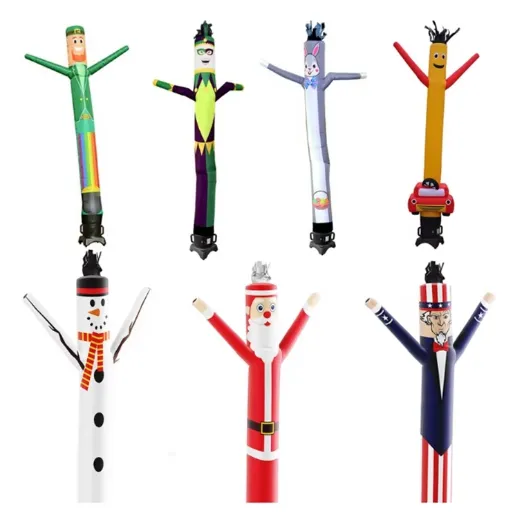
Five checks catch most inflatable advertising fabric failures before the first installation. Each check maps to a method in our .
| Check | Method | Pass criterion |
|---|---|---|
| Weight consistency | Cut samples across the roll width and along the length | Within the stated tolerance, typically ±5% premium or ±10% standard |
| Coating adhesion | Peel test to the named method | Meets the quoted adhesion value; no clean separation |
| Weld peel | 180° pull on a production coupon | Base fabric tears before the weld separates |
| Pressure hold | Inflate to 1.5× operating pressure, hold 24 hours | Air loss under 5% |
| Print adhesion and cold fold | Tape pull plus flex at the lowest service temperature | No ink lift, no cracking at the fold |
The lot is the unit of quality. Run the checks on the production lot, not on a laboratory sample. The variables that matter, resin source, coating line, cooling profile and weld settings, are all lot-specific.
Tom, an operations manager at a UK event supplier, ordered 2,000 m² of 610 gsm PVC for a run of 40 cold-air arches. The mill’s certificate said 610 gsm. His incoming samples measured 585 to 632 gsm across the roll.
Twelve arches leaked at the seam within a week. The batch was scrapped. The replacement order added a per-roll GSM record and a production weld coupon to the purchase order.
The cost of those two documents is small. The cost of a failed batch is the fabric, the labor, the freight and the event.
Tensile testing is the anchor for the other numbers. The defines how coated fabrics are pulled, so a supplier’s number can be compared with a competitor’s.
Frequently Asked Questions
What fabric are advertising inflatables made of?
Advertising inflatables are made from three material families. Coated woven fabric covers constant-air displays. PVC-coated polyester or TPU covers sealed airtight displays. Lightweight film or coated nylon covers helium-lifted envelopes.
The format decides which one, and the weight range follows from the airflow and load case.
Is PVC or Oxford better for an advertising inflatable?
PVC is better when the display must hold air without a blower, carry a large printed surface, or survive repeated outdoor handling. Oxford is better when the display runs on a blower, needs to pack small, and will be replaced before the fabric wears out. Oxford isn’t airtight, so it can’t replace PVC on a sealed shape.
What weight PVC should an inflatable billboard use?
Most inflatable billboards start at 500–650 gsm, roughly 0.4–0.6 mm, on a base fabric heavy enough for the span. The span, wind load and anchor design decide whether that range is sufficient. A 500 gsm roll with a light base isn’t equivalent to a 500 gsm roll built for a 6 m span.
Can you print on PVC inflatable fabric?
Yes. UV-curable, solvent, eco-solvent and latex inks are used on PVC-coated fabric. Dye sublimation isn’t a default option because it runs at 190–215°C and standard PVC softens well below that. The print file must leave an unprinted weld margin, usually 20–30 mm, and the printed coupon should be weld-tested before production.
Does an advertising inflatable need to be fire retardant?
Often, yes. Public venues, exhibition halls and permitting authorities commonly require a fire test for banners, tents, tarps and membrane structures. NFPA 701 Method 2 is the common US reference for those applications; DIN 4102 B1, EN 13501-1 and M2 are used in Europe. Confirm the exact standard and method with the authority having jurisdiction.
How do I test fabric before ordering a full roll?
Order a sample length from the production lot, then check GSM across the width, coating adhesion, weld peel, pressure hold and print adhesion. If the display is printed, test the printed coupon on the production welder. A flat-sheet print test alone doesn’t prove the seam will hold.
The Bottom Line
Inflatable advertising fabric is a format decision before it’s a material decision. Constant-air displays need light, flexible, printable fabric. Sealed displays need an airtight, weldable coating. Helium displays need an envelope light enough for the lift budget.
Once the format is fixed, three specifications control the outcome: the base denier and weave, the GSM and its tolerance, and the print and weld process as one system. Fire performance follows the application and the venue, not the fabric label alone. Quality follows the lot, not the certificate.
We supply PVC and TPU coated fabrics for sealed advertising shapes, billboards, large structures and printed inflatables. Widths run up to 3.2 m and weights from 300 to 1,500 gsm. Our standard range starts at 300 gsm, so we will point you elsewhere if your helium envelope needs a lighter film.
with your display format, finished dimensions, airflow, print method and target fire standard. We will reply with a construction, the tests we can document for the lot, and a recommended inflatable advertising fabric specification.