
PVC Inflatable Fabric: Specs, Airtightness & Sourcing Guide
PVC inflatable fabric is a woven polyester scrim coated or laminated with polyvinyl chloride on both faces. It is specified by four numbers: base-cloth denier, finished weight in GSM, thickness in millimeters, and air permeability. For most commercial inflatables, the working band is 500–650 GSM with a 500D–1000D scrim and a 0.35–0.55 mm finished thickness. Marine and high-pressure structures move up to 1000D–1500D and 0.9–1.1 mm.
A tarpaulin keeps water out. An inflatable fabric keeps air in. That difference is measured in pressure retention, seam integrity, and coating continuity, not in how heavy the roll feels.
Most buyers start with price per square meter and a weight label. That works until a seam opens in season two.
This guide gives you the specification bands, the test methods behind them, and the RFQ fields that make a supplier’s answer verifiable. You’ll see how denier, GSM, and thickness relate. You’ll also see how airtightness is tested, which standards apply in each market, and how to compare total cost instead of unit price.
Our engineering team specifies coated fabrics for inflatable manufacturers, rental fleets, and marine fabricators. If you’re specifying a run now, send the application and target service life to our team and request a spec-matched sample.
Key Takeaways
- Denier, GSM, and thickness are three different measurements. Specify all three; a weight label alone does not define tear strength or air retention.
- Airtightness is a system property. Coating continuity, seam welding, and valve seating decide pressure retention more often than coating weight.
- 500–650 GSM with a 500D–1000D scrim covers most commercial bounce houses and dry inflatables. Boats and high-pressure structures typically need 1000D–1500D and 0.9–1.1 mm.
- Match compliance to the market: ASTM F2374-24 and CPSIA in the US, EN 14960-1 and REACH in the EU, NFPA 701 where flame propagation applies.
- A 12-field RFQ plus lot-level test reports prevents most field failures and makes unit-price comparisons meaningful.
What Is PVC Inflatable Fabric?
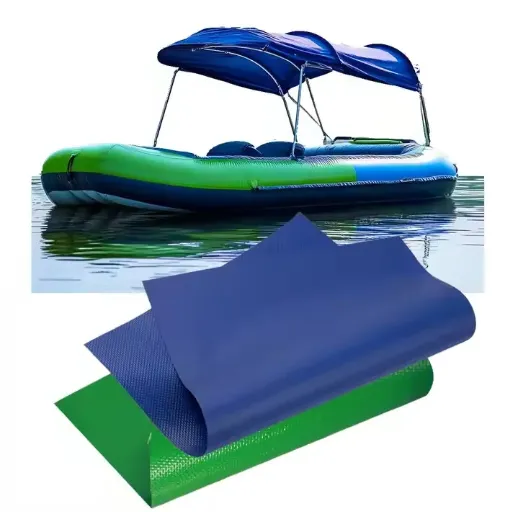
PVC inflatable fabric is a composite of a woven polyester scrim and a PVC coating or film on both faces. The scrim carries load. The PVC provides the airtight barrier and the weldable surface. The combination holds pressure, resists abrasion, and can be joined into large chambers without stitching.
Buyers often use PVC inflatable material and PVC inflatable fabric interchangeably. Both describe the same coated composite, though suppliers may reserve one phrase for a finished roll and the other for a fabricated product.
Construction: scrim, coating, and lamination
The base cloth is usually an oxford weave of high-tenacity polyester, from 300D to 1500D. The weave matters because it determines tear propagation and seam strength. A tighter weave with higher yarn density resists seam pull-out better than a loose weave of the same weight.
There are two ways to apply the PVC. Coating spreads PVC plastisol into and onto the scrim, then fuses it. Lamination bonds a pre-formed PVC film to the scrim with adhesive and heat.
Coating encapsulates the yarns. Lamination gives a smoother, more uniform barrier. Both can be airtight when the film or coating is continuous.
Ask which process your supplier uses. It affects weldability and how the fabric folds.
How PVC inflatable fabric differs from PVC tarpaulin
A tarpaulin is built to shed water. An inflatable fabric is built to hold pressure. That changes the construction.
Tarpaulins often use a lighter coating, a looser weave, and sewn or hemmed edges. Inflatable fabrics need a continuous coating on both faces, welded seams, and a scrim that carries pressure load without stretching. A tarp can be waterproof and still leak air through a stitch line.
This is why a heavy-duty PVC tarp is not a substitute for an inflatable-grade fabric, even when the two look similar on a sample card.
The material family: PVC, TPU, nylon, Oxford, and drop stitch
PVC is the default for large inflatables because it balances cost, weldability, and abrasion resistance. TPU is lighter, more flexible, and can be formulated without phthalates, but it costs more and needs different welding parameters. Nylon and Oxford fabrics are light-duty options for consumer inflatables. Drop stitch is a construction, not a polymer. Two fabric faces are connected by thousands of internal yarns. That lets a flat panel hold high pressure and become rigid.
For a detailed polymer comparison, see PVC vs TPU for inflatables. The rest of this guide focuses on PVC, because that is where most commercial volume sits.
PVC Inflatable Fabric Specifications That Decide Performance
Four numbers do most of the work: denier, GSM, thickness, and coating formulation. They are related, but they are not interchangeable.
Base cloth denier
Denier measures yarn mass per 9,000 meters. A 1000D yarn is heavier and thicker than a 500D yarn. In practice, higher denier raises tear strength, abrasion resistance, and seam holding power. It also adds weight and stiffness.
- 300D–500D: light-duty inflatables, advertising displays, small consumer products.
- 500D–1000D: commercial bounce houses, dry inflatables, water slides, air structures.
- 1000D–1500D: boats, RIBs, high-pressure structures, heavy abrasion.
Denier is not finished fabric weight. A 1000D scrim can be coated to 500 GSM or to 900 GSM. The scrim sets the mechanical backbone; the coating sets the barrier and the hand feel.
Coating weight (GSM and oz/yd²) and thickness
GSM is the finished weight in grams per square meter, including the coating. The inflatable trade also uses ounces per square yard. One ounce per square yard is about 33.9 GSM, so 15 oz is roughly 508 GSM, 18 oz is about 610 GSM, and 20 oz is about 678 GSM.
PVC inflatable fabric thickness is often quoted as a single number. In practice, thickness is an output of scrim plus coating. A 650 GSM fabric is commonly around 0.55 mm. A 900 GSM fabric is often around 0.7 mm. A 1,100 GSM marine fabric is often around 0.9 to 1.1 mm.
Do not specify GSM alone. Two fabrics at 650 GSM can have different denier, different coating split, and different tear performance. Ask for the coat weight per side as well as the total.
A 650 GSM fabric with a 1000D scrim and a heavy topcoat behaves differently from a 650 GSM fabric with a 500D scrim and a thin coat. The roll labels still match.
Surface treatment and formulation
The base polymer is only part of the specification. The formulation decides how long the fabric lasts and what it can be used for.
- UV stabilizers: slow chalking, color fade, and tensile loss outdoors.
- Flame retardants: change flame spread, but can affect flexibility and weldability.
- Anti-mildew and anti-static additives: matter in humid or dust-heavy service.
- Phthalate-free plasticizers: required for many children’s products and some medical applications.
- Surface finish: gloss, matte, or embossed. It affects printability, cleaning, and slip resistance.
Each addition can change the weld window. A flame-retardant grade that welds well at one supplier may need different parameters at another. Test the actual production lot, not just the sample.
Need reliable PVC-coated materials? Connect with LY TRUSTLINK.
Width, roll length, and seam allowance
Standard roll widths run from about 1.5 m to 3.2 m. Wider rolls reduce the number of seams in a large chamber, which reduces leak paths and labor. Roll length is usually 50 m, but confirm it.
Seam allowance depends on the welding method. RF welding typically needs 6 to 10 mm of overlap; hot-air welding often needs 25 to 40 mm. If the cutting plan assumes the wrong allowance, the finished panel comes up short.
| Denier | Typical GSM | Typical thickness | Typical use |
|---|---|---|---|
| 300D–500D | 270–500 | 0.25–0.45 mm | Advertising inflatables, light consumer products |
| 500D–1000D | 500–650 | 0.35–0.55 mm | Commercial bounce houses, dry inflatables |
| 1000D | 650–900 | 0.55–0.70 mm | Water slides, water parks, air structures |
| 1000D–1500D | 850–1,100 | 0.90–1.10 mm | Boats, RIBs, high-pressure structures |
Ranges are typical market bands. Confirm against the application, the weld method, and lot test data.
Compare the two common commercial grades: 500D PVC inflatable fabric and 1000D PVC inflatable fabric.
Airtightness and Pressure Retention in PVC Inflatable Fabric
Airtightness is the property that separates an inflatable fabric from a coated tarp. It is also the property buyers test least often before ordering. When buyers ask for airtight fabric for inflatables, the specification they need is not a single permeability number. It is a tested chamber with controlled seams and valves.
What airtight actually means
Air permeability is measured as a volume of air passing through a defined area at a stated pressure differential. ASTM D737-18 is the common textile method; ISO 9237 is the international counterpart. Results are reported in cm³/cm²/s or mm/s at a stated pressure.
A well-coated inflatable fabric should show very low permeability. However, a low permeability result on a flat sample does not prove the finished chamber will hold pressure. Seams, valves, and cut edges are not in that sample.
The pressure-decay test
A pressure-decay test inflates the finished chamber, isolates it, and records pressure over time. The test should control for temperature, because a warm afternoon can raise pressure and hide a leak.
There’s no single universal pass/fail threshold. Define the acceptance criterion with your customer and the applicable standard. A common production check is a 24-hour hold at 1.25 to 1.5 times working pressure, with no drop beyond the agreed tolerance.
Ask for the test conditions, the starting pressure, the hold time, and the acceptance limit. A report that says passed without those four details is not useful. Bring your inflatable fabric requirements to LY TRUSTLINK.
Where leaks start: seams, valves, and pinholes
Most pressure loss happens at interfaces, not in the middle of a panel.
- Seams: under-welded joints, contaminated surfaces, or insufficient overlap.
- Valves: a poorly seated valve, a weak base weld, or a missing reinforcement patch.
- Pinholes: coating defects, needle damage from handling, or sharp folds.
- Cut edges: exposed scrim that wicks air along the yarn.
A leak path is usually a process problem, not a polymer problem. That is why the same fabric can perform well in one factory and poorly in another.
Start your next inflatable fabric project with LY TRUSTLINK.
Valve construction and placement
The valve is a small part with a large effect on perceived quality. A welded flange distributes stress better than a glued flange. A reinforcement patch spreads load into the panel. Placement matters too: a valve in a high-flex zone will fatigue faster than one in a low-stress area.
For a rental fleet, valve repairs are often the most common maintenance item. Specify the valve type, flange method, and patch construction before production.
Consider a rental operator we’ll call Daniel. He runs 60 bounce units and tracked every repair for two seasons. The fabric itself held up. The failures clustered at valve bases and along two seam lines.
When he specified a welded valve flange and a wider RF seam overlap on the next order, the repair log thinned out. The fabric cost rose by a few percent; the labor and downtime fell by more. It’s an illustrative scenario, but the pattern is common.
For the test methods behind these checks, see coated fabric testing.
Performance Data by Fabric Weight
A spec sheet is only useful if every number has a method behind it.
| Property | Test method | Unit | What it tells you |
|---|---|---|---|
| Breaking strength | ASTM D751 (grab or strip) | N/5 cm | Load capacity of the base fabric |
| Tear strength | ASTM D751 (tongue or trapezoid) | N | How easily a tear propagates |
| Coating adhesion | ASTM D751 or DIN 53357 | N/5 cm | Bond between coating and scrim |
| Hydrostatic resistance | ASTM D751 | cm H₂O or kPa | Water barrier under pressure |
| Air permeability | ASTM D737 | cm³/cm²/s | Air barrier at a stated pressure |
| UV aging | ASTM G154 | hours, % retention | Weathering life |
| Cold flexibility | ASTM D2136 or customer method | °C | Cold-crack resistance |
Tensile and tear strength
Tensile strength tells you how much pull the fabric takes before it breaks. Tear strength tells you how a cut or pinhole behaves once it starts. For inflatables, tear strength is often the more practical number, because field damage starts as a small cut or abrasion point.
For example, don’t compare a grab tensile value with a strip tensile value. They are different tests. Ask for the method, the sample direction (warp or weft), and the number of specimens.
Coating adhesion and peel strength
Peel strength measures how well the coating stays bonded to the scrim. A low peel value shows up as delamination at folds, seams, and abrasion points. It is especially important in fabrics that will be folded for transport.
DIN 53357 is common in European specifications; ASTM D751 includes adhesion methods for US buyers. Either way, request the value in N/5 cm and the test direction.
UV and weathering performance
UV exposure breaks down the polymer chain, which shows up as chalking, color fade, and loss of tensile strength. The stabilizer package and topcoat determine how long that takes.
ASTM G154 is a common accelerated weathering method. Ask for the exposure hours, the cycle, and the percentage of tensile retention. A claim of UV resistant without those numbers is a label, not a specification.
Cold-weather flexibility
Plasticizers keep PVC flexible at low temperature. A poor plasticizer package makes the fabric stiff and brittle in winter, which leads to cracks at folds and seams.
Ask for a cold-flex or cold-crack result at the lowest expected service temperature. For cold-climate rental fleets, that may be -20°C or lower.
Request a tailored quote for your PVC inflatable fabric project.
PVC Inflatable Fabric Specifications by Application
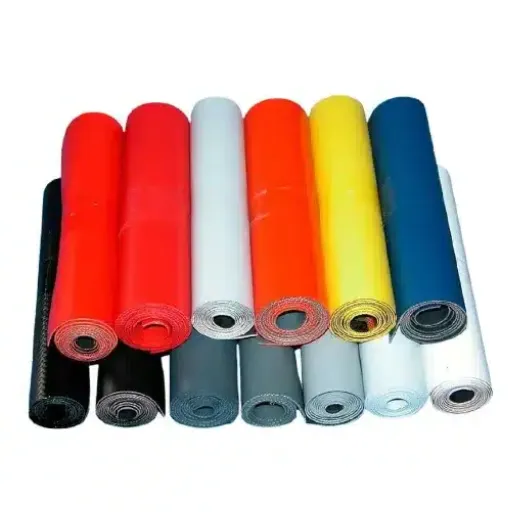
The same polymer serves very different duty cycles. Use the application to set the starting band, then confirm with test data.
| Application | Typical GSM | Typical denier | Typical thickness | Key requirements |
|---|---|---|---|---|
| Commercial bounce houses | 500–650 | 500D–1000D | 0.35–0.55 mm | FR, UV, phthalate-free, weldable |
| Water slides | 650–900 | 1000D | 0.55–0.70 mm | Slip resistance, chlorine, UV, mildew |
| Boats and RIBs | 850–1,100 | 1000D–1500D | 0.90–1.10 mm | Saltwater, UV, abrasion, fuel resistance |
| Air structures and tents | 600–900 | 1000D | 0.50–0.80 mm | FR, cold flexibility, UV |
| Water parks and obstacle courses | 650–900 | 1000D | 0.55–0.70 mm | Abrasion, chlorine, UV |
| Medical, rescue, advertising | 270–500 | 300D–500D | 0.25–0.45 mm | Cleanability, phthalate-free, printability |
Commercial bounce houses and dry inflatables
This is the highest-volume inflatable category, and the one where spec discipline pays fastest. A 500–650 GSM fabric with a 500D–1000D scrim covers most commercial units. For buyers specifying commercial grade thick PVC inflatable fabric, the upper end of that band is usually the safer choice.
Compliance matters here. In the US, ASTM F2374-24 is the reference practice for commercial inflatable amusement devices. In the EU, EN 14960-1:2019 applies.
Children’s products also bring phthalate limits under CPSIA in the US and REACH in the EU. If flame propagation is part of the specification, NFPA 701 is the common US test.
For a deeper bounce-house specification, see bounce house fabric.
Water slides and wet/dry combos
Water slides add chlorine, constant moisture, and slip resistance to the requirement. A 650–900 GSM fabric with a 1000D scrim is a common starting point. The coating needs to resist hydrolysis and mildew, and the surface finish needs to perform wet.
Don’t assume a bounce-house fabric will serve a water slide. The duty cycle is different, and the warranty exposure is higher. See PVC fabric for water slides for the application-specific requirements.
Inflatable boats, RIBs, and marine applications
Marine duty adds saltwater, UV, abrasion, and fuel or oil exposure. Fabric weights move up to 850–1,100 GSM, with 1000D–1500D scrims and 0.9–1.1 mm thickness.
PVC is common, but Hypalon and TPU are also used. Each has a different repair and welding workflow. Specify the polymer, the coating weight, and the test data together, because the same GSM can behave very differently in saltwater.
Air structures, tents, and event domes
Air structures need a fabric that is both airtight and structural. A 600–900 GSM fabric with a 1000D scrim is typical. Cold flexibility matters for winter events, and flame retardancy matters for occupied spaces.
For a permanent structure, confirm the UV package and expected service life. A fabric that lasts three summers may not suit a five-year installation.
Water parks and obstacle courses
Water parks combine abrasion, chlorine, and high traffic. A 650–900 GSM fabric with a 1000D scrim is common. Reinforced seams and abrasion-resistant coatings matter more here than in a dry inflatable.
Ask for chlorine resistance data if the unit will sit in treated water. Standard UV data does not cover that exposure.
Medical, rescue, and advertising inflatables
These are smaller-volume categories with different priorities. Medical and rescue products need cleanability, phthalate-free formulations, and consistent pressure. Advertising inflatables need printability, color consistency, and low weight.
A 270–500 GSM fabric with a 300D–500D scrim is often enough. Don’t over-specify weight; it adds cost and handling burden without improving the outcome.
Not sure which band fits your unit? Send the application, working pressure, and expected service life, and our team will return a spec sheet with the relevant fields filled in. Request an application review.
Consider Priya, a product manager at an inflatable OEM. Her team used a 15 oz fabric in a high-use rental market. The units looked fine in the showroom, but seam failures climbed after the first season.
The fix was not a new polymer. It was an 18 oz, 1000D fabric with a wider RF weld and a stricter weld-parameter log. Warranty claims fell in the next production run. The lesson is that the seam and the scrim often decide the outcome before the coating does. Explore durable PVC inflatable fabric options with LY TRUSTLINK.
Welding and Seam Construction
An inflatable is only as airtight as its worst seam. The welding method, the overlap, and the process control matter as much as the fabric.
RF welding versus hot-air welding
RF welding uses radio-frequency energy to heat the PVC between two electrodes. It’s fast, repeatable, and produces a strong bond on PVC. It works best on smooth, clean surfaces with consistent thickness.
Hot-air welding directs heated air between two layers and presses them together with a roller. It is flexible and works well for large seams and repairs. It is also more sensitive to operator technique, temperature, and speed.
Hot-wedge welding is another option for thick films and heavy seams. The right method depends on the fabric, the seam geometry, and the production volume.
Seam types and overlap
Lap seams, fin seams, and butt seams behave differently under pressure. A lap seam is common for inflatables because it puts the load across two bonded surfaces. The overlap must be wide enough to carry the load without peeling at the edge.
Specify the overlap in millimeters, the weld width, and the test method. Welded seam is not a specification.
Why seams fail before the fabric
Most seam failures come from four causes: insufficient heat, contamination, insufficient overlap, or stress concentration.
A cold weld looks closed but never reaches full bond strength. Dust, mold release, or plasticizer bloom on the surface can block the bond. A narrow overlap peels under pressure. A sharp corner or valve base concentrates stress until the seam starts.
The fix is process control: clean surfaces, calibrated equipment, recorded parameters, and a peel or burst test from each lot.
For more detail, see RF and hot-air welding and why inflatable seams fail.
Certifications and Compliance by Market
Compliance is not a single certificate. It is a set of standards that depend on the product, the market, and the user.
| Market | Standard | What it covers | Typical product |
|---|---|---|---|
| US | ASTM F2374-24 | Design, manufacture, operation, and maintenance of commercial inflatable amusement devices | Bounce houses, slides, obstacle courses |
| US | CPSIA / 16 CFR 1307 | Phthalate limit of 0.1% in children’s toys and child care articles | Children’s inflatables |
| US | NFPA 701 | Flame propagation of textiles and films | Tents, air structures, event inflatables |
| EU | EN 14960-1:2019 | Safety requirements and test methods for inflatable play equipment | Bounce houses, play inflatables |
| EU | REACH | Restricted substances and SVHC disclosure | All PVC inflatables |
| EU | EN 13501-1 | Reaction-to-fire classification | Air structures and tents |
United States
ASTM F2374-24 is the reference practice for commercial inflatable amusement devices. It covers design, manufacture, operation, and maintenance, and it is cited by the CPSC inflatable safety bulletin. CPSIA and 16 CFR 1307 cap specified phthalates at 0.1% in children’s products. NFPA 701 applies where flame propagation is part of the specification.
State and local amusement-device regulators may add inspection, anchoring, and wind requirements. A fabric that meets a national standard can still fail a local inspection if the operating plan is incomplete.
European Union
EN 14960-1:2019 sets safety requirements and test methods for inflatable play equipment. REACH restricts certain substances and requires disclosure of SVHC above the threshold. EN 13501-1 classifies reaction to fire for construction products, which matters for air structures and tents.
How to verify a test report
A certificate is a summary; the report is the evidence. Check the issuing lab, standard and year, sample identification, test conditions, and result.
Ask for the lot number and the production date. A report from a sample made two years ago does not prove the current lot. If the supplier cannot connect the report to the lot, treat the claim as unverified.
For phthalate and heavy-metal compliance, see lead-free PVC fabric for inflatables.
Sourcing PVC Inflatable Fabric: The RFQ Checklist
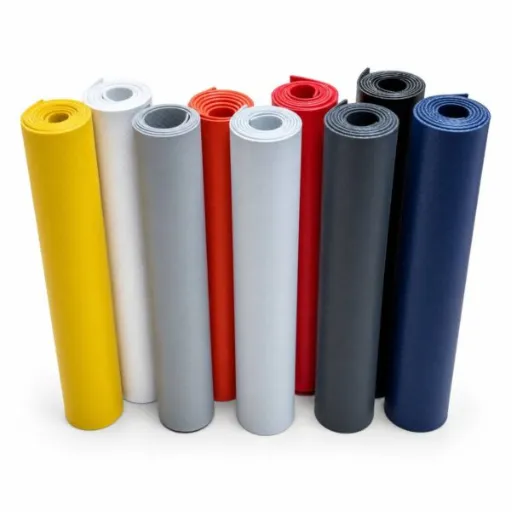
A clear RFQ gets a comparable quote. A vague RFQ gets a low price and a surprise. Choosing a PVC inflatable fabric supplier starts with the same 12 fields.
The 12 fields to specify
| # | Field | What to specify |
|---|---|---|
| 1 | Application and duty cycle | Use case, hours per week, indoor or outdoor |
| 2 | Working pressure | Operating pressure and test pressure |
| 3 | Dimensions | Finished size and panel count |
| 4 | Base cloth denier | 500D, 1000D, 1500D, or a tested equivalent |
| 5 | Weight | Finished GSM and coat weight per side |
| 6 | Thickness | Target in millimeters, with tolerance |
| 7 | Coating and finish | Coating type, gloss or matte, embossing |
| 8 | Color | Reference standard and color-fastness requirement |
| 9 | Additives | UV, FR, anti-mildew, phthalate-free |
| 10 | Welding | RF or hot-air, seam overlap in millimeters |
| 11 | Roll format | Width, length, and seam allowance |
| 12 | Verification | Test reports, MOQ, lead time, lot traceability |
Add the applicable standard and the acceptance criteria for each test. If you need a starting point, our team can review your application and return a spec sheet with the fields filled in. Request a specification review.
Evaluating supplier capability
Ask whether the supplier coats or laminates in-house or buys finished fabric. Ask where the scrim comes from. Ask what lab equipment they use for tensile, peel, and air permeability. Ask how they trace a lot from scrim to finished roll.
A supplier who can answer those questions is easier to audit and hold to a specification. A trading company may still be the right partner, but verification sits with you.
Sample and lot verification
Test the sample and the first production lot. Check fabric weight and thickness at several points. Check weld peel strength and seam width. Check pressure decay on a finished chamber, UV and phthalate reports if required, and color match under the agreed light source.
Don’t approve a production run from a hand sample alone. The sample may come from a different scrim lot or a different coating line.
Total cost of ownership
Unit price is the easiest number to compare and the least useful on its own. A cheaper fabric that fails earlier costs more in replacement, labor, and downtime.
Here is an illustrative 15-year comparison. Fabric A costs 100 units and lasts 3 years. Fabric B costs 130 units and lasts 5 years.
Over 15 years, A needs five cycles (500 units) and B needs three cycles (390 units). B is about 22% cheaper before repair labor, even though its unit price is 30% higher. The numbers are illustrative, but the arithmetic is the point. Therefore, service life belongs in the comparison.
Consider Marcus, a procurement manager for a rental fleet. His team had been buying on unit price for years. When they added repair labor and replacement cycles to the comparison, the higher-spec fabric won.
The fleet did not switch suppliers. It switched specifications. That is often the cheaper move.
For lot-level quality control, see quality control.
Custom Manufacturing and OEM/ODM
Standard rolls cover most applications. Custom work covers the rest: wider panels, specific colors, flame-retardant grades, phthalate-free formulations, printed surfaces, and pre-welded panels that reduce assembly time.
A custom run needs a complete specification, not a sample photo. The more precisely you define denier, GSM, thickness, coating, finish, and test criteria, the fewer production surprises.
Our engineering team supports custom projects from concept to certified delivery. Prototype samples are typically available within 2 to 3 weeks, with production lead times confirmed at order. Discuss a custom specification.
Frequently Asked Questions
What is PVC inflatable fabric made of?
PVC inflatable fabric is a woven polyester scrim coated or laminated with PVC on both faces. The scrim provides strength; the PVC provides the airtight barrier and weldable surface. UV stabilizers, flame retardants, and plasticizers adjust performance.
Is PVC inflatable fabric waterproof?
Yes. A continuous PVC coating resists liquid water, and a properly welded chamber is both waterproof and airtight. Waterproof doesn’t automatically mean airtight, though. A sewn or poorly welded seam can pass water resistance tests and still leak air under pressure.
How thick is PVC inflatable fabric?
Most commercial inflatable fabrics run from 0.3 mm to 1.2 mm. Bounce houses use 0.35–0.55 mm, water slides 0.55–0.70 mm, and boats 0.90–1.10 mm. Specify thickness with GSM and denier; any one number alone can mislead.
What GSM is PVC inflatable fabric?
Common ranges are 270–500 GSM for light inflatables, 500–650 GSM for commercial bounce houses, 650–900 GSM for water slides and air structures, and 850–1,100 GSM for marine use. These are starting bands, not universal rules. Confirm against the application and test data.
What denier is inflatable fabric?
Denier typically ranges from 300D to 1500D. Light inflatables use 300D–500D, commercial bounce houses use 500D–1000D, and boats or high-pressure structures use 1000D–1500D. Higher denier improves tear and abrasion resistance but adds weight and stiffness.
What is 0.55 mm PVC fabric used for?
0.55 mm PVC fabric is a common commercial inflatable grade. It is often around 650 GSM with a 1000D scrim, and it suits bounce houses, dry inflatables, water slides, and air structures. Confirm the denier and coating weight, because 0.55 mm alone does not define performance.
How is inflatable fabric tested for airtightness?
A flat sample can be tested for air permeability under ASTM D737. A finished chamber is usually checked with a pressure-decay test: inflate to a set pressure, isolate, and record the drop over time. Define the starting pressure, hold time, temperature, and acceptance limit before production.
Can PVC inflatable fabric be repaired?
Yes. Small punctures and seam separations can be repaired with a compatible PVC patch and heat or adhesive, following the fabric supplier’s procedure. Repairs in high-stress areas such as valve bases or seam corners should be reinforced. See our tear repair guidance for methods.
How do you weld PVC inflatable fabric?
PVC inflatable fabric is usually joined with RF welding or hot-air welding. RF welding is fast and repeatable for production seams. Hot-air welding is flexible and useful for large seams and repairs. The overlap, temperature, speed, and pressure must be set for the specific fabric and recorded for each lot.
Is PVC inflatable fabric fire retardant?
It can be. Flame-retardant grades are available and are commonly tested to NFPA 701 in the US or EN 13501-1 in the EU. Flame retardants can change flexibility and weldability, so test the actual FR lot before production. A general fire-resistant label isn’t a substitute for a standard and a report.
Conclusion
PVC inflatable fabric is specified by denier, GSM, thickness, and air permeability, not a single weight label. The scrim sets tear and seam strength. The coating sets the air barrier. The weld and valve decide whether the chamber holds pressure.
Start with the application band, then confirm every number with a test method. Match the standard to the market. Put the 12 RFQ fields in writing. Compare service life, not just unit price.
If you are specifying a new inflatable or replacing a fabric that failed in the field, send us the application, the current spec, and the failure mode. Our engineering team will review the requirement and recommend a spec-matched construction. Request a quote or spec review.