
Fire Retardant Inflatable Fabric: Spec & Test Guide
Fire retardant inflatable fabric is PVC-coated polyester with flame-retardant additives compounded into the coating itself, not sprayed on afterwards. You buy it against a named test method. For commercial inflatables in the US that is usually NFPA 701 Test Method 2; Europe classifies the same roll as EN 13501-1 or DIN 4102 B1.
Search the phrase and you get vinyl by the yard and a Reddit thread asking where to buy material. The person who has to prove flame performance to a fire marshal gets almost nothing.
“Flame retardant” on a data sheet has stopped meaning anything on its own. What follows is the decision behind the label: where the retardancy sits, which test your construction triggers, what the additive package costs, and how to read the report that arrives with the container.
Key Takeaways
- Flame retardancy is a coating-compound property. A topical spray can pass one test and won’t survive a season outdoors.
- Method 1 covers materials up to roughly 700 g/m²; Method 2 covers heavier fabrics, films, and coated blackout. Commercial inflatable PVC sits in the Method 2 band.
- The ICC International Fire Code requires Test Method 2 for inflatable amusement devices, so a Method 1 report is the wrong document, not a weaker one.
- FR is a priced option that trades against cold flexibility, weld window, and colour. Ask what it costs in the properties you need, not only in dollars.
- A pass on a flat specimen doesn’t transfer to a welded seam, a thread line, or netting. Verify the construction you actually ship.
What Fire Retardant Inflatable Fabric Actually Is
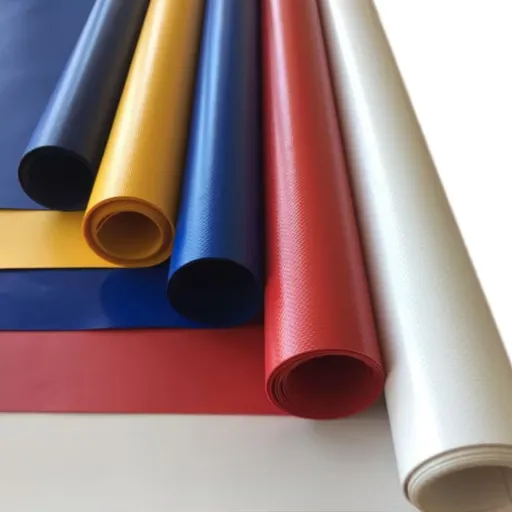
Every inflatable fabric starts as a woven scrim, usually polyester, coated on one or both faces with plasticized PVC. The scrim carries load. The coating provides airtightness, weather resistance, weldability, and, when specified, flame performance.
Suppliers sell the same roll as flame retardant PVC fabric, fire retardant PVC fabric, or FR PVC coated fabric. The label changes. The specification doesn’t.
Where the retardancy sits
Two routes put flame retardancy into a coated fabric, and only one is a specification.
The first is in-compound. Additives are dispersed into the PVC plastisol before it goes on the line, so the chemistry runs through the full coating thickness. Cut the roll anywhere and the same formulation is exposed.
The second is topical. A treatment applied to finished goods can pass a flame test the day it’s applied. Rain, abrasion at the fold, and cleaning remove it. Published formulation guidance is blunt: a surface treatment is a stopgap, not a specification.
Our own states the same principle for LY material, where the FR additive is integrated during coating. and we’ll tell you which method applies before you request samples.
Why PVC starts ahead, and why that isn’t enough
Rigid PVC carries roughly 57% chlorine by weight, and that chemistry gives it a high limiting oxygen index. It resists ignition largely on its own.
Flexible PVC is different in fire terms. An inflatable needs 50 to 80 parts of plasticizer per hundred of resin, and the plasticizer is fuel. The limiting oxygen index falls to roughly 19 to 22%, near ordinary air, so the chlorine advantage is spent before any additive is considered.
Consider a buyer we’ll call Priya, who develops products for an inflatable play-equipment brand. A supplier sent her a “flame retardant” sample, and a field match test on the cut edge looked convincing. The lab report that arrived later covered a 550 GSM construction. Her order was 850 GSM.
She rewrote the RFQ to name the test method, the weight, and the construction, and asked for one report per construction. That’s the whole lesson, and it costs nothing to apply.
Which Fire Test Applies to Your Inflatable Fabric
The test isn’t chosen by preference. The material’s weight and type decide it, and the standard’s own scope decides it for you.
NFPA 701 Method 1 versus Method 2
is a US pass/fail standard for flame propagation in textiles and films. Its two methods aren’t interchangeable grades of the same test.
| Method 1 | Method 2 | |
|---|---|---|
| Applies to | Fabrics up to roughly 700 g/m², plus curtain assemblies | Fabrics above roughly 700 g/m², films, coated blackout, tents, tarps, awnings, banners, membrane structures |
| Specimens | 10 pieces, 150 × 400 mm, vertical | 10 flat 125 × 1200 mm, plus 4 folded 610 × 1200 mm |
| Ignition | 45-second flame at the bottom edge, open cabinet | 2-minute flame at 25° to vertical, closed cabinet |
| Pass criteria | Average weight loss ≤40%; flaming drip ≤2 s | Self-extinguish ≤2 s; char ≤435 mm flat, ≤1050 mm folded; no flaming debris |
The practical consequence is simple. Commercial inflatable PVC commonly runs 500 to 1,100 GSM, which puts it in the Method 2 band. A Method 1 report for that material doesn’t answer a fire inspector’s question.
Method 2 is the harder test too: a 1.2-metre specimen in a chimney, a two-minute flame, a measurement of how far flame climbs. Suppliers sometimes offer Method 1 because it’s cheaper to pass.
The code requirement for inflatable amusement devices
In the United States, this stops being a commercial preference and becomes a code item.
requires that construction materials in inflatable amusement devices meet the flame propagation criteria of NFPA 701 Test Method 2, with a permanent label and the certification the code specifies. Section 3106.2 points to ASTM F2374 for design, manufacture, and operation.
The material requirement and the device practice are separate obligations, and the fabric mill only serves the first. Our guide covers how ASTM F2374, EN 14960, and the fire requirement fit together.
ASTM F2374-24 also excluded internal gusset fabrics from Method 2 testing, and it permits Method 1 for some lightweight components. If a supplier cites that exception, ask which component it applies to. It doesn’t cover the main body panels.
European and other-market equivalents
Europe doesn’t use NFPA 701, and the classes don’t convert.
| Market | Instrument | What the document says |
|---|---|---|
| EU | EN 13501-1 | A class from A1 to F, plus smoke (s1 to s3) and droplet (d0 to d2) sub-classes, written as for example B-s1,d0 |
| Germany | DIN 4102-1 | B1, B2, or B3. Still valid in parallel with EN 13501-1 for many building uses |
| France | NF P 92-507 | M1 to M5, with M1 stricter than M2 |
DIN 4102 B1 is the class most often requested by name across Europe. German authorities commonly map it to at least B-s1,d0 or C-s1,d0, but that is a convention rather than an equivalence, because the two systems use different tests.
For a compliance file rather than a single number, our guide to separates test methods, specifications, classifications, certifications, and regulations. That distinction prevents most rejected submittals.
Adjacent standards that are not your standard
Three standards get cited here without applying to inflatable fabric, and each can be rejected on sight.
carries the tent-flammability requirements CPAI-84 established, and several US state laws still reference older CPAI-84 editions statically. EN 14960-1:2019 requires that inflatable play equipment fabrics be flame retardant, but pins no specific fire-test method. BS 5867-2 covers curtains and blinds: right for a stage drape, wrong for a bouncer wall.
This Celina Tent explainer covers the three standards that are routinely confused. External footage, not ours.
What Flame Retardancy Does to the Rest of the Fabric
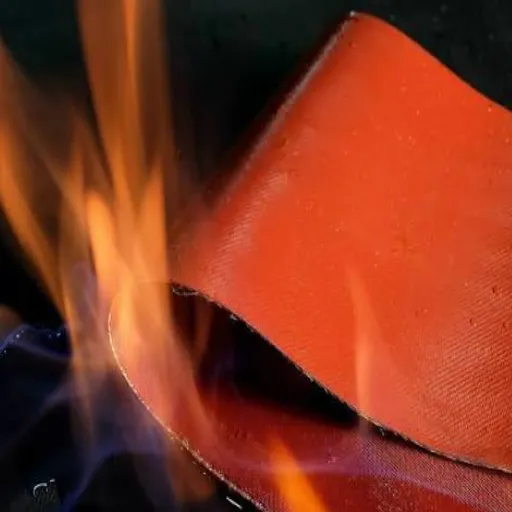
This is the part buyers discover after the fire test passes. The FR package isn’t free, and it isn’t neutral.
| Property | What the FR package does | What to specify instead of the default |
|---|---|---|
| Cold flexibility | Fillers raise stiffness and can push the cold-crack point up | A stated cold-bend temperature, with FR loading confirmed |
| Weld window | Higher filler loads narrow the hot-air and RF window | Sample welds at production settings, with a peel check |
| Colour | Some additives shift shade, and re-matching costs a run | A Pantone or RAL reference plus a colour-difference limit |
| Smoke | PVC’s chlorine controls flame well and makes dense smoke | The smoke sub-class where the application is enclosed |
| Weight | Additives add mass at the same coating thickness | Weight and thickness both, with tolerances |
| Cost | FR is a priced option, not a default | A line-item price, not a blended quote |
Published formulation guidance puts the additive loadings in ranges. Those are starting points for a compounder, but they explain what you’re buying.
| Additive | Typical loading | What it does |
|---|---|---|
| Phosphate-ester plasticizer | 20 to 50 phr | Carries phosphorus into the compound |
| Antimony trioxide | 3 to 8 phr | Synergist that works with the chlorine in the PVC |
| Aluminium hydroxide | 10 to 40 phr | Endothermic filler that cools the surface |
| Zinc borate or zinc stannate | 2 to 8 phr | Smoke suppressant and char former |
phr = parts per hundred of resin.
The phosphate-ester route is the elegant one, because the plasticizer has to be there anyway. Replace part of it with a phosphate ester and you add phosphorus without solid filler: no stiffness penalty, no weight gain.
The filler route is blunter. Aluminium hydroxide releases water and cools the surface, so it needs high loading, and past roughly 40 parts per hundred it starts to cost low-temperature flexibility. A fabric that cracks at minus 20 °C has traded a fire risk for a field failure.
The failure that shows up two years later
Plasticizer migrates. In hot climates and under sustained UV, a phosphate ester can move out of the coating. A roll that passed at production can drift toward the edge of its performance after two summers in direct sun.
Higher-molecular-weight and polymeric phosphate esters cost more and hold their position far better. Where service life matters, ask whether the supplier has tested after ageing. That question separates a compounder from a reseller.
Share your material specifications with LY TRUSTLINK for a custom solution.
Reading the Fire Test Report
A certificate is a claim. A report is evidence, and only if six things line up.
The six things that must match
| Check | What you’re confirming |
|---|---|
| Method and edition | Method 2, and the year of the standard the laboratory applied |
| Construction and weight | The same scrim, coating, GSM, and colour family you’re ordering |
| The supplier’s legal name | A report issued to another company proves that company’s material |
| The laboratory | ISO/IEC 17025 accreditation is the baseline |
| The date | A report for a formulation that has since changed is history |
| Scope | Whether the specimen was a prototype, a production-line sample, or a specific lot |
Scope is where files break most often. A prototype pass tells you the formulation can work, not that the container in your warehouse matches it.
Consider a European event-structure fabricator that submitted a three-year-old NFPA 701 Method 1 report for a Method 2 application. The fire officer rejected it on method, not on result. The material might well have passed the right test, but nobody had checked which test the file answered. The fix was procedural: check method and edition first, then construction, then date.
What a report doesn’t cover
A flat specimen report covers a flat specimen.
Seams, thread, netting, printing, and the finished assembly sit outside it. A welded seam has a different surface, a heat-affected zone, and often a different thickness. There’s no clean way to test a finished inflatable to Method 2, so control what you can. Get the flat-specimen report on the exact construction, weld and pressure-test your own assembly, and keep both records.
Our guide to covers how to read a lab report line by line.
The durability clause most buyers miss
NFPA 701 requires retesting after cleaning or weathering when durability is claimed. The exposure routes are defined:
- Three full dry-cleaning cycles
- Five full laundering cycles
- For outdoor use, at least 72 hours of water immersion, with the water changed every 24 hours
An inflatable that sits in the rain for a season is exactly the case this clause anticipates. If your supplier claims the rating persists through cleaning and outdoor exposure, the report should show a post-exposure result as well as an as-produced one.
If it doesn’t, the honest position is that the rating is verified as produced and long-term behaviour is unverified. That’s fine to hold. It’s a bad one to discover after a fire officer asks.
Specifying Fire Retardant Inflatable Fabric
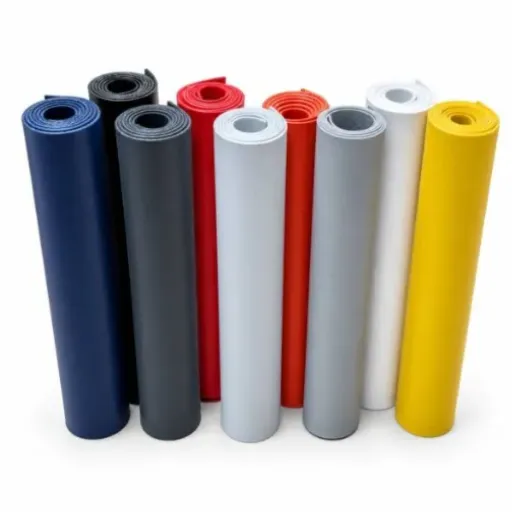
The RFQ is where this gets decided. “Fire retardant required” produces answers that can’t be compared. A specification for fire retardant fabric for inflatables names the evidence before anyone quotes.
| RFQ field | Why it changes the answer |
|---|---|
| Application and environment | Indoor venue, outdoor seasonal, or permanent outdoor sets the exposure route |
| Destination market | Decides NFPA 701, EN 13501-1, DIN 4102 B1, or several |
| Test method and edition | Method 2 for heavy inflatable fabric |
| GSM and tolerance | Decides the method band and the coating weight behind the result |
| Construction | Scrim denier, weave, coating weight per face, surface finish |
| Colour system | Pantone or RAL, plus the minimum run and matching policy |
| Evidence package | Report, certificate in the supplier’s name, lot data, retained sample |
| Cold-bend requirement | Stops the FR package buying a pass at the cost of winter performance |
The fields that make quotes comparable are the same ones our guide uses to qualify a mill. That article covers how a custom run is proven and released by lot. This one covers what the fire evidence inside that process has to be.
What LY TRUSTLINK can and cannot state
We should be precise here, because the market is full of claims that outrun their documents.
LY TRUSTLINK integrates the flame-retardant additive during coating rather than applying it as a surface treatment. The product page lists DIN 4102 B1/B2, BS 5867 Part 2 Type B, NFPA 701, M2, and California Fire Marshal among the available options.
Those are options, not guarantees for every order. Confirm the certificate, its scope, and its test date for the construction you’re buying before you commit. Our custom range runs 300 to 1,500 GSM, standard roll width to 3.2 m, custom widths by arrangement.
Ready to specify? with your method, weight, width, and destination market, and we’ll respond against those parameters rather than a generic spec sheet.
What to put in the purchase order
The report is the evidence. The purchase order is what keeps it true on the next container.
| Clause | Wording that holds |
|---|---|
| Flame standard | Named method and edition, not a class letter alone |
| Material | Construction, GSM with tolerance, coating weight per face, colour reference |
| Lot data | Retained sample and batch data with each shipment |
| Change control | Written notice before any change to resin, plasticizer, or additive package |
Change control matters most. A pass on file covers the material as tested. That clause covers what arrives a year later, after a compounder swaps one phosphate ester for a cheaper one.
Frequently Asked Questions
Is PVC naturally fire retardant?
Partly. Rigid PVC carries around 57% chlorine and resists ignition well on its own. The plasticizer an inflatable needs to stay flexible is combustible and drops the limiting oxygen index to roughly 19 to 22%, so plasticized PVC without FR additives won’t pass NFPA 701.
What is the difference between fire retardant and fireproof?
Fire retardant means the material resists ignition and limits flame spread under a defined test. Fireproof is a marketing word with no test behind it. Any coated fabric will burn under sustained exposure; only glass-fibre and silica welding blankets withstand direct flame.
Which NFPA 701 method applies to inflatable fabric?
Method 2, for commercial inflatable PVC. Method 1 applies to fabrics up to roughly 700 g/m², and commercial inflatable material is heavier. The ICC International Fire Code also names Test Method 2 for inflatable amusement devices, so a Method 1 certificate on an NFPA 701 inflatable fabric order is the wrong document.
Can flame retardancy be added after the fabric is made?
It can be applied, and it can pass an initial test. It won’t survive rain, abrasion at the fold, or repeated cleaning in outdoor service. For anything requiring ongoing certification, the additive has to be in the coating compound.
Does fire retardant fabric lose its rating over time?
It can. Plasticizers migrate, especially in hot and sunny service, and a fabric that passed at production can drift out of compliance. NFPA 701 requires retesting after cleaning or leaching when durability is claimed, so ask for the post-exposure result rather than the as-produced one alone.
What should I ask a supplier for before ordering?
Ask for the test report naming the method and edition, the construction and GSM it covers, the supplier’s legal name, the accredited laboratory, and the date. Then ask which lot it describes, and get a production-line sample with batch data before the full run ships.
Conclusion
Fire retardant inflatable fabric is a compound decision, not a label. The retardancy sits in the PVC coating, it is priced as an option, and it trades against cold flexibility, weld window, and colour.
The test follows from the material. Commercial inflatable PVC is a Method 2 material under NFPA 701, and the ICC International Fire Code names that method for inflatable amusement devices. Europe classifies the same roll against EN 13501-1 or DIN 4102 B1, and none of those documents convert.
From there the work is verification. Match the report to your construction. Check the method and edition first. Ask for the post-exposure result where durability matters, and test your own welded assembly, because no flat specimen covers it.
LY TRUSTLINK has made coated fabric since 2005, with calendering, laminating, coating, and printing under one roof. If you’re sourcing fire retardant inflatable fabric for your own production, and we’ll tell you what we can evidence.