
Medical Inflatable Fabric: PVC Specs for Medical Devices
Medical inflatable fabric is a PVC- or TPU-coated synthetic cloth welded into air cells that lift, turn or cushion a patient on a medical air mattress, a pressure-relief cushion or a positioning device. What makes it medical is not the polymer. It is the evidence behind it. That means the contact category the material was tested in, the plasticizer system it carries, and whether the welded assembly, not just the flat sheet, still holds pressure and still passes the same biological tests.
A converter in Poland qualified a 620 GSM PVC-coated roll last spring. Cytotoxicity passed on the flat sheet, the price was right, and production started.
Six months later a notified body asked for the biological evaluation of the welded cell. What the converter held was a sheet report with a weld nowhere in it. The retest cost a quarter of the original qualification budget and the launch slipped a season.
That gap between a certificate and a device is the whole problem. You already know the phrase “medical grade” means little on its own.
So this guide works from the test list outward: the contact category, the plasticizer question, the weld evidence and the batch documents that let you hold a supplier to something specific.
We build PVC inflatable fabric and test every production batch, so we have a stake in that argument. We also have no biocompatibility certificate to sell you, and this guide says so in the places where it matters. and we will tell you exactly what our batch reports cover and what your device file has to carry itself.
Key Takeaways
- Medical inflatable fabric is qualified by contact category and duration, not by a label. ISO 10993-1:2025 defines four contact categories and counts exposure in contact days.
- A flat-sheet cytotoxicity report does not cover a welded cell, a valve patch or a baffle seam. Specify the test article, not only the test.
- Plasticizer choice is a first-order decision. DEHP is classified Repr. 1B, and EU MDR Annex I §10.4 sets a 0.1% w/w threshold with a justification route for the device types it covers.
- Air retention and weld strength belong in a purchase order as measured values on a finished cell, not as adjectives on a datasheet.
- Ask for five documents: a lot-referenced test report, material safety data, a plasticizer declaration, a change-notification clause and a written statement of biological evaluation scope.
What Medical Inflatable Fabric Has to Do
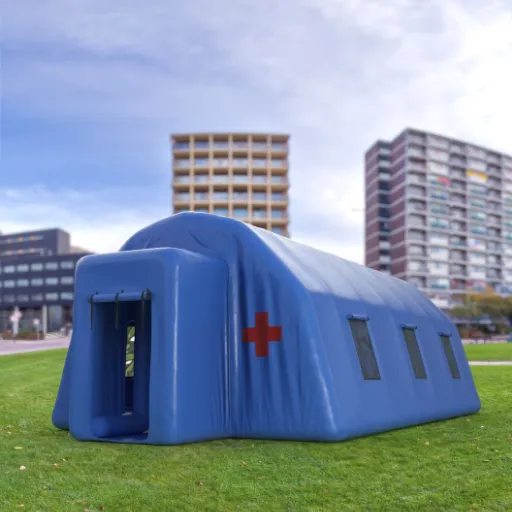
Medical inflatable fabric is a coated textile that has to do two jobs at once. It has to hold air across thousands of inflation cycles, and it has to present a surface a patient can lie on, lean against or wear for hours without the material causing harm. Those two jobs pull in different directions, and the specification has to satisfy both.
The device families are broader than most buyers expect. Alternating-pressure and low-air-loss mattresses, pressure-relief cushions, surgical and rehabilitation positioning devices, compression sleeves, blood-pressure cuffs, vacuum mattresses and stretchers, inflatable splints, and medical tents that need to pack down and redeploy.
| Device family | What the fabric carries | Governing property |
|---|---|---|
| Alternating-pressure and low-air-loss cells | Repeated inflation, patient load | Weld strength, flex fatigue, air retention |
| Top cover over air cells | Skin contact, friction, shear | Low-friction surface, stretch, cleanability |
| Pressure-relief cushion | Point load, lateral shear | Tear strength, weld creep |
| Positioning device | Localised load at straps and baffles | Tensile strength, puncture, weld quality |
| Compression sleeve, BP cuff | Pressure cycling at small radius | Coating adhesion, flex cracking |
| Vacuum mattress, stretcher | Rigid body under vacuum, abrasion | Airtightness, abrasion, cold flex |
| Medical tent, inflatable shelter | Structure, weather, repeated pack-down | Tensile strength, UV stability, cold fold |
The pattern is that one device often uses two fabrics: a cell that is the pressure boundary, and a cover that is the skin interface. A supplier who quotes the same construction for both has usually costed the cell fabric twice and the cover not at all.
A hospital bed mattress, a pressure relief mattress and a static cushion all follow the same construction logic, with cell height, weight and surface finish changing between them.
The video below shows the finished article in use, which is the context the fabric has to perform in.
<iframe width=”560″ height=”315″ src=”https://www.youtube.com/embed/yU5CM8AS5gw” title=”Low air loss mattress: basics and usage” frameborder=”0″ allow=”accelerometer; autoplay; clipboard-write; encrypted-media; gyroscope; picture-in-picture; web-share” allowfullscreen></iframe>
Healthcare tarpaulins, privacy screens and equipment covers are a different job with different failure modes, and they sit on our page rather than here.
Contact Category Decides the Test List
Every biological test a device needs follows from two variables: what the material touches, and for how long. ISO 10993-1:2025, published as the sixth edition on 18 November 2025, reorganised that decision around four contact categories and counts duration in contact days rather than calendar weeks.
The four categories are intact skin, intact mucosa, breached or compromised surfaces and internal tissue other than blood, and circulating blood. Chemical characterisation moved from a table row to a prerequisite step. Genotoxicity is now expected for all prolonged-contact devices except those in intact-skin contact only.
The standard is written around ISO 14971 risk management, so the output is a documented biological evaluation plan rather than a test menu. Working an anti-decubitus mattress through the categories is a useful exercise.
An alternating-pressure mattress touches intact skin for prolonged or long-term duration, depending on how the device is actually used. The cell itself sits under a cover, so the cell surface isn’t in direct patient contact while the cover is. That distinction changes which article gets tested and which endpoints apply. A cover in prolonged intact-skin contact and a cell behind it aren’t the same evaluation.
| Contact category | Duration | Effects the package should address |
|---|---|---|
| Intact skin | Limited, under 24 h | Cytotoxicity, irritation, sensitisation |
| Intact skin | Prolonged, 24 h to 30 days | Above, plus genotoxicity and chemical characterisation |
| Intact skin | Long-term, over 30 days | Above, plus systemic toxicity and material-mediated pyrogenicity where relevant |
| Intact mucosa | Limited, under 24 h | Cytotoxicity, irritation, sensitisation |
| Intact mucosa | Prolonged or long-term | Above, plus genotoxicity and chemical characterisation |
| Breached surface or internal tissue | Any | Above, plus implantation and local tissue effects |
| Circulating blood | Any | Above, plus haemocompatibility and complement activation |
Two practical notes. Contact days are counted per calendar day of contact, so an intermittent-use device can move up a duration category faster than the label suggests. The standard also allows existing data and clinical history to stand in for retesting where the material and the device already have an established safety profile. That matters if you’re changing a supplier rather than a design.
Anyone writing the evaluation plan should read directly rather than a summary.
Why a Flat-Sheet Certificate Does Not Cover a Welded Cell
A cytotoxicity report describes a specimen. The patient lies on a seam. That sentence is the whole problem, and it is the one the five supplier pages we reviewed all skip.
Four things change at a weld. The plasticizer migrates toward the bond line under heat and pressure, so the local formulation is no longer the formulation on the certificate. The coating thins where the electrode compresses it.
The polymer takes a heat history it won’t fully recover from. And the cut edge of the seam presents a surface chemistry that didn’t exist on the flat sheet.
None of those changes is automatically a failure. They are reasons to test the article the patient actually contacts.
| Test article | What it proves | What it leaves open |
|---|---|---|
| Flat sheet, as supplied | The incoming material is within specification | Nothing about the weld, the valve patch or the baffle |
| Welded coupon, same machine settings | The bond survives the biological and mechanical protocol | Scale effects, seam geometry at corners |
| Finished cell, inflated | The assembly holds pressure and passes as built | Long-term creep, disinfection cycling |
| Retained production cell, aged | The device still passes after storage and use simulation | Nothing, if the ageing protocol matches your shelf life |
The 2023 FDA final guidance on ISO 10993-1 adds a materials argument that gets misread. Attachment G covers devices made from common synthetic polymers and natural fabrics in contact with intact skin, and it allows a reduced test set in defined circumstances. It is an argument about materials in a specific contact category. It is not a blanket exemption for a welded assembly whose bond line was never characterised.
The instruction that follows is short. Write the test article into the specification, in the same paragraph as the test name. “ISO 10993-5, welded coupon, 20 mm weld width, production machine settings” is a specification. “Biocompatible” is a word.
Read the if Attachment G is part of your argument.
Phthalates, DEHP and the 0.1% Threshold
Flexible PVC needs a plasticizer, and the plasticizer is the part of a medical inflatable fabric most likely to be regulated. DEHP, the historic default, is classified Repr. 1B under the CLP Regulation. That classification is why “DEHP-free” became a product category rather than a preference, and why the question now reaches a fabric mill rather than stopping at the compounder.
EU MDR restricts CMR category 1A and 1B substances, and endocrine-disrupting substances with probable serious effects to human health, above 0.1% weight by weight. Section 10.4.2 sets the justification route. Section 10.4.5 sets the labelling duty.
The scope is narrower than it is often quoted. §10.4.1 applies to devices that are invasive, that administer or remove medicinal products, body liquids or other substances, or that transport or store such substances for later administration.
An alternating-pressure mattress cell is none of those in normal classification, so §10.4 isn’t the clause that automatically binds it. Device types in the same family do fall inside the scope, including blood-pressure cuffs and any component on an infusion or drainage path.
That distinction matters for how you write the specification. Even where §10.4 doesn’t bind the device, a plasticizer declaration costs nothing and answers the first question a notified body asks. Two further floors apply in parallel. CPSIA limits lead to 100 ppm in substrate and restricts eight phthalates at 0.1% for children’s products, and REACH restricts the phthalate group separately under entry 51.
What a fabric mill can actually declare is narrower than what a compounder can. We run a Ca/Zn stabiliser system and a DOTP plasticizer, with no DEHP, DBP or BBP, which is the formulation behind our . That is a statement about our formulation, not a claim that every medical device can use it.
The change-control consequence is the part buyers miss. Swap the stabiliser package to fix a colour issue, and the material in the next lot is not the material in your biological evaluation. Nothing illegal happened, and your device file no longer matches your supply. Ask for a written change-notification clause before the first order, not after the first complaint.
Nadia runs quality at a converter in northern Italy and caught that exact drift in 2024. A stabiliser substitution had fixed a yellowing complaint, and her incoming inspection passed it, because stabilisers are not on a test report. She found it in a material safety data sheet revision two versions later. The evaluation had to be re-scoped for the next submission.
Construction: Specifying Medical Inflatable Fabric
Medical inflatable mattress fabric is three construction decisions stacked: the base cloth, the coating system and the weight. Width sits on top as a panel-count decision.
Base cloth is polyester or nylon, and the denier and weave decide tensile strength, tear propagation and how much the seam creeps under sustained pressure. A tighter weave at the same denier gives a stiffer hand and better weld support. Nylon brings abrasion resistance and a softer drape at higher cost.
The coating system is where PVC and TPU diverge most. PVC plastisol responds to radio-frequency energy because the polymer is polar, which is why RF welding at 27.12 MHz works on it at all. Polyolefins do not respond, and TPU sits somewhere between the two depending on formulation. For high-volume welded cells, that welding behaviour is often the deciding factor, which is why our treats weldability as a first-class property rather than an afterthought.
| Application | Typical finished weight | Width notes |
|---|---|---|
| Alternating-pressure air cell | 350 to 500 GSM | Narrow rolls suit cell geometry; low elongation matters |
| Low-air-loss cell with vapour transmission | 300 to 450 GSM | Perforation or microporous topcoat is a separate spec |
| Top cover over cells | 400 to 600 GSM | Low surface friction and 4-way stretch dominate |
| Pressure-relief cushion | 500 to 700 GSM | Tear strength at the valve and strap anchors |
| Positioning device or vacuum mattress | 600 to 900 GSM | Abrasion and puncture take priority over hand |
| Medical tent or inflatable shelter | 550 to 750 GSM | Tensile strength, UV stability, cold fold |
Our own band for inflatable fabric runs 300 to 1,500 GSM with width up to 3.2 m, and the detail behind those numbers sits in the . Width is worth a separate calculation. Going from 1.5 m to 3.2 m removes a seam per panel and removes the leak path that comes with it, but it also changes how the roll handles on your cutting table.
Air Retention, Weld Quality and Disinfection
Three properties decide whether a good roll becomes a good device, and all three are measured on the assembly.
Air retention is the first. A flat-specimen permeability figure tells you about the film. It doesn’t tell you what a 90 cm cell does over 24 hours at working pressure.
Specify a pressure-hold test on a finished cell: inflate to a stated pressure, hold for a stated period, record the drop. The exact figures belong in your device specification, not in a supplier’s marketing copy.
Weld quality is the second. Peel strength and shear strength on the actual seam, at the actual weld width, with the failure mode recorded. Adhesive failure and cohesive failure mean different things, and a report that gives a number without the mode is half a result. Weld width belongs in the drawing.
Disinfection is the third, and it is the one most often left as an adjective. “Easy to clean” is not a requirement. A requirement reads: resistant to a named agent, at a named concentration, for a named number of cycles, with the acceptance criterion stated. Care homes change disinfectant products more often than device manufacturers change fabrics, and a seam that survives one wipe chemistry can fail another.
For method detail on tensile, tear, peel and hydrostatic testing, see our page.
The third story is the shortest. A care-home group switched to a higher-concentration chlorine wipe in early 2025 to meet a new infection-control protocol.
The covers passed the trial. The cell seams at the mattress head end began failing within four months, always at the same radius. Nothing in the fabric specification was wrong. The disinfection specification simply didn’t exist.
How to Qualify a Supplier for Medical Inflatable Fabric
Qualification is four steps, and about four weeks if the supplier can move at that speed.
Write the specification first: test articles, methods, acceptance criteria and disinfection agents. Send it, and ask for a written response against each line rather than a datasheet.
Second, request a sample length plus a batch report. Ten to fifty metres is enough to weld coupons, run a pressure hold and check hand, drape and cut edge. Confirm the report is tied to the lot you’re sampling, not to a previous run.
Third, run a welded coupon trial on your own machine with your own settings. This is where most supplier claims meet reality, because a fabric that welds well on the mill’s equipment can behave differently on yours.
Fourth, run a pilot batch and retain sealed samples from it, from the batch report and from your own incoming inspection. When a dispute arrives two years later, that sample turns an argument into a measurement.
The five documents to request
- A lot-referenced test report covering adhesion, tensile and tear, with the method named for each.
- Material safety data for the compound, including the plasticizer and stabiliser system.
- A plasticizer declaration stating DEHP status and the phthalate content basis.
- A change-notification clause with a defined notice period and a re-qualification trigger.
- A written statement of biological evaluation scope: which tests were run, on which article, by which laboratory, under which report number.
The fifth document separates honest suppliers from optimistic ones. A genuine package names the laboratory and the report number. A supplier without one calls the material biocompatible and moves on.
Our position is narrower. Every production batch is tested, and third-party reports from accredited laboratories can be issued against your lot. Our routine scope covers physical properties, not biological endpoints.
Biological testing is a scope your device file has to carry, and we support it with samples, lot data and the material declarations your test house will ask for. The detail is on our , and the product specification sits on the .
Ready to test the material on your own line? before you commit to a container.
Frequently Asked Questions
Is PVC or TPU better for medical inflatable fabric?
Neither is better in the abstract; the device decides. PVC welds reliably by RF and holds pressure well, and phthalate-free formulations remove the main regulatory objection. TPU offers better hydrolysis resistance in some grades and a softer hand, at higher cost and with more demanding handling.
What does “medical grade PVC fabric” actually mean?
It has no single definition. It usually means the supplier claims some biological testing and some formulation control. Treat it as a prompt to ask which tests, on which article, by which laboratory, under which report number.
Does a flat-sheet ISO 10993 report cover a welded mattress cell?
No. A flat specimen describes the sheet as supplied. A welded cell has a different local formulation at the bond line, a heat history and a cut edge, so the test article needs to match the article the patient contacts.
Are phthalate-free PVC inflatable fabrics available?
Yes. Ca/Zn stabiliser systems with non-phthalate plasticizers such as DOTP are established, and they remove DEHP, DBP and BBP. Ask for the plasticizer declaration and its test basis rather than taking the phrase at face value.
What GSM is used for anti-decubitus air cells?
Most alternating-pressure cells fall between 350 and 500 GSM, with low elongation and high weld strength mattering more than raw weight. Top covers usually run 400 to 600 GSM with a low-friction finish. Confirm against your own cell geometry and pump pressure.
Can the fabric be disinfected between patients?
That depends on the agent, the concentration and the cycle count, not on the fabric alone. Specify all three plus an acceptance criterion, then test the welded assembly rather than the flat sheet.
Conclusion
Medical inflatable fabric is specified by contact category, by plasticizer system and by what survives the weld. Get those three right and the rest follows: the test list from the category, the declarations from the plasticizer, the air retention and seam evidence from the assembly.
The five documents are the practical version of that, and they cost a week to collect. They will tell you more about a supplier than any datasheet.
We make PVC inflatable fabric in custom weights from 300 to 1,500 GSM and widths to 3.2 m, with a lead-free and phthalate-free formulation and batch testing on every run. We won’t hand you a biocompatibility certificate we don’t have. We’ll hand you the lot data, the samples and the declarations that let your test house finish the job. and we’ll come back with what we can support line by line.