

Coated Fabric Standards & Certifications: The Procurement Guide
The coated fabric standards that decide most procurement approvals are ISO 8095 (tarpaulin specification), NFPA 701 (US flame propagation), ASTM D751 (coated-fabric test methods), EN 13501-1 (EU fire classification), and EN 12641-1 (commercial vehicle tarpaulins). Chemical compliance adds REACH, RoHS, and CPSIA. The trouble is that “standard” covers five different kinds of document, and buyers routinely request the wrong one.
In practice, that mismatch is where approvals stall. Elena, a sourcing lead for a European logistics fleet, asked a supplier whether a replacement curtain fabric “met standard.” She received a certificate PDF, an ISO 9001 logo, and a confident “yes.” None of it answered whether the material passed NFPA 701 at the coating weight being quoted, met EN 12641-1 as a truck curtain, or cleared REACH for her destination market. She spent three weeks chasing the right documents after placing the order, a delay that a single line in the RFQ would have prevented.
This guide separates the five document types and decodes what the commonly cited coated fabric standards actually prove. It then maps coated fabric certifications by application and by market, and closes with a verification routine that tests a supplier’s claims instead of trusting a certificate. If you specify, approve, or import protective fabrics, the goal here is to remove friction from that process. Talk to an engineer at any point if a project has a compliance requirement we have not covered.
Key Takeaways
- “Standard” is five different document types: test methods, specifications, classifications, certifications, and regulations. Conflating them is the single most common cause of failed procurement reviews.
- ISO 8095 is the on-topic specification for PVC-coated tarpaulin fabric, and its normative references double as the tarpaulin test menu. Most buying guides never mention it.
- Fire standards do not translate across borders. An NFPA 701 pass is not an EN 13501-1 classification, and ASTM D6413 is a test method, not a pass/fail result.
- A batch-specific test report with measured values from an accredited lab is evidence. A framed certificate is not.
- Specify compliance in the RFQ, not after the sample arrives, and request the seven documents in the procurement pack below.
Why “Standard” Is Five Different Things in Coated Fabric Procurement
Ask ten suppliers what “standard” a fabric meets and you will get ten different document types. That is the root of most compliance confusion in coated fabric standards, so it is worth fixing before anything else.
The word “standard” describes five distinct things:
- Test method, a procedure that produces data. ASTM D6413 tells you afterflame time, afterglow time, and char length. It does not tell you whether the fabric passes, because it sets no universal limit.
- Specification, required values for a product. ISO 8095 states what a PVC-coated tarpaulin fabric must do, and references the test methods used to check it.
- Classification, a grade assigned to test results. EN 13501-1 sorts building materials into A1 through F, with smoke and droplet sub-classes.
- Certification, third-party attestation of a system or product. ISO 9001 certifies a quality management system. CFFA HC-201 certifies a coated fabric for healthcare use.
- Regulation, a legally binding market requirement. REACH, RoHS, and CPSIA are law, not voluntary standards.
A specification names the test methods it relies on. A classification interprets the data those methods produce.
A certification confirms someone audited the process. A regulation makes compliance mandatory for market access. They stack, and they are not interchangeable.
This is why a supplier can answer “yes” to a standards question and still be wrong. ISO 9001 is the classic trap, because it is the certificate most suppliers lead with and the one that proves the least about the product itself. It confirms the factory runs a documented quality system. It says nothing about whether the fabric in the box passes a flame test at the quoted coating weight.
This guide covers which standard applies. How a test is actually run, and how to read a lab report line by line, belongs in our coated fabric testing and quality control guide.
The PVC coated fabric specifications guide covers what those specifications mean at the material level: GSM, denier, weave, coating weight, and adhesion.
The Coated Fabric Standards Decoder Table
Use this table by finding your application first, then reading the “type” column. That tells you which kind of document to request from a supplier, and it is the fastest way to navigate coated fabric standards without reading every entry.
| Standard | Type | What it proves | Typical application | Region |
|---|---|---|---|---|
| ISO 8095 | Specification | PVC-coated fabric requirements for tarpaulins | Tarpaulins, truck covers | International |
| BS 3408 | Specification | Tarpaulin materials, manufacture, accessories | Tarpaulins (incl. uncoated) | UK |
| DIN EN 15619 | Specification | Coated fabrics for tents and temporary structures | Event tents, canopies | EU |
| EN 12641-1 | Specification | Minimum strength and attachment for vehicle tarpaulins | Truck side curtains | EU |
| ISO 7617-1 / -2 | Specification | PVC-coated fabric for upholstered furniture | Seating, interior trim | International |
| NFPA 701 | Regulation-adjacent standard | Flame propagation of textiles and films (pass/fail) | Drapes, coverings, membranes | US |
| ASTM D6413 | Test method | Afterflame, afterglow, char length | Protective textiles | US |
| EN 13501-1 | Classification | Building material fire grade (A1–F, s1–d2) | Architectural membranes | EU |
| DIN 4102 | Classification | Building material fire classes (A2, B1, B2) | Construction fabrics | Germany |
| ASTM D751 | Test method | Coated fabric physical properties (incl. peel adhesion) | General coated fabrics | US |
| ASTM D4851 | Test method | Coated/laminated architectural fabric properties | Fabric roof systems | US |
| EN ISO 1421 | Test method | Tensile strength and elongation at break | All coated fabrics | International |
| ISO 2411 | Test method | Coating adhesion strength | All coated fabrics | International |
| ISO 4674-1 | Test method | Tear resistance | All coated fabrics | International |
| ISO 811 / AATCC 127 | Test method | Water penetration / hydrostatic head | Waterproof fabrics | Intl. / US |
| ISO 4892 / ASTM G154 | Test method | Accelerated UV and weathering | Outdoor fabrics | Intl. / US |
| REACH | Regulation | EU restricted substances incl. SVHC | Any EU market product | EU |
| RoHS | Regulation | Restricted hazardous substances | Electrical-adjacent products | EU |
| CPSIA | Regulation | US lead and phthalate limits for children’s products | Inflatables, sports equipment | US |
| ISO 9001 | Certification | Quality management system (not product performance) | Supplier qualification | International |
| CFFA HC-201 | Certification | Coated fabric for healthcare applications (16 tests) | Medical fabrics | US |
Edition years matter, and the table does not list every national variant. ISO 8095 has identical adoptions as GB/T 24139 in China and TCVN 8836 in Vietnam, which is useful when a buyer cites a local number instead of the international one. Confirm the current edition with the issuing body before you write it into a purchase order.
Specification Standards for Coated Fabrics
This is the part most buying guides skip. Fire standards get all the attention, but for a tarpaulin, curtain, or tent, the specification standard is what actually defines the product. PVC coated fabric standards sit in this group; they define what the material must do, which is a different question from how it burns.
ISO 8095: The Tarpaulin Specification
ISO 8095, from the International Organization for Standardization, is the international specification for fabric coated on one or both sides with plasticized PVC, intended for tarpaulin manufacture. It is the single most on-topic ISO 8095 tarpaulin standard for heavy protective covers, and almost no editorial competitor names it.
For procurement, its value is that this ISO 8095 tarpaulin standard collects the test menu in one place through its normative references:
- ISO 1421, breaking strength and elongation at break
- ISO 1420, resistance to water penetration
- ISO 2411, coating adhesion
- ISO 4674, tear resistance
- ISO 4675, low-temperature bend test
- ISO 5978, blocking resistance
- ISO 6451, rapid check of PVC coating fusion
- ISO 7771, dimensional change from cold-water immersion
- ISO 7854, resistance to flex damage
- ISO 176, loss of plasticizers
- ISO 105-B02, colour fastness to artificial light
- ISO 2286, roll characteristics (length, width, mass, thickness)
ISO 8095 also requires marking: manufacturer or mark and batch number, the standard number, the base fibre type (polyamide or polyester), and cleaning recommendations. If a supplier cannot tell you which fibre the base is, that is a specification gap, not a paperwork gap.
BS 3408: The Broader UK Tarpaulin Specification
BS 3408 covers more ground than ISO 8095. It addresses impregnated uncoated tarpaulins, PVC-coated synthetic-fibre tarpaulins, and accessories such as lashing ropes and grommets. It references the BS 3424 coated-fabric test series, recommends third-party certification with continuing surveillance, and includes an optional flammability requirement. Its fibre-coating table covers PVC-coated polyamide and PVC-coated polyester.
For a UK-bound or Commonwealth-bound project, BS 3408 is often the standard a buyer means when they say “tarpaulin specification.”
DIN EN 15619: Tents and Temporary Structures
Event tents, canopies, and temporary structures carry a safety case that generic tarpaulin standards do not address. DIN EN 15619 specifies coated fabrics intended for tents and related structures. It pairs with DIN EN 15618 for coated upholstery classification.
If your fabric goes into an occupied structure rather than a cargo cover, this is the specification family to check, alongside the fire classification for the market. Our event and temporary structure fabric page lists the weights and constructions used in these applications.
EN 12641-1: Truck Tarpaulins, With a Liability Caveat
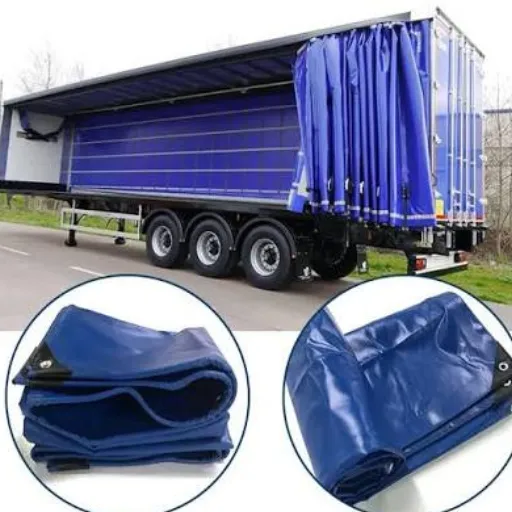
EN 12641-1 gives minimum requirements for the strength and attachment of tarpaulins on swap bodies and commercial vehicles. It is the standard to cite when specifying a truck side curtain for EU road or road-rail service.
The caveat is easy to miss and expensive to miss. A curtainsider tarpaulin meeting EN 12641 is not suitable for cargo securing.
Cargo restraint requirements sit in EN 12640 and EN 12642 XL. Fleet managers who assume one standard covers both are carrying an uninsured load. State both requirements separately in the purchase order.
ISO 7617-1 and -2: Coated Fabric for Upholstery
ISO 7617-2 covers PVC-coated woven fabric for interior upholstery, in grades A and B. By contrast, ISO 7617-1 covers the knitted equivalent with solid and expanded PVC coatings. These matter for transport seating, marine interiors, and contract furniture, where a tarpaulin standard would be the wrong reference entirely.
Fire and Flammability Standards: NFPA 701, ASTM D6413, EN 13501-1, DIN 4102
Fire is the most quoted and least understood standards family in coated fabrics. Flame retardant fabric standards are also the least portable across borders. Test protocols differ enough that the industry works from an unofficial consensus ranking of test difficulty, not a conversion table. ShowTex, a specialist in flame-retardant textiles, makes this point directly: fabrics commonly hold multiple certifications precisely because one does not substitute for another.
NFPA 701 is a United States pass/fail standard for flame propagation in textiles and films. Method 1 is the small-scale procedure, Method 2 the large-scale one. It is the standard cited for drapes, coverings, and membrane enclosures; the International Fire Code requires membrane enclosures to be noncombustible or to pass NFPA 701 Method 2.
ASTM D6413 is a test method, not a pass/fail standard. A specimen is mounted vertically above a controlled flame, the flame is removed, and afterflame time, afterglow time, and char length are measured. Limits come from the product standard or buyer specification. NFPA 2112, for example, requires char length of 100 mm or less and afterflame of two seconds or less. Do not conflate D6413 with ASTM F1506, which addresses arc-rated protective clothing and a different hazard.
EN 13501-1 is the European classification system for building materials. It assigns grades A1 through F for fire performance and adds sub-classifications for smoke production (s1 through s3) and burning droplets (d0 through d2). It draws on the Single Burning Item test (EN 13823) and ignitability testing (EN ISO 11925-2). A result reads like “B-s1,d0” rather than “passed.”
DIN 4102 is the German building material classification, using classes A2, B1, and B2. France uses M1 and M2. A fabric may hold several of these classifications at once for different markets.
The practical point for procurement: flame retardancy in coated fabric is a priced, specifiable option, not a default property. Request the flame test report naming the exact method and edition, and confirm which test the report covers. A report for NFPA 701 does not answer an EN 13501-1 question. Our fire retardant tarpaulin page covers formulation, and the self-extinguishing fabric page covers the compounding that supports these results.
Physical Test Methods Required by Coated Fabric Standards
Behind the specification standards sits a set of test methods. Each one answers a specific question about how the fabric will behave in service.
- Tensile strength and elongation (EN ISO 1421, ASTM D5034 grab) measure how much load the fabric takes before it fails, and how far it stretches. See tensile strength.
- Tear resistance (ISO 4674-1, ASTM D2261) measures resistance to a tear propagating from a cut or puncture. See tear resistance.
- Coating adhesion (ISO 2411, ASTM D751 peel) measures the bond between coating and base fabric. Poor adhesion shows up as delamination, and the failure mode is described on our adhesion loss page.
- Water penetration (ISO 811, AATCC 127, ASTM D3393) measures hydrostatic resistance, the pressure a column of water exerts before it passes through. Our waterproof versus water resistant breakdown covers why the distinction matters commercially.
- UV and weathering (ISO 4892-2 and -3, ASTM G154) accelerate sun exposure to predict field life. See UV resistance and UV damage.
- Flex and cold resistance (ISO 7854, ASTM D2136) test repeated folding and low-temperature behaviour, the mechanism behind flex-crack and cold-crack failures.
- Abrasion, blocking, and dimensional stability round out the set for surfaces that rub, stack, or get wet.
Two umbrella references are worth knowing. ASTM D751 is the broad test-method standard for coated fabrics, including peel adhesion; the ACT voluntary guideline for outdoor coated fabrics uses a minimum of 3 lb/in for peel adhesion and references ASTM D751 for tear and grab strength. ASTM D4851 covers coated and laminated fabrics for architectural use, including weathering, flame, and mechanical properties. One caveat worth recording in your file: D4851 has known poor inter-laboratory precision for adhesion and crease-fold strength, so comparative testing between labs can produce different numbers from the same material.
Chemical and Regulatory Compliance: REACH, RoHS, CPSIA, and Food Contact
Regulations are different from standards. They are law, they apply by destination market, and they can stop a shipment at the border.
REACH governs chemical substances in the EU, and a supplier’s compliance claim usually rests on restricted-substance screening, often quoted as a screen of up to 253 items. RoHS restricts hazardous substances in a related set of products. Together they form the baseline for REACH RoHS coated fabric compliance in Europe; the European Chemicals Agency maintains the candidate list of substances of very high concern that drives the screening.
CPSIA is the United States regulation covering children’s products, which captures inflatable amusement devices and many sports products. Section 101 sets a substrate lead limit of 100 ppm. Section 108 covers phthalates. There is a nuance worth planning around: a material that passes the CPSIA lead limit can still trigger a California Prop 65 warning, because the safe-harbor exposure calculation works differently.
Phthalates deserve their own note, however, because “phthalate-free” is imprecise. The groups are:
- 3P: DEHP, DBP, BBP
- 6P: adds DINP, DIDP, DNOP
- 8P: the current US list, which adds DIBP, DPENP, DHEXP, and DCHP
Compliance commonly means restricting the listed phthalates to a cap of 0.1%, or replacing them with a non-phthalate plasticizer such as DOTP. Test methods include CPSC-CH-C1001.09.3 for phthalates in vinyl, 16 CFR 1303 and CPSC-CH-E1002 for lead, and EN 71-3 for heavy-metal migration.
That is a compounding problem before it is a paperwork problem. A compliant fabric starts with a calcium-zinc stabilizer system instead of a lead-based one, a non-phthalate or restricted-phthalate plasticizer route, heavy-metal-free pigments, and segregated production lines with batch testing and traceability. Our lead-free PVC fabric for inflatables guide covers this in detail, and the PVC compounding and additives guide explains how the formulation is built.
Food contact is a separate regime again. Pond liners, fish-farming tanks, and silage covers may fall under FDA requirements in the US or EU 10/2011 in Europe, which generic tarpaulin certificates do not address. See our food-grade tarpaulin page and the fish farming and pond liner range for the documentation those applications require.
Which Coated Fabric Standard Do You Need? Application by Market
Regulations apply by destination. Specifications apply by product. Fire requirements apply by occupancy or building code. Read down to your application, then across to your market.
| Application | Specification standard | Fire | Chemical / regulatory |
|---|---|---|---|
| Truck side curtain | EN 12641-1 (EU), ISO 8095 | NFPA 701 where required | REACH, RoHS |
| General tarpaulin | ISO 8095, BS 3408 (UK) | Optional FR | REACH, RoHS |
| Event tent / temporary structure | DIN EN 15619 | EN 13501-1 or NFPA 701 | REACH |
| Inflatable amusement (bounce house) | ASTM F2374 | NFPA 701 | CPSIA §101 and §108 |
| Architectural / tensile membrane | ASTM D4851 | ASTM E84 or EN 13501-1 | REACH |
| Pool, pond, fish farming | CFFA marine and pool protocols (US) | As applicable | FDA or EU 10/2011 |
| Marine cover | CFFA protocols | As applicable | REACH |
| Railway and transport interior | National rail FR (e.g. EN 45545-2) | Required | REACH |
| Healthcare | CFFA HC-201 | As applicable | REACH, RoHS |
| Military | Contract specification (e.g. MIL-PRF) | Per contract | Per contract |
A concrete example shows how the layers stack. An inflatable amusement device bound for the United States needs ASTM F2374 for design and manufacture, NFPA 701 for flame performance, and CPSIA for lead and phthalates. The same device bound for Europe needs EN 13501-1 fire classification and REACH compliance instead. One fabric, two document sets, because the markets differ.
That is not a reason to use two fabrics. It is a reason to specify the compliance set in the RFQ so the correct compound and coatings are selected once. Material changes at the compound level, not the paperwork level. Explore durable PVC coated fabric options with LY TRUSTLINK.
How to Verify Coated Fabric Standards Compliance: Reports Beat Certificates

Here is the distinction that resolves most compliance disputes. A certificate is a document that states a conclusion. A test report is a document that states a measurement. Procurement that accepts the first without the second is relying on a summary it cannot audit.
When a supplier claims compliance, ask for the batch-specific test report and check seven things:
- Naming. The report should identify the exact lot or batch, not a “representative” sample. A report for a different lot is not a report for your material.
- Measured values. Look for numbers, not pass/fail. A value you can compare against your specification is evidence; a stamp is not.
- Method and edition. The report should name the test method and its edition, for example NFPA 701 Method 2 or ISO 1421:2016. An unnamed method cannot be checked.
- Accredited lab. Confirm the issuing lab is a third party with relevant accreditation, such as SGS, Intertek, TUV, or BV, and confirm the accreditation covers the test performed.
- Product identity. The tested construction, coating weight, and compound must match what you are buying. FR performance at one coating weight does not carry to another.
- Date and retention. Check validity, and for flame performance ask whether a retention sample is held.
- Regional relevance. A US flame result does not answer a European classification question. Match the document to the market.
Our own quality control process follows this model: batch testing, traceability, and reports tied to the lot that shipped. That is what a supplier should be able to produce on request, not as a favour.
The Procurement Document Pack
Ask for these seven documents before finalising a purchase order, not after:
- Declaration of conformity naming the specification standard and the product.
- Batch test report with measured values for the physical properties in scope.
- Flame test report, where required, naming the method and edition.
- Safety data sheet (SDS) for the material.
- REACH, RoHS, and phthalate statements, where the market requires them.
- ISO 9001 certificate, read as a system certification rather than a product guarantee, and checked for scope.
- Marking and labelling data where a specification standard requires it, as ISO 8095 and BS 3408 do.
Two representative scenarios illustrate why the pack matters. Dana, a purchasing manager at an events company in Manchester, accepted an ISO 9001 certificate as evidence of fire performance for a batch of tent covers in early 2025. During a venue inspection that spring, the certificate proved irrelevant, because it covered the management system and said nothing about flame testing. The covers were rejected on site and replaced on a compressed schedule that cost more than the original order.
Now consider Ravi, a fleet operator who specified a truck curtain to EN 12641 and assumed the same standard covered cargo restraint. It does not.
After a roadside check flagged the securing arrangement, he separated the restraint requirement from the tarpaulin specification and sourced the correct straps and load-rated components. The compliance file closed on the next audit. Both problems were document problems, not material problems, and both were avoidable at the RFQ stage.
When you are ready to specify, request a custom quote and list the standards and regulations your project must satisfy. We will confirm which the specified construction can be tested to, and which documents we can issue.
FAQ: Common Questions About Coated Fabric Standards
What is the difference between a test method and a specification standard?
A test method is a procedure that produces data, such as ASTM D6413 or ISO 1421. A specification standard states the required values a product must meet and references the test methods used to check them, such as ISO 8095. Specifications rely on methods; methods do not set pass/fail limits on their own.
Is NFPA 701 the same as EN 13501-1?
No. NFPA 701 is a US pass/fail standard for flame propagation in textiles and films, tested in small-scale (Method 1) or large-scale (Method 2) procedures. EN 13501-1 is a European classification system for building materials that assigns grades A1 through F, with smoke and droplet sub-classes. The protocols differ, so one does not substitute for the other.
What is ASTM D751 used for?
ASTM D751 is the umbrella test-method standard for coated fabrics. It covers breaking strength, elongation, adhesion, puncture resistance, hydrostatic resistance, and tear strength. The ACT outdoor coated-fabric guideline references ASTM D751 peel adhesion with a minimum of 3 lb/in, making it a common procurement reference.
What is ISO 8095?
ISO 8095 is the international specification for PVC-coated fabrics used to make tarpaulins. It requires the coating to be plasticized PVC over polyamide or polyester base fabric, references a defined set of test methods, and specifies roll marking including batch number, standard number, and base fibre type.
What standard applies to truck tarpaulins in the EU?
EN 12641-1 sets minimum requirements for the strength and attachment of tarpaulins on swap bodies and commercial vehicles. Note that meeting EN 12641 does not make a curtain suitable for cargo securing, which falls under EN 12640 and EN 12642 XL.
What standard covers inflatable amusement devices like bounce houses?
ASTM F2374 is the US standard practice for the design, manufacture, operation, and maintenance of inflatable amusement devices. Flame performance is commonly specified to NFPA 701, and children’s-product chemical limits fall under CPSIA for lead and phthalates.
What is the difference between a test report and a certificate?
A certificate states a conclusion, such as an ISO 9001 system certification. A test report states measurements tied to a specific batch and method, such as char length or tensile force from an accredited lab. A report is auditable evidence; a certificate is a summary you cannot verify against your own specification.
How do I verify a fabric test report?
Check that it names the exact batch, gives measured values rather than pass/fail, cites the test method and edition, comes from an accredited third-party lab, matches the construction you are buying, is current with a retention sample where relevant, and applies to your destination market.
Conclusion
Compliance problems in coated fabric procurement are usually document problems wearing a material costume. Resolve the document layer and the rest gets simpler.
Five things are worth carrying into your next RFQ:
- Name the document type you need. A method, specification, classification, certification, and regulation are five different things.
- Cite the specification standard, not just the fire standard. ISO 8095, BS 3408, DIN EN 15619, and EN 12641-1 define the product.
- Treat fire standards as market-specific. NFPA 701, EN 13501-1, and DIN 4102 do not convert.
- Separate chemical regulations by destination. REACH in Europe, CPSIA in the United States, food-contact rules for water and agricultural applications.
- Ask for the batch test report, not the certificate.
The coated fabric standards that decide an approval are knowable in advance, and specifying them early costs less than discovering them at inspection. If you are working through a compliance requirement now, talk to an engineer and we will map the standards your project needs to the constructions we can supply and test.