
500D vs 1000D PVC: Which Denier Do You Need?
In a 500D vs 1000D PVC decision, the higher number is not automatically the better buy. Choose 1000D for commercial inflatables, truck covers, and any surface in daily abrasion. Choose 500D for light-duty inflatables, banners, and medium covers where handling weight matters more than service life.
That is the short answer. The longer answer matters more, because the 500D vs 1000D PVC question hides three different questions behind one label.
Here is the part most buyers get wrong. The fabric that fails first in the field is often not the one with the lower denier.
It’s the one with an unbalanced weave, a thin coating, or a base cloth that was never PVC to begin with. Denier tells you how heavy the yarn is. It doesn’t tell you whether the finished fabric will hold.
You already know that higher denier means a heavier, coarser scrim. That instinct is sound. What this guide adds is the part the label leaves out: how denier relates to GSM and thickness, why the same number means different things in an inflatable and a truck tarp, and how to verify a supplier’s claim before you commit a production run. Find suitable inflatable fabric solutions for demanding applications.
Key Takeaways
- Denier measures yarn mass, not fabric strength. 1000D yarn carries roughly twice the mass per 9,000 metres of 500D yarn, but tear performance also depends on weave density, coating weight, and yarn tenacity.
- A balanced 500D × 500D scrim is a legitimate light-duty inflatable specification. An asymmetric 1000D × 500D weave is not, and that distinction is why no single answer fits every application.
- In tarpaulin, 500D × 1000D is a normal warp-and-weft pairing. In an inflatable, it is a defect.
- A budget bounce house sold as “500D” is frequently PVC-coated nylon or Oxford, not a PVC scrim. Ask for base cloth composition and coat weight per side.
- Verify every denier claim against a test method: ASTM D5034 for grab tensile, ASTM D2261 for tongue tear, ASTM D751 for coated fabrics.
What Denier Actually Measures
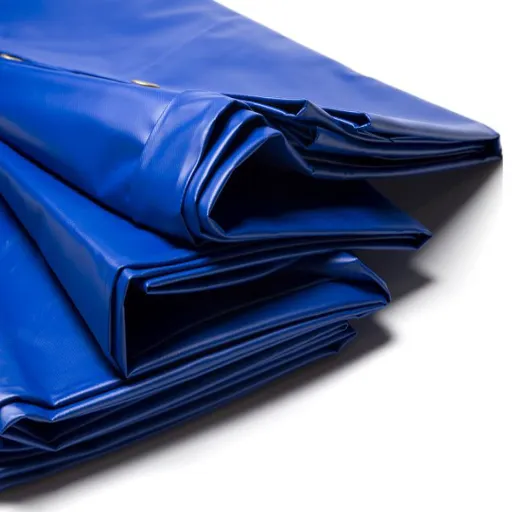
Denier is the mass in grams of 9,000 metres of yarn. A 500D yarn weighs 500 grams across that length. A 1000D yarn weighs 1,000 grams.
That is the whole definition. It describes the yarn, not the cloth.
This matters because buyers routinely treat denier as a strength rating. It is not. Two fabrics can carry the same denier and behave very differently in service, depending on three variables the number does not capture:
- Weave density. A tight weave with a high thread count resists tear propagation and seam pull-out far better than a loose weave of the same yarn.
- Coating weight. The PVC coating supplies the barrier, the abrasion surface, and much of the hand feel. A 1000D scrim coated thin can underperform a 500D scrim coated heavy.
- Yarn tenacity. High-tenacity polyester and standard polyester share a denier and not much else.
One number is still missing from that list: denier per filament. A 500D yarn built from 96 filaments and a 500D yarn built from 48 filaments carry the same denier, but the finer bundle bends more easily, feels softer, and tears differently. Suppliers rarely volunteer filament count unless you ask for it written as 500D/96F or 500D/48F.
Denier sets the mechanical backbone. The coating and the weave decide what happens when that backbone is loaded.
This is why a specification that lists denier alone is incomplete. Ask for denier, thread count, finished GSM, coat weight per side, and thickness together. PVC scrim weight and coat weight are separate line items, and only the pair tells you what you’re buying. Those five numbers describe a fabric. One number describes a yarn.
If you want the full specification framework, our PVC inflatable fabric specifications guide walks through how the numbers interact and which test methods verify each one.
500D vs 1000D PVC: Side-by-Side Specs
The table below compares the two grades across the properties that decide performance. Treat the weight and thickness bands as directional. Actual figures move with weave count and coating build, and your supplier should confirm them on a production sample.
| Property | 500D scrim | 1000D scrim |
|---|---|---|
| Yarn mass per 9,000 m | 500 g | 1,000 g |
| Typical finished weight | ~350–500 GSM | ~500–1,000 GSM |
| Typical thickness | 0.25–0.45 mm | 0.45–0.80 mm |
| Tear and abrasion resistance | Moderate | High |
| Hand and packability | Softer, folds tighter | Stiffer, bulkier |
| Weldability | Good | Good, with matched parameters |
| Relative cost | Baseline | Higher |
| Best fit | Light and dry inflatables, banners, medium covers | Commercial inflatables, water slides, truck covers, ponds |
For reference on the unit conversion: one ounce per square yard equals about 33.9 grams per square metre. That makes 15 oz roughly 509 GSM, 18 oz roughly 610 GSM, and 22 oz roughly 746 GSM. If a supplier quotes ounces and your specification is in GSM, that is the bridge.
The denier vs GSM question has no fixed answer, because GSM measures the finished fabric and denier measures the yarn. The same 1000D yarn finishes anywhere from 500 to 1,000 GSM depending on weave count and coating build. A supplier quoting one number without the other is quoting half a specification. The PVC-coated fabric specifications guide carries the full conversion and weight framework.
Supplier listings commonly pair denier with weight like this. A 1000D × 1000D construction at 20 × 20 lands near 510 GSM and 15 oz. The same denier at 23 × 23 reaches roughly 610 GSM and 18 oz. At 30 × 30 it climbs toward 1,000 GSM and 0.8 mm.
The 20 × 20 and 30 × 30 figures are threads per inch in warp and weft. So 20 × 20 means twenty threads per inch each way. Ask for TPI explicitly, because 1000D at 20 × 20 and 1000D at 30 × 30 are different products at the same denier.
Read those pairings carefully. They show the same denier producing three different finished weights. Denier did not change. The weave and the coating did. That is the trap in every 1000D PVC fabric listing: the denier is true, and the fabric behind it can still weigh 400 GSM less than the one you compared it against.
The Answer Depends on What You’re Buying
This is where most 500D vs 1000D PVC comparisons stop being useful. They treat the question as universal. It is not.
The same label means three different things depending on the product in front of you.
Inflatables: Balanced Weave or Nothing
In an inflatable, the scrim carries internal pressure across two axes at once. Warp and weft must be balanced, or the fabric distorts under inflation and the seam takes loads it was never designed for.
A balanced 500D × 500D scrim is a real, legitimate specification for a light or dry inflatable. A commercial bounce house running daily should be 1000D. The number that should never appear in a pressure-retaining product is the asymmetric pairing, such as 1000D × 500D. Our 15 oz vs 18 oz PVC vinyl comparison specifies 1000D × 20 × 20 for 15 oz and 1000D × 23 × 23 for 18 oz, and flags asymmetric weaves as a defect to reject.
Tarpaulins: Asymmetric Weave Is Normal
In tarpaulin and truck covers, 500D × 1000D is not a defect. It is a deliberate design choice. The warp carries the tension along the roll, the weft handles cross-load, and a different denier on each axis lets the manufacturer tune cost against performance.
Here, denier is half the story and GSM is the other half. A 500D × 1000D cover at 420 GSM and a 1000D × 1000D cover at 610 GSM are different products for different duty cycles, and both are correctly specified for their intended use.
Budget Bounce Houses: The Label May Not Be PVC
The third case is the one that costs buyers the most money.
A residential bounce house marketed as “500D” is often made from PVC-coated nylon or Oxford cloth. That is a woven nylon base with a thin coating, not a PVC scrim. The denier number is real. The material is not what a commercial buyer assumes when they read “PVC.”
The tell is simple. Ask for the base cloth composition and the coat weight per side. A PVC scrim supplier can answer both in writing. A reseller of coated nylon usually cannot.
Our PVC vs Oxford fabric comparison covers that distinction in detail if you are sourcing for inflatables.
Need a spec-matched sample before you commit to a grade? Request a sample and test report and we will send the denier, GSM, and coat weight for the exact construction you are evaluating.
500D vs 1000D PVC for Inflatables
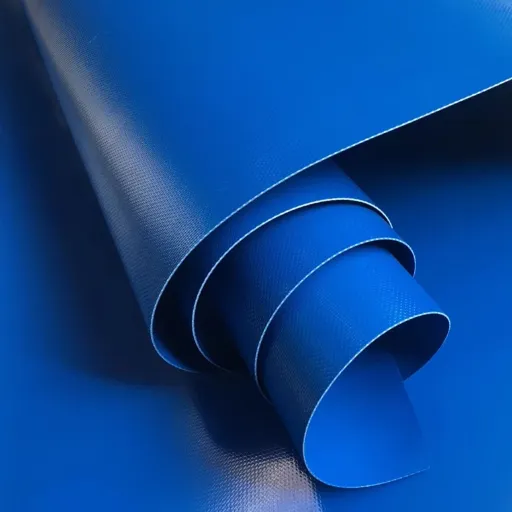
For inflatables, the decision rule is short. If you’re still choosing between material families, our fabrics for inflatables hub shows where PVC sits against TPU and drop-stitch.
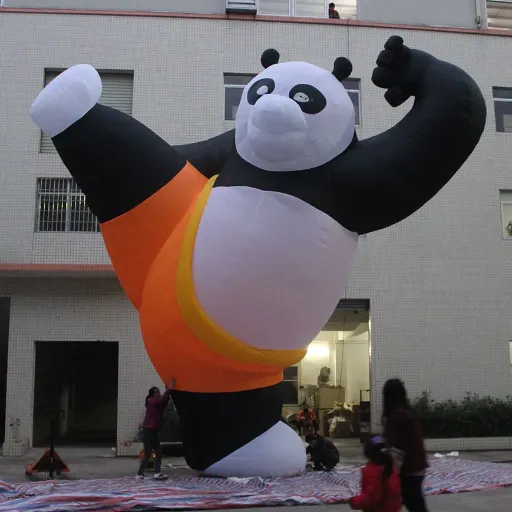
Choose 500D when the unit is light-duty, dry-use, and not in daily commercial rotation. Advertising inflatables, seasonal displays, and small consumer products sit here. The lower weight reduces handling burden and pack size, and the balanced weave still carries pressure correctly.
A 500D PVC fabric at 18 × 18 and roughly 400 GSM is a defensible light-duty specification. The same denier at 12 × 12 is not.
Choose 1000D when the unit runs commercially. Bounce houses in rental fleets, water slides, obstacle courses, and air structures belong in this band. The heavier scrim resists the abrasion that comes from dragging, folding on the same crease, and repeated setup and teardown.
There is a cost dimension worth naming. A 500D fabric is lighter and cheaper per square metre. A 1000D fabric costs more upfront and lasts longer in commercial service. For a rental operator running weekend events, the arithmetic usually favors 1000D, because the replacement cost of a failed unit dwarfs the material delta.
The three scenarios in this article are illustrative composites drawn from common field failures, not accounts of specific customers.
Denise runs a three-unit rental operation outside Sacramento. She bought two 500D inflatables in 2023 to test whether the lighter fabric would hold up. By the second summer, both had seam separation along the climb wall.
The scrim hadn’t torn. The coating had worn through at the fold line, and the seam lost its bond. Her 1000D units from the same period are still in rotation.
The lesson is not that 500D is bad. It is that the failure mode moved from the scrim to the coating, and the lighter fabric had less coating to lose. When a unit folds on the same line forty times a season, coating thickness decides the outcome.
For commercial duty, our commercial-grade bounce house material page lists the constructions we run for rental fleets.
500D vs 1000D for Tarpaulins and Truck Covers
Tarpaulin buyers face a different trade-off, because the load path is different. A truck side curtain or container cover is tensioned and exposed, not pressurized.
That is why the 500D vs 1000D tarpaulin decision turns on tension and exposure rather than internal pressure.
Here the practical hierarchy is weight first, denier second, weave third.
A 500D construction in the 350–500 GSM band suits medium covers, temporary protection, and applications where the tarp is handled often and replaced on a shorter cycle. It drapes well, folds compactly, and costs less.
A 1000D construction in the 550–900 GSM band suits fleet curtains, container covers, lumber tarps, and anything exposed to sustained wind, abrasion, or repeated tensioning. The heavier scrim holds grommet and hem loads better, which is where most tarp failures begin.
Ask for hydrostatic head and cold-crack temperature alongside denier if the cover sees standing water or winter service, because neither property follows from yarn weight.
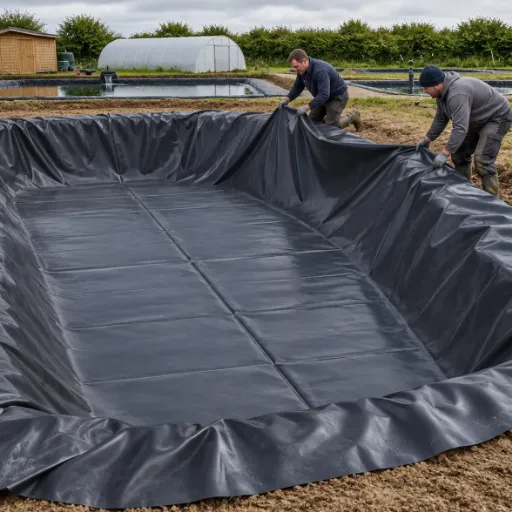
For pond and aquaculture liners, the same logic pushes toward 1000D. Constant water load, UV exposure, and abrasion from the bank make the heavier scrim the safer specification. Our fish farming tarpaulin range runs in that band.
Mark sources curtains for a regional flatbed fleet in Ohio. He switched one tractor-trailer set from a 500D × 1000D construction at 420 GSM to a 1000D × 1000D at 610 GSM after losing two curtains to wind flap in a single season. The failure was not a tear in the panel. It was grommet pull-out along the bottom hem.
The heavier fabric did not make the curtain stronger in the abstract. It gave the hem more material to distribute load into, which is what the failure needed.
If you are specifying curtains, our PVC tarpaulin truck side curtain page covers tensioning and hem construction alongside the fabric grades.
How to Verify a Denier Claim Before You Order
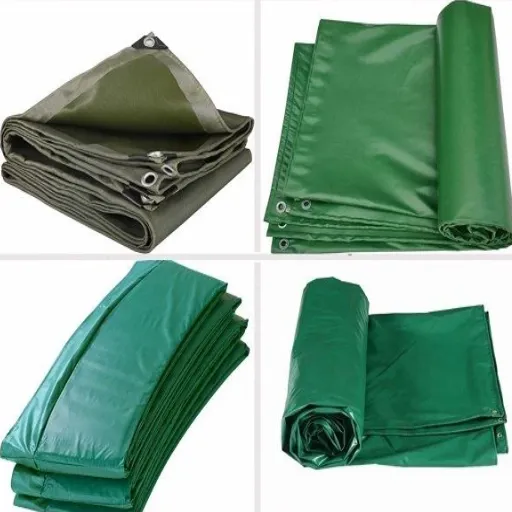
Denier is easy to print on a roll label and hard to verify after the fact. PVC coated fabric denier is a claim about the base cloth, and each of these five checks is designed to confirm that the base cloth matches the label.
- Ask for warp and weft separately. A single number hides asymmetric constructions. You want “1000D × 1000D, 20 × 20” or “500D × 500D, 18 × 18,” not “1000D.”
- Ask for finished GSM and coat weight per side. Total weight alone can be reached with a light scrim and a heavy coat, or the reverse. The split tells you which one you’re buying.
- Ask which test method produced the tensile and tear figures. A number without a method isn’t comparable to anything. Grab tensile per ASTM D5034 and tongue tear per ASTM D2261 are the common references for woven base fabrics. For coated fabric breaking strength, ASTM D751 is the more directly applicable method.
- Request a weld trial on production material. Denier affects how the fabric takes heat. A fabric that welds cleanly on a sample may behave differently on a roll from a different lot. Ask for the weld parameters and a peel result, specified in N/5 cm rather than as “good weldability.”
- Check the compliance documentation against the application. Inflatable play equipment falls under EN 14960 in many markets. Flame retardancy is commonly specified to NFPA 701. Neither standard substitutes for the denier check, but both are easier to confirm before production than after.
Priya audits suppliers for an event rental group in Singapore. Her standard request is one page: denier warp and weft, thread count, finished GSM, coat weight per side, thickness, test method, and a weld peel result. Three of the five suppliers she approached in 2025 could not produce the coat weight figure. Two of those three were reselling coated nylon as PVC scrim.
That single question filtered the shortlist faster than any sample. Explore durable PVC inflatable fabric options with LY TRUSTLINK.
FAQ: 500D vs 1000D PVC
Is 1000D PVC always stronger than 500D?
Not automatically. For a given weave and coating, the heavier scrim improves tear and abrasion resistance. Change the weave or thin the coating, and a well-built 500D fabric can outperform a poorly built 1000D one. Denier is one variable among several.
What does 500D mean in fabric?
It means 9,000 metres of the yarn weighs 500 grams. It describes yarn mass, not fabric weight, thickness, or strength.
Is 1000D PVC waterproof?
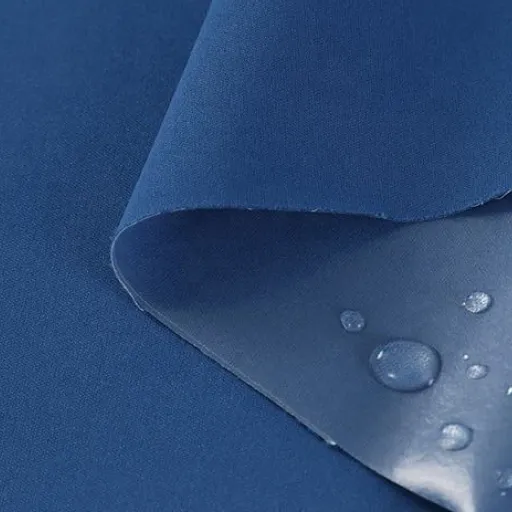
Water resistance comes from the PVC coating and the seam, not the denier. A 1000D scrim with a compromised weld will leak. A 500D fabric with a continuous coating and a sound seam will not.
Can 500D PVC be heat welded?
Yes. Both grades weld well with RF or hot-air equipment, but the parameters differ. Always run a trial weld on production material rather than assuming settings transfer between grades or lots.
How thick is 1000D PVC?
Typically 0.45 to 0.80 mm finished, depending on coating build. A 1000D scrim can be coated to several different thicknesses, so thickness alone does not confirm denier.
Which is better for a bounce house, 500D or 1000D?
For commercial use, 1000D in a balanced weave. For light, dry, occasional-use units, a balanced 500D construction is a legitimate choice. Avoid asymmetric 1000D × 500D in any pressure-retaining product.
Conclusion
The 500D vs 1000D PVC decision comes down to three questions, and none of them is answered by the denier number alone.
Ask what the product is. An inflatable needs a balanced weave, and a commercial one needs 1000D. A tarpaulin can use an asymmetric pairing, and there GSM carries equal weight. A budget bounce house labelled 500D may not be PVC at all.
Ask how hard it will work. Daily commercial rotation, abrasion, and repeated folding justify the heavier scrim. Occasional light duty does not.
Ask what you can verify. Denier, thread count, finished GSM, coat weight per side, thickness, test method, and a weld result. A supplier who can answer all seven is selling you a fabric. A supplier who answers one is selling you a label.
If you are specifying a run and want the numbers confirmed against your application, send us your requirement and our engineering team will return a matched construction with the test data attached.