
PVC vs Oxford Fabric for Bounce Houses: Which Wins?
For commercial use, PVC tarpaulin is the better bounce house material. It lasts 3-5+ years against the 2-3 years of Oxford fabric, it’s fully waterproof where Oxford is only water-resistant, and it costs less to own over five years once repairs and replacements are counted. Oxford fabric is a legitimate choice for occasional backyard parties and indoor play, where its low price, light weight, and softer surface matter more than long-term durability.
The PVC vs Oxford fabric bounce house question looks like a simple “cheap vs durable” tradeoff. It is not. The two materials are different constructions: Oxford is a woven cloth (typically polyester or nylon with a polyurethane coating), while PVC tarpaulin is a load-bearing polyester scrim coated with PVC on both faces. They tear differently, weld differently, repair differently, and fail differently.
Most comparison guides are written by people who sell finished units. We manufacture the raw fabric, and we test every production batch for tensile strength, tear resistance, and seam integrity.
This guide defines both materials precisely, adds the third material most buyers never hear about (PVC-coated Oxford), compares real specs, runs the five-year cost, and shows you how to verify what you’re actually buying. For the full material stack and grade tiers, start with our bounce house fabric guide.
Key Takeaways
- PVC tarpaulin is the commercial standard: 3-5+ year lifespan, fully waterproof, heat-welded seams, and 10-15 minute field repairs. Oxford fabric lasts 2-3 years commercial or 6-18 months residential and is often unrepairable once torn.
- Oxford fabric is a woven polyester/nylon cloth with a PU coating (210D-840D typical), not a coated scrim; its tensile strength runs roughly 800-1,200 N/5cm against 2,200-2,500 N/5cm for commercial 18 oz PVC.
- A large share of cheap “PVC” bounce houses are actually PVC-coated Oxford, a middle-grade material with its own performance envelope. It is durable enough for residential use but does not carry commercial scrim, tear, or certification specs.
- Despite costing 8−12/m2against8−12/m2against3-6/m² for Oxford, PVC typically costs 25-40% less over five years because it needs far fewer repairs and fewer replacements.
- You can identify the real material in minutes: welded seams mean PVC, stitched seams mean Oxford construction, and a supplier who cannot name the scrim and coating is probably selling PVC-coated Oxford labeled as PVC.
What Is Oxford Fabric for Bounce Houses?
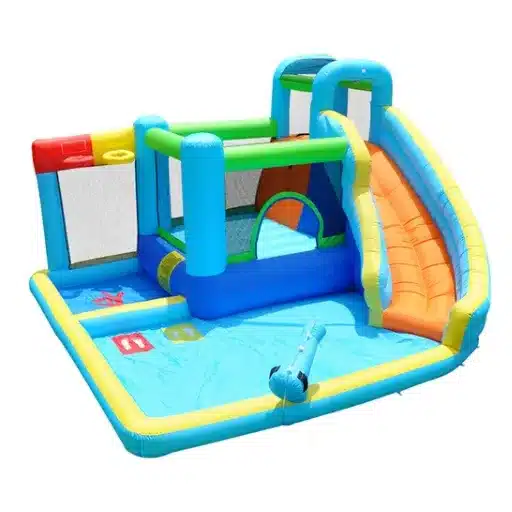
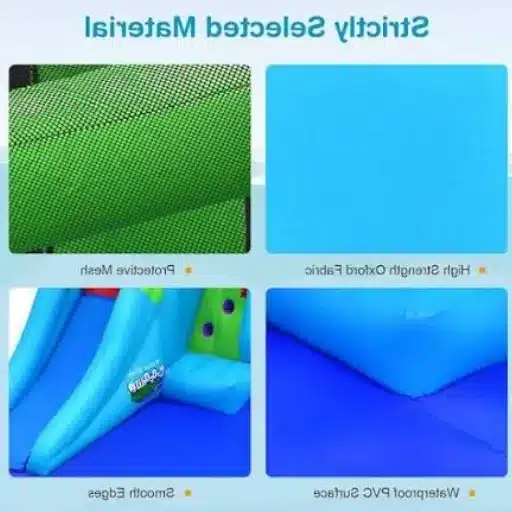
Oxford fabric is a woven polyester or nylon cloth in a basketweave pattern, typically coated with polyurethane (PU) for water resistance, used in residential and light-duty inflatables. The weave gives it a soft, flexible hand, and the coating makes it water-resistant rather than fully waterproof. It is the material behind most budget-priced home bounce houses.
The name describes the weave construction, not the polymer. Oxford cloth is woven with a double warp and a thicker weft, producing the checkerboard “basketweave” relief you can feel on the surface. The same construction can be made from polyester or nylon, and the two behave differently. Polyester Oxford resists UV and moisture better; nylon Oxford is stronger but absorbs water, which invites mildew in a unit left damp.
On bounce houses you will most often see 210D, 420D, or 600D Oxford fabric, with heavier 840D grades appearing on higher-end residential units. The “D” stands for denier, the yarn thickness. 420D is the most common spec on budget bounce houses sold through big-box and marketplace channels. To understand the weave construction in detail, this Oxford fabric reference from a textile manufacturer explains the difference between basketweave and standard plain weaves.
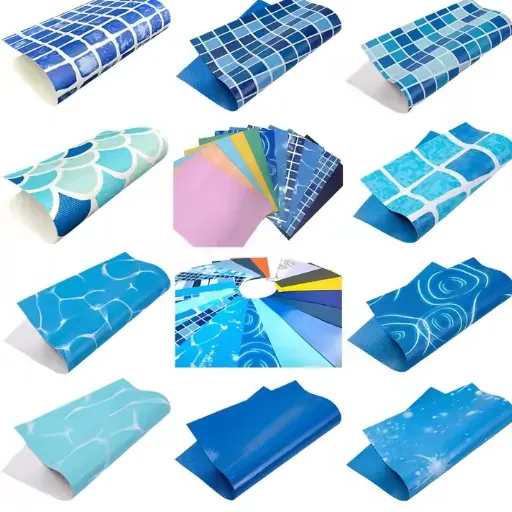
The defining weakness of Oxford bounce house construction is the seam. Oxford panels are joined with stitched seams that are then sealed. Every stitch perforates the fabric, and those perforations are the first place a unit fails under load. A welded PVC seam is a molecular bond. A stitched Oxford seam is a line of holes held closed by thread. Looking for durable inflatable castle tarpaulin fabric? Contact us to discuss the right material, coating, thickness, and color for your production needs.
What Is PVC Tarpaulin for Bounce Houses?
PVC tarpaulin is a polyester scrim, typically 1000D, knife-coated or calendered with PVC on both faces, creating a dense, fully waterproof, load-bearing sheet. It is the commercial industry standard for inflatable bounce houses and water slides.
The construction is the opposite of Oxford. Instead of woven yarns exposed on the surface, the polyester scrim is buried inside a continuous PVC coating. That coating does three things a PU-coated woven cloth cannot: it seals the fabric against water, it distributes point loads so tears do not start as easily, and it allows panels to be joined by high-frequency (RF) or hot-air welding, which fuses the coatings together into a seam often stronger than the material itself.
The commercial baseline is 18 oz (about 610 gsm, roughly 0.55 mm) of PVC over a 1000D high-tenacity polyester scrim. Commercial fabric runs 500-900 gsm (15-26 oz), with heavier 20 oz grades used on slide surfaces and high-abrasion zones. We manufacture this fabric and publish the full spec range in our PVC inflatable fabric specifications guide.
If you’re weighing PVC against other coating polymers rather than against woven cloth, our PVC vs TPU comparison for inflatables covers the other engineered option you may encounter.
The Third Material Nobody Names: PVC-Coated Oxford
Before the side-by-side comparison, there’s a material that sits between Oxford and PVC tarpaulin, and it’s what most cheap “PVC” bounce houses are really made of: PVC-coated Oxford.
PVC-coated Oxford is Oxford cloth with a PVC coating or laminated PVC film instead of PU. It is stiffer and more water-resistant than PU-coated Oxford, and it resists punctures better, which is why manufacturers can honestly print “PVC” on the listing. But it is still a woven cloth. It does not carry the 1000D scrim-and-coating build of commercial tarpaulin, it is usually joined with stitched seams, and it typically ships without commercial-grade tensile, tear, or certification data.
Maya learned this distinction the hard way. She runs a small event company outside Orlando and bought six “commercial PVC” combo units for her school-party bookings in spring 2025. The material felt dense and the listing said PVC. On the second booking, a bounce-floor seam split.
When she finally got the spec sheet from the importer, the base fabric was listed as “420D Oxford with PVC coating.” The units were PVC-coated Oxford, not commercial PVC tarpaulin, and the seam that failed was stitched, not welded. Three of the six units needed repair within a single season.
The point is not that PVC-coated Oxford is bad. For a residential unit that sees a birthday party a few times a year, it is often perfectly adequate, and it explains why many budget units survive light use despite the “PVC” label being technically true. The point is that it is a different performance tier from commercial PVC tarpaulin, and buyers who believe they purchased one and received the other are making decisions on false assumptions.
PVC Tarpaulin vs Oxford Fabric: Side-by-Side Spec Comparison
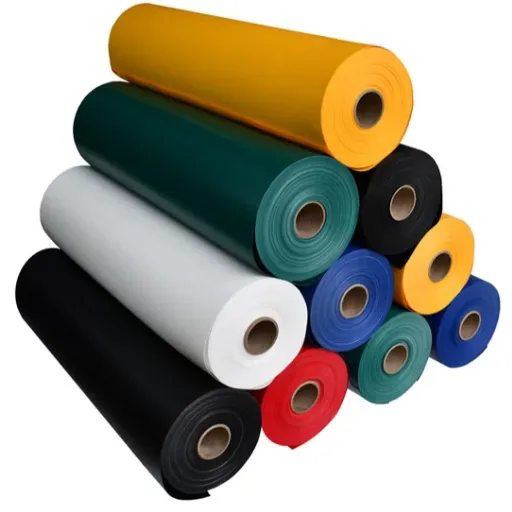
The table below is the direct answer to the PVC vs Oxford fabric bounce house question. The PVC figures are manufacturer-spec values for commercial 18 oz fabric over a 1000D scrim. The Oxford figures are realistic ranges for 420D-840D PU-coated cloth; verify any supplier’s actual numbers with a test report before you rely on them.
| Spec | PVC Tarpaulin (Commercial) | PVC-Coated Oxford | Oxford Fabric (PU-Coated) |
|---|---|---|---|
| Base fabric | 1000D polyester scrim | Woven polyester/nylon, 420D-840D | Woven polyester/nylon, 210D-600D |
| Coating | Knife-coated PVC, both faces | PVC coating or film | PU (polyurethane) |
| Typical weight | 500-900 gsm (15-26 oz/yd²) | ~250-450 gsm | ~200-400 gsm |
| Tensile strength | 2,200-2,500 N/5cm | ~1,200-1,800 N/5cm (est.) | 800-1,200 N/5cm |
| Tear resistance | 280-320 N | ~150-250 N (est.) | 100-200 N |
| Water resistance | Fully waterproof (3,000 mm+) | Water-resistant to waterproof | Water-resistant (1,000-2,000 mm) |
| Seam type | Heat/RF-welded | Stitched + sealed / light weld | Stitched + sealed |
| Field repairability | Easy, vinyl patch, 10-15 min | Moderate | Difficult, often unrepairable |
| Commercial lifespan | 3-5+ years (up to 7 at 18-20 oz) | 1-3 years | 2-3 years commercial; 6-18 months residential |
| Weight capacity | Up to ~2,000 lbs | ~400-800 lbs | 200-400 lbs |
| Cold-weather behavior | Stiffens below ~40°F | Moderate | Stays pliable |
| Approx. material cost | $8-12/m² | $5-8/m² | $3-6/m² |
Two numbers in that table carry most of the decision weight. The tensile difference (2,200-2,500 N/5cm for PVC against 800-1,200 N/5cm for Oxford) is what lets a commercial unit carry several children jumping in unison. The seam difference is what decides whether a failure is a 15-minute patch or a replacement unit. If you are comparing inflatable castle fabric suppliers, contact us to evaluate material performance, customization options, and production costs for your application.
Durability, Waterproofing & Repairability: Where the Materials Separate
Tear, Puncture & Abrasion
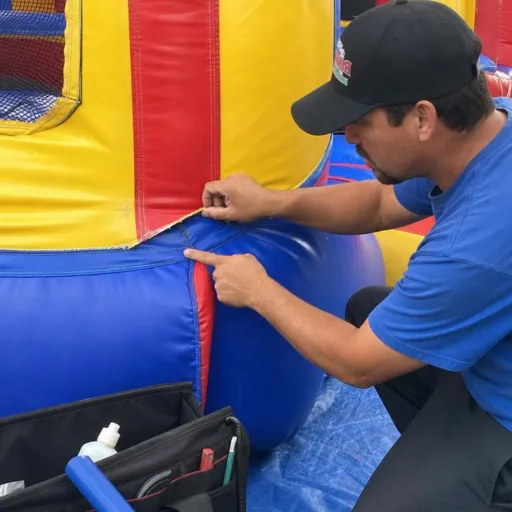
Oxford cloth fails first at the woven surface and the stitch line. High-friction zones, the bounce floor, slide beds, and the base of entrance ramps, wear the coating and then the yarns, and a torn Oxford panel often cannot be patched cleanly. PVC tarpaulin distributes the load across the continuous coating, so a puncture stays a localized puncture instead of running into a tear. That is why rental fleets report dramatically fewer service incidents on PVC units.
Water & Mold
PVC is fully waterproof and resists mold and mildew. Oxford is water-resistant, not waterproof. For the PVC vs Oxford fabric bounce house decision, this is often the tie-breaker. Prolonged moisture degrades a PU coating over a season or two of wet use, and the woven construction holds moisture against the yarns, which invites mildew. For water slides, splash zones, or any unit stored outdoors, PVC is the only practical choice. For dry, sheltered use, the difference matters less.
Repair Economics
Renee runs a festival rental fleet outside Austin and has kept a repair ledger for four years. Her two Oxford combo units averaged seven service events per unit per year, mostly seam re-stitching, and she retired both before their second full season because the fabric around the seams was too worn to repair. Her four 18 oz PVC units averaged two service events per unit per year, almost all surface patches cured in an afternoon. The repair spend difference, roughly $2,400 a year across the fleet, was larger than the upfront price difference that led her to try Oxford in the first place. The math is explained in full in our guide to how a commercial bounce house is constructed.
Safety & Load Ratings
Material choice is a safety decision, not just a cost decision. Welded PVC seams and a 1000D scrim are what let a unit meet the structural expectations of ASTM F2374-22, the US standard for inflatable amusement devices. Oxford’s lower load ratings and stitch-line weak points cap the safe occupancy of a unit, which is why residential Oxford units carry far lower weight limits than commercial PVC units. Fire retardancy is a separate requirement, covered by NFPA 701 for textiles in public use; ask for the certificate, not the word “fireproof.”
The Real Cost: 5-Year Total Cost of Ownership
The lifespan claims on this topic are all over the map, and that’s because they describe different grades and duty cycles. The “10-15 year PVC” figure applies to lightly used, well-maintained premium material. Commercial 15-18 oz PVC realistically lasts 3-5+ years under weekly rental duty. Oxford lasts 2-3 years commercial or 6-18 months residential. Reconcile them by grade and duty cycle and the picture is consistent.
Now run the money. Oxford saves 15-25% upfront, about 3−6/m2against3−6/m2against8-12/m² for PVC, and a lighter unit is genuinely cheaper to transport and store. But Oxford also needs roughly double the annual maintenance, 200−400/yearagainst200−400/yearagainst100-200/year for PVC, and it gets replaced years earlier. For a 15×15 unit, the crossover is usually around year two: the Oxford unit’s initial savings are consumed by repairs and a replacement that the PVC unit simply does not need.
Leo bought a single Oxford bounce house for his church’s monthly fundraiser rather than the more expensive PVC unit. Over three years, he replaced the Oxford unit twice, at about $1,100 each, and logged nine repair events. A comparable 18 oz PVC unit at roughly $1,400 would have been in service the entire time with minor patching. The upfront savings cost him about $1,800 over three years.
For a family bouncing a few weekends a year, the Oxford unit’s lower price and easier storage can genuinely win; the honest answer depends on how hard the unit works. That context matters more than any single lifespan number.
If you want the complete cost model and a worked example, the grade-by-grade economics and repair ledger in our bounce house fabric guide lay out the full picture.
How to Verify What Material a Bounce House Is Made Of
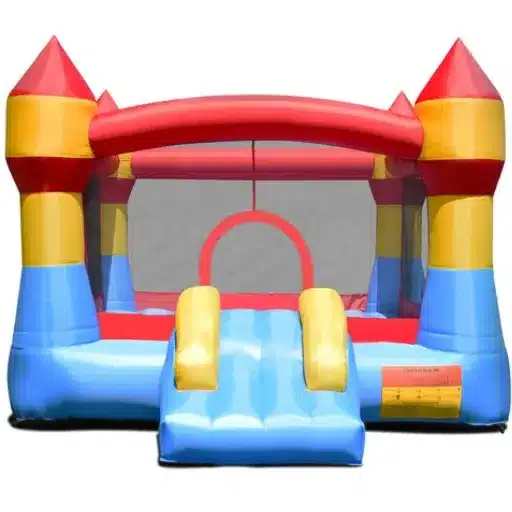
A significant share of the market blurs these categories on purpose. A unit can be listed as “PVC,” ship as PVC-coated Oxford, and fail like an Oxford unit, and the buyer only discovers the truth after the first seam goes. Here is the field checklist we give buyers who want to know what they are actually holding.
- Check the seams. Welded seams, smooth and continuous, mean PVC tarpaulin. Stitched seams that are then sealed mean Oxford construction, regardless of the coating.
- Ask for the spec sheet. A real spec states the base fabric (1000D scrim for commercial PVC), the weight in oz/yd² and gsm, and the coating type (PVC or PU). A weight with no unit is not a spec.
- Ask for the test report. Demand measured tensile and tear values from a recognized method such as ASTM D751 or EN ISO 1421. See this commercial inflatable spec sheet guide from a fellow manufacturer on what each number means.
- Confirm fire certification. NFPA 701 or CPAI-84 compliance should come with a certificate number you can trace. See the NFPA standard for the test method.
- Confirm chemical compliance. Lead-free, phthalate-free material meeting CPSIA, REACH, or EN 71-3 is the baseline for children’s equipment.
- Weigh a sample if you can. A roll of material can be weighed in minutes, and oz/yd² follows directly. PVC-coated Oxford is noticeably lighter than commercial PVC of the same listed size.
- Treat “commercial grade” with no numbers as a red flag. If the supplier cannot name the scrim and coating, you’re likely holding PVC-coated Oxford labeled as PVC.
Verification is not paranoia; it is procurement. If you decide the cheaper material genuinely fits your use case, buy it deliberately and price it as what it is. If you decide you need commercial PVC, make sure the invoice matches the spec sheet, not the listing.
FAQ: PVC vs Oxford Fabric for Bounce Houses
Which is better for a bounce house: PVC or Oxford fabric?
For commercial or heavy outdoor use, PVC tarpaulin is better: it lasts 3-5+ years, is fully waterproof, welds into seams stronger than the material, and costs 25-40% less over five years. Oxford fabric is better for occasional backyard parties, indoor play, and young children, where its low price, light weight, and softer surface matter most.
What is Oxford fabric made of?
Oxford fabric is a woven polyester or nylon cloth in a basketweave pattern, typically coated with polyurethane for water resistance. It is used in residential and light-duty inflatables, commonly in 210D to 840D grades. The name describes the weave, not the polymer.
Is Oxford fabric waterproof?
No. Oxford fabric is water-resistant, not waterproof. PU-coated Oxford typically rates 1,000-2,000 mm water column, and prolonged moisture degrades the coating and invites mildew. PVC tarpaulin is fully waterproof and is the required choice for water slides and wet environments.
Can an Oxford fabric bounce house be repaired?
Sometimes, but a torn Oxford panel is often unrepairable and must be replaced. Stitched Oxford seams are a common failure point, and re-stitching costs more than patching a PVC unit, which is fixed with a vinyl patch in 10-15 minutes.
How long does an Oxford fabric bounce house last?
An Oxford bounce house lasts 6-18 months under residential use and 2-3 years under light commercial duty. Commercial PVC tarpaulin at 18 oz typically lasts 5-7 years, which is why the upfront price difference usually pays for itself.
What is the difference between PVC-coated Oxford and PVC tarpaulin?
PVC-coated Oxford is Oxford cloth with a PVC coating instead of PU. It is stiffer and more water-resistant than standard Oxford, which is why it is often labeled “PVC,” but it is still a woven cloth with stitched seams and no commercial scrim, tensile, tear, or certification specs. It is a middle tier, not commercial PVC.
Conclusion: PVC vs Oxford Fabric for Bounce Houses
The PVC vs Oxford fabric bounce house decision is really a question of duty cycle. PVC tarpaulin is the commercial standard: longer lifespan, fully waterproof, welded seams, easy repairs, and lower five-year cost despite the higher upfront price. Oxford fabric is a legitimate residential option when portability, price, and softness matter more than longevity, provided it is specified honestly and you accept the shorter service life.
The one material to watch for is PVC-coated Oxford, which is neither fully PVC nor fully Oxford and is often sold under the “PVC” label. Read the seams, request the spec sheet, and confirm the scrim, coating, and certifications before you order. A supplier who can state those numbers is selling a spec. A supplier who cannot is selling a label.
When you are ready to spec a commercial unit, our engineering team supplies certified 18 oz and 20 oz PVC inflatable fabric. Start with our commercial PVC inflatable fabric range, or request a sample order and specification sheet. If your design needs a custom weight, coating, or reinforcement, our custom tarpaulin manufacturing team will build to your exact operational requirements. The right material, specified correctly, is the difference between a unit that earns for years and one that fails on a Saturday morning.