
Bounce House Fabric Wholesale: Sourcing Guide & MOQs
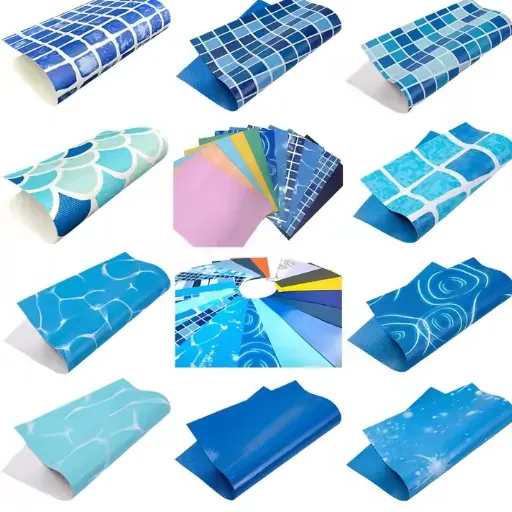
Bounce house fabric wholesale means buying PVC-coated polyester tarpaulin in bulk roll form directly from a fabric manufacturer, typically at quantities of 2,000 square meters or more. The commercial grade you should be sourcing is 18 oz (about 610 gsm) on a 1000D polyester scrim, and the working wholesale price at volume is roughly 1.04to1.04to1.05 per meter, or 8to8to10 per square meter for 18 oz fabric. This guide, written from the fabric manufacturer’s side of the deal, explains what to specify, what to pay, what to test, and what to walk away from.
Buying wholesale bounce house fabric is a bulk bet. A single 2,000-meter order commits thousands of dollars before the first unit is sewn, and the search results are a wall of marketplace listings with no way to tell a real mill from a trading desk. Get the spec wrong and you own the failure.
We manufacture commercial PVC inflatable fabric and test every production batch for tensile strength, tear resistance, and coating adhesion. This guide is the RFQ template and supplier checklist we give to buyers who want to source roll goods without getting burned. For the full material stack and grade-by-grade breakdown, start with our bounce house fabric guide.
Key Takeaways
- Wholesale bounce house fabric is sold in rolls, typically 2.5 to 3.2 m wide, and real MOQs run from about 2,000 square meters up to 4,000, depending on the mill.
- The commercial baseline is 18 oz (about 610 gsm) on a 1000D scrim; anything under 500 gsm labeled “commercial grade” is residential material wearing a commercial label.
- Budget around 1.04to1.04to1.05 per meter at volume for 18 oz stock, or 8to8to10 per square meter, and be suspicious of quotes that come in far below market.
- Vet the mill, not the listing: real factories answer technical questions instantly, send samples from the production line, and provide batch-specific test reports.
- A two-step QC gate, in-process coating monitoring plus pre-shipment batch testing, is what separates a supplier you can build a product line on from one who ships a scrapped batch.
What Does “Wholesale Bounce House Fabric” Mean?
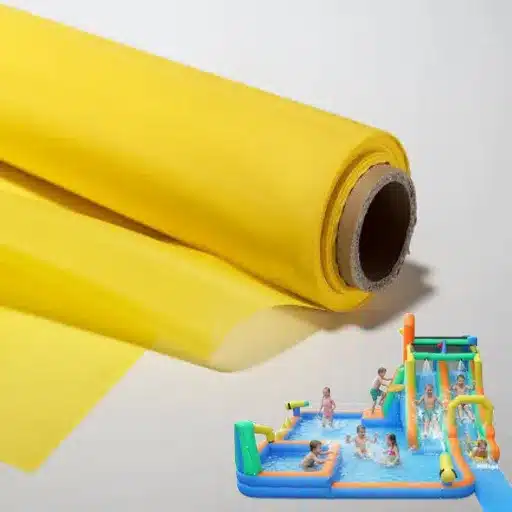
Wholesale bounce house fabric is the raw material that inflatable manufacturers, rental fleets, and importers buy in volume instead of buying finished bounce houses. It ships as a roll of PVC-coated polyester tarpaulin, cut to width and wound on a core, and it becomes a bounce house only after it is cut, welded, and fitted with blowers and anchors downstream.
The buyers fall into three groups. OEM manufacturers weld the fabric into units and sell them under their own brand. Rental fleets buy fabric to build or replace units in-house and control their own repair costs. Importers and distributors buy roll goods in bulk and resell to smaller operators who lack a direct factory relationship.
The product format matters for sourcing. Rolls come in widths of 2.5 to 3.2 meters as standard, with some mills offering up to 5 meters for specialty applications. Roll lengths are commonly 50, 70, or 100 meters. Every RFQ needs to lock down width and roll length, because they determine how many panels you can cut from a single roll and how much waste you carry.
The commercial standard for bounce house fabric is 18 to 20 oz per square yard (610 to 650 gsm) on a 1000D high-tenacity polyester scrim. That is the grade built to survive a rental duty cycle. If you are sourcing wholesale fabric to build commercial units, that is your target. For a deeper look at the three-layer construction and how weight, denier, and weave interact, see our PVC inflatable fabric specifications guide.
What to Specify on a Bounce House Fabric RFQ
The single biggest sourcing mistake we see is an RFQ that says only “18 oz PVC inflatable fabric.” Weight alone does not define the material, and two rolls can both be labeled 18 oz while performing very differently. A complete RFQ carries eight fields, and each one changes the price and the performance.
- Application. Bounce house, water slide, obstacle course, or wet/dry combo. This sets the weight grade and the coating.
- Base scrim. Denier and weave count. Minimum commercial is 1000D x 20 x 20; industry standard is 1000D x 23 x 23; heavy-duty and water slides go to 1000D x 30 x 30 or 1100D.
- Weight with tolerance. State the GSM target and the acceptable tolerance. Premium mills hold plus or minus 5 gsm; the industry standard is plus or minus 10 gsm.
- Coating type. Knife-coated, hot-melt coated, or calendered. Hot-melt coating is widely recommended for inflatables because it delivers better airtightness and welding adhesion.
- Surface treatment. UV stabilization, anti-mildew, flame retardancy, anti-slip embossing. Specify which ones your application needs.
- Certifications. ASTM F963, EN 71, NFPA 701, REACH, RoHS, CA Prop 65. Compliance must be specified up front and documented in test reports, never assumed.
- Dimensions. Roll width, roll length, and whether you need custom widths.
- Color. Reference a Pantone or RAL number, not a name like “red” or “blue.”
The GSM tolerance field deserves extra attention, because inconsistent coating is the root cause of welding failures. When coating weight varies across a batch, the fabric welds unevenly, and the result is seams that look fine and fail under pressure. A supplier who will not commit to a weight tolerance in writing is not a supplier you can build a product line on. Our engineering team can help you lock down a full spec for your unit type, and we build custom grades to your exact custom fabric manufacturing requirements.
Bounce House Fabric Wholesale Pricing: What You Should Expect to Pay
Wholesale pricing tracks fabric grade, and the spread between grades is wider than most first-time buyers expect. These are realistic manufacturer price bands for roll goods at volume, based on current market data:
| Fabric Grade | Weight | Approx. cost per m² | Typical application |
|---|---|---|---|
| 15 oz | ~510 gsm | $6-8 | Light commercial, promotional |
| 18 oz | ~610 gsm | $8-10 | Standard commercial bounce houses |
| 20 oz | ~650 gsm | $10-12 | Premium commercial, water slides |
At high volume, per-meter pricing drops. Current wholesale listings for 18 oz PVC tarpaulin roll goods run about 1.04 to 1.05 per meter at 2,000 to 3,000 meters and up. Three factors push price upward from that floor: flame-retardant treatment, REACH and certification compliance, and cold-crack additives for low-temperature markets.
Sarah Kim runs a 12-unit rental fleet in Texas, and her experience is the case for not buying the cheapest roll. In 2022 she switched her units from 15 oz to 18 oz PVC. The fabric cost her about $180 more per unit. Her annual repairs dropped from 14 incidents to 3, and with repairs averaging about $350 each, she saved roughly $3,800 in maintenance by year three on a fleet generating $85,000 in annual revenue. The upgrade paid for itself in the first season.
The lesson carries into wholesale buying. A quote for 480 gsm material priced as “commercial” is not a bargain; it is a different product. When you compare wholesale prices, compare at the same grade, the same certification set, and the same coating specifications. If one supplier is 40 percent below every other quote, ask what is missing before you celebrate. Looking for durable inflatable castle tarpaulin fabric? Contact us to discuss the right material, coating, thickness, and color for your production needs.
MOQs & Roll Sizes: Realistic Minimums
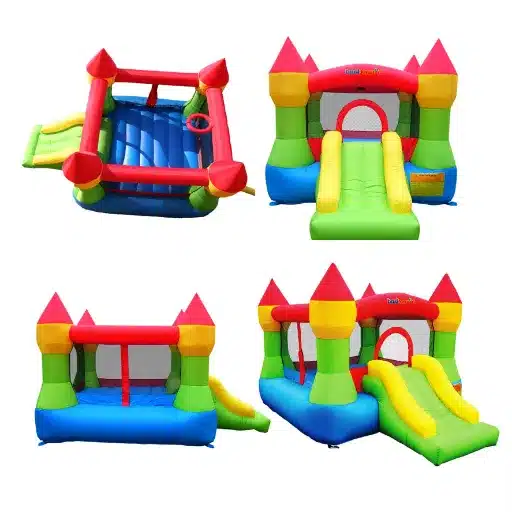
Minimum order quantities for bounce house fabric roll goods cluster in a predictable range. In current supplier listings, MOQs run from about 2,000 square meters up to 4,000 square meters, and at least one mill quotes 40 rolls as a minimum order. A first-time buyer should plan for a starting order around 2,000 square meters, which covers roughly 20 standard rolls at 2.5 m x 50 m.
Sampling happens before you commit. Most legitimate mills send A4-size swatches or 1 x 3 m samples by express courier, and some deduct the sample fee from your first order. Ask for a sample that comes off the production line you will actually buy from, not a hand-built pilot version. A sample that is assembled with premium materials that never appear in bulk production tells you nothing about what you will receive.
Prototype and R&D quantities are more flexible than production MOQs. LY TRUSTLINK keeps minimums flexible for prototyping and scales pricing for volume, so a buyer validating a new unit design can start small and grow the order once the spec is proven. That flexibility matters for a manufacturer testing a new bounce house model before committing to a container of fabric.
How to Vet a Wholesale Bounce House Fabric Supplier
Treat B2B platforms as a lead-generation funnel, not a vetting tool. A “verified” badge confirms a business license exists; it does not confirm production capability. The questions below separate a real mill from a trading desk faster than any badge.
- Does the supplier specialize? A real fabric mill makes fabric. A supplier who also sells tents, LED furniture, and playground slides is almost certainly reselling.
- Can they answer technical questions instantly? Ask about GSM tolerance, weld method, and coating type. A factory answers specifically and immediately. A trader says they will check with the workshop.
- Are the certifications in their own name? A factory shows its own certificates and business license. A trader borrows the manufacturer’s paperwork.
- Will they walk the production floor on a video call? Real factories do this routinely. Traders stall or show a clean office.
- Are they fluent in OEM/ODM? A genuine manufacturer discusses custom weights, coatings, and dimensions without hesitation. A trader offers catalog items with logo printing.
Then verify the paperwork. Request the mill spec sheet, not just a product name, and ask for independent lab test reports from SGS, TUV, Intertek, or BV covering the certifications your market requires. Ask for batch traceability, meaning the ability to link a finished roll to its specific production batch. A buyer we know in Ohio shortlisted three “manufacturers” for a container order and eliminated two of them in a single video call: one could not show any production floor, and the other answered every technical question with a stock phrase. The third, a real mill, walked him through the coating line and sent batch test reports with measured values within 24 hours. He ordered from the third supplier, and the delivery matched the sample.
Quality Control Checkpoints for Roll Goods
Buying wholesale fabric on price alone is how buyers end up with a container of material that fails in the weld shop. Quality control for roll goods happens at two points that matter: during coating and before shipment.
In-process coating monitoring. This is where the Marcus Chen case lives. Marcus runs an OEM inflatable workshop in Guangdong. He ordered a 2,000-meter batch that arrived measuring between 585 and 632 gsm, a swing of nearly 50 gsm on a roll that was specified at 610. His welding team ran the material through high-frequency welding, and the seams passed visual inspection. They failed pressure testing at 18 PSI, and the entire batch was scrapped. The supplier had skipped in-process coating monitoring, and the inconsistent coating produced welds that looked sealed and were not. Marcus switched suppliers, and his weld-failure rate dropped to zero.
Pre-shipment batch testing. Every roll-goods batch should carry test reports for tensile strength, tear resistance, and coating adhesion, with dates that match the batch number. Ask for the specific test methods: ASTM D751 and EN ISO 1421 for tensile and tear, DIN 53357 for peel strength, and ASTM G154 or ISO 4892 for UV stability. A commercial 18 oz fabric should deliver tensile strength in the 2,200 to 2,500 N/5cm range and tear resistance of 280 to 320 N.
Airtightness is the inflatable-specific number. Quality fabric holds permeability below 0.05 cm³ per cm² per second at 20 mbar, while commodity grades run 0.15 to 0.30. UV claims should be verifiable too: stabilized grades retain 85 to 90 percent of their strength after 2,000 hours of ASTM G154 testing, while untreated material can lose 30 to 50 percent in 12 months.
For the full test methodology and what each value means for a commercial inflatable, the PVC inflatable fabric specifications guide walks through it in depth.
Red Flags When Sourcing Bounce House Fabric
Some warning signs are technical, and some are commercial. Either kind is enough to disqualify a supplier.
- GSM variance outside the stated tolerance, especially inconsistent coating across a sample roll.
- A “commercial grade” label on material under 500 gsm. That is the red line, and it catches most fakes.
- Refusal to send a raw material sample, or a sample that took an unreasonably short turnaround on a custom spec.
- Certificates without report numbers, or test reports from labs you have never heard of.
- Glued seams instead of high-frequency or hot-air welding. Glue melts under UV and heat.
- A product catalog so broad it reads like a general trading company.
- No production-floor access, no video walkthrough, and vague answers to spec questions.
- Warranty terms that vanish when you ask for them in writing.
- Prices far below every other quote. Cheap is not a discount; it is a warning.
- A sample that cannot be confirmed as coming from the same line as the bulk order.
A single red flag is worth a second look. Two or more is worth walking away. Sourcing is decided in the first round, and the cost of a bad supplier is the container, the freight, the duties, and the weeks of lost production, not just the invoice.
Lead Times, Shipping & Payment Terms
Plan your timeline around three numbers. Production runs 25 to 45 days from a confirmed purchase order, and peak season for inflatable demand pushes it to the long end. Samples arrive in 2 to 3 weeks. Sea freight from major Chinese ports takes 18 to 25 days to the US West Coast or Northern Europe.
Payment terms follow a standard pattern in fabric sourcing. The norm is a 30 percent deposit on purchase order and 70 percent against the bill of lading before shipment, with first orders sometimes requiring a 50/50 split. Letters of credit are common for large orders, and escrow services protect first-time buyers. Never send full payment upfront, and never skip the pre-shipment inspection.
Incoterms matter for cost control. FOB at a named Chinese port is the common starting point and gives you control over the forwarder. CIF bundles freight and insurance but reduces that control. Whatever you choose, the supplier stability matters more than the per-meter price, because a supplier who communicates transparently and ships consistently is worth more than one who quotes 5 percent lower and disappears at the first quality dispute.
Bounce House Fabric Wholesale: Frequently Asked Questions
What is the MOQ for inflatable fabric?
Most fabric mills set MOQs between 2,000 and 4,000 square meters for production roll goods, with some quoting a minimum of 40 rolls. Prototype and R&D quantities are usually smaller and negotiable, and most mills send A4 or 1 x 3 m samples by express courier before any bulk order.
How much does bounce house fabric cost per meter?
Wholesale pricing for 18 oz PVC tarpaulin runs about 1.04 to 1.05 per meter at 2,000 to 3,000 meters and up. Per square meter, 15 oz fabric costs about 6to6to8, 18 oz about 8to8to10, and 20 oz about 10to10to12, depending on certifications and surface treatments.
How do I know if a bounce house fabric supplier is legitimate?
Ask technical questions about GSM tolerance, coating type, and weld method. A real mill answers instantly and shows its own certifications and production floor on a video call. A trading company gives vague answers, borrows paperwork, and cannot show a production line.
What should I put on an inflatable fabric RFQ?
Eight fields: application, base scrim denier and weave count, GSM with tolerance, coating type, surface treatments, certifications, roll dimensions, and color reference. Specify compliance up front and require batch-specific test reports.
What is the difference between a factory and a trading company?
A factory manufactures and specializes in a narrow product range. A trading company resells and tends to carry a broad catalog. The quickest test is a video walkthrough of the production floor and an instant, specific answer to a technical question.
What certifications should a bounce house fabric supplier have?
For children’s products and commercial inflatables, look for ASTM F963 and EN 71 for toy safety, NFPA 701 for fire retardancy, and REACH or RoHS for chemical compliance. Require independent lab reports with report numbers and issue dates.
Can I order a sample before a bulk purchase?
Yes, and you should. Most mills send A4 or 1 x 3 m samples by express courier, and some deduct the sample fee from the first order. Ask for a sample from the production line you will buy from, not a hand-built version.
What is the commercial grade standard for bounce house fabric?
Commercial grade means 18 oz (about 610 gsm) on a 1000D polyester scrim with tear resistance of at least 240 to 280 N. Anything under 500 gsm labeled “commercial grade” is residential material regardless of the marketing.
Conclusion
Sourcing bounce house fabric wholesale comes down to four steps: specify the grade in writing, anchor the price against market bands, verify the mill instead of trusting the listing, and test the batch before it ships. A buyer who does those four things gets 18 oz commercial material on a 1000D scrim at a fair price from a supplier who stands behind the delivery. A buyer who skips them gets a container of material that fails in the weld shop.
Start with the specification. If you are unsure what grade your unit type needs, our engineering team will help you lock down the full spec, and we can send production-line samples before you commit to volume. For the complete breakdown of weights, scrim construction, and test methods, read our commercial inflatable fabric range and the full PVC inflatable fabric specifications guide. Then request a quote and put the supplier checklist in this article to work. The right wholesale supplier is the difference between a product line you can trust and a batch you scrap.