
Commercial Grade Bounce House Material: What It Means
Commercial bounce house material is PVC-coated tarpaulin built to survive repeated rental duty, most commonly 18 oz per square yard (about 610 gsm, 0.50 to 0.60 mm thick) over a 1000D x 23 x 23 high-tenacity polyester scrim, with tear resistance of at least 240 to 280 N and NFPA 701 fire-retardant certification. Below that threshold, and especially below 500 gsm, it is residential material wearing a commercial label.
“Commercial grade” is the most used phrase in the inflatable industry and the least defined. Search any marketplace and you’ll find a hundred units claiming it, most of them with no spec sheet, no test report, and no number behind the label. Then one of those units splits a seam in its second season, and a rental operator learns what the phrase was worth.
We manufacture commercial PVC inflatable fabric on 1000D high-tenacity polyester scrims and test every production batch for tensile strength, tear resistance, and coating adhesion. This article decodes the term in the language buyers actually need: the numeric thresholds that qualify a material for commercial duty, the safety standards it must meet, and a checklist for verifying that what you’re buying is what the label claims. For the full construction breakdown of a finished unit, start with our guide to what bounce houses are made of.
Key Takeaways
- Commercial grade is a numeric spec set, not a marketing label: 18 oz (about 610 gsm) PVC over a 1000D x 23 x 23 scrim, tear resistance of 240 to 280 N, and NFPA 701 fire certification.
- The 500 gsm red line is the fastest filter: material under roughly 500 gsm (about 14.7 oz) is residential grade no matter how it is marketed.
- Commercial PVC handles 3,000+ rental cycles and patches in 10 to 15 minutes, while lighter 15 oz material fails 3 to 4 times more often and needs re-stitching, not patching.
- ASTM F2374 governs design and manufacture of commercial inflatables, and the ICC fire code requires NFPA 701 Test Method 2 for inflatable amusement fabrics.
- Verify the claim before you pay for it: request the spec sheet, check the scrim, ask for lab test reports, and weigh a sample. Many import units are advertised 18 oz but ship 12 to 15 oz.
What Does “Commercial Grade” Mean for Bounce House Material?
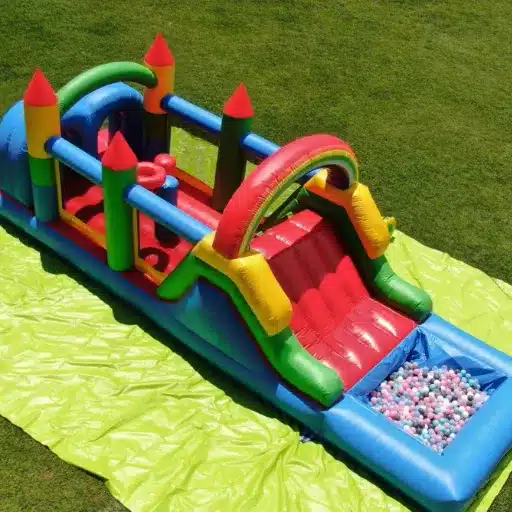
Commercial grade describes a material’s duty cycle, not its color or its price point. A commercial bounce house is set up and torn down hundreds of times a year, filled and deflated, dragged across grass and pavement, soaked by rain, and baked in the sun. The material has to hold air, hold seams, and hold its shape through that abuse for years. Residential units get set up on weekends for a season or two, so their material is built to a much lighter standard.
There is no single global standard that says “this is commercial grade.” What exists is a clear industry consensus, backed by the requirements of safety standards like ASTM F2374, that buyers and manufacturers converge on. That consensus is the 18 oz PVC tarpaulin on a 1000D scrim described at the top of this article. It’s the material the commercial rental industry builds around, and it’s the benchmark against which every cheaper option should be measured.
Tony runs a regional party rental business in Arizona. In spring he bought six “commercial grade” units from a marketplace listing at about 40 percent below the price of comparable units he had rented out for years. The units were fine for the first two months. By September, three of them had seam splits in the bounce surface, and two more were leaking air at the floor seams. When he cut a sample of the fabric and weighed it, the “commercial grade” material measured out at 15 oz. He had paid a commercial price for a residential product. Planning a new inflatable castle product? Contact us to source tarpaulin fabric engineered for repeated inflation, outdoor use, and demanding production conditions.
The Commercial Grade Baseline: Specs That Qualify
Commercial grade is easier to verify than to define, because it comes down to measurable numbers. The table below is the threshold set we use when specifying fabric for commercial bounce houses.
| Spec | Commercial Grade Threshold | Why It Matters |
|---|---|---|
| Fabric weight | 18 oz/yd² (about 610 gsm) | Clears the 500 gsm residential red line with margin |
| Thickness | 0.50 to 0.60 mm | Consistent coating means reliable seam welding |
| Base scrim | 1000D x 23 x 23 high-tenacity polyester | Tear-stop backbone; 20 x 20 is the minimum |
| Tensile strength | 2,200 to 2,500 N/5cm | Resists seam rupture at peak load |
| Tear resistance | 240 to 280 N minimum | Withstands punctures and repeated flex stress |
| Fire retardancy | NFPA 701 compliant | Required for indoor and event use under the ICC fire code |
| Chemical safety | Lead-free, phthalate-free (CPSIA/REACH) | Required for children’s-use compliance |
Weight is where most of the confusion lives, because buyers encounter three different unit systems. They’re all measuring the same thing. The weights and conversions below are the ones that matter for bounce houses.
- 15 oz is about 510 gsm at 0.45 to 0.50 mm thick. Light commercial and promotional duty. Two to three years of lifespan.
- 18 oz is about 610 gsm at 0.50 to 0.60 mm thick. The commercial standard. Five to seven years of lifespan.
- 20 oz is about 650 gsm at 0.60 to 0.75 mm thick. Premium commercial, water slides, and high-abrasion surfaces. Six to eight years of lifespan.
The 500 gsm red line deserves emphasis. Material under roughly 500 gsm, which is about 14.7 oz, can’t reliably survive commercial duty regardless of what the marketing says. Some sellers push 480 gsm and 490 gsm material as “commercial grade” because it sits just under the threshold where a buyer would notice. It is residential material with a label problem. For the full test methods behind these numbers, including how tensile and tear strength are measured, see our PVC inflatable fabric specifications guide.
Why PVC Is the Commercial Grade Standard
PVC-coated polyester dominates commercial inflatables for a reason: it is the only mainstream material that combines the durability, repairability, and weldability commercial duty demands. In surveys of commercial rental suppliers, roughly 90 percent build their products around PVC vinyl, and nearly none use nylon as the primary commercial material.
The difference shows up at the point of tear. Commercial PVC is roughly five times stronger than nylon at the point where a tear starts, which is exactly where a bounce house fails under repeated flex. It is fully waterproof, so it is the practical choice for water slides and wet weather. It holds UV stabilizers that prevent the cracking and fading that destroy untreated polymers. And when it does get punctured, it patches cleanly with vinyl cement in 10 to 15 minutes, a repair that holds for years.
Nylon and Oxford cloth still appear, but almost entirely in residential and budget units. They are lighter and cheaper, which makes them attractive for a unit that will be set up occasionally. They are also only water-resistant rather than waterproof, they wear faster on high-friction surfaces, and their stitched seams fail under heavy use. Their lifespan under commercial conditions is typically two to three years against five to seven for 18 oz PVC. We covered the full comparison in our PVC vs Oxford fabric guide, and the polymer-level comparison in PVC vs TPU for inflatables.
The cost picture follows the durability. Commercial PVC runs about $ 3.10 per setup against $ 14.50 to $22.50 for nylon equivalents, because the PVC unit spreads its higher upfront cost across far more rentals. Buying cheaper material is rarely cheaper.
Want to see the spec sheet for a material that meets this baseline? Our engineering team supplies certified 18 oz and 20 oz PVC inflatable fabric and will send production-line samples before you commit. Request a sample order.
How Material Specs Protect a Commercial Duty Cycle
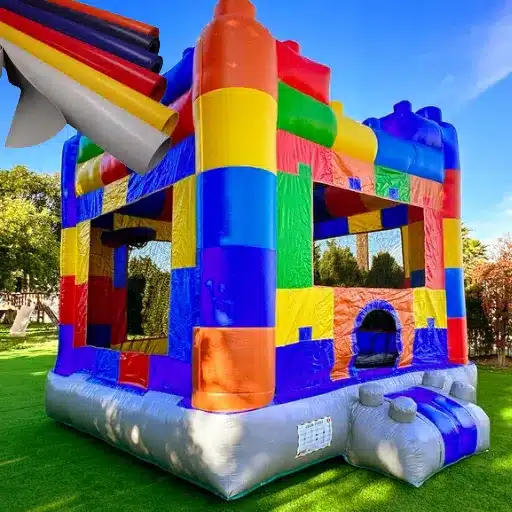
The numbers in the baseline table exist because each one protects a specific part of the commercial duty cycle. Understanding what each spec is protecting makes it easier to evaluate a supplier’s claims.
Rental Cycles and Load
A commercial unit is filled and deflated hundreds of times a year, and every cycle stresses the fabric. Quality 18 oz PVC handles 3,000 or more rental cycles when maintained properly. Lighter residential material measures its life in dozens of cycles, not thousands.
Seams and Welding
Seam failure accounts for most structural failures in commercial inflatables, so the seam is where material quality becomes operational. Commercial-grade fabric is welded with high-frequency or hot-air welding, which fuses the material into a molecular bond that holds air. Stitched-only seams, common on cheaper units, fail under the repeated pressure of commercial use. The fabric has to be consistent in thickness for welding to work, which is why coating tolerance matters as much as overall weight.
UV and Weathering
Ultraviolet light is the slow killer of outdoor PVC. UV stabilizers in the material prevent the chemical breakdown that turns flexible vinyl brittle. Unstabilized material can lose 30 to 50 percent of its strength in 12 months of outdoor storage, which is why UV resistance is a spec, not a feature.
Repair Economics
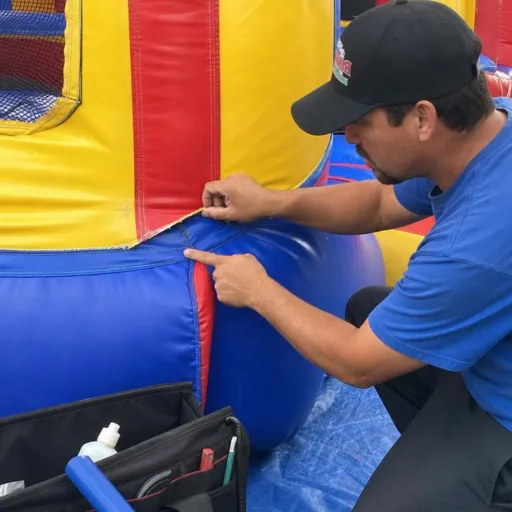
The weight of the material determines how a unit is repaired. A puncture in 18 oz PVC is a 10 to 15 minute field patch with a kit that costs about $25. A failure in lighter material often means a re-stitch and re-weld, taking the unit out of service. The heavier material fails less often too: 18 oz runs about 3 to 5 repair incidents per 10 units per year, against 12 to 16 for 15 oz. We break down the full decision between the two weights in our 15 oz vs 18 oz PVC vinyl comparison.
Safety Standards Commercial Buyers Must Verify
Material choice does not just determine lifespan. It determines whether a unit can be legally operated, insured, and passed by inspectors. Three standard families matter most.
ASTM F2374 is the primary US standard for commercial inflatable amusement devices, covering design, manufacture, operation, and maintenance. It’s the standard that buyers and insurers reference when they ask whether a unit is built to commercial spec. The current edition is ASTM F2374-22.
NFPA 701 is the fire-retardancy standard for fabrics. The ICC International Fire Code explicitly requires NFPA 701 Test Method 2 for fabrics used in inflatable amusement devices, and fire marshals in most US jurisdictions require documentation before a unit is installed indoors. If a unit is NFPA 701 compliant, the seller should be able to produce the test report.
EN 14960 is the comparable European standard for inflatable play equipment, and it matters for anyone selling into EU markets. Chemical compliance also applies: lead-free and phthalate-free material under CPSIA and REACH is required for children’s-use products, and buyers should request the test reports rather than accept a blanket “safe” claim.
The compliance question has an insurance dimension. Major liability underwriters maintain approved manufacturer lists that require ASTM F2374 compliance, and uncertified equipment can raise premiums dramatically or be denied coverage entirely. For a deeper treatment of what each standard tests and how material choice supports it, our bounce house safety standards guide walks through the details.
How to Verify “Commercial Grade” Claims
Verification is the step nearly every buyer skips, and it is the step that separates a real commercial purchase from a gamble. Use this checklist when you are evaluating a unit or a fabric supplier.
- Request the material spec sheet. The weight should be stated in oz per square yard AND gsm, with thickness in millimeters. No numbers, no commercial grade.
- Check the scrim. Look for 1000D x 23 x 23 high-tenacity polyester. Beware asymmetric weaves like 1000D x 500D, which tear easily.
- Ask for the test report. Tensile and tear values per ASTM D751 or EN ISO 1421, with measured numbers and a report date.
- Confirm fire certification. NFPA 701 or CPAI-84, with a certificate number you can check.
- Confirm chemical compliance. Lead-free and phthalate-free under CPSIA, REACH, or EN 71-3, with reports.
- Weigh a sample. Fabric weight is measurable in minutes. Cut a sample, weigh it, and convert to oz/yd² or gsm. This single step catches most mislabeled material.
- Ask about construction. Welded seams, double-stitched reinforcement, and D-rings tested to load are all part of a commercial-grade build.
- Beware “commercial grade” with no numbers. The phrase is a starting point, not a specification.
Rosa is a purchasing manager at a 40-unit party rental company. When a new supplier offered her “commercial grade” fabric at 30 percent below her current cost, she asked for a sample and a spec sheet. The supplier sent both. The spec sheet claimed 18 oz; the sample, weighed in her office on a postal scale, measured out at 15 oz. She asked for a test report and got a generic certificate with no report number. She passed on the deal. Her existing supplier, who sent a sample from the production line plus batch-specific test reports, kept the account. If you are sourcing roll goods in bulk to build or replace units yourself, our bounce house fabric wholesale guide walks through MOQs, price bands, and the same supplier vetting end to end.
Red Flags: When “Commercial Grade” Is Overclaimed

Some warning signs are technical, and some are commercial. Any two of these is reason to walk away.
- No stated weight on the spec sheet or listing.
- “Commercial grade” or “commercial PVC” with zero supporting data.
- Unverifiable certificates, certificates in a distributor’s name rather than the mill’s, or a blanket “CE” claim (CE is not a bounce house material standard).
- A price far below every comparable quote. Cheap is a warning, not a discount.
- Advertised 18 oz material that weighs out to 12 to 15 oz when you check it.
- A warranty of one year or less on a “commercial” unit. The industry norm for commercial equipment is one to three years.
- A seller who cannot answer technical questions about GSM, scrim, or weld method.
A single red flag deserves a closer look. Two or more is worth moving on. The cost of buying mislabeled material is not just the invoice; it is the failed season, the lost bookings, and the liability exposure that comes with a unit failing under load.
Ready to spec a commercial unit? Our engineering team manufactures certified 18 oz and 20 oz PVC inflatable fabric and supports custom builds from prototype to production. Talk to an engineer or request a specification sheet.
Commercial Grade Bounce House Material: Frequently Asked Questions
What does commercial grade mean for a bounce house?
Commercial grade means the material is built to survive repeated rental duty. In practice it means 18 oz (about 610 gsm) PVC-coated tarpaulin on a 1000D scrim, with tear resistance of at least 240 to 280 N and NFPA 701 fire certification.
What is the best material for a commercial bounce house?
Commercial-grade PVC vinyl is the industry standard. It is roughly five times stronger than nylon at the point of tear, waterproof, UV-stabilized, and repairable in the field. About 90 percent of commercial rental suppliers build around it.
Is 15 oz or 18 oz vinyl commercial grade?
18 oz is the commercial standard. 15 oz (about 510 gsm) is light commercial at best and fails 3 to 4 times more often under rental duty. Anything under about 500 gsm is residential grade regardless of the label.
How long does commercial grade bounce house material last?
18 oz commercial PVC lasts five to seven years under normal rental conditions, extending toward eight years with good maintenance and dropping to three to five years under intensive weekend-rental use. Lighter grades last two to three years.
Is commercial bounce house material fire resistant?
Fire retardancy is not automatic. NFPA 701-compliant fabric passes the required fire test, and the ICC fire code requires it for inflatable amusement fabrics. Always verify with the test report rather than assuming.
How do I know if a bounce house is really commercial grade?
Request the spec sheet, check for 18 oz on a 1000D scrim, ask for tensile and tear test reports, confirm NFPA 701, and weigh a fabric sample. The weight measurement catches most mislabeled units.
Do I need certifications to operate a commercial bounce house?
In most jurisdictions, yes. ASTM F2374 covers design and manufacture, NFPA 701 covers fire retardancy, and many states and insurers require documented compliance. Uncertified equipment can be refused coverage or inspection.
Conclusion
“Commercial grade” is not a label you can trust; it is a specification you can verify. The threshold set is well established: 18 oz (about 610 gsm) PVC over a 1000D x 23 x 23 scrim, tear resistance of 240 to 280 N, and NFPA 701 fire certification, with ASTM F2374 compliance backing the build. Material under the 500 gsm red line is residential grade wearing a commercial label.
When you evaluate a unit or a supplier, run the verification checklist before you pay for the label: request the spec sheet, check the scrim, ask for test reports, and weigh a sample. That routine is what separates a commercial purchase from a gamble, and it is the same standard we hold our own production to. Our engineering team manufactures certified 18 oz and 20 oz PVC inflatable fabric, and we will send production-line samples and batch test reports before you commit. Read our commercial inflatable fabric range or the full bounce house fabric guide to start, then request a quote. The material you verify is the material that will carry your business through the season.