
PVC Tarpaulin vs PVC Inflatable Fabric: The Real Difference
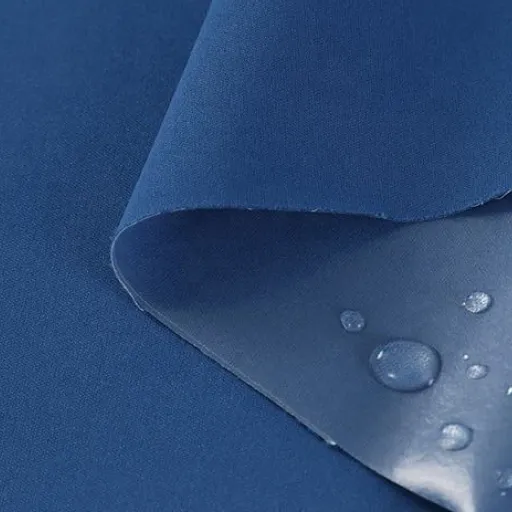
PVC tarpaulin and PVC inflatable fabric are both PVC-coated polyester, and both are waterproof. The difference is what they’re engineered to hold: a tarpaulin sheds water, while an inflatable fabric holds air under pressure. That single change in job description rewrites the coating, the weave, and above all the seam, which is why the two aren’t interchangeable even when they carry the same weight on the label.
Here is the part that catches buyers. A 610 GSM cover and a 610 GSM bounce house fabric can weigh the same, feel the same on a sample card, and arrive with near-identical roll labels.
One will keep a cargo deck dry for season after season. The other will hold a couple of psi of internal pressure without measurable loss. Swap them and both fail, and neither failure looks like a material defect from the outside.
If you buy, specify, or audit coated fabric, you already know the labels are unreliable. What you need is the set of differences that actually separate the two products, a table you can put in front of a supplier, and the test results that settle a grade dispute before the container ships. Both categories sit inside the wider family of PVC coated fabric, and that shared label is exactly why the distinction gets lost.
This guide covers the three engineering differences, the weights where the two categories overlap, the four failure modes that follow from getting it wrong, and the nine fields to put in your next RFQ. If you want the specification detail that sits behind these categories, our walks through denier, coating weight, and thickness one at a time.
Key Takeaways
- A tarpaulin is specified by hydrostatic resistance. An inflatable fabric is specified by air retention plus hydrostatic resistance. A fabric can pass the first and fail the second on the same day.
- Seam construction separates the two more reliably than weight does. A stitched seam is acceptable on a cover and disqualifying on a pressure-retaining panel.
- Asymmetric weaves such as 500D × 1000D at 30 × 17 are a normal cost decision in tarpaulins and a defect in inflatables, where the scrim must be balanced.
- Weight bands overlap between 550 and 650 GSM, so GSM alone can’t identify which product you’ve been quoted.
- Four questions settle a grade dispute: base cloth denier and weave balance, coat weight per side, weld method, and a peel adhesion value with its test method.
Comparing two supplier quotes right now? Send us both specification sheets and we’ll tell you where they diverge. It’s usually the fastest way to find out which quote is real. .
The Three Differences That Actually Matter
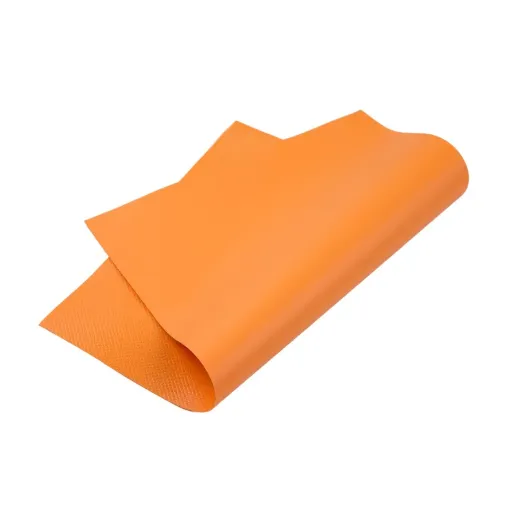
Most comparison articles stop at “tarps are waterproof and inflatables are airtight.” That’s true and it isn’t useful, because waterproofness is a subset of what an airtight panel has to do. The three differences that change a purchase decision are permeability target, seam architecture, and scrim balance.
Difference 1: Permeability Target
A covering fabric is judged on hydrostatic head, the height of water column it holds before water passes through. A pressure-retaining fabric is judged on the same number and then on air retention: how much internal pressure it loses over a defined period, usually 24 hours.
These are two levels of evidence and they get conflated. Air permeability is measured on the material, as a volume of air per unit area per second at a stated pressure differential. Pressure decay is measured on a finished, welded panel.
The first tells you about the coating. The second tells you about the coating, the seams, and the valves together, which is what actually keeps a structure inflated. Ask for both, and be specific about which one you are being handed.
These are different measurements, and the market quotes them unevenly. Hydrostatic head appears on most tarpaulin data sheets because it’s the number buyers expect. Pressure decay is rarer, which means a supplier selling an inflatable grade can quote a strong hydrostatic figure and never be asked the question that actually matters.
A panel that holds water can leak air through a stitch line, a valve patch, or a pinhole in the coating, and the reason isn’t molecular size. Water is the smaller and faster molecule of the two. What differs is the force pushing it.
Hydrostatic head measures liquid water fighting gravity, and a pinhole resists that column through capillary pressure and surface tension. A metre of water is a weak driver.
Air inside a sealed structure supplies its own differential, continuously, and any path that runs the full thickness of the coating will flow. That’s how a panel passes a hydrostatic test on Monday and loses pressure by Friday.
That difference in driving force is why the two products are specified against different tests.
Difference 2: Seam Architecture
This is where a purchase fails in the field.
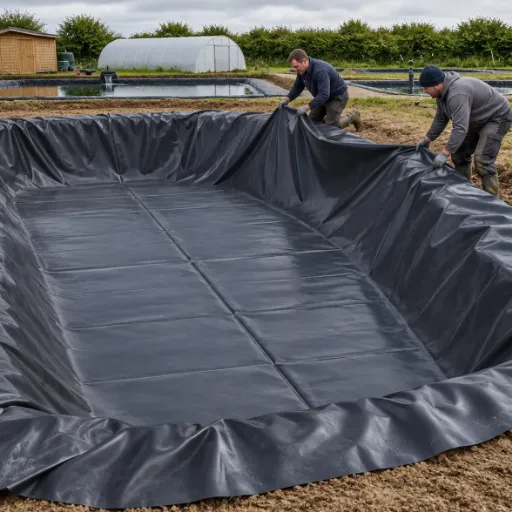
A tarpaulin seam can be sewn, hemmed, taped, or welded. All four are legitimate for shedding water, because the fabric underneath is doing the barrier work and the seam only needs to hold the panel together. A stitched seam on a truck cover is normal and often the right cost decision.
An inflatable seam carries the same pressure the fabric does, so it has to be a continuous bond. That means RF welding or hot-air welding with a controlled overlap, qualified on the production material rather than a lab swatch. A stitched seam on a pressure-retaining panel isn’t a weaker seam. It’s a designed leak.
Our makes the same point from the construction side: a coated panel becomes airtight only once its seams are welded. The coating supplies the barrier, and the weld closes the only remaining path.
Difference 3: Scrim Balance
The base cloth is a woven polyester scrim, and its warp and weft can be the same weight or different.
In tarpaulin, an asymmetric weave is deliberate. A 500D × 1000D construction at a 30 × 17 thread count puts the load-carrying yarn where the load goes and saves weight and cost elsewhere. It is a sound engineering choice for a cover that hangs and flexes.
In an inflatable, that same weave is a defect. Internal pressure loads warp and weft almost equally, so an unbalanced scrim distorts under inflation. Panels bulge unevenly, seams take unequal load, and the weld at the highest-stress edge becomes the first thing to fail. Airtight PVC fabric takes balanced constructions, typically 1000D × 1000D at 20 × 20 or 23 × 23.
This is the one distinction most suppliers won’t volunteer, because it’s invisible on a roll label and it costs money to control. Our covers the same ground in more depth.
PVC Tarpaulin vs PVC Inflatable Fabric: Side by Side
The table below sets the two categories against each other on the rows that decide performance. Weight and thickness bands are market ranges, not a single supplier’s line. Confirm them against production data before you write them into a purchase order.
| Covering-grade PVC tarpaulin | Airtight PVC inflatable fabric | |
|---|---|---|
| Primary job | Shed water, block UV, resist abrasion | Hold internal air pressure without measurable loss |
| Permeability specification | Hydrostatic head | Hydrostatic head plus pressure decay over 24 hours |
| Coating coverage | One or both faces; may be asymmetric | Both faces, continuous, with a minimum coat weight per side |
| Scrim | Balanced or asymmetric (500D × 1000D at 30 × 17 is normal) | Balanced only (1000D × 1000D at 20 × 20 or 23 × 23) |
| Seam | Sewn, hemmed, taped, or welded | RF or hot-air welded, continuous overlap |
| Typical finished weight | 400 to 900 GSM | 490 to 650 GSM for dry inflatables (550 to 650 commercial); 850 to 1,450 GSM marine |
| Typical thickness | 0.4 to 0.8 mm | 0.45 to 0.60 mm dry; 0.85 to 1.40 mm marine |
| Dominant failure | Water ingress, UV embrittlement, tear | Pressure decay, seam leak, delamination |
| Test emphasis | Hydrostatic, tensile, tear, UV | Peel adhesion, pressure decay, seam strength |
| Cost driver | Weight and UV package | Adhesion, weld quality, and lot consistency |
Read the weight row twice. The two columns overlap between 550 and 650 GSM, which is the subject of the next section.
If you need the decision in two lines rather than a table: take the covering grade when the panel sheds water and never has to hold a pressure differential. Take the airtight grade when anything inside it has to stay inside. Everything else in this guide is detail behind those two sentences.
PVC Tarpaulin vs PVC Inflatable Fabric: Why GSM Cannot Tell Them Apart
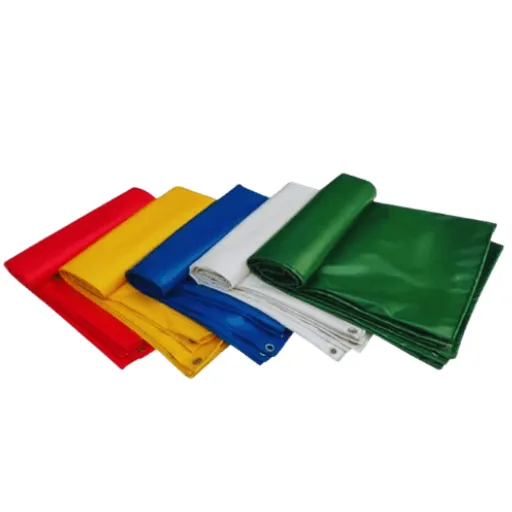
Finished weight in grams per square metre is the number buyers compare, and it’s the least diagnostic number on the sheet. It tells you almost nothing about air permeability, which is the property that actually separates the two products.
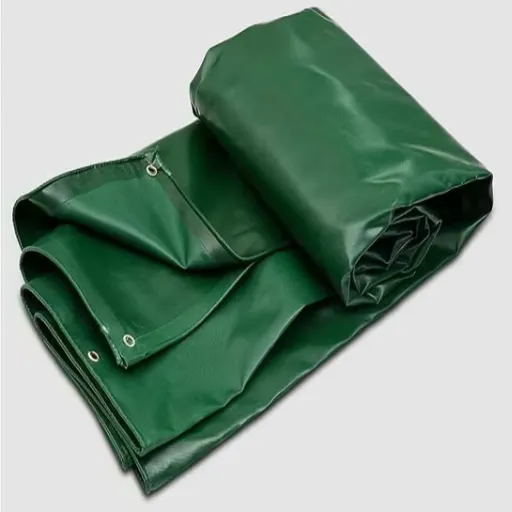
A truck tarpaulin commonly lands between 750 and 900 GSM at 0.6 to 0.8 mm. A tent or event cover sits around 650 to 850 GSM at 0.5 to 0.7 mm. Light-duty covers run lighter again, down into the 400s.
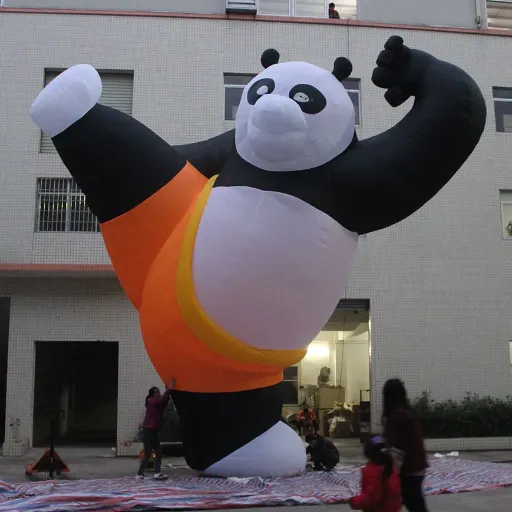
A commercial bounce house runs about 550 to 650 GSM at 0.50 to 0.60 mm. Promotional inflatables run lighter, from about 490 GSM. A marine inflatable climbs to 850 to 1,450 GSM at 0.85 to 1.40 mm.
Put those ranges in order and the two categories interleave. A 610 GSM fabric could be a light-duty cover or a standard commercial inflatable grade. So could a 550 GSM one. The number can’t distinguish them, which means a buyer comparing two quotes at the same weight is comparing nothing.
Two fabrics at identical GSM can differ in four ways that all matter:
- Denier. A 500D scrim and a 1000D scrim at the same finished weight have different tear performance and different seam holding power.
- Coat weight per side. A 610 GSM fabric with 200 GSM of coating per side has a 210 GSM scrim. Another at the same total might run 150 GSM per side over a heavier scrim.
- Weave balance. Balanced or asymmetric, as covered above.
- Adhesion. Peel strength decides whether the coating stays bonded under pressure, and it isn’t on the label at all.
This is the same argument our makes about tensile figures: a number without its test method and its basis is a marketing figure, not a specification.
The three scenarios below are illustrative composites drawn from common field failures, not accounts of specific customers.
Picture a rental operator replacing four aging inflatables, specifying them by weight at 610 GSM because that was the number on the previous quote.
The units arrived, held air, and looked correct. Within one season, three had developed slow leaks at the anchor patches.
The fabric was 610 GSM on a 500D scrim with a lighter coat than the previous stock. The weight matched. Nothing else did.
The fix is to specify denier, coat weight per side, and weld method, and to ask for the peel adhesion result with its standard.
If you’re rebuilding a specification and want a second read, our engineering team reviews load, weld method, and destination market before quoting. We produce a sample from the production line rather than a library swatch. .
What Fails in Service
Four failure modes account for most inflatable fabric complaints, and each traces back to a specification decision rather than user error. This is also where the two categories diverge most visibly in service: a tarp that fails tends to fail dry.
| Failure | Cause | What the buyer sees |
|---|---|---|
| Seam leak | Sewn or taped seam on a pressure-retaining panel | Unit deflates overnight; soap test bubbles along the stitch line |
| Delamination | Peel adhesion too low for the internal pressure | Coating lifts from the scrim, usually at a fold, valve patch, or seam edge |
| Plasticizer migration | Under-stabilized formulation, heat, or prolonged UV exposure | Fabric goes stiff and brittle, then cold-cracks along existing creases |
| Weave distortion | Asymmetric scrim under pressure | Panel bulges unevenly, seams load unevenly, weld fails at the edge |
Seam leak and delamination are the two that arrive fastest, and both are detectable before shipment. A pressure-decay test on a finished panel finds the first. A peel adhesion test on the roll finds the second.
Neither is expensive. Both require the buyer to ask.
The UV failure is slower and more often misdiagnosed. Ultraviolet exposure attacks the PVC polymer chain itself and accelerates plasticizer loss from the compound. The visible symptom is a fabric that has lost its flexibility rather than its color.
A unit that looks acceptable in year three and cracks at the fold in year four usually had an adequate coating weight and an inadequate stabilizer package. Weight won’t predict it. The formulation will.
If you’re weighing a polymer switch instead, our covers where TPU wins and where it doesn’t. The third option marine buyers ask about is Hypalon, or CSM. It’s a rubber rather than a PVC, it wins on UV and chemical resistance and on natural lifespan, and it loses on cost, weight, and repair difficulty. Telling a PVC hull from a Hypalon one is a touch and texture question, not a label question, so it sits outside this comparison.
Is a PVC Tarp Ever Acceptable on an Inflatable?
Sometimes, and the honest answer is worth stating plainly because it affects how you read every supplier claim. Airtight fabric and covering fabric aren’t grades of the same thing.
A low-pressure decorative inflatable that runs for a weekend, holds shape rather than load, and never sees a rental schedule can be built from a covering-grade fabric with welded seams. What it can’t do is hold that pressure across a season of daily inflation. The fabric won’t fail the day it’s made. It’ll fail at the seam or the valve patch once the adhesion has been cycled enough times.
The reverse mistake is more expensive. Buying an airtight grade for a truck cover or a construction screen pays for permeability you will never use. It can also cost you flexibility, because high-adhesion airtight constructions are often stiffer and less forgiving to fold.
If the panel only has to keep cargo dry, start with our . The specification conversation is shorter.
A common version of this: an events contractor inherits a specification that used one 900 GSM fabric for everything, marquee walls, ground sheets, and the air structures included. The air structures leaked from year one. The walls were over-specified and hard to handle.
Splitting the order into a covering grade for flats and an airtight grade for the two air structures cuts annual fabric spend and eliminates the leak complaints in the same move. The saving comes from specifying each product by its job rather than by a single preferred weight.
That is the practical rule. Specify by what the panel has to do, not by the number that appears on your last purchase order.
For the budget alternative most often confused with PVC in this market, our breakdown of explains why a “500D” residential unit may not be PVC at all.
How to Verify a PVC Tarpaulin or Inflatable Fabric Quote
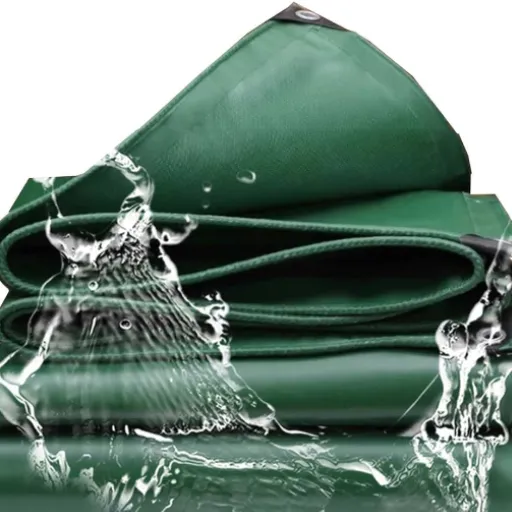
Verification is a document exercise and a physical exercise, and both are cheap. This is the point where PVC tarpaulin vs PVC inflatable fabric stops being a definition argument and becomes a purchase order.
The nine RFQ fields
Put these in the request, not in the follow-up conversation. A supplier who can’t answer them is telling you something useful.
- Base cloth denier, stated as warp × weft, plus thread count.
- Weave balance, stated explicitly as balanced or asymmetric.
- Finished weight in GSM, plus the same figure in oz/yd² if the market uses it.
- Coat weight per side, not just the total.
- Thickness in mm, with the tolerance.
- Coating method: knife, calender, lamination, or a combination.
- Peel adhesion value with its test method, normally EN ISO 2411.
- Hydrostatic head, and for pressure products, a pressure-decay result over 24 hours.
- Seam method, plus a trial weld on production material.
Add the fire rating required for your destination market, since that changes the compound and isn’t interchangeable across regions. These ratings don’t substitute for one another, and our sets out which one applies where.
The physical checks
Documents can be forwarded. The material can’t.
Weigh a cut sample of known area against a known offcut. Inspect the cut edge for a dense scrim rather than an open weave. Pull a seam flat. Look for a stitch line.
Fold a corner twice and watch whether the coating lifts. None of these replaces a lab test, and all of them catch the shipment that doesn’t match the certificate.
The relevant standards for the numbers above are worth holding a supplier to directly:
- covers coated fabric breaking strength and related procedures.
- EN ISO 1421 covers tensile strength and elongation.
- covers coating adhesion.
- covers US flammability.
- EN 14960-1 covers inflatable play equipment.
Ask for the result and the method together. A figure without its method can’t be verified, and an unverifiable figure is what the label already gave you.
Frequently Asked Questions
Is PVC tarpaulin airtight?
No. A standard covering-grade PVC tarpaulin is built to resist water, not to retain air. It may hold pressure briefly on a low-pressure decorative unit if every seam is welded. Over time it loses pressure through the seam and coating paths a covering specification was never designed to close.
Can you use a PVC tarp for an inflatable?
You can use a covering-grade fabric for a short-life, low-pressure decorative inflatable with fully welded seams. You shouldn’t use it for anything with a rental schedule, a water slide, or a marine application. Pressure retention, adhesion, and seam strength all sit below what those duties require.
What is the difference between PVC tarpaulin and PVC inflatable fabric?
A PVC tarpaulin is specified by hydrostatic resistance and is usually sewn or welded with a lighter coating. A PVC inflatable fabric is specified by air retention as well as water resistance, uses continuous coating on both faces, a balanced scrim, and RF or hot-air welded seams.
What GSM is inflatable fabric?
Dry commercial inflatables typically run 550 to 650 GSM. Marine inflatables run 850 to 1,450 GSM, and drop-stitch constructions higher still. Because tarpaulin weights overlap that range, GSM alone can’t confirm that the PVC inflatable material in your sample is pressure grade.
Is PVC inflatable fabric the same as PVC coated fabric?
No. PVC coated fabric is a construction description that covers both categories. Inflatable fabric is a performance requirement applied on top of a coating or lamination construction.
A coated fabric can be a tarp. Airtight PVC fabric has to be coated or laminated in a way that retains pressure.
How do you test whether PVC fabric is airtight?
Inflate a welded test panel to its service pressure, hold it for 24 hours, and measure the pressure loss. Then pair that with a peel adhesion test on the roll using EN ISO 2411. A panel can pass pressure decay while its coating is already lifting at a fold.
Conclusion
PVC tarpaulin vs PVC inflatable fabric comes down to one question: does the panel shed water, or does it hold pressure? Answer that honestly and the specification follows. The permeability test, the seam method, and the weave balance all resolve from it.
Five things to carry into your next specification:
- Specify by function. Water-shedding and pressure-retaining are different purchases.
- Treat GSM as a starting point only. Denier, coat weight per side, and weave balance decide the rest.
- Require a welded seam for anything that holds pressure, and reject asymmetric weaves in pressure products.
- Ask for peel adhesion and pressure decay with their test methods, not as standalone numbers.
- Verify the lot physically. A weighed sample and a cut-edge check cost minutes.
The same sequence plays out for marine buyers: a specification engineer adds the nine RFQ fields to the standard template after a supplier substitution goes wrong on a set of RIB tubes, and starts asking for lot-referenced peel results.
In practice, two or three suppliers decline to quote at all, and the one that answers in full becomes the sole source. The delamination claims stop because the ones who could not answer never got the order.
A supplier who can discuss your test data is a partner. One who quotes a weight and a price is selling rectangles.
The PVC tarpaulin vs PVC inflatable fabric question gets settled in the end by a peel test and a weld trial, not by a catalog page. Say you’re specifying an inflatable grade, replacing a supplier whose adhesion has drifted, or simply want a second read on a specification you inherited. Our engineering team will review the application, recommend the construction, and send production-line samples with batch test data. .