
PVC Membrane Structure: Specs, Applications & Durability
A PVC membrane structure is a tensile architecture system that uses flexible, high-strength PVC-coated polyester fabric stretched over a structural support framework to create stable, load-bearing roof and facade forms. It delivers the most cost-effective balance of span capability, design flexibility, and proven weather protection among modern architectural membrane systems.
When the project team at Meridian Transit Authority began evaluating roofing options for their new bus terminal in Minneapolis, they faced a familiar challenge. The 35-meter clear span eliminated conventional roofing from consideration on weight grounds. Steel trusses would require massive columns interrupting passenger flow. ETFE cushions offered excellent light transmission but pushed the budget beyond approval. The specification team needed a material that could achieve the span, withstand Minnesota’s snow loads and temperature swings, and deliver a 15-year service life without premium cost.
That scenario plays out in engineering offices worldwide. PVC membrane structure technology has become the standard specification for transportation canopies, sporting facilities, event venues, and commercial shade structures where cost efficiency and proven performance outweigh the marginal benefits of premium alternatives. This guide delivers the manufacturer-level technical depth specifiers need to evaluate, select, and procure PVC membrane with confidence. We will cover material construction, GSM-based specification ranges, coating technologies, fire compliance, application guidance, and procurement best practices. Every tensile structure presents unique challenges. Reach out to LY TRUSTLINK for expert guidance on material selection, structural optimization, and project feasibility.
Key Takeaways
- PVC membrane structure systems use high-tenacity polyester base fabric coated with PVC and a protective topcoat, engineered in GSM ranges from 650 to 1800 depending on load requirements.
- Standard commercial 850–950 GSM PVC membrane delivers 4,000–4,500 N/5cm tensile strength, sufficient for parking canopies and walkway covers with 10–15 year service life.
- PVDF topcoats extend lifespan to 15–25 years through superior UV resistance and self-cleaning properties, while acrylic lacquers suit shorter-term and budget-sensitive projects.
- PVC membrane achieves NFPA 701 and EN 13501-1 B1 fire classifications with appropriate formulations, meeting major international building codes.
- For permanent landmark structures exceeding 25-year design life, PTFE-coated fiberglass outperforms PVC; for everything else, PVC typically delivers the optimal total cost of ownership.
What Is a PVC Membrane Structure?
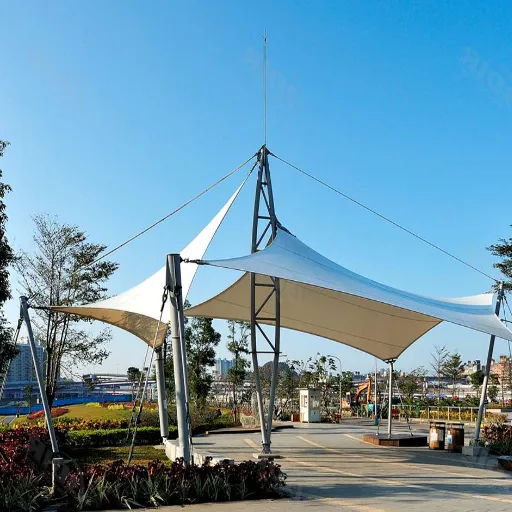
Material Construction: Base Fabric Plus Coating System
Architectural PVC membrane is not simply a heavy-duty tarpaulin. The distinction matters for specifiers evaluating supplier claims.
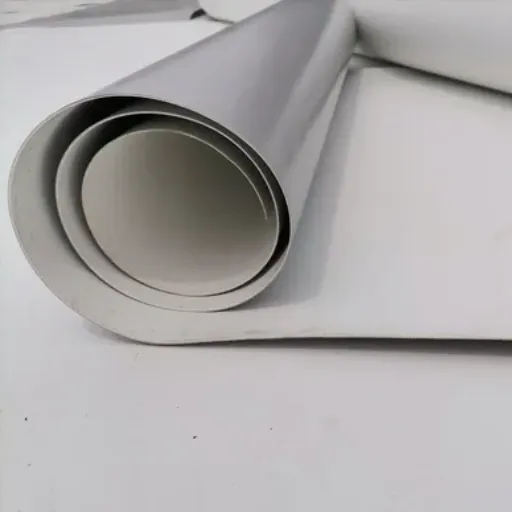
The material consists of three engineered layers. The base layer is a high-tenacity woven polyester (PES) scrim, typically constructed with warp and weft yarns ranging from 1000D to 1500D depending on structural requirements. This woven substrate provides the mechanical backbone that carries tensile loads across the membrane surface.
The middle layer is the primary PVC coating, applied through knife-coating or calendering processes. Virgin-grade PVC compound is distributed across both sides of the polyester base to create a waterproof, UV-stabilized barrier. Coating weight directly correlates with durability and structural capacity, which is why manufacturers specify membrane by total GSM (grams per square meter), not just base fabric weight.
The outer layer is a protective topcoat. Acrylic lacquer, PVDF (polyvinylidene fluoride), or titanium dioxide (TiO2) formulations shield the PVC substrate from UV degradation, airborne pollutants, and mechanical abrasion. Topcoat selection is the single most important factor in determining service life.
Need a custom specification for your project? Our engineering team supports membrane fabric selection from concept to certified delivery. Request a technical consultation.
How PVC Membrane Structures Work
PVC membrane structures operate on the principle of tensile prestressing. The fabric itself has negligible compressive strength. Structural stability comes from stretching the membrane over a support system (masts, arches, cables, or rigid frames) and maintaining that tension permanently.
For geometric stability, designers shape membranes with double curvature. Anticlastic surfaces curve in opposite directions, like a saddle or hyperbolic paraboloid. Synclastic surfaces curve in the same direction, like a dome. This curvature prevents the fabric from fluttering under wind load and ensures that all applied forces (whether from wind uplift, snow weight, or the membrane’s own dead load) resolve into pure tension distributed through the fabric to the boundary supports.
The tensioning system is critical to performance. Edge cables, clamping plates, keder rails, and turnbuckles maintain design tension across the membrane’s service life. Inadequate pretension allows wind-induced vibration that accelerates fatigue. Excessive pretension over-stresses seams and boundary connections.
[Embed: YouTube video demonstrating tensile membrane structure installation and tensioning process]
PVC Membrane Technical Specifications by GSM Range
Unlike commodity tarpaulins sold by color and approximate weight, architectural PVC membrane is specified by precise GSM ranges that correlate to base fabric denier, tensile strength, and application suitability.
Light-Duty Range: 650–750 GSM
Light-duty PVC membrane suits small canopies, awnings, temporary pavilions, and indoor atrium enclosures where wind loads are moderate and spans are limited.
- Base fabric: 1000D polyester, plain weave
- Tensile strength (warp/weft): 2,500–3,500 N/5cm
- Tear strength: 300–400 N/5cm
- Typical thickness: 0.60–0.70 mm
- Design wind speed: ~31.5 m/sec
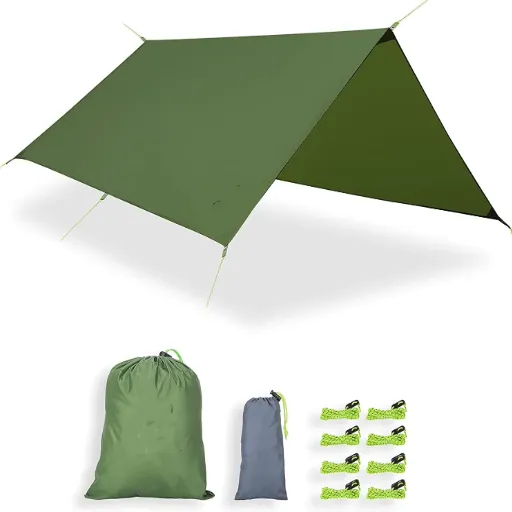
- Best applications: Walkway awnings, small entrance canopies, festival tents, retractable seasonal covers
Standard Commercial Range: 850–950 GSM
This is the most commonly specified range for commercial and semi-permanent structures. It balances structural capacity, durability, and cost efficiency.
- Base fabric: 1000D × 1300D polyester
- Tensile strength (warp/weft): 4,000–4,500 N/5cm
- Tear strength: 500 N/5cm
- Adhesion (coating to base): >120 N/5cm
- Typical thickness: ~0.77 mm
- Light transmission: ~6–8%
- Service life: 10–15 years (acrylic topcoat); 15–20 years (PVDF topcoat)
- Best applications: Parking canopies, transit station roofs, sporting facility covers, event halls
Heavy-Duty Structural Range: 1050–1250 GSM
Heavy-duty PVC membrane addresses large-span permanent structures where snow loads, wind pressures, or safety factors demand higher structural reserves.
- Base fabric: 1300D × 1300D to 1500D × 1500D polyester
- Tensile strength (warp/weft): 5,500–6,300 N/5cm
- Tear strength: 800–900 N/5cm
- Typical thickness: 0.86–1.03 mm
- Service life: 15–25 years with PVDF topcoat and proper maintenance
- Best applications: Stadium roofs, arena canopies, large exhibition halls, airport terminals
Ultra Heavy-Duty Range: 1350–1800 GSM
Ultra heavy-duty formulations serve industrial enclosures, extreme-climate installations, and specialized applications requiring maximum puncture resistance and dimensional stability.
- Base fabric: 1500D+ polyester, Panama weave
- Tensile strength (warp/weft): 7,000+ N/5cm
- Tear strength: 1,000+ N/5cm
- Typical thickness: 1.06–1.20 mm
- Temperature range: -40°C to +70°C
- Best applications: Industrial warehouses, environmental containment, high-altitude or arctic installations
How to Read a PVC Membrane Technical Datasheet
When Elena Voss reviewed supplier documentation for a new logistics canopy at her firm’s Rotterdam facility, she quickly realized that not all datasheets deliver equal value. Some manufacturers list only GSM and color options. Others provide comprehensive mechanical testing data.
A datasheet worth specifying from should include:
- Tensile strength per EN ISO 1421 or ASTM D751, reported in N/5cm for both warp and weft directions
- Tear strength per EN ISO 4674 or ASTM D4533
- Adhesion strength between coating and base fabric
- UV resistance ratings, typically gray scale 4–5 per ISO 105-B02 after specified exposure hours
- Seam strength, usually 70–80% of base fabric tensile strength for welded seams
- Fire classification certificates: NFPA 701, EN 13501-1, or DIN 4102 B1
- Coating composition: PVC compound formulation and topcoat chemistry
Red flags include missing test standards, unsupported lifespan claims, and absence of batch consistency protocols. A reliable supplier documents every production batch with traceable test reports.
Coating Technologies: Acrylic, PVDF, and TiO2
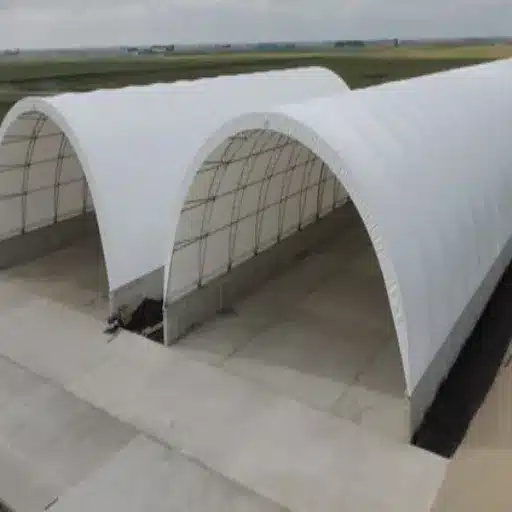
The topcoat is where membrane performance diverges. Three technologies dominate the architectural market, each with distinct cost and performance profiles.
Acrylic Lacquer Topcoats
Acrylic lacquers provide entry-level UV protection at the lowest cost increment. The acrylic formulation creates a sacrificial surface layer that absorbs UV radiation before it reaches the PVC substrate.
Effective service life for acrylic-topcoated membrane ranges from 5–10 years in moderate climates. In high-UV zones such as the southwestern United States, Australia, or the Middle East, degradation accelerates. Acrylics also offer limited self-cleaning capability; dirt and organic deposits tend to adhere more readily than to fluoropolymer surfaces.
Specify acrylic when the project budget is constrained, the structure is temporary or semi-permanent, or the installation is indoors or in a low-pollution environment.
PVDF Topcoats
PVDF (polyvinylidene fluoride) represents the industry standard for permanent and semi-permanent PVC membrane structures. The fluoropolymer chemistry delivers two decisive advantages.
First, UV resistance. PVDF molecular bonds absorb and dissipate ultraviolet energy with minimal chain scission. Independent weathering data demonstrates 15–25 year effective life before significant aesthetic or mechanical degradation occurs.
Second, self-cleaning. PVDF’s low surface energy prevents dirt, industrial pollutants, and organic matter from adhering. Rainfall washes contaminants away naturally, maintaining reflectivity and appearance with minimal manual cleaning. In high-pollution urban environments, this property alone can reduce maintenance frequency by 40–60% compared to acrylic-topcoated alternatives.
The trade-off is initial cost. PVDF topcoats add 15–25% to raw material cost versus acrylic. For structures with 10+ year design life, the lifecycle calculation typically favors PVDF through avoided maintenance, extended replacement interval, and retained property value.
TiO2 Photocatalytic Coatings
Titanium dioxide photocatalytic coatings represent the emerging premium tier. When exposed to UV light, TiO2 triggers photocatalytic oxidation at the membrane surface, actively breaking down organic pollutants and biological growth.
For structures in severe pollution zones (industrial corridors, coastal salt-spray environments, or airports with jet exhaust exposure), TiO2 delivers measurable maintenance savings. The technology remains premium-priced and is typically specified only where pollution-induced soiling would otherwise demand quarterly or monthly cleaning cycles.
When to Specify Which Coating
| Project Condition | Recommended Topcoat | Rationale |
|---|---|---|
| Temporary / <5 year design life | Acrylic | Lowest cost, adequate protection |
| Semi-permanent / 10–15 year life | PVDF | Optimal cost-durability balance |
| Permanent / 15–25 year life | PVDF with re-lacquer protocol | Proven longevity, repairable |
| High pollution / severe UV | TiO2 or premium PVDF | Active or superior self-cleaning |
| Indoor / minimal UV exposure | Acrylic or untopcoated PVC | Unnecessary premium for protected environment |
Fire Safety and Code Compliance
PVC membrane achieves legitimate fire-safety certifications with appropriate compound formulations. Specifiers should demand documentation rather than accepting generic “fire-resistant” claims.
NFPA 701 Fire Test for Textiles
NFPA 701 is the standard fire test for flame-propagation resistant textiles and films used in architectural applications. The test measures flame spread, after-flame time, and char length under controlled ignition exposure.
PVC membranes formulated with flame-retardant additives can achieve NFPA 701 compliance. The certification is pass-fail; there are no gradations. For procurement teams, verify that the supplier provides a current test certificate from an accredited laboratory, not an internal declaration.
European Fire Classification (EN 13501-1)
European projects require classification per EN 13501-1, the unified European fire performance standard. PVC membranes typically achieve B-s2,d0 or B-s1,d0 ratings:
- B: Contribution to fire (limited contribution, second-highest class)
- s1/s2: Smoke production (s1 = low smoke, s2 = limited smoke)
- d0: Flaming droplets / particles (d0 = none, d1 = very limited)
For projects in Germany, DIN 4102 B1 classification remains commonly referenced. B1 corresponds closely to EN 13501-1 B-s2,d0. A membrane certified to one standard can often be cross-referenced to the other, but always confirm with the project authority having jurisdiction.
Other Relevant Standards
- CAN/ULC-S109: Required for Canadian fire code compliance
- ASTM E84: Surface burning characteristics for U.S. building code integration
- NFPA 70 / NEC: Electrical clearance requirements for membrane structures supporting lighting or signage
Specifying fire-rated membrane for a regulated project? Request our complete certification package including NFPA 701, EN 13501-1, and DIN 4102 test reports. Contact our compliance team.
Durability and Expected Lifespan
Standard PVC Membrane: 10–15 Years
Standard PVC membrane with acrylic topcoat delivers 10–15 years of service life in temperate climates with moderate UV exposure and standard pollution levels. Three degradation mechanisms govern actual lifespan:
UV-induced chain scission: Ultraviolet radiation breaks molecular bonds in the PVC polymer and polyester base. Without effective topcoat protection, tensile strength degrades measurably after 5–8 years of exposure.
Plasticizer migration: PVC flexibility depends on internal plasticizers. Over time, heat and UV drive plasticizers toward the surface, where they volatilize or wash away. The membrane becomes increasingly brittle and prone to cracking at folds and seams.
Soiling and biological growth: Accumulated dirt reduces reflectivity, increasing surface temperature and accelerating thermal degradation. Organic deposits in humid climates support mildew and algae growth that can penetrate compromised topcoat layers.
PVDF-Topcoated PVC: 15–25 Years
PVDF topcoats interrupt all three degradation pathways. By reflecting and absorbing UV before it reaches the PVC substrate, PVDF extends the induction period for chain scission by a factor of two or more. The fluoropolymer surface resists dirt adhesion, maintaining lower operating temperatures and cleaner substrate conditions.
With scheduled inspection and maintenance, PVDF-topcoated PVC membrane structures routinely achieve 20–25 years before replacement becomes economically preferable to continued service. Re-lacquering (applying a renewed PVDF coating in situ after 12–15 years) can extend service life further, though seam integrity and base fabric condition must be evaluated before investing in recoating.
Maintenance Requirements
PVC membrane maintenance is minimal compared to conventional roofing, but neglect accelerates degradation.
Cleaning frequency: Annual cleaning in moderate environments; semi-annual in high-pollution or coastal zones. Use low-pressure water and soft brushes. Avoid high-pressure washing, which can damage topcoat surfaces and force water through seam micro-gaps.
Inspection protocol: Annual structural inspection checking tension uniformity, boundary connection integrity, seam condition, and surface degradation signs (chalking, discoloration, cracking).
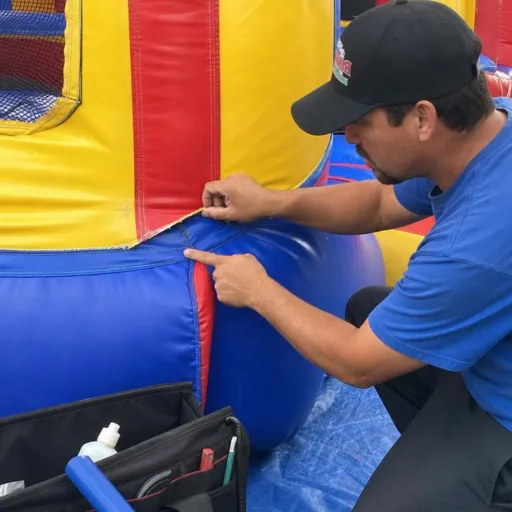
Repair techniques: Small punctures and tears are field-repairable using PVC patch kits and hot-air welding. Seam failures require professional re-welding. Panel replacement is practical when damage exceeds approximately 15–20% of panel area or when UV degradation has compromised overall fabric strength.
Architectural Applications Best Suited for PVC
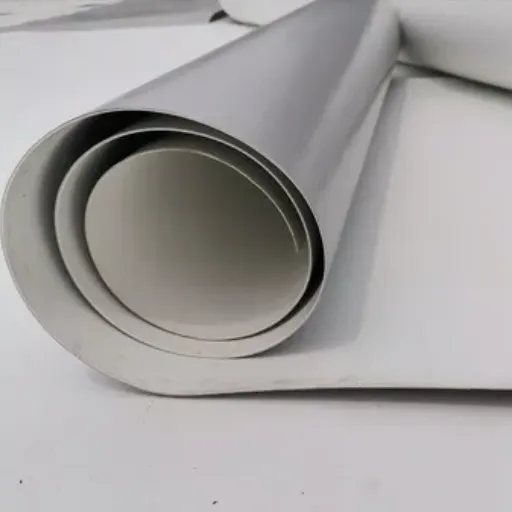
Transportation and Parking Canopies
Multi-bay parking canopies represent one of the highest-volume applications for PVC membrane structure technology. The 850–950 GSM specification spans 12–15 meters between columns while supporting snow loads typical of temperate climates. The lightweight membrane (approximately 1 kg/m²) minimizes foundation and steel requirements compared to conventional roofing.
For fleet operators and transit authorities, PVC delivers rapid installation. Prefabricated panels can be tensioned and secured in days rather than weeks, minimizing operational disruption.
Walkway Covers and Entrance Canopies
Walkway applications exploit PVC’s design flexibility. The material accepts complex curved geometries, printed graphics, and a wide color palette beyond PTFE’s typical white and sand tones. For commercial developments seeking brand expression or architectural distinction, PVC offers aesthetic options unavailable with premium alternatives.
Standard 850 GSM specification with PVDF topcoat is the recommended baseline for entrance canopies in most climates, delivering 15-year service life with minimal maintenance.
Event Tents and Temporary Pavilions
PVC’s foldability and transportability make it the dominant material for event structures. Unlike PTFE-coated fiberglass, which is rigid and difficult to handle in panels, PVC membrane can be folded, rolled, and redeployed repeatedly without structural damage.
For seasonal or rotating event venues, 650–850 GSM PVC with acrylic topcoat delivers the optimal balance of portability, cost, and adequate durability for 3–5 year replacement cycles.
Sporting Facility Roofs
Swimming pool enclosures present a specialized challenge: constant humidity, chlorine vapor, and UV exposure. PVC membrane formulated with chemical-resistant additives and PVDF topcoat resists chlorine-induced degradation while providing the waterproof barrier and natural daylighting that pool operators require.
Tennis court covers and training facility roofs similarly benefit from PVC’s moderate translucency (typically 6–8% light transmission), which reduces artificial lighting demand during daytime hours.
Building Facades and Awnings
Tensile facade systems use PVC membrane as a secondary building skin, providing solar shading, wind buffering, and visual screening. The material’s ability to span between minimal structural points creates architectural effects impossible with rigid cladding systems. For facade applications, printed PVC membrane enables large-format graphics and branding integrated directly into the building envelope.
Similar to how sandwich mesh fabric balances breathability and structural integrity in technical textile applications, PVC membrane achieves a unique balance of flexibility and load-bearing capacity that rigid architectural materials cannot match.
PVC Membrane vs. PTFE: When PVC Is the Right Choice
The PVC versus PTFE decision is not about quality hierarchy. It is about aligning material capabilities with project requirements.
PTFE-coated fiberglass offers exceptional longevity (25–35+ years) with superior fire performance (A2 classification) and self-cleaning properties. For landmark buildings, Olympic stadiums, and airports where design life exceeds three decades, PTFE is the rational specification.
PVC membrane structure technology wins on four decisive criteria:
Initial cost: PVC raw material and installation costs typically run 40–60% lower than PTFE for equivalent coverage area. For budget-sensitive projects, that differential funds enhanced support structures or additional architectural features.
Color and finish flexibility: PVC accepts virtually any color and surface finish. PTFE is manufactured almost exclusively in white or light sand tones due to the sintering process.
Repairability and modification: PVC is thermoplastic. Field repairs using hot-air welding are straightforward. PTFE requires specialized sintering equipment for repairs and cannot be easily modified after initial fabrication.
Speed of deployment: PVC fabrication and installation timelines are shorter. For projects with compressed schedules (event venues, seasonal structures, or fast-track commercial developments), PVC’s faster turnaround reduces project risk.
Choose PVC when the design life is 10–25 years, the budget rewards cost efficiency, color flexibility matters, or the project demands rapid deployment. Specify PTFE when the structure is a permanent landmark, fire rating demands Class A performance, or the project timeline extends beyond 30 years.
For projects facing extreme cold, the material’s cold-crack resistance becomes a critical factor alongside cost. Our analysis of laminated fabric performance in sub-zero environments provides additional guidance on low-temperature material selection.
Specifying and Procuring PVC Membrane Structure Fabric
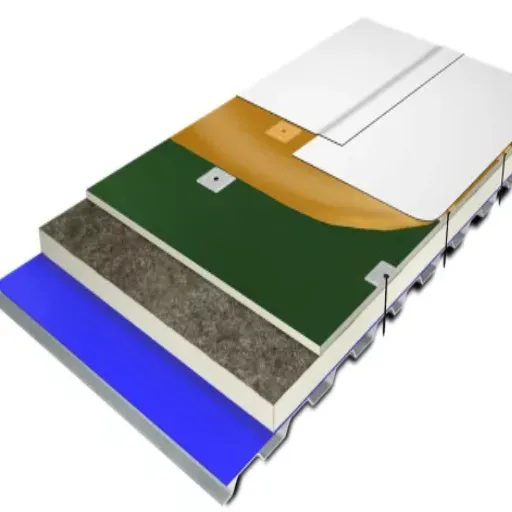
What to Include in Your Material Specification
A procurement-ready PVC membrane specification should address seven parameters:
- GSM and base fabric denier: Specify total weight and base fabric construction (e.g., “minimum 950 GSM with 1000D × 1300D high-tenacity polyester base”)
- Tensile strength: State minimum values in N/5cm for warp and weft directions, referenced to EN ISO 1421 or ASTM D751
- Topcoat chemistry: Specify acrylic, PVDF, or TiO2; state minimum dry film thickness
- Fire rating: List required certifications (NFPA 701, EN 13501-1 B-s2,d0, etc.)
- Seam construction: Requires high-frequency or hot-air welding; specify minimum seam strength as a percentage of base fabric tensile strength
- Color and light transmission: Reference specific color codes and maximum/minimum translucency percentages
- Warranty: Demand written warranty terms covering coating adhesion, seam integrity, and tensile retention over the stated service life
How to Evaluate Suppliers
When Marcus Chen’s engineering firm tendered a membrane canopy for a Singapore retail development, they received quotes spanning 40% in price. The lowest bid came from a commodity trader with no manufacturing capability. The highest came from a European brand-name supplier with impressive credentials but inflexible minimum order quantities.
Chen’s team developed a supplier scorecard that weighted four factors equally: technical documentation quality, production capacity and lead time transparency, batch consistency protocols, and post-delivery support capability. The winning supplier, a specialized manufacturer with in-house coating lines and documented QC testing, delivered the project on specification, on schedule, and within the median budget range.
That outcome illustrates a procurement principle: the lowest unit price rarely delivers the lowest total cost of ownership. Evaluate suppliers on their ability to provide certified test reports for every production batch, transparent communication about lead times, and engineering support during specification development.
Custom Manufacturing Capabilities
A standard off-the-shelf PVC membrane does not address every project requirement. Custom manufacturing capabilities become critical for non-standard applications.
Custom widths: Modern coating lines produce seamless widths up to 5.1 meters. Wider seamless panels reduce seam count, accelerate installation, and improve waterproof integrity.
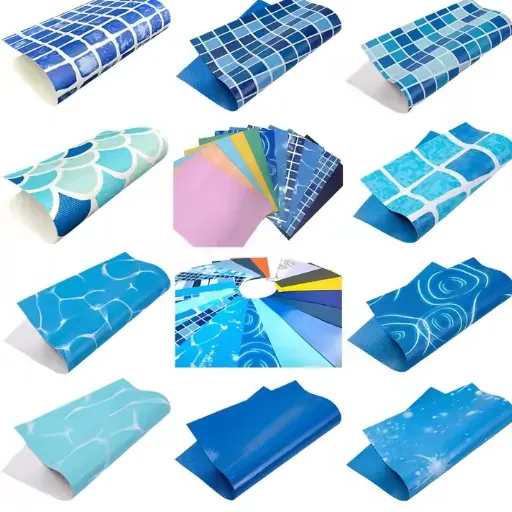
Custom colors and printed graphics: Pigmented PVC formulations and surface printing enable brand integration, wayfinding graphics, and architectural color matching.
Non-standard GSM and coating formulations: Projects in extreme environments may require custom GSM, enhanced cold-crack additives, or specialized chemical resistance beyond standard catalog offerings.
Prototype samples and R&D support: Reputable manufacturers provide prototype samples within 2–3 weeks for evaluation of weldability, color accuracy, and mechanical performance before committing to full production.
Certification packages: Export projects require comprehensive documentation, including material safety data sheets, fire test certificates, mechanical test reports, and customs compliance declarations. Confirm that your supplier can package these documents accurately and promptly.
Frequently Asked Questions
What is a PVC membrane structure?
A PVC membrane structure is a tensile architecture system that uses flexible PVC-coated polyester fabric stretched over a structural framework to create load-bearing roofs, canopies, or facades. Structural stability comes from tensile prestressing and double-curvature geometry, not from the fabric’s compressive strength.
How long does a PVC membrane structure last?
Standard PVC membrane with acrylic topcoat lasts 10–15 years in temperate climates. PVDF-topcoated PVC extends service life to 15–25 years with proper maintenance. Lifespan varies with UV exposure intensity, pollution levels, installation quality, and maintenance diligence.
What is the tensile strength of PVC membrane?
Tensile strength varies by GSM grade. Standard 850–950 GSM commercial PVC membrane achieves 4,000–4,500 N/5cm. Heavy-duty 1050–1250 GSM ranges reach 5,500–6,300 N/5cm. Ultra heavy-duty 1350+ GSM formulations exceed 7,000 N/5cm. Always verify values against EN ISO 1421 or ASTM D751 test reports.
Is PVC membrane fire-resistant?
PVC membrane can be formulated to achieve recognized fire safety certifications including NFPA 701, EN 13501-1 B-s2,d0, and DIN 4102 B1. Fire performance depends on compound formulation, not PVC chemistry alone. Always request current test certificates from accredited laboratories.
What is the difference between PVC and PTFE membranes?
PVC membrane uses a polyester base with PVC coating, offers 10–25 year lifespan, lower cost, wide color flexibility, and field repairability. PTFE membrane uses fiberglass base with PTFE coating, delivers 25–35+ year lifespan, superior fire rating (Class A), and excellent self-cleaning, but at higher initial cost with limited color options.
Can PVC membrane structures be repaired?
Yes. Small punctures and tears are repairable in the field using PVC patch material and hot-air welding techniques. Seam failures require professional re-welding. For extensive UV degradation or damage exceeding 15–20% of panel area, panel replacement is typically more cost-effective than repair.
How much does a PVC membrane structure cost?
Installed cost varies by project complexity, location, and specification grade. Material-only costs for 850–950 GSM PVC membrane typically range from 15–30 per square meter, topcoat specification and color. Total installed structure cost, including steel, cables, engineering, and installation, generally ranges from 15–30 per square meter, topcoat specification, and color. Total installed structure cost, including steel, cables, engineering, and installation, generally ranges from 200–500 per square meter, roughly 40–60% less than equivalent PTFE installations.
Conclusion
PVC membrane structure technology occupies a well-defined position in the architectural materials spectrum. It does not attempt to match PTFE’s 35-year lifespan or ETFE’s optical transparency. Instead, it delivers precisely what a large category of projects demands: proven structural performance, design flexibility, international standards compliance, and total cost of ownership that aligns with 10–25 year design timelines.
For specifiers, the key to successful procurement lies in understanding the specification hierarchy. Start with GSM range matched to structural load requirements. Select topcoat chemistry based on environmental exposure and design life. Demand comprehensive test documentation and batch certification. Evaluate suppliers on engineering support capability and quality control transparency, not unit price alone.
At LY TRUSTLINK, we engineer PVC membrane fabric across the full specification range (from 650 GSM light-duty formulations to 1800 GSM extreme-environment grades) with custom widths, colors, and certification packages for global export. Our manufacturing process incorporates multi-point quality inspection including tensile strength verification, tear resistance testing, and accelerated UV aging evaluation on every production batch.
If you are specifying membrane for an upcoming project, our engineering team can support your material selection, provide prototype samples for evaluation, and deliver certified production with transparent lead times. Talk to an engineer about your PVC membrane structure requirements or request a custom specification tailored to your project’s load, climate, and compliance parameters.