
Tensile Structure Cost: Pricing Guide by Material & Size
Tensile structures cost between $150 and $1,500 per square meter installed, depending on the membrane material and project complexity. PVC membrane structures range from $150–400 per square meter. PTFE membrane structures run $400–900 per square meter. ETFE cushion systems cost $800–1,500 per square meter. The total project budget also includes design, engineering, structural steel, cables, and installation labor.
In 2023, Marcus Chen, a project developer in Singapore, received three quotes for a 2,000 square meter event canopy. The bids ranged from $340,000 to $920,000. None of the contractors explained why. Marcus spent six weeks in meetings trying to reconcile the numbers before discovering that the lowest bid excluded engineering fees and used industrial-grade PVC instead of architectural membrane. The highest bid assumed a custom PTFE system with imported steel. Both were valid prices. Neither was the right price for his project.
This guide eliminates that confusion. You will learn the real cost-per-square-meter ranges for every major tensile membrane material. You will see exactly where each dollar goes across design, materials, steel, and installation. You will understand how to compare bids accurately, identify red flags in low offers, and plan a budget that aligns with your project’s timeline and risk tolerance. Looking for an innovative membrane architecture that combines aesthetics with functionality? Contact LY TRUSTLINK to explore bespoke solutions designed around your project’s specific requirements.
Key Takeaways
- PVC membrane structures cost 150−400/m2installed.PTFEruns150−400/m2installed.PTFEruns400-900/m2. ETFE cushions cost $800-1,500/m2.
- Material and fabrication represent 40-50% of the total project budget. Design and engineering add 10-15%. Structural steel and cables account for 20-30%. Installation and tensioning take 15-25%.
- The cheapest bid is rarely the cheapest project. Hidden exclusions and substandard specifications generate change orders that exceed the original budget.
- PTFE membrane becomes cheaper than PVC over a 30-40 year lifecycle due to lower maintenance and zero replacement cycles.
- Simplifying geometry, repeating modules, and bundling multiple structures under one contract are the three most effective cost-saving strategies.
How Much Does a Tensile Structure Cost?
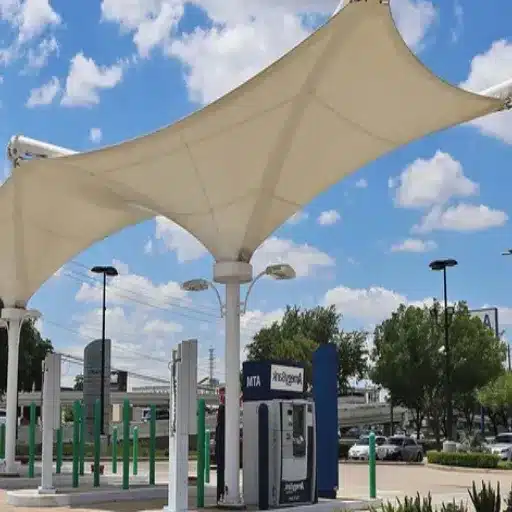
Cost Per Square Meter by Material (Installed)
The installed cost includes membrane fabric, structural steel, cables, foundations, and labor. It does not include site preparation, landscaping restoration, or ongoing maintenance.
| Material | Installed Cost per m2 | Typical Applications |
|---|---|---|
| PVC-coated polyester | $150-400 | Canopies, shade structures, event tents, temporary pavilions |
| PTFE-coated fiberglass | $400-900 | Stadium roofs, permanent landmarks, airport terminals |
| ETFE film (cushion systems) | $800-1,500 | Atriums, facades, transparent roofs, botanical gardens |
| Silicone-coated fiberglass | $300-600 | Industrial exhaust enclosures, high-heat applications |
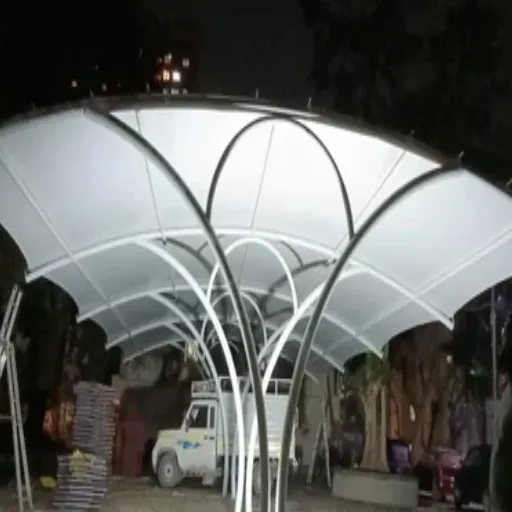
The ranges are wide because geometry costs more than material alone. A simple cone-shaped canopy over a restaurant patio requires minimal engineering and standard steel masts. A free-form saddle roof over a concert stage requires computational form-finding, custom-fabricated panels, and complex boundary structures. Both might use PVC membrane. The cost per square meter differs by a factor of two.
Need a budget estimate for your specific project? Talk to an engineer about scope and pricing.
Material-Only vs. Installed Cost
Material-only prices help procurement managers compare fabric suppliers. They do not predict the total project cost.
- PVC membrane fabric: $8-25/m2
- PTFE membrane fabric: $40-100/m2
- ETFE film: $30-80/m2 (material only, before cushion hardware)
Installed costs are typically 3 to 10 times material-only costs. The multiplier depends on project size, complexity, and local labor rates. Small projects suffer from high fixed costs. Engineering, patterning, and site mobilization cost nearly the same for 200 square meters as for 2,000 square meters. This means small installations often have the highest cost per square meter.
Tensile Structure Cost Breakdown by Project Phase
Design and Engineering: 10-15% of Total
Every tensile structure begins with form-finding and structural analysis. Engineers model wind loads, snow loads, and pretension requirements. They pattern the membrane into flat panels that can be fabricated and welded. They design the cable system, mast connections, and foundation anchorage.
Complex geometry increases engineering hours dramatically. A symmetrical cone requires basic analysis. A free-form surface with multiple peaks and valleys demands computational fluid dynamics for wind modeling and iterative form-finding. For a 1,000 square meter project, engineering might cost 15,000-30,000 for simple geometry. Complex forms can push that to 15,000-30,000 for simple geometry. Complex forms can push that to 60,000-100,000.
Design fees are typically fixed-price or percentage-based. Fixed-price contracts protect the owner from scope creep. Percentage-based contracts align the engineer’s incentives with project scale. Either way, this line item should appear explicitly in every bid.
Material and Fabrication: 40-50% of Total
This is the largest single cost category. It includes the membrane fabric, cutting, welding, and panel finishing.
For a PVC project, material costs might break down as follows on a $300,000 total budget:
- Membrane fabric: $40,000-80,000
- Cutting and welding labor: $20,000-40,000
- Panel inspection and packaging: $5,000-10,000
- Factory overhead and margin: $15,000-30,000
Fabrication is often done in specialized shops with RF welding equipment and CNC cutting tables. Factory fabrication ensures quality control. On-site fabrication is rarely used except for emergency repairs or extremely remote locations where shipping finished panels is impractical.
Structural Steel and Cables: 20-30% of Total
The membrane carries tension. Something must carry compression. That is the role of steel masts, ring beams, boundary trusses, and cable systems.
Steel costs fluctuate with global commodity markets. As of 2026, structural steel ranges from $2-5 per kilogram depending on grade and region. A typical tensile canopy might use 5-15 tonnes of steel. A stadium roof might use 200-500 tonnes.
Cable systems add cost per meter. Typical ranges:
- Spiral strand cable: $5-12/meter
- Locked coil cable: $10-20/meter
- Cable terminations and clamps: $50-200 each
Foundation costs vary by soil conditions. A simple concrete pad for a mast might cost $2,000-5,000. Deep pile foundations for a major stadium roof can run into the millions.
Installation and Tensioning: 15-25% of Total
Installation labor rates vary by region. In North America and Western Europe, specialized tensile installers charge 80−150perhour.In Southeast Asia and the Middle East, rates run 80-150 per hour. In Southeast Asia and the Middle East, rates run 20-50 per hour. This regional difference can shift the total installed cost by 20-30% for the same design.
Crane and equipment rental adds cost. A mobile crane for a small canopy might cost 1,500 per day. Tower cranes for the largest stadium projects run 1,500 per day. Tower cranes for the largest stadium projects run 10,000-30,000 per day. Tensioning equipment, including hydraulic jacks and load cells, is typically included in the installer’s scope.
The installation timeline affects cost indirectly. A project that must be completed during a two-week stadium off-season commands premium labor rates. Phased installation spreads cost over time but may increase total labor hours due to multiple mobilizations.
Looking for innovative membrane architecture that combines aesthetics with functionality? Contact LY TRUSTLINK to explore bespoke solutions designed around your project’s specific requirements.
Material Cost Comparison
PVC Membrane Cost Details
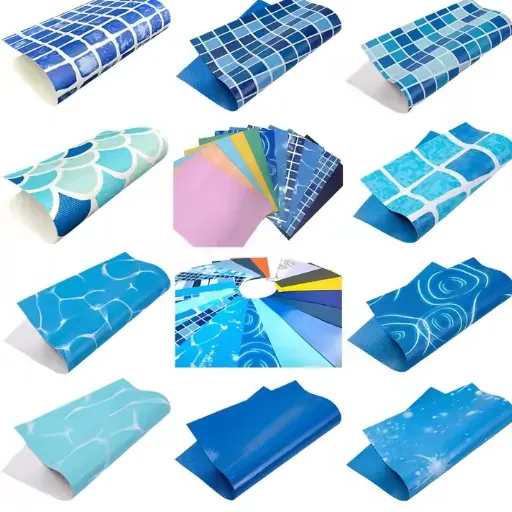
PVC-coated polyester is the entry point for tensile architecture. The material itself is economical. The installed cost remains accessible because PVC is easy to weld, handle, and tension.
- Material: $8-25/m2 depending on GSM, coating quality, and color
- Typical installed: $150-400/m2
- Lifespan: 15-25 years
- Maintenance: Moderate (cleaning, lacquer renewal, minor repairs)
For a deeper look at PVC specifications, see our guide to PVC membrane structure technical details.
PTFE Membrane Cost Details
PTFE-coated fiberglass commands a premium for durability and low maintenance. The material cost is 2.5 to 4 times higher than PVC. The installed cost reflects this plus the more demanding fabrication and tensioning requirements.
- Material: $40-100/m2, depending on fiber grade and coating passes
- Typical installed: $400-900/m2
- Lifespan: 30-50 years
- Maintenance: Very low (inspection and occasional cleaning)
ETFE Cost Details
ETFE cushion systems are priced as complete assemblies. The film itself is inexpensive. The air supply system, aluminum perimeter frames, and control hardware represent the majority of the cost.
- Cushion system installed: $800-1,500/m2
- Lifespan: 25-50 years for film; air systems require ongoing maintenance
- Maintenance: Low for film; moderate for air supply and controls
Steel and Cable Costs
Structural steel is priced by weight. Cable systems are priced by length and diameter. These costs are relatively transparent because they track global commodity markets.
- Structural steel: $2-5/kg
- Cable systems: $5-20/meter depending on type and diameter
- Foundation costs: Highly variable based on geotechnical conditions
For a complete material comparison, read our tensile structure materials guide.
Cost-Saving Strategies
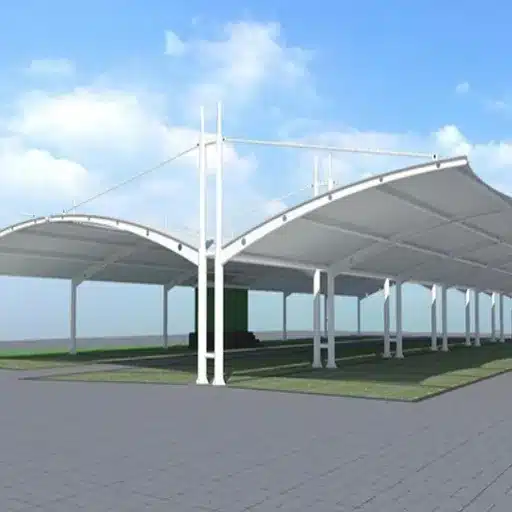
Design-Level Savings
The most powerful cost lever is geometry. Simple shapes use fewer unique panels, less complex steel, and shorter engineering hours.
- Choose conical or saddle forms over free-form surfaces. Repeated modules cut fabrication time by 30-50%.
- Standardize connection details. Custom-designed mast clamps and cable terminations look elegant but add engineering and fabrication cost. Standard hardware is faster to procure and easier to replace.
- Reduce peak complexity. Every additional peak in a membrane surface adds a mast, a foundation, and a set of cables. A single-peak cone uses one mast. A five-peak canopy uses five.
Procurement Savings
- Bundle multiple structures under one contract. A contractor mobilized for a 5,000 square meter stadium roof can add a 500 square meter entrance canopy at marginal additional cost.
- Evaluate local vs. imported materials. PVC membrane manufactured locally avoids shipping costs and import duties. PTFE membrane may only be available from a limited number of global suppliers, making import unavoidable.
- Consider phased installation for large campuses. Build the central structure first. Add peripheral canopies in later budget years. This spreads capital expenditure without compromising the core design.
Value Engineering Without Compromising Safety
There are places to cut costs and places where cutting creates risk.
Safe to reduce: Aesthetic complexity, non-structural color matching, custom surface finishes, excessive seam overlaps.
Never reduce: Fire rating certification, wind load safety factors, snow load capacity, seam strength specifications, foundation design.
A value-engineered project maintains full structural safety while eliminating decorative extras. The right question is not “how cheap can we make this?” but “what is the simplest form that meets all performance requirements?”
Lifecycle Cost Analysis
20-Year Total Cost of Ownership
The initial bid is only the first payment. Maintenance, cleaning, repairs, and eventual replacement determine the true economic impact.
When Ana Kowalski, facilities director for a Polish sports complex, planned her 2019 budget, she chose PVC membrane for a 3,000 square meter roof at $280/m² installed. Total initial cost: $840,000. She budgeted $12,000 annually for maintenance. By 2034, she had spent $180,000 on cleaning, lacquer renewal, and minor repairs. In 2039, she faced a partial membrane replacement costing $340,000. Her 20-year total: $1.36 million.
Her counterpart in Munich chose PTFE for a similar roof at $620/m² installed. Total initial cost: $1.86 million. Annual maintenance averaged $3,000. No replacement was needed. His 20-year total: $1.92 million. The gap narrowed from $1.02 million initially to $560,000 over two decades. By year 30, the Munich facility will have spent less in total than the Polish facility.
Maintenance Costs Over Time
| Material | Annual Maintenance per 1,000 m2 | Major Intervention |
|---|---|---|
| PVC | $3,000-6,000 | Lacquer renewal at 10-15 years; replacement at 20-25 years |
| PTFE | $500-1,500 | Minimal; possible cable hardware inspection at 20 years |
| ETFE | $2,000-4,000 | Air system service; film replacement at 25-50 years |
| Silicone | $1,000-2,500 | Coating inspection; patch repairs as needed |
Energy Savings and Operational Benefits
Tensile structures reduce operational costs in ways that do not appear in the construction budget. Translucent membranes reduce lighting demand. Lightweight structures reduce foundation requirements. Faster construction means earlier revenue generation for commercial projects.
A retail developer in Dubai reported that the PTFE roof over his shopping atrium reduced cooling loads by 18% compared to the original glass design. The $400,000 premium for PTFE over glass was recovered in energy savings within seven years.
Getting Accurate Quotes
What Information Contractors Need
A contractor cannot price what they cannot define. Provide the following at a minimum:
- Site plan with approximate dimensions and anchor point locations
- Wind load requirements per local building code
- Snow load requirements (if applicable)
- Fire code classification required
- Project timeline and access constraints
- Budget range (yes, sharing your budget helps contractors propose realistic solutions)
Red Flags in Low Bids
The lowest bid often conceals the highest risk. Watch for these exclusions:
- Missing engineering fees. Some contractors bid only supply and install, leaving the owner to hire a separate engineer.
- Unspecified material grades. “PVC membrane” could mean 600 gsm architectural grade or 400 gsm industrial tarpaulin. The difference is $10/m2 in material and 10 years in lifespan.
- No allowance for site conditions. Rocky soil, limited crane access, or high wind exposure during installation all add cost.
- Vague installation scope. “Installation included” means different things to different contractors. Specify tensioning, quality control, and cleanup.
Value Engineering Checklist
Before finalizing any bid, run through this checklist:
- Geometry simplified where architecturally acceptable
- Repeating modules used instead of unique panels
- Standard hardware specified where possible
- Multiple structures bundled under one contract
- Phased installation evaluated for large campuses
- Local material sourcing confirmed
- Fire rating and structural standards explicitly met
- Maintenance program and budget planned
Case Study: Cost Comparison of Three Real Projects
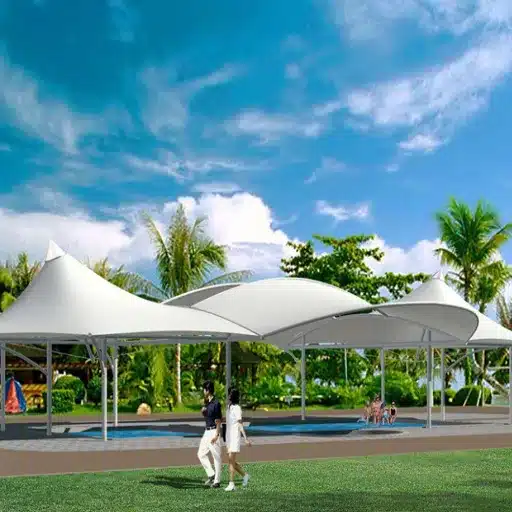
Project A: Commercial Canopy (PVC, 500 m2)
A shopping center in Bangkok needed a pedestrian canopy linking two buildings. The design was a simple barrel vault using white PVC membrane.
- Design and engineering: $18,000 (12%)
- PVC membrane and fabrication: $62,000 (41%)
- Steel and cables: $38,000 (25%)
- Installation: $33,000 (22%)
- Total: 151,000(151,000(302/m2)
The project stayed on budget. Simple geometry and local material sourcing kept costs predictable.
Project B: Stadium Roof (PTFE, 15,000 m2)
A municipal stadium in Melbourne replaced an aging concrete roof with a PTFE membrane system.
- Design and engineering: $1,200,000 (12%)
- PTFE membrane and fabrication: $4,800,000 (48%)
- Steel and cables: $2,400,000 (24%)
- Installation: $1,600,000 (16%)
- Total: 10,000,000(10,000,000(667/m2)
PTFE was chosen despite the higher initial cost because the 50-year design life and minimal maintenance aligned with the city’s long-term asset management strategy.
Project C: Atrium Skylight (ETFE, 800 m2)
A university in Toronto wanted maximum daylight in a new atrium. ETFE cushions with three layers and printed fritting provided 70% light transmission with solar control.
- Design and engineering: $180,000 (15%)
- ETFE cushions and air systems: $480,000 (40%)
- Structural support and frames: $300,000 (25%)
- Installation and commissioning: $240,000 (20%)
- Total: 1,200,000(1,200,000(1,500/m2)
The premium was justified by the architectural requirement for transparency. No other material could achieve the same daylighting performance at lower weight.
Frequently Asked Questions
Are tensile structures expensive?
Tensile structures cost more per square meter than standard roofing for small projects. For large spans, they often cost less than conventional construction because the lightweight membrane reduces foundation and structural steel requirements. The economic answer depends on span, complexity, and lifecycle horizon.
What is the cheapest tensile structure material?
PVC-coated polyester is the lowest-cost material for architectural tensile structures. Material-only prices start at 8/m2.Installedcostsstartat8/m2.Installedcostsstartat150/m2. For very short-term applications, lower-grade materials exist, but they do not meet building code requirements for permanent or semi-permanent structures.
How much does a tensile structure cost per square foot?
Converting the metric ranges: PVC 14−37/sqft installed.PTFE14−37/sqft installed.PTFE37-84/sq ft installed. ETFE $74-139/sq ft installed. These are rough conversions. Actual pricing depends on local labor rates and material availability.
Why do tensile structure quotes vary so much?
Quotes vary because contractors make different assumptions about geometry, material grade, engineering scope, and site conditions. A 300% range between high and low bids is common when the project brief is vague. The solution is a detailed specification that locks these variables before bidding.
Can I save money by sourcing my own membrane fabric?
Sometimes. If you have direct relationships with membrane manufacturers and your installer agrees to work with third-party material, you might save 10-20% on the fabric line item. However, the installer may not warranty fabric they did not supply. Coordinate carefully before pursuing this path.
How do I budget for tensile structure maintenance?
Plan 1-3% of the initial installed cost annually for PVC structures. Plan 0.2-0.5% annually for PTFE. ETFE requires 1-2% annually for air system maintenance. These percentages cover routine cleaning, inspection, and minor repairs. Major replacements require separate capital reserves.
Conclusion
Cost transparency is the first step to budget control. The right budget is not the lowest bid. It is the bid that accurately reflects your project’s requirements, timeline, and risk tolerance. A contractor who omits engineering fees, underestimates steel tonnage, or specifies substandard membrane will deliver change orders that exceed the original budget by the time the structure is tensioned.
By understanding the cost drivers outlined in this guide, you can evaluate quotes with the same rigor you apply to steel or concrete procurement. You know what each material costs. You know where each dollar goes. You know which strategies reduce cost without compromising safety.
For custom PVC membrane pricing, engineering consultation on value engineering, or a detailed budget estimate for your next tensile structure project, contact our engineering team. We support projects from concept to certified delivery with the technical transparency and partnership reliability that protects your investment.