
Tensile Structure Materials: PVC, PTFE, ETFE & Silicone Guide
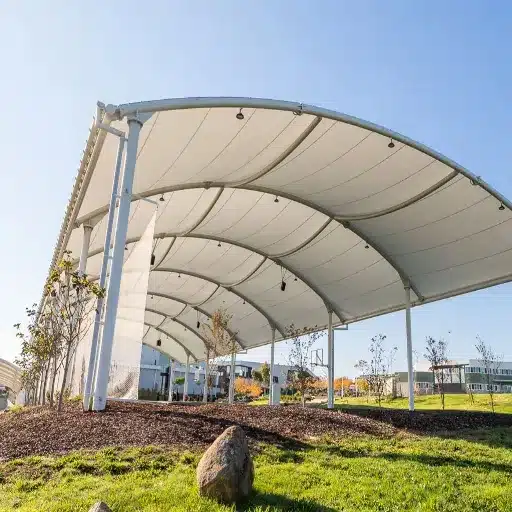
The four primary tensile structure materials are PVC-coated polyester, PTFE-coated fiberglass, ETFE film, and silicone-coated fiberglass. PVC offers the lowest initial cost and widest color range for temporary to permanent structures. PTFE delivers the longest lifespan and lowest maintenance for iconic buildings. ETFE provides maximum transparency for facades and atriums. Silicone-coated fiberglass serves niche high-temperature and chemical-resistant applications.
Yet choosing between them is rarely that simple. In 2019, the engineering team on a mid-size stadium project in Southeast Asia specified PVC membrane based on budget constraints alone. Five years later, the tropical UV exposure had degraded the top-coat prematurely. The maintenance budget, originally forecast at 8,000 annually, ballooned to 34,000. The material was not wrong. The specification was incomplete.
This guide covers the material science, technical specifications, and real-world decision logic that prevent those outcomes. You will learn how each tensile membrane material is constructed, how it performs under load and weather, what it costs over its full lifecycle, and how to match the right material to your project’s timeline, climate, and budget. Every tensile structure presents unique challenges. Reach out to LY TRUSTLINK for expert guidance on material selection, structural optimization, and project feasibility.
Key Takeaways
- PVC-coated polyester is the most versatile tensile membrane material, with a 15-25 year lifespan and the lowest material cost at $8-25 per square meter.
- PTFE-coated fiberglass outperforms all alternatives in durability, delivering 30-50 years of service with minimal maintenance in harsh environments.
- ETFE film transmits 90-95% of visible light, making it the material of choice for transparent roofs, facades, and atriums.
- Material selection should be based on five factors: project timeline, environmental exposure, budget, aesthetic requirements, and maintenance capacity.
- All architectural membrane fabrics must meet NFPA 701, EN 13501-1, or equivalent fire safety standards before installation.
How Tensile Membrane Materials Work
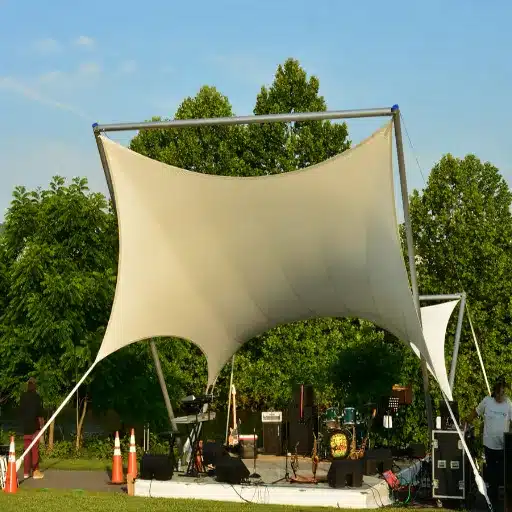
Every tensile membrane begins as a woven base fabric. High-tenacity polyester or fiberglass yarns are woven into a scrim that provides the structural skeleton. The coating system, applied to both sides of this base, determines waterproofing, UV resistance, weldability, and surface finish. Without understanding this layered construction, specification decisions are guesswork.
Woven Base Fabric + Coating System
The base fabric carries the structural load. High-tenacity polyester, typically 1,100 dtex to 3,300 dtex, offers flexibility and shock absorption. E-glass fiberglass provides higher modulus and dimensional stability but with less elongation. The choice of base fabric affects how the membrane behaves under wind load, snow load, and pretension.
The coating system serves multiple functions beyond simple waterproofing. A PVC plastisol or PTFE dispersion creates the primary barrier. Additives include UV absorbers, fungicides, and anti-soiling agents. A top-coat or lacquer extends surface life and can provide self-cleaning properties. In architectural membrane fabric systems, this layered approach is what separates engineered solutions from commodity covers.
Warp vs. Weft: Why Orientation Matters
Woven fabrics have two distinct directions. Warp yarns run parallel to the roll length and carry the primary tensile loads. Weft yarns run across the roll and provide dimensional stability. In tensile structures, the warp direction is aligned with the primary stress paths. Specifying unbalanced construction, where warp strength exceeds weft strength, is common in high-load applications. Balanced construction suits biaxially loaded surfaces like saddle-shaped canopies.
Coating Functions Beyond Waterproofing
Waterproofing is the baseline. The coating also determines weldability, which affects how fabric panels are joined on site. PVC coatings allow RF welding and hot-air bonding. PTFE requires heat-sealing at higher temperatures. UV stabilizers prevent photodegradation of the base fabric. Surface lacquers reduce dirt adhesion and can restore UV protection mid-life. These secondary functions often matter more than the waterproofing itself when predicting long-term performance.
PVC-Coated Polyester
PVC-coated polyester is the workhorse of tensile architecture. It accounts for the majority of installed membrane area worldwide. That is not because it is the most advanced material. It is because PVC delivers predictable performance at a cost point that makes tensile architecture accessible to projects of every scale, from temporary event tents to permanent stadium roofs.
Construction and Manufacturing
The manufacturing process begins with a high-tenacity polyester base fabric. The scrim is coated with virgin-grade PVC plastisol using a knife-over-roll or dipping process. Multiple passes build the coating weight to the specified GSM. A lacquered top-coat, typically acrylic or PVDF, is applied as the final layer. This top-coat is renewable, which is a significant advantage over materials that cannot be surface-treated mid-life.
When Elena Voss, a procurement manager for a German event infrastructure company, sourced membrane for a touring pavilion series, she specified 900 gsm PVC with a PVDF lacquer. The initial quote was 40% below PTFE alternatives. More importantly, the lacquer could be renewed between tour cycles, resetting the UV clock without replacing panels. That specification decision saved her operation €127,000 over eight years.
Technical Specifications
Typical PVC membrane specifications fall within these ranges:
- Weight: 600 gsm to 1,500 gsm
- Tensile strength: 3,000-6,000 N/5cm (warp), 2,500-5,500 N/5cm (weft)
- Tear resistance: 400-800 N
- Elongation at break: 15-25%
- UV resistance: 5-10 years without lacquer; 15-25 years with PVDF top-coat
- Weldability: RF welding and hot-air bonding compatible
- Color range: Extensive, including custom color matching
For a deeper technical breakdown of PVC in architectural applications, see our guide to PVC membrane structure specifications.
Fire Safety and Compliance
PVC-coated polyester achieves NFPA 701 certification for both small-scale and large-scale flame tests. European projects require EN 13501-1 classification, typically B-s2,d0 or better depending on formulation. Canadian installations must meet CAN/ULC-S109. Fire retardancy is achieved through additives in the PVC compound, not through surface treatments that can wear off. This makes PVC a reliable choice for enclosed public spaces where code compliance is non-negotiable.
Lifespan and Maintenance
With proper maintenance, PVC membranes last 15-25 years. The critical variable is the top-coat. A PVDF lacquer can be renewed at 10-15 years, effectively resetting the UV degradation timeline and extending service life. Without lacquer renewal, the PVC surface chalks and cracks. The base fabric may still be structurally sound, but the waterproofing and aesthetic properties degrade. Repairability is excellent. Small punctures are patched with welded overlays. Seam failures are re-welded. This repairability is unique among tensile structure materials and significantly reduces lifecycle cost.
Cost and Value Proposition
PVC material costs range from 8to8to25 per square meter for the fabric alone, before fabrication markup. Installed costs, including steel, cables, and labor, typically run $150-400 per square meter depending on project complexity and location. The value proposition is straightforward: lowest initial cost, widest application range, and repairability that no other material matches. For temporary installations, semi-permanent structures, and budget-sensitive permanent projects, PVC is the rational starting point.
Want to see how PVC membrane performs in your specific climate? Talk to an engineer about custom specifications.
PTFE-Coated Fiberglass
PTFE-coated fiberglass represents the premium tier of tensile architecture. It is the material specified when the design lifespan exceeds 30 years, when maintenance access is difficult or expensive, and when the structure must remain visually pristine with minimal intervention. The Munich Olympiapark roofs, now over 50 years old, demonstrated what this material could achieve before computer modeling existed.
Construction and Manufacturing
The base fabric is E-glass fiber, woven into a scrim with high modulus and zero moisture absorption. PTFE dispersion is applied in multiple passes and sintered to create a chemically bonded surface. The resulting membrane is inert, hydrophobic, and UV-stable by molecular structure rather than by additive.
When PTFE membrane is first installed, it has a brownish tint. This is the uncured PTFE surface. Within 24-72 hours of UV exposure, the material bleaches to the pure white that defines iconic tensile structures worldwide. This color shift is not degradation. It is a visual confirmation that the surface chemistry has activated.
Technical Specifications
- Weight: 800 gsm to 1,500 gsm
- Tensile strength: 5,000-9,000 N/5cm (warp), 4,000-7,000 N/5cm (weft)
- Tear resistance: 300-600 N
- Elongation at break: 3-8% (significantly lower than PVC)
- UV resistance: 30+ years (inherent molecular stability)
- Weldability: Heat-sealed seams; more technically demanding than PVC
- Color range: Predominantly white; limited custom colors
Self-Cleaning Properties and UV Stability
The PTFE surface is hydrophobic. Rainwater beads and carries away dust and pollution. In industrial environments where PVC would require annual cleaning, PTFE remains visually clean with minimal intervention. This self-cleaning behavior is not a coating that wears off. It is a property of the fluoropolymer chemistry itself. The UV stability is equally inherent. Where PVC relies on UV absorbers that deplete over time, PTFE molecules do not photodegrade under terrestrial solar radiation. This is why PTFE membranes on structures from the 1970s and 1980s continue to perform.
Lifespan and Maintenance
Documented lifespan ranges from 30 to 50 years. The Denver International Airport roof, installed in 1995, continues to perform without significant degradation nearly 30 years later. Maintenance is minimal: occasional inspection of seams and hardware, and cleaning only in environments with unusual pollution or biological growth. Replacement is typically driven by end-of-building-life decisions, not membrane failure. This longevity must be factored into total cost of ownership calculations.
Cost and Value Proposition
PTFE material costs range from 40to40to100 per square meter for fabric only. Installed costs run $400-900 per square meter. The initial investment is 2.5 to 4 times higher than PVC. However, over a 30-year lifecycle, the gap narrows. A PVC roof requiring two replacements, annual cleaning, and a mid-life lacquer renewal can approach or exceed the total cost of a single PTFE installation. For permanent landmarks, high-UV environments, and structures where access for maintenance is restricted, PTFE is the economically rational choice despite the higher upfront cost.
For a direct side-by-side analysis, read our detailed PTFE vs PVC membrane comparison.
ETFE Film
ETFE film operates by different engineering principles than coated fabrics. It is an extruded fluoropolymer film, not a woven textile. This distinction matters for designers seeking transparency, curved geometries, and lightweight structural systems that fabric membranes cannot achieve.
Construction and Manufacturing
ETFE is extruded into thin films, typically 100 to 300 micrometers thick. Single-layer applications behave like a flexible glass pane. Multi-layer pneumatic cushion systems, using 2 to 5 layers separated by aluminum perimeter frames, create insulated transparent roofs. Air pressure, maintained by small blowers, gives the cushions their structural form. This is fundamentally different from the pretensioned fabric systems used with PVC and PTFE.
Technical Specifications
- Thickness: 100-300 micrometers (single layer)
- Tensile strength: 50-60 MPa (isotropic, unlike woven fabrics)
- Light transmission: 90-95% (clear film)
- UV transmission: High (plants grow beneath ETFE; occupants receive natural vitamin D)
- Weight: 1/100th of glass per unit area
- Self-cleaning: Hydrophobic surface, similar to PTFE
Structural Behavior and Cushion Systems
ETFE cushions rely on internal air pressure for stability. A typical cushion maintains 200-700 Pascals of overpressure. This is low enough that punctures do not cause catastrophic failure. The film simply deflates gradually, and the damaged panel can be replaced without dismantling the entire roof. Replacement cycles for the film itself range from 25 to 50 years. The air supply systems require ongoing maintenance, which is a operational consideration distinct from the material longevity.
Fire Safety
ETFE is self-extinguishing. When exposed to flame, it melts and shrinks away rather than spreading fire. Smoke density is low. European classification is typically B-s1,d0 under EN 13501-1. This behavior makes ETFE suitable for atriums, shopping centers, and transit facilities where fire safety codes are stringent.
Cost and Value Proposition
ETFE cushion systems cost $800-1,500 per square meter installed, including structural support, air supply, and control systems. Material-only costs are lower, but the supporting infrastructure represents a significant portion of the total. ETFE is the right choice when the design requires maximum transparency, complex curved geometries, or where the weight savings over glass justify the premium. The Allianz Arena in Munich and the Water Cube in Beijing are benchmark projects that demonstrate what ETFE enables architecturally.
Silicone-Coated Fiberglass
Silicone-coated fiberglass occupies a smaller but critical niche in the tensile structure materials spectrum. It combines fiberglass’s dimensional stability with silicone rubber’s resistance to extreme temperatures and chemical exposure.
Niche Applications and Properties
The silicone coating maintains flexibility at temperatures from -60°C to 260°C. It resists degradation from acids, alkalis, and industrial solvents that would attack PVC or PTFE. The material is lighter than equivalent PTFE constructions and can be produced at lower cost. Typical specifications include tensile strength of 4,000-7,000 N/5cm and a lifespan of 20-30 years under normal conditions.
When to Specify Silicone
Specify silicone-coated fiberglass when the operating environment exceeds the temperature or chemical resistance limits of PVC and PTFE. Common applications include industrial exhaust enclosures, wastewater treatment plant covers, and kiln hoods. It is also specified when PTFE-like durability is required at a lower material cost, and where transparency is not a design priority. The color range is limited, and self-cleaning properties are inferior to PTFE, so aesthetic applications are generally better served by other materials.
Tensile Structure Materials Comparison
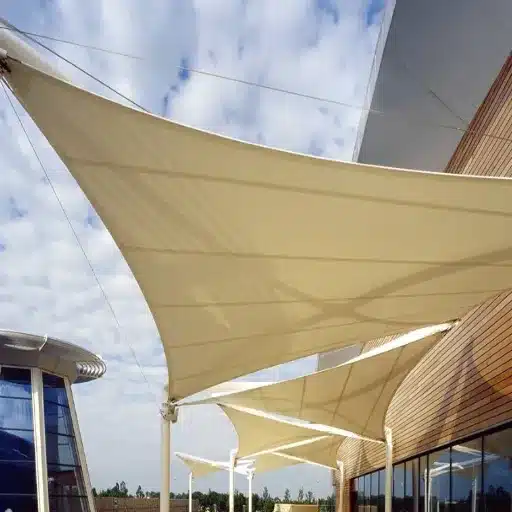
The following matrix summarizes the key decision factors across all four primary tensile membrane materials.
| Property | PVC-Polyester | PTFE-Fiberglass | ETFE Film | Silicone-Fiberglass |
|---|---|---|---|---|
| Tensile strength | 3,000-6,000 N/5cm | 5,000-9,000 N/5cm | 50-60 MPa | 4,000-7,000 N/5cm |
| Tear resistance | 400-800 N | 300-600 N | High puncture resistance | 350-600 N |
| Lifespan | 15-25 years | 30-50 years | 25-50 years | 20-30 years |
| Fire rating | NFPA 701 pass | NFPA 701 pass | Self-extinguishing | NFPA 701 pass |
| Translucency | 5-20% | 10-40% | 90-95% | 5-15% |
| Material cost/m² | $8-25 | $40-100 | $80-150 installed | $25-60 |
| Maintenance | Moderate | Very low | Low (air systems) | Low |
| Repairability | Excellent | Difficult | Panel replacement | Moderate |
| Weldability | Excellent | Heat-seal only | Heat-seal/welding | Moderate |
| Color options | Extensive | White/limited | Clear/fritted | Limited |
Performance Summary by Application
- Stadium roofs: PTFE for permanent landmarks; PVC for retractable or replaceable panels
- Event tents and temporary pavilions: PVC exclusively
- Commercial canopies and shade structures: PVC or PTFE depending on permanence
- Building facades and atriums: ETFE for transparency; PTFE for durability
- Industrial high-heat environments: Silicone-coated fiberglass
- Transportation terminals: PTFE or PVC depending on span and budget
Need a detailed cost breakdown for your project? Our tensile structure cost guide breaks down material, engineering, fabrication, and installation pricing by project type.
How to Specify the Right Material for Your Project
Material specification is not a product selection exercise. It is a risk management decision. The wrong material does not fail immediately. It fails incrementally, through UV degradation, coating breakdown, or maintenance costs that erode the project’s financial viability. The following framework eliminates that risk by connecting project requirements to material properties systematically.
Step 1: Define Project Timeline
Temporary structures with a design life under five years should almost always use PVC. The lower material cost aligns with the shorter payback period. Semi-permanent structures, with expected service of 5 to 15 years, can use high-grade PVC with PVDF lacquer or entry-level PTFE. Permanent structures with design lives exceeding 25 years should specify PTFE or high-end PVC with a rigorous maintenance plan. ETFE is viable for permanent installations where transparency is the primary design driver.
Step 2: Assess Environmental Exposure
Climate and pollution determine coating degradation rates. Tropical and desert environments with high UV exposure accelerate PVC aging unless PVDF lacquer is specified. Industrial pollution favors PTFE’s self-cleaning surface. Coastal salt air attacks hardware more than membrane, but PTFE’s inert chemistry provides margin. Snow and wind loads are engineering challenges more than material selection issues; all four materials perform adequately when properly engineered. The critical question is not whether the material can survive the environment, but what maintenance burden that survival requires.
Step 3: Set Budget Parameters
Initial cost and lifecycle cost often tell different stories. A municipal sports facility with a 50-year design life and tight annual maintenance budget should specify PTFE despite the higher capital outlay. A touring event company that replaces its canopy every three years should specify PVC and allocate nothing to maintenance. For a complete lifecycle cost analysis, see our detailed cost breakdown for tensile structure projects.
Step 4: Evaluate Aesthetic Requirements
Color range is widest with PVC. PTFE is predominantly white, which delivers the luminous quality seen in classic tensile architecture but limits design flexibility. ETFE is clear or printed with fritted patterns for solar control. Silicone offers matte finishes in limited colors. Translucency requirements drive material choice directly: ETFE for maximum daylighting, PTFE for diffuse natural light, PVC for opaque or partially translucent surfaces.
Step 5: Consider Maintenance Capacity
Projects with on-site facilities teams and accessible roofs can manage PVC’s moderate maintenance requirements. Structures over 30 meters high, in remote locations, or with minimal facilities budgets should specify PTFE or ETFE to minimize lifecycle intervention. The cost of accessing a roof often exceeds the cost of the maintenance work itself. When access is expensive, material durability becomes the dominant economic variable.
Decision Checklist for Specifiers
Before finalizing specification, verify the following:
- Project design lifespan documented and agreed with stakeholders
- Environmental loads assessed: wind, snow, seismic, and temperature extremes
- UV exposure and pollution levels quantified for the site
- Budget established for both initial installation and 30-year lifecycle
- Aesthetic requirements documented: color, translucency, surface finish
- Maintenance program planned with realistic cost and access assessments
- Fire code requirements confirmed with local authority
- Lead times checked against project schedule
- Fabrication and installation contractor capabilities verified
Standards and Certifications for Tensile Membranes
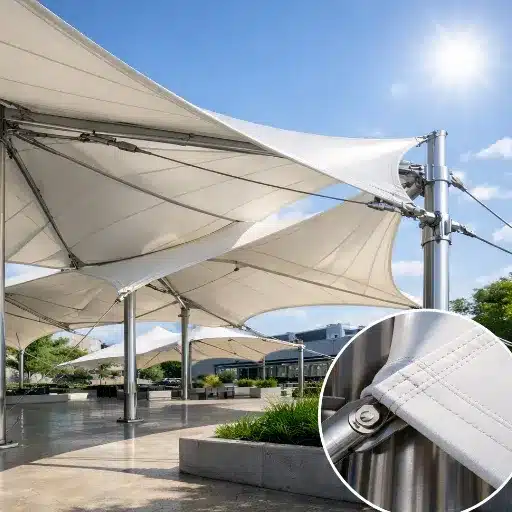
Compliance is not optional. Missing certifications create procurement delays, insurance complications, and liability exposure. Every tensile structure material must be specified with reference to recognized international standards.
International Fire Standards
NFPA 701 is the primary fire standard for textiles and films in the United States. It includes both small-scale and large-scale flame tests. Small-scale testing evaluates vertical flame spread. Large-scale testing evaluates flame propagation under more realistic exposure conditions. All four materials discussed in this guide can achieve NFPA 701 certification with appropriate formulation.
EN 13501-1 is the European reaction-to-fire classification system. It assigns classes from A1 (non-combustible) to F (no performance determined). PTFE-coated fiberglass typically achieves A2-s1,d0 or B-s1,d0. PVC-coated polyester achieves B-s2,d0 or C-s2,d0 depending on formulation. ETFE achieves B-s1,d0. Silicone-coated fiberglass achieves A2 or B classifications. Canadian projects require CAN/ULC-S109, which aligns closely with NFPA 701.
Mechanical Testing Standards
Tensile strength and elongation are measured under EN ISO 1421 or ASTM D751. These tests determine whether the fabric can withstand the specified structural loads with adequate safety factors. Tear resistance is measured under ASTM D4533 or DIN 53363. Trapezoid tear testing simulates the propagation of a small cut under load, which is critical for assessing damage tolerance.
Flex cracking resistance, tested under EN ISO 7854, evaluates how the coating performs under repeated folding. This matters for structures with moving components or frequent deployment cycles. Accelerated UV aging under ASTM G154 or ISO 4892 predicts long-term weathering performance by exposing samples to controlled UV and moisture cycles.
Why Standards Matter for Procurement
Certification requirements appear in bid documents, building codes, and insurance policies. A membrane without the specified certification cannot be approved for installation. Warranty validity depends on proof that the installed material meets the tested specification. Procurement managers should require test reports from the fabricator, not just claims from the manufacturer. LY TRUSTLINK provides comprehensive certification documentation with every order, including tensile strength test reports, fire rating certificates, and UV aging data.
Frequently Asked Questions
What is the best material for tensile structures?
There is no single best material. PTFE-coated fiberglass offers the longest lifespan and lowest maintenance. PVC-coated polyester offers the lowest initial cost and greatest flexibility. ETFE film provides unmatched transparency. The best material is the one that aligns with your project’s timeline, environment, budget, and maintenance capacity.
How long do tensile structure materials last?
PVC-coated polyester lasts 15-25 years with proper maintenance and lacquer renewal. PTFE-coated fiberglass lasts 30-50 years. ETFE film lasts 25-50 years in cushion systems. Silicone-coated fiberglass lasts 20-30 years. Actual lifespan depends on climate, maintenance, and installation quality.
Can tensile structures withstand snow and wind loads?
Yes. All four materials can be engineered to withstand specified snow and wind loads. The structural engineering, pretension levels, and curvature of the membrane surface matter more than the material choice itself. Proper form-finding and structural analysis ensure performance under extreme loads.
What is the difference between PVC and PTFE tensile membranes?
PVC-coated polyester uses a flexible plastic coating over a polyester base. It is lower cost, repairable, and available in many colors. PTFE-coated fiberglass uses a sintered fluoropolymer over glass fiber. It is higher cost, longer lasting, self-cleaning, and limited primarily to white. The choice depends on budget, lifespan requirements, and maintenance capacity.
Are tensile membrane materials fire-resistant?
Yes. PVC, PTFE, silicone-coated fiberglass, and ETFE all achieve fire safety certifications including NFPA 701 and EN 13501-1. PTFE and silicone have inherent fire resistance due to their inorganic base fabrics. PVC achieves fire resistance through additives in the polymer compound.
Conclusion
Material selection is the foundational decision that determines structural performance, visual character, maintenance burden, and total project cost over decades. Every tensile structure material has a specific domain where it outperforms alternatives. PVC-coated polyester dominates versatility and value. PTFE-coated fiberglass dominates longevity and low maintenance. ETFE film dominates transparency and lightweight construction. Silicone-coated fiberglass dominates extreme temperature and chemical resistance.
The most expensive specification error is not choosing the wrong material. It is choosing the right material for the wrong reasons. A 25-year PVC roof specified without maintenance planning will fail financially before it fails physically. A PTFE roof on a temporary pavilion wastes capital that could fund the next three projects.
By matching project timeline, environmental exposure, budget, aesthetic requirements, and maintenance capacity to the material properties in this guide, you eliminate that risk. You specify with the confidence that the membrane will perform as designed, and that the total cost of ownership aligns with the project’s financial model.
For custom PVC membrane specifications, engineering consultation on material selection, or certification documentation for your next tensile structure project, contact our engineering team. We support projects from concept to certified delivery with the technical transparency and partnership reliability that protects your operations.