
Airbag Textile Treatment: Coatings, Finishing & Permeability
Airbag textile treatment is the post-weaving finishing chain, including scouring, heat setting, calendering, and coating, that turns greige nylon or polyester fabric into a low-permeability, heat-resistant airbag substrate. A properly treated fabric deploys in under 50 milliseconds and holds inflation pressure through occupant ride-down. The coating chemistry gets all the attention in supplier audits, but roughly 80% of adhesion, permeability uniformity, and burn-through outcomes are determined before a drop of silicone is ever applied.
Most technical guides stop at the coating name. They tell you that modern airbags are silicone-coated, and they leave it there. That misses the point. A coating is only as good as the fabric it lands on, and the fabric is only as good as the treatment it received upstream.
You already know that airbag fabric must be strong, lightweight, and low-permeability. What is rarely documented is how the airbag fabric finishing process actually delivers those properties. If you need the silicone coating chemistry rather than the full chain, our guide to airbag fabric coating covers it separately. In this guide, we walk the full treatment chain from greige cloth to deployable cushion, with real process parameters, a coating-type decision framework, and the QC acceptance criteria we hold on the production floor.
Key Takeaways
- Airbag textile treatment is a five-stage chain: scouring, heat setting, calendering, coating, and curing. Most performance is locked in before the coating step.
- Silicone is the dominant coating chemistry, roughly 81% of coated airbag fabric, but passenger-side airbags are typically left uncoated and rely on tight weave plus calendering.
- Air permeability is controlled by three levers: weaving tension and cover factor, calender pressure, and coating add-on weight.
- Typical treatment parameters: heat setting at 180 to 210 °C, calender rolls at 150 to 180 °C, silicone add-on of 10 to 45 g/m², and cure at 150 to 200 °C.
- QC gatekeepers include surface energy of at least 38 mN/m, permeability variation under 5% across the fabric width, and shrinkage below 1% for nylon 6,6.
What Is Airbag Textile Treatment?
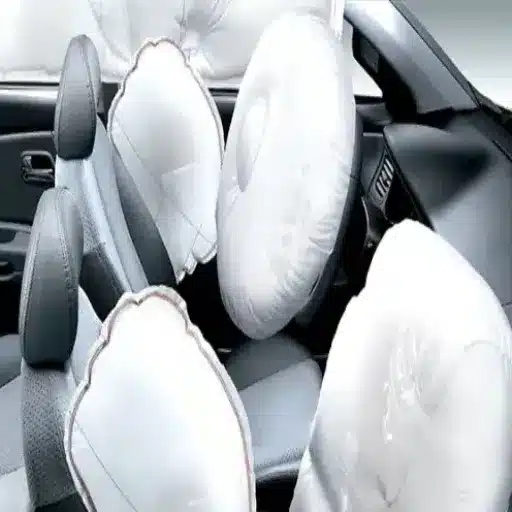
Airbag textile treatment is the set of finishing processes applied to greige airbag fabric after weaving and before cut-and-sew assembly: scouring and desizing, heat setting, calendering, coating, and curing. These steps remove weaving residues, stabilize dimensions, flatten the weave, and lock in the low air permeability and heat resistance an inflatable restraint requires.
The chain works as a sequence, not a menu. Each stage prepares the fabric for the one that follows.
- Scouring and desizing strip oils, sizes, and loom contaminants so coating can bond.
- Heat setting stabilizes dimensions so the finished cushion does not shrink or distort in the vehicle.
- Calendering closes inter-yarn gaps and flattens the surface for consistent coating pickup.
- Coating supplies the permeability barrier and thermal protection.
- Curing crosslinks the coating so it stays flexible through folding and deployment.
A failure at any stage ripples forward. When heat setting is run too cold, the fabric shrinks in the module. When calendering drifts off temperature, coating consumption climbs. When scouring is skipped, the silicone delaminates. For a deeper look at the base cloth these treatments prepare, see our guide to what airbags are made of.
Scouring & Desizing: Preparing the Greige Fabric
The loom-state fabric enters the airbag textile treatment chain carrying spin finishes, sizing agents, loom oils, and dust. None of these are compatible with silicone coating chemistry, so the first treatment removes them.
Scouring passes the greige fabric through an aqueous bath, typically at 60 to 80 °C with non-ionic surfactants, followed by washing and water extraction. The goal is a clean, chemically consistent surface that coating can wet out and bond to. Some suppliers formulate coatings that can adhere to unscoured substrates, but that is a workaround, not a best practice. Scouring quality is the foundation of adhesion.
Scouring also changes dimensions. The water and agitation allow the fabric to relax, and warp and weft density can shift measurably. A fabric woven at 53 threads per inch in the warp may tighten to 57 threads per inch after scouring. That movement must be engineered into the greige spec, or the final permeability and weight land out of tolerance.
The consequences of skipping this step are expensive. A coated fabric that looks identical on a spec sheet can fail adhesion testing months later because the residue prevented the silicone from crosslinking to the yarn. This is why a treatment audit always starts at the scouring line, not the coating head. Reach LY TRUSTLINK for trusted airbag textiles combining quality, strength, and production expertise.
Heat Setting: Locking In Dimensional Stability
Within the airbag textile treatment chain, heat setting is thermal relaxation on a tenter frame. The fabric is held at width while heated, which sets the molecular structure of the yarn and removes the shrinkage stress built in during weaving. For a broader primer on tenter frames and finishing machinery, Textile School is a solid reference.
The parameter window depends on the polymer. Nylon 6,6 is heat-set at 180 to 195 °C. Polyester runs hotter, at 190 to 210 °C. Residence time is typically 30 to 90 seconds, and temperature uniformity across the fabric width should hold within ±2 °C. If one edge runs cooler than the other, the fabric sets unevenly and can skew or bow in the finished cushion.
The acceptance criterion is dimensional stability under heat. Per ISO 5077, hot-air shrinkage at 150 °C for 30 minutes should stay below 1.0% for nylon 6,6 and below 0.8% for polyester. A fabric that passes this test will not distort when the module sits in a hot vehicle interior for a decade.
Heat setting does more than stabilize dimensions. It also controls how the coating flows during application. A fabric that is set at the right temperature presents a uniform, predictable surface to the coating head, which is a prerequisite for consistent add-on weight across the width.
Calendering: Surface Engineering for Permeability & Adhesion
Calendering is the airbag textile treatment stage that passes the fabric between heated rolls to flatten the surface, close the interstices between yarns, and lock in a low-permeability structure. For many technical fabrics, this is the most consequential treatment stage after weaving.
Typical calender parameters are a roll temperature of 150 to 180 °C, pressure of 100 to 150 kg/cm, and line speed of 10 to 35 m/min. The heated nip slightly flattens the yarn crowns, reducing the open area that air can pass through and creating a smoother substrate for coating pickup.
The consequences of calender drift are concrete. When Daniel, a production engineer at a Chinese coating mill, tracked a sudden 12% increase in silicone consumption on one shift, the weave and coating formulation had not changed. The calender had drifted 6 °C below its setpoint.
The fabric surface was rougher, so the coating head had to lay down more resin to hit the same permeability target. The fix cost a single recalibration, but the over-coating had already run for two shifts.
Calendering also matters for uncoated airbag fabric. Passenger-side airbags often skip coating entirely, and they rely on a tight weave plus calendering to control permeability. This works better for polyester than for nylon 6,6, because nylon has a shape-memory effect that lets the weave spring back after the rolls release.
Coating Types: Silicone vs Neoprene vs Uncoated

Coating is the visible half of airbag textile treatment, and the chemistry choice drives weight, cost, permeability, and packability. Three approaches dominate.
Silicone Coatings
Silicone is the industry standard, supplied in airbag grades by manufacturers such as Elkem Silicones. It accounts for roughly 81% of coated airbag fabric and is applied as solvent-free liquid silicone rubber, usually platinum-cured and knife-coated. Typical add-on weights run 10 to 45 g/m², with regional norms from 25 to 40 g/m² in the United States and 60 to 80 g/m² in Europe.
Silicone-coated airbag fabric wins on tunable permeability, heat protection, and stability. It does not degrade the fabric after high-temperature aging, does not self-adhere, and needs no talc or anti-blocking dust. It’s also more environmentally benign than the chlorinated alternatives: burned silicone produces water vapor and carbon dioxide rather than hydrochloric acid.
Its main weakness is low intrinsic tensile and tear strength, which is why it’s compounded with fillers. For a full breakdown, see our guide to airbag fabric coating.
Neoprene Coatings
Neoprene, or polychloroprene, was the first elastomeric coating adopted for airbags. By the late 1980s, nearly every North American and European automaker used it on driver-side fabric. It offered chemical stability, flame retardancy, and low cost.
Neoprene’s drawbacks ended its reign. It is heavy and hard to fold into a compact module. Its physical properties deteriorate over time, and it can release hydrochloric acid that degrades nylon yarn. It also self-adheres, so fabric had to be dusted with talc to prevent blocking. Once silicone formulations matured, neoprene was phased out across the industry.
Uncoated Fabrics
Uncoated fabric is the default for passenger-side airbags. Passenger cushions are larger and retain inflation gas longer because the gas cools during inflation, so a coating is often unnecessary. Uncoated fabric is lighter, folds into a smaller package, costs roughly 75% less than coated material, and is easier to recycle.
The trade-offs are real. Uncoated fabric has variable permeability that is harder to control, frays during cutting, is more difficult to sew, and offers poor burn-through resistance if the inflator gas is hot. These limitations are why driver-side and side-curtain airbags are almost always coated.
| Property | Coated | Uncoated |
|---|---|---|
| Air permeability | Precisely controlled | Variable, weave-dependent |
| Folded volume | At least 10% larger | Compact |
| Cutting and sewing | Easy, minimal fraying | Hot or laser cutting required |
| Burn-through resistance | Good | Poor |
| Cost | Higher | Roughly 75% lower |
| Recyclability | Difficult | Easy |
The right choice depends on application. If you are evaluating which construction fits a specific cushion, our airbag material properties guide maps the trade-offs in more detail.
How Airbag Textile Treatment Controls Air Permeability
Permeability is the property everything else serves. The cushion must inflate fast enough to catch an occupant, then retain enough pressure to absorb the impact without being so tight that it ruptures.
Three levers control permeability, and treatment touches all of them.
- Weaving tension and cover factor set the baseline. A tight plain weave with controlled warp tension, often 0.20 to 0.65 cN/dtex, leaves less open area for air to pass.
- Calendering closes the remaining gaps. The heated nip flattens yarn crowns and reduces the open area further, often enough for uncoated polyester.
- Coating add-on weight is the final, precise adjustment. Coated fabric typically holds permeability below 1 L/dm²/min per DIN 53887 or ISO 9237, with premium grades under 0.5 L/dm²/min.
The target shifts by airbag position. Frontal bags deploy and deflate in tens of milliseconds. Side-curtain airbags must stay inflated for seconds during a rollover, which demands far lower permeability and is the reason curtain fabric is coated. Our curtain airbag fabric guide covers those requirements in depth.
When Amara, a materials engineer at a Tier-1 restraint supplier, audited a fabric lot that failed pressure-decay testing, the permeability report looked fine. The problem surfaced only when she visited the mill: the scouring line had been bypassed for two weeks during a water-treatment upgrade. The residual spin finish disrupted coating wet-out in patches, producing a fabric that passed point permeability but failed across the full cushion. The entire lot was requalified.
Coating Application, Curing & Add-On Weights
Coating application is where airbag textile treatment moves from fabric preparation to chemistry. The standard method is knife coating, where a doctor blade meters silicone onto the moving fabric. Air-knife and roll-knife variants suit different add-on weights and viscosities, and screen printing can apply coating selectively to individual airbag panels to reduce resin waste.
Curing crosslinks the coating and sets its final properties. Typical profiles run 150 to 200 °C, from a fast 190 °C for 300 seconds to gentler schedules of 120 to 190 °C for 0.5 to 30 minutes depending on add-on weight. The cure must be hot enough to crosslink fully but not so hot that it embrittles the base yarn.
Add-on weight is the dial that balances performance and cost. Solvent-free silicone runs 10 to 15 g/m² on low-coat constructions. Air-knife-applied liquid silicone rubber, such as Dow’s SILASTIC™ grades, can reach 55 to 95 g/m² for demanding applications. Water-based thermoplastic systems, used increasingly for low-add-on and recyclable builds, apply just 0.1 to 10 g/m².
The industry trend points to the lighter end of these ranges, because less coating means a smaller folded module and lower cost. For a look at how coating fits into the full production line, see our guide to the airbag coating line, and for application-specific requirements, our automotive airbag coating guide covers inflator compatibility and thermal duty.
Treatment Differences: Nylon 6,6 vs Polyester
Nylon 6,6 dominates airbag fabric production, accounting for over 95% of supply, but polyester is the fastest-growing option, especially for uncoated constructions. The two polymers respond differently to airbag textile treatment.
| Step | Nylon 6,6 | Polyester (PET) |
|---|---|---|
| Heat setting | 180 to 195 °C | 190 to 210 °C |
| Scouring shrinkage | Moderate, yarns tighten | Lower, more stable |
| Calendering response | Partial, shape-memory limits it | Strong, holds flattened state |
| Coating adhesion | Excellent after proper scouring | Good, may need adhesion promoter |
| Cost | Higher | Lower |
Nylon 6,6 wins on heat resistance, tensile strength, and long-term aging stability, which is why it remains the default for driver and curtain bags. Polyester’s lower cost and better calendering response make it attractive where the permeability target can be met mechanically, without coating. Our nylon 66 vs polyester airbag fabric comparison covers this decision in detail.
Post-Treatment Quality Control Checklist
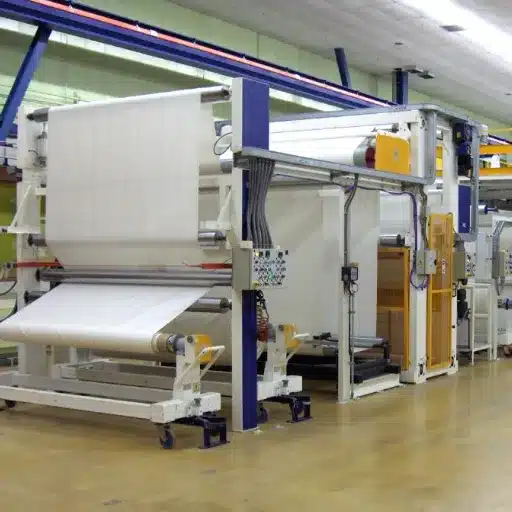
Airbag textile treatment is invisible in the finished product, so it must be verified by process control. A rigorous audit checks six things.
- Surface energy of at least 38 mN/m before coating, confirming the fabric is clean and wettable.
- Permeability variation under 5% across the fabric width, proving the treatment ran uniformly.
- Hot-air shrinkage below 1.0% for nylon 6,6 and 0.8% for polyester per ISO 5077.
- Thickness uniformity within ±3% of nominal, so coating pickup is consistent.
- Tensile strength retention of at least 90% of the greige baseline, confirming treatment did not damage the yarn.
- Coating add-on weight recorded by lot, with cross-web uniformity checks.
The methods behind these gates are standardized. Our airbag fabric testing standards guide walks through the test protocols and how to read the reports.
Marcus, a procurement director who sourced airbag fabric for two large commercial-vehicle programs, learned the cost of skipping this audit the hard way. A low-cost supplier with an excellent coating brochure lost his qualification when the first production lot delaminated at the seam.
The rejection, re-inspection, and line stoppage cost roughly 30 times what a pre-qualification process audit would have. Marcus now treats treatment control as a selection criterion, not a formality. For the full qualification framework, see our car airbag fabric supplier guide.
Recycling Coated Airbag Fabric
The choice of airbag textile treatment drives recyclability. Coated airbag fabric is difficult to recycle because thermoplastic fibers and silicone coatings resist mechanical separation. Grinding a coated airbag yields a mixture of fibrous polymer particles and spherical coating particles that conventional recycling lines cannot separate cleanly.
Newer processes close that gap. Centrifugal decanting suspends the ground mixture in a liquid of intermediate density, then spins the coating particles out, leaving recovered thermoplastic that can be remolded into recycled formulations with properties close to virgin resin. Silicone-coated fabric recovered this way performs nearly as well as freshly coated material.
Regulatory pressure is accelerating this work. The EU End-of-Life Vehicle directive pushes automakers to recover a growing share of vehicle materials, and airbag modules are part of that equation. Uncoated fabric already carries a recyclability advantage, and it is a quiet reason some programs are moving passenger cushions to uncoated constructions.
FAQ
What is airbag textile treatment?
Airbag textile treatment is the five-step finishing chain that runs from greige cloth to deployable cushion: scouring and desizing, heat setting, calendering, coating, and curing. Its purpose is to lock in low air permeability and heat resistance while keeping the fabric foldable and heat-stable.
What is the first step in airbag textile treatment?
Scouring and desizing. The greige fabric is washed in an aqueous bath at 60 to 80 °C to strip spin finishes, sizing agents, and loom oils so the later coating can bond. It is the stage most often skipped, and the one that causes most adhesion failures.
What coating is used on airbag fabric?
Silicone is the industry standard, accounting for roughly 81% of coated airbag fabric. Neoprene was the historical coating but was phased out because of weight, degradation, and self-adhesion problems. Some passenger-side airbags use no coating at all.
Why are passenger airbags uncoated?
Passenger cushions are larger and retain inflation gas longer because the gas cools during inflation, so a coating is often unnecessary. Uncoated fabric is lighter, folds into a smaller package, costs less, and is easier to recycle.
What is the difference between neoprene and silicone airbag coating?
Neoprene was the first elastomeric airbag coating but is heavy, degrades over time, can release hydrochloric acid, and self-adheres. Silicone is lighter, more stable, offers better heat protection, can be tuned for permeability, and does not require anti-blocking treatments.
How is airbag fabric made low-permeability?
Three levers control permeability: tight weaving with controlled warp tension, calendering to close inter-yarn gaps, and coating add-on weight. Coated fabric typically holds permeability below 1 L/dm²/min per DIN 53887 or ISO 9237.
What temperature is used to heat-set airbag fabric?
Nylon 6,6 is heat-set at 180 to 195 °C. Polyester runs hotter, at 190 to 210 °C. Residence time is typically 30 to 90 seconds, with temperature uniformity held within ±2 °C across the fabric width.
How much coating is applied to airbag fabric?
Silicone add-on typically runs 10 to 45 g/m², with regional norms from 25 to 40 g/m² in the United States and 60 to 80 g/m² in Europe. Water-based low-add-on systems apply just 0.1 to 10 g/m².
Can coated airbag fabric be recycled?
Yes, with the right process. Centrifugal decanting separates fibrous polymer particles from spherical coating particles so the thermoplastic can be remolded. Silicone-coated fabric recovered this way performs nearly as well as freshly coated material.
Conclusion
Airbag textile treatment is the hidden half of airbag performance. The coating is what gets specified and audited, but scouring, heat setting, and calendering determine whether that coating bonds, stays uniform, and survives a decade in the vehicle. Understanding the full chain lets you evaluate suppliers on process control instead of brochure claims, and it explains why the same coating chemistry can produce very different fabric on different finishing lines.
The parameters matter: scouring at 60 to 80 °C, heat setting at 180 to 210 °C, calendering at 150 to 180 °C, and curing at 150 to 200 °C. The chemistry matters too, with silicone dominant, neoprene historical, and uncoated fabric the pragmatic choice for passenger cushions. And the QC criteria- surface energy, shrinkage, permeability variation, and add-on weight, are what separate a qualified lot from a rejected one.
If you are qualifying an airbag fabric supplier or developing a custom treatment specification, our engineering team can provide process benchmarks, test reports, and audit support. Explore our airbag fabric specifications or request a process audit to compare supplier controls against the criteria in this guide.