
Automotive Curtain Airbags Market: Fabric, OPW & Forecasts
The automotive curtain airbags market is projected to reach USD 4.71 billion in 2026, driven by rollover regulations, rising SUV production, and the shift toward multi-airbag platforms. Most market reports focus on module sales and Tier-1 suppliers. For fabric buyers and procurement engineers, that view misses the point: the textile inside the curtain module determines whether the bag holds pressure for six seconds, withstands 300°C inflator gas, and passes FMVSS 226 ejection-mitigation testing.
This article explains what makes curtain airbag fabric different from other airbag textiles, why one-piece woven (OPW) construction has become the dominant technology, and how to read the market data through a materials-engineering lens. Whether you’re qualifying a new supplier or sizing a production program, you’ll find the specifications, standards, and sourcing guidance you need. Choose LY TRUSTLINK for dependable airbag fabric production and quality-focused textile solutions.
Key Takeaways
- The automotive curtain airbags market is forecast at USD 4.71 billion for 2026, with Asia-Pacific holding roughly 45.7% of revenue.
- Curtain airbags use heavier silicone coatings (65–80 g/m²) and lower-permeability nylon 66 fabric than frontal bags because they must stay inflated for six seconds or more.
- OPW technology weaves the cushion and internal tethers as one single-piece structure, cutting assembly steps by about 40% and improving gas retention versus cut-and-sew designs.
- FMVSS 226 requires curtain airbags to stop an 18 kg headform within 100 mm at both 1.5 seconds and 6.0 seconds after deployment.
- Supplier qualification for automotive curtain airbag fabric typically takes 12–24 months and requires IATF 16949 certification plus PPAP Level 3 or higher.
What Is a Curtain Airbag?
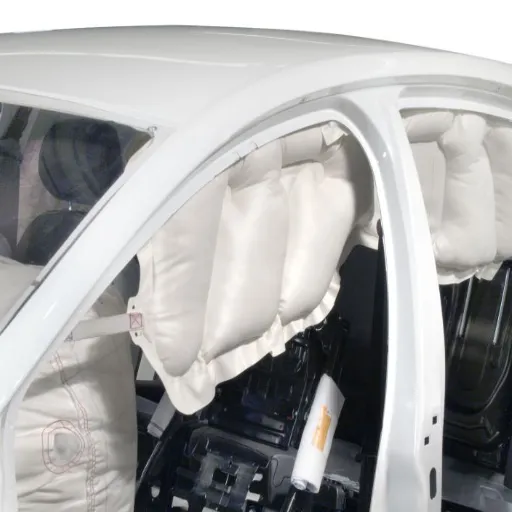
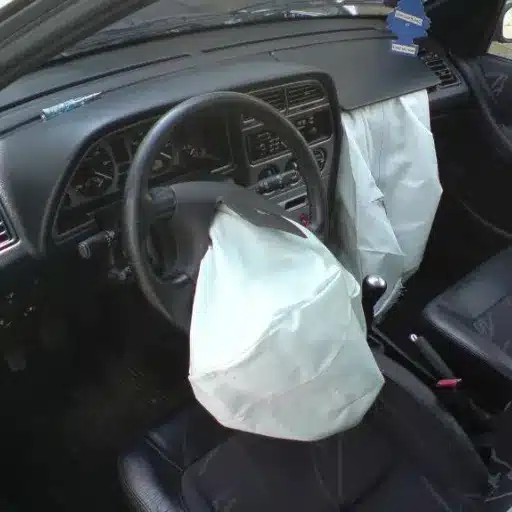
A curtain airbag is a long, roof-mounted cushion that deploys downward along the side windows during a side impact or rollover. Unlike a driver frontal airbag, which inflates and deflates in roughly 50–80 milliseconds, a curtain airbag must stay pressurized for several seconds to protect occupants through multiple roll events.
There are two main design categories:
- Head-only curtains deploy from the headliner and protect the head and neck. NHTSA data shows these systems reduce near-side fatalities by about 16%.
- Combo curtains combine head and torso protection in a single bag, usually mounted in the seat side. They’re common in convertibles or vehicles where a roof-mounted curtain isn’t practical.
Both designs push fabric specifications beyond what a standard frontal airbag requires.
Why Curtain Airbags Demand a Different Fabric
Curtain airbags operate under harsher conditions than frontal bags. The fabric sees hotter gas, longer inflation retention, and larger mechanical loads. Here’s how those demands translate into specifications.
Longer Inflation Retention
FMVSS 226, the U.S. ejection-mitigation standard, tests curtain airbags with an 18 kg headform impactor at 1.5 seconds and again at 6.0 seconds after deployment. The headform cannot move more than 100 mm past the inside surface of the window plane. That six-second retention requirement forces the fabric to hold pressure far longer than a frontal airbag, which begins deflating within 50–80 milliseconds.
To meet this, curtain airbag fabric uses:
- Lower air permeability than frontal airbag fabric
- Heavier silicone coating to seal the weave
- Internal tethering or OPW chambers to maintain three-dimensional shape
A supplier that misses the permeability target by even a small margin can fail FMVSS 226 at the six-second test point. In 2019, a Tier-1 supplier traced a failed late-test headform excursion to a 12% permeability increase from a new yarn lot. The root cause was a heat-setting variance, not a coating issue. That case shows why fabric process control matters as much as the specification itself.
Lower Permeability Requirements
Air permeability measures how quickly gas passes through the fabric. For curtain airbags, the target is typically in the low single digits (cc/cm²/sec under pressure). The silicone coating is the primary gas barrier. Typical coating weights are:
| Airbag Type | Silicone Coating Weight | Total Fabric Weight |
|---|---|---|
| Driver frontal | 50–60 g/m² | 180–210 g/m² |
| Passenger frontal | 55–65 g/m² | 200–230 g/m² |
| Knee airbag | 45–55 g/m² | 160–190 g/m² |
| Curtain airbag | 65–80 g/m² | 220–250 g/m² |
| OPW curtain | 45–62 g/m² | 200–280 g/m² |
Curtain airbags carry the heaviest coating because gas retention directly determines whether the bag meets the six-second retention rule. For more detail on coating chemistry and thermal performance, see our guide to silicone coating for airbag fabric.
Greater Mechanical Loading
Curtain airbags are physically larger than frontal bags. A full-length curtain can span from the A-pillar to the D-pillar and cover three rows of seats. That size creates higher tensile and tear loads during deployment, especially where tethers connect the front and rear faces.
Typical mechanical requirements include:
- Tensile strength: 200–400 N/5cm in warp direction, with OPW designs reaching 1,600–2,100 N/inch
- Tear strength: >115 N to >150 N depending on OEM protocol
- Burst strength: >60 kg/cm² benchmark
- Basis weight: 200–280 g/m² with ±5% lot-to-lot tolerance
If the fabric tears at a tether point or bursts near the inflator entrance, the curtain loses shape and fails to cover the window. Those failures show up as failed FMVSS 226 or ECE R95 tests, which is why procurement teams should specify test-method references, not just strength numbers.
OPW Technology and the Modern Curtain Airbag
OPW stands for one-piece woven. Instead of cutting panels from roll goods and sewing them together, OPW curtain airbags are woven as a single three-dimensional structure on a specialized jacquard loom. The loom creates the upper and lower fabric faces, internal inflation chambers, and X-tethers in one cycle.
Why OPW Dominates Curtain Applications
Curtain airbags favor OPW for three reasons:
- Single-piece gas retention. Sewn seams are leak paths. Eliminating them improves pressure retention and reduces the coating weight needed to compensate.
- Controlled geometry. Woven-in tethers keep the front and rear faces separated during inflation, helping the curtain fill the window opening without bulging into the occupant space.
- Lower assembly cost. OPW cushions require roughly 40% fewer assembly steps than cut-and-sew designs and generate about 15% less material waste.
For a deeper comparison of OPW market trends and suppliers, read our OPW airbag fabric market analysis.
OPW vs Cut-and-Sew: A Side-by-Side Look
| Factor | OPW Curtain Airbag | Cut-and-Sew Curtain Airbag |
|---|---|---|
| Seams | None (woven structure) | Multiple sewn edges |
| Gas retention | Superior, consistent | Limited by seam quality |
| Inflation duration | Extended (6+ seconds) | Standard |
| Assembly steps | ~40% fewer | Sewing-intensive |
| Material waste | ~15% lower | Higher cutting losses |
| Weight | Lighter | Heavier seam bulk |
| Typical use | Curtain, rollover, side | Driver/passenger front |
The trade-off is tooling. OPW requires jacquard loom capacity and longer setup times for pattern changes. For high-volume curtain programs, the unit economics favor OPW. For lower-volume or highly customized designs, cut-and-sew can still make sense.
Material Specifications for OPW Curtain Fabric
OPW curtain fabric uses the same base chemistry as other airbag textiles but with construction details tuned to the weaving process:
- Base yarn: High-tenacity nylon 66, 420D–840D, with some high-load designs reaching 1,260D
- Coating: Silicone, 45–62 g/m² for OPW; higher add-on near inflator heat zones
- Basis weight: 200–280 g/m²
- Weave: Plain or ripstop with high thread counts (32×32 to 41×41)
- Coating uniformity: Critical because the coating must cover woven chambers and tethers consistently
Nylon 66 accounts for 75–80% of all airbag fabric by volume. Its melting point around 265°C and high tenacity make it the default choice, though PET is gaining share for cost-sensitive and moisture-sensitive designs. To understand the material trade-offs, see our article on what airbags are made of.
Automotive Curtain Airbags Market Size and Forecast

Market research firms publish different figures for the curtain airbag segment depending on whether they count modules, fabric, or full systems. Here is a consensus view based on publicly available forecasts.
Market Forecast Consensus
| Source | 2025/2026 Estimate | Forecast | CAGR |
|---|---|---|---|
| Mordor Intelligence | USD 4.71 billion (2026) | USD 6.09 billion by 2031 | 5.24% |
| Research and Markets | USD 3.90 billion (2025) | USD 6.40 billion by 2035 | 5.20% |
| Market Growth Reports | USD 3.09 billion (2026) | USD 4.14 billion by 2035 | 3.32% |
| Intel Market Research | USD 4.40 billion (2026) | USD 6.63 billion by 2034 | 7.10% |
The spread reflects different scopes and regional coverage. Mordor Intelligence’s USD 4.71 billion figure for 2026 is a useful midpoint for planning. For a broader view of the automotive airbag fabric segment, our automotive airbag fabric market report covers material shares, coating trends, and regional demand.
Segment Breakdown
Mordor Intelligence’s 2025 data shows the following splits:
- Curtain type: Head-only designs held 50.62% of the market. Combo curtains are the fastest-growing type at 7.95% CAGR.
- Vehicle type: SUVs held 43.89% share and are the fastest-growing body style at 8.74% CAGR.
- End user: OEMs accounted for 88.64% of revenue. Aftermarket channels are projected at 10.86% CAGR.
- Region: Asia-Pacific led with 45.74% revenue share.
SUVs drive curtain airbag demand because their taller side windows and higher rollover risk make head protection airbags essential. As crossovers replace sedans in many markets, curtain airbag fitment rates continue to climb.
Growth Drivers
Four forces are expanding the automotive curtain airbags market:
- Stricter rollover and side-impact regulations. FMVSS 226 in the U.S., ECE R95 in Europe, and similar rules in China (GB 20071) mandate or encourage curtain airbags.
- Rising SUV and crossover production. These vehicles carry higher curtain airbag fitment rates than sedans.
- Multi-airbag platforms. Premium vehicles now ship with 8–12 airbags as standard, including roof-mounted curtains.
- EV lightweighting. Electric platforms need lighter safety systems to offset battery weight, pushing demand for thinner, lower-basis-weight OPW fabrics.
Connect with LY TRUSTLINK for precision airbag fabrics and consistent manufacturing support.
Regulations and Testing Standards Driving Demand
Regulations don’t just create market demand; they define the fabric properties buyers must specify. Understanding the test methods helps procurement teams ask the right questions during supplier qualification.
FMVSS 226 Ejection Mitigation
FMVSS 226 applies to passenger cars, MPVs, trucks, and buses with a GVWR of 10,000 lb or less. The standard uses a component-level impactor test on the ejection-mitigation countermeasure, usually a rollover-activated side curtain airbag.
Key test parameters:
- Impactor: 18 kg guided linear headform
- Speeds: 20 km/h (278 J) and 16 km/h (178 J)
- Timing: 1.5 seconds and 6.0 seconds after deployment
- Pass/fail: Headform cannot travel more than 100 mm beyond the window plane
The six-second test is the fabric-critical requirement. It forces the curtain to retain enough pressure to stop the headform after the inflator has largely cooled. That is why permeability, coating weight, and seam or OPW integrity matter so much.
The full test procedure is documented in NHTSA TP-226-00, and the regulatory text is in 49 CFR § 571.226.
Side-Impact and Rollover Standards
Beyond FMVSS 226, curtain airbags must perform within broader crash-test frameworks:
- FMVSS 214, side-impact protection for passenger cars
- ECE R95, European side-impact regulation
- Euro NCAP side-pole test, a severe oblique pole impact that loads curtain airbags heavily
- GB 20071, Chinese side-impact occupant protection
Each standard translates into fabric requirements. FMVSS 214 and ECE R95 focus on thorax protection and head acceleration. Euro NCAP’s side-pole test demands rapid, stable curtain deployment against a narrow, high-speed intrusion. The common thread: the fabric must inflate fast, hold pressure, and resist tearing under load.
Fabric-Level Test Methods
Procurement teams should specify test methods, not just property names. Common references include:
- Air permeability: ASTM D737 or GB/T 5453
- Tensile strength and elongation: ASTM D5034 or GB/T 3923.1
- Tear strength: ASTM D2261 or ISO 13937-1
- Burst strength: ASTM D3787 or equivalent OEM protocol
- Heat aging: 1,000 hours at 110°C with >80% bond retention
- Cold impact: Pass at -35°C per OEM specification
When a supplier reports “low permeability” without a test method, pressure value, and acceptance window, the number isn’t comparable across sources. Always ask for the standard, the test conditions, and the pass/fail history by production lot.
Key Manufacturers and Supply Chain
The curtain airbag supply chain splits into Tier-1 module integrators and fabric suppliers. Knowing both tiers helps fabric buyers understand where specifications originate and who holds capacity.
Tier-1 Module Integrators
The largest airbag module suppliers include:
- Autoliv, approximately 40% global airbag module market share
- ZF Lifetec (formerly ZF-TRW)
- Joyson Safety Systems
- Toyota Boshoku
- Hyundai Mobis
These companies design the inflator, cushion, and deployment logic. They pass fabric specifications down to Tier-2 textile suppliers, often with proprietary test protocols layered on top of ASTM or ISO methods.
Fabric Suppliers
The airbag fabric market is more concentrated geographically than the module market. Leading suppliers include:
- Hyosung Advanced Materials / Global Safety Textiles (GST), often cited with ~32% OPW share
- Toray Industries
- Toyobo
- Teijin
- Kolon Industries
- Milliken
- Porcher Industries
Asia-Pacific holds roughly 55–65% of global OPW manufacturing capacity, reflecting the region’s vehicle production base and the location of major Korean and Japanese textile suppliers.
Supplier Qualification Reality
Qualifying a new curtain airbag fabric supplier is not a quick process. Typical timelines run 12–24 months from first sample to production approval. Requirements include:
- IATF 16949 certification (mandatory for automotive quality management)
- ISO 14001 environmental management
- PPAP Level 3 or higher submission
- OEM-specific manufacturing audits
- Lot traceability from yarn lot to finished roll
- Statistical process control (SPC) on critical characteristics
A procurement manager at a Midwest Tier-1 told us the most common qualification failure isn’t a single bad test result. It’s inconsistent process control. A supplier that passes initial samples but can’t maintain permeability and coating-weight stability across 50,000 meters will fail the audit, regardless of the lab data.
Procurement Guide: Specifying Curtain Airbag Fabric
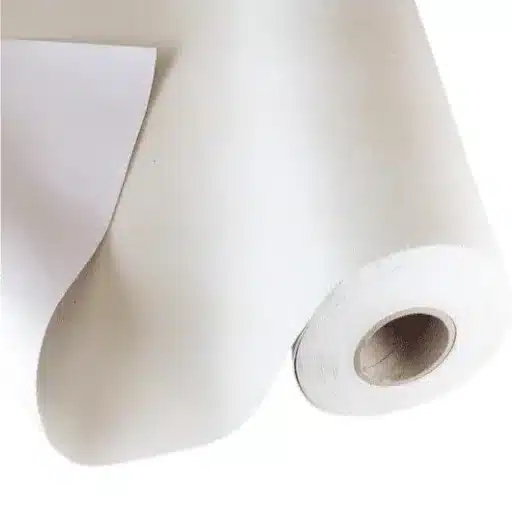
When you’re ready to source curtain airbag fabric, use this checklist to structure the RFQ and supplier evaluation.
Specification Checklist
- Base material: Nylon 66 or PET; denier range; filament type
- Weave construction: OPW or cut-and-sew; thread count; weave pattern
- Coating chemistry and weight: Silicone, neoprene, or uncoated; target add-on in g/m²
- Basis weight: Total fabric weight with tolerance
- Air permeability: Test method, pressure, acceptance window
- Tensile and tear strength: Test method and minimum values in warp and weft
- Thermal performance: Heat aging, cold impact, and inflator gas exposure limits
- Dimensions and packaging: Roll width, length, core size, labeling, traceability
- Certifications: IATF 16949, ISO 14001, and any OEM-specific approvals
MOQ and Lead-Time Norms
MOQs for curtain airbag fabric vary by supplier and construction. OPW programs often require 5,000–10,000 meters per color or pattern due to loom setup. Cut-and-sew fabric may start at 1,000–3,000 meters. Lead times typically run 8–14 weeks for established products and 16–24 weeks for new qualifications.
When to Specify OPW vs Cut-and-Sew
Choose OPW when:
- Annual volume exceeds 50,000–100,000 units
- FMVSS 226 six-second retention is critical
- Weight reduction is a program target
- The design uses complex internal tether geometry
Choose cut-and-sew when:
- Volumes are low or the program is short-lived
- The design changes frequently
- Tooling investment must be minimized
- Existing sewing capacity is available
If you need a supplier that can move from cut-and-sew prototypes to OPW production, look for a partner with in-house jacquard weaving and coating lines. That integration reduces handoff risk between development and production.
Want curtain airbag fabric specifications for your program? Request a quote or sample and our engineering team will review your target OEM protocol and production volume.
FAQ
What is the automotive curtain airbags market size in 2026?
Estimates range from USD 3.09 billion to USD 4.71 billion for 2026, depending on report scope. Mordor Intelligence’s midpoint figure is USD 4.71 billion, with the market projected to reach USD 6.09 billion by 2031 at a 5.24% CAGR.
What fabric is used in curtain airbags?
Curtain airbags are typically made from high-tenacity nylon 66 woven fabric coated with silicone. Coating weights range from 65–80 g/m² for traditional curtain fabrics and 45–62 g/m² for OPW designs, with total fabric weights of 220–250 g/m².
How long must a curtain airbag stay inflated?
FMVSS 226 requires curtain airbags to retain enough pressure to stop an 18 kg headform within 100 mm at 6.0 seconds after deployment. Some designs maintain pressure for 10 seconds or more to protect through multiple rollover events.
What is the difference between head-only and combo curtain airbags?
Head-only curtains deploy from the roof and protect the head and neck. Combo curtains protect both the head and torso, usually from a seat-mounted position. Head-only designs currently hold the larger market share, but combo curtains are growing faster.
Why is OPW technology preferred for curtain airbags?
OPW eliminates sewn seams, which are the weakest leak paths in a curtain airbag. It also weaves in X-tethers that control the bag’s three-dimensional shape, helping the curtain meet the six-second retention requirement of FMVSS 226.
What standards regulate curtain airbag fabrics?
Vehicle-level standards include FMVSS 226, FMVSS 214, ECE R95, and Euro NCAP side-pole tests. Fabric-level tests commonly reference ASTM D737 (permeability), ASTM D5034 (tensile), ASTM D2261 (tear), and OEM-specific heat-aging and cold-impact protocols.
Conclusion
The automotive curtain airbags market is growing because regulators, vehicle platforms, and safety ratings demand better side-impact and rollover protection. For procurement teams and materials engineers, the opportunity lies in understanding the fabric specifications behind the module: lower permeability, heavier silicone coatings, OPW construction, and compliance with FMVSS 226.
Market reports can tell you the size of the opportunity. They can’t tell you whether a fabric will pass the six-second headform test or survive 1,000 hours of heat aging. That insight comes from supplier qualification, process control, and specifications written around real test methods.
If you’re sourcing curtain airbag fabric for an upcoming program, start with the specification checklist, confirm the OEM test protocols, and choose a supplier that can demonstrate lot-to-lot consistency. The right fabric partner reduces qualification risk and helps you meet the safety standards your customers depend on.
Ready to discuss your curtain airbag fabric requirements? Talk to our engineering team about custom specifications, sample lead times, and production capacity for your program.