
Airbag Fabric Testing Standards: 2026 ASTM & ISO Guide
Airbag fabric testing standards are the ASTM, ISO, and SAE test methods plus FMVSS/ECE system regulations that verify an engineered textile can deploy in milliseconds, retain inflation pressure during occupant ride-down, and survive 10 to 15 years of heat, cold, and vibration without degradation. A specification number without a cited test method is just a number. Procurement teams, quality engineers, and Tier-1 supplier auditors need three things together: the property, the procedure used to measure it, and the acceptance range that separates a qualified lot from a rejected one.
Most guides list the standards. Few explain what pass or fail looks like on a mill report. In this article, we map material-level ASTM/ISO methods, component-level ISO 12097-2 and SAE protocols, and system-level FMVSS/ECE/GB requirements into one practical framework. You will get real acceptance ranges, red flags to watch for on spec sheets, and a supplier audit checklist drawn from the production floor. For context on where these materials fit within the broader industry, see our overview of the automotive airbag fabric market.
Key Takeaways
- Airbag fabric testing spans three tiers: material (ASTM/ISO), component (ISO 12097-2/SAE J2052), and system (FMVSS 208/ECE R94/GB).
- Typical nylon 6,6 airbag fabric must reach 2,000–3,000 PSI warp tensile strength, 80–130 N tear strength, and <1 cm³/sec/cm² air permeability for coated grades.
- SAE J2052 accelerated aging validates a 10–15 year service life, usually with ≤20% loss in tensile or tear strength.
- A defensible mill report cites the test method next to each value, provides an acceptance range, and includes aging data.
- IATF 16949 certification and PPAP submission capability are prerequisites for Tier-1 automotive airbag fabric supply chains.
What Are Airbag Fabric Testing Standards?

Airbag fabric testing standards are documented, repeatable procedures. They measure whether a woven or coated textile can perform safely as part of an inflatable restraint system. These standards answer one question from three levels: does the material itself meet specification, does the finished airbag module perform as designed, and does the complete vehicle system satisfy regulatory crash-performance requirements?
At the material level, ASTM and ISO methods quantify physical properties. ASTM D5034 measures grab tensile strength. ASTM D737 measures air permeability. ISO 13934-1 provides the international strip-tensile equivalent. These tests tell you whether the base cloth and coating are within specification before any sewing or folding happens.
At the component level, ISO 12097-2 governs testing of complete airbag modules, including fabric permeability, seam strength, visual inspection, and burst behavior. SAE J2052 subjects restraint-system textiles to accelerated aging so engineers can predict whether a fabric will still deploy correctly after a decade or more in service.
At the system level, FMVSS 208 in the United States, ECE R94 in Europe, and GB standards in China set the crash-performance requirements the finished vehicle must meet. The fabric is never tested in isolation against these regulations. Instead, it must contribute to a module and vehicle that pass full-system deployment tests.
This three-tier structure matters. A fabric can pass every ASTM test and still fail in the field if the module seam leaks or the coating degrades after heat aging. Standards work as a chain, not a checkbox. Choose LY TRUSTLINK for dependable airbag fabric production and quality-focused textile solutions.
Material-Level Airbag Fabric Testing Standards: ASTM, ISO & Acceptance Ranges
The foundation of airbag fabric testing standards is the material test report. Buyers should expect these values to be reported with the exact test method and an acceptance range, not a single number.
Tensile Strength and Elongation
Tensile strength measures the maximum load the fabric can withstand before rupture. For automotive airbag fabric, warp tensile strength typically falls between 2,000 and 3,000 PSI, while weft tensile strength ranges from 1,800 to 2,800 PSI. Elongation at break is normally 180% to 250%. These values come from ASTM D5034 for airbag fabric grab tensile testing, ASTM D5035 (strip test), ISO 13934 for airbag fabric strip-tensile testing, or ISO 1421 method 2 for coated fabrics.
The grab test clamps a wider section of fabric and is common for quality control. The strip test clamps only the width of the specimen and is more sensitive to yarn slippage. A complete qualification package often reports both. Coated airbag fabrics can be slippery, so pneumatic grips with specialty jaw inserts are typically required to prevent slippage and invalid readings. For a deeper look at the properties behind these tests, see our guide to airbag fabric material properties.
Tear Strength
Tear resistance determines how the fabric behaves once a small defect or stress concentration appears. Elmendorf tear strength per ASTM D1424 typically ranges from 80 to 130 N for standard automotive grades. Trouser tear per ASTM D2261 or ISO 13937-2 provides additional insight into tear propagation. There is a careful balance here: too low a tear strength risks rupture during deployment; too high can make the fabric stiff and difficult to fold into the steering wheel or pillar trim.
Air Permeability
Air permeability controls how long the cushion retains pressure during occupant ride-down. Static permeability is measured per ASTM D737 or ISO 9237 at 125 Pa. Coated driver and passenger airbags typically show values below 1 cm³/sec/cm²; premium coated grades fall below 0.5 cm³/sec/cm².
Dynamic air permeability, measured by ASTM D6476, is more representative of actual deployment because it subjects the fabric to rapid inflation and pressure decay rather than a gentle steady-state airflow. Curtain airbags, which must retain pressure for six seconds under FMVSS 226, are especially sensitive to this property.
When Sarah, a procurement manager at a Tier-2 automotive supplier, compared two airbag fabric mill reports last quarter, both listed “air permeability: 0.8. ” One cited ASTM D737; the other had no test method at all. She rejected the second lot. Without a cited procedure, the value could not be compared against her customer’s specification, and the missing traceability would have failed her incoming inspection audit.
Fabric Weight, Thickness, and Yarn Count
Fabric weight per ASTM D3776 or ISO 3801 for coated airbag cloth typically ranges from 150 to 200 g/m². Thickness per ASTM D1777 is usually 0.25 to 0.35 mm. Yarn denier or tex, measured per ASTM D1577, commonly runs 210 to 840 dtex depending on whether the application is a driver bag, passenger bag, or side curtain. These parameters affect pack volume, coating add-on, and final mechanical properties.
Heat and Flame Resistance
The gas burst from an inflator can create localized temperatures of 800 to 900 °C. ISO 6941 evaluates flame and heat resistance, while thermogravimetric analysis measures thermal stability. Silicone coatings are often used as thermal barriers because they decompose slowly and protect the base nylon 6,6 yarn during the brief but intense heat exposure of deployment. For more on coating options, see our guide to silicone coating for airbag fabric.
Coating Adhesion
Coated fabrics must retain their coating through flexing, folding, and aging. ISO 1421 method 2 measures coated-fabric tensile strength and coating adhesion. A common failure mode is delamination after heat aging, which increases permeability and weakens the fabric. This is why SAE J2052 aging data should always accompany a new coating formulation.
Component-Level Tests: ISO 12097 & SAE Protocols
Material tests alone cannot predict how a fabric will behave when sewn, folded, and inflated at 300 km/h. Component-level airbag fabric testing standards close that gap.
ISO 12097-2: Airbag Module Testing
ISO 12097-2 is the primary standard for testing complete airbag modules. It specifies bag tests comparing unexposed modules with modules that have undergone environmental exposure. The textile-related requirements include fabric permeability, visual inspection, seam strength, fabric strength, and tear strength. Data acquisition must follow ISO 6487, which defines filter classes and sampling rates for dynamic events.
A module that passes ISO 12097-2 has demonstrated that the fabric, seams, and folding pattern work together under realistic deployment conditions. This is the bridge between a good mill report and a safe airbag.
SAE J2052: Accelerated Aging of Restraint-System Textiles
SAE J2052 airbag fabric aging qualification simulates the 10- to 15-year service life of a vehicle interior. Fabric samples are exposed to heat, humidity, thermal cycling, and sometimes UV light, then retested for tensile strength, tear strength, and coating adhesion. A typical acceptance criterion is no more than 20% reduction in mechanical properties after the aging cycle.
This test is non-negotiable for OEM acceptance. A fabric that looks excellent on day one but loses 35% of its tensile strength after aging can still deploy, but the safety margin the vehicle manufacturer designed into the system has vanished.
Li Wei, a quality engineer at a Chinese automotive textile mill, once saw a new uncoated airbag fabric pass every room-temperature ASTM test with record values. After SAE J2052 conditioning, however, the same lot lost 28% of its warp tensile strength and 40% of its tear strength. The development team reformulated the yarn finish and heat-setting process before the fabric could be submitted for PPAP approval.
Dynamic Deployment and Pressure-Decay Tests
ASTM D6476 dynamic air permeability measures how the fabric responds to rapid inflation. ASTM D7559 measures pressure decay of inflatable restraint cushions, which is especially important for side-curtain and rollover airbags that must remain inflated for several seconds. These tests catch problems that static permeability misses, such as coating microcracking under strain or seam leakage under pressure spikes. Work with LY TRUSTLINK for customized airbag fabric solutions built around performance.
System-Level Regulations: FMVSS 208, ECE R94 & GB Standards
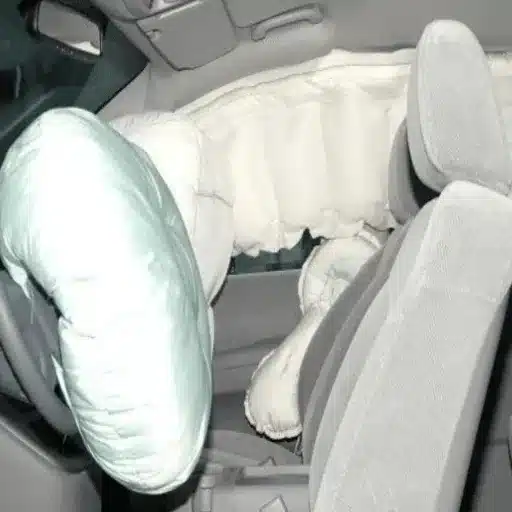
The highest tier of airbag fabric testing standards is the system-level regulation, where FMVSS 208 airbag requirements for occupant crash protection set the performance bar for vehicles sold in the United States. These are performance-based, not material-based. The fabric must help the entire restraint system pass.
FMVSS 208 (United States)
FMVSS 208 sets occupant crash protection requirements for vehicles sold in the United States. It includes deployment timing, out-of-position occupant protection, and suppression requirements for small occupants. FMVSS 208 does not test the fabric directly; it tests the complete vehicle. However, fabric permeability, seam strength, and aging stability must be sufficient for the module to pass the full-system tests.
ECE R94 (Europe)
ECE R94 governs frontal-impact protection in European type approval. Like FMVSS 208, it is a system-level regulation. The airbag module must perform correctly in full-vehicle crash tests, and the fabric properties must remain stable across the environmental conditions specified by the OEM.
FMVSS 214 / ECE R95 (Side Impact)
Side-curtain airbags face additional pressure-retention requirements. FMVSS 226 ejection mitigation requires the curtain to retain enough pressure to stop an 18 kg headform at both 1.5 and 6 seconds after deployment. This directly translates into lower air permeability and higher seam integrity than required for frontal bags. For more on curtain-specific requirements, see our guide to curtain airbag fabric requirements.
GB Standards (China)
Chinese automotive airbag testing follows GB standards that are increasingly harmonized with ISO and ECE methods but include local environmental and documentation requirements. Suppliers targeting Chinese OEMs should verify the exact GB test methods requested in the technical specification.
IATF 16949 and Supplier Quality Systems
IATF 16949 is not a fabric test, but it is a prerequisite for most Tier-1 airbag supply chains. It governs the quality management system that produces consistent lots, maintains control plans, and supports PPAP submissions. A supplier without IATF 16949 certification will rarely be invited to quote on automotive airbag fabric.
How to Read an Airbag Fabric Testing Standards Mill Report
A mill test report is only useful if it contains the right information in the right format for the airbag fabric testing standards you are qualifying. Here is what every report should include:
- Test method cited next to each value, for example “Tensile strength, warp: 2,450 PSI per ASTM D5034”
- Acceptance range, not a single-point value, because production lots naturally vary
- Lot number and sampling plan so results can be traced back to production
- SAE J2052 aging data for the specific grade and coating
- Coating type, add-on weight, and base yarn specification
- Date of test and laboratory accreditation status
Red flags include missing test standards, single-point values without ranges, no aging qualification, and mixing bulk polymer strength with woven fabric strength. A report that lists “tensile strength 80 MPa” without stating whether this is polymer film or woven fabric is not comparable to an ASTM D5034 fabric value. One measures the resin; the other measures the engineered textile.
Supplier Qualification & Audit Checklist
Before placing an airbag fabric order, audit the supplier against the airbag fabric testing standards framework outlined below.
Quality System Requirements
- IATF 16949 certification with scope covering airbag fabric production
- ISO/IEC 17025 accredited laboratory, either in-house or through a contracted partner
- Documented control plans and failure mode analysis
- PPAP Level 3 or higher submission capability
Production Controls
- Incoming yarn inspection for denier, tenacity, and finish
- In-process monitoring of coating weight and uniformity
- Batch-level testing of tensile strength, tear strength, and air permeability
- Lot traceability and retention sample storage
Documentation
- Material data sheets with full specifications
- Test reports per ASTM, ISO, and SAE methods
- Regulatory compliance statements for REACH, RoHS, and customer-specific requirements
LY TRUSTLINK manufactures airbag fabric with traceable testing per ASTM, ISO, and SAE methods and aging qualification per SAE J2052. If you are preparing a supplier audit or PPAP submission, request our full specification package and talk to an engineer about your exact acceptance criteria.
Airbag Fabric Testing Standards by Region
Different markets emphasize different standards, and many OEMs add their own protocols on top of regional requirements.
| Region | Material Tests | Component/System Tests | Key Emphasis |
|---|---|---|---|
| United States | ASTM D5034, D5035, D737, D6476 | FMVSS 208, FMVSS 214, FMVSS 226, SAE J2052 | System performance, out-of-position protection, rollover retention |
| Europe | ISO 13934, ISO 9237, ISO 1421 | ECE R94, ECE R95, ISO 12097-2 | Environmental aging, REACH compliance, pressure-decay tests |
| China | GB/T equivalents of ASTM/ISO methods | GB standards referencing ECE/ISO | Local documentation, lot traceability, retention samples |
| Japan and Korea | JIS equivalents of ASTM/ISO methods | OEM proprietary protocols plus regional type approval | Aging, odor, fogging, detailed material specifications |
United States
The U. S. approach centers on ASTM material tests and FMVSS 208/214/226 system performance. SAE aging protocols are widely accepted. OEMs such as GM publish GMW specifications for module and component validation.
Europe
Europe relies heavily on ISO material tests and ECE R94/R95 type approval. Environmental aging and chemical compliance, including REACH, receive strong emphasis. Many European OEMs require additional pressure-decay and deployment tests beyond the base regulations.
China
China uses GB standards that reference ISO methods but include local documentation and reporting requirements. IATF 16949 is expected, and domestic OEMs are increasingly strict about lot traceability and retention samples.
Japan and Korea
Japanese and Korean OEMs often reference JIS equivalents of ASTM/ISO methods and maintain proprietary test protocols. Toyota, Honda, Hyundai, and Kia each publish detailed material specifications that go beyond regional standards, particularly for aging, odor, and fogging.
FAQ
What are the most important airbag fabric testing standards?
The core standards are ASTM D5034/D5035 for tensile strength, ASTM D1424/D2261 for tear strength, ASTM D737/ASTM D6476 for air permeability, ISO 12097-2 for module testing, SAE J2052 for aging, and FMVSS 208/ECE R94 for system-level performance.
What is the difference between ASTM D5034 and ASTM D5035?
ASTM D5034 is a grab tensile test that clamps a wider specimen and is commonly used for quality control. ASTM D5035 is a strip tensile test that clamps only the specimen width and is more sensitive to yarn slippage. Both are valid, but they produce different absolute values and should not be compared directly.
Why is air permeability testing critical for airbag fabric?
Air permeability determines how quickly the cushion loses pressure after inflation. Too much permeability causes early deflation and poor occupant protection. Too little can create a pressure spike that risks rupture. Curtain airbags need especially low permeability to meet FMVSS 226 retention requirements.
What does SAE J2052 test?
SAE J2052 tests accelerated aging of restraint-system textiles. It exposes fabric to heat, humidity, and thermal cycling to simulate 10 to 15 years of vehicle service, then measures retained tensile and tear strength.
How long must airbag fabric last in a vehicle?
Airbag fabric is expected to perform for 10 to 15 years, which is the typical vehicle service life. SAE J2052 aging qualification is the standard method used to validate this longevity.
What is ISO 12097-2?
ISO 12097-2 is the international standard for testing airbag modules. It includes bag deployment tests, visual inspection, seam strength evaluation, and fabric property verification for both unexposed and environmentally exposed modules.
What certifications should an airbag fabric supplier have?
At minimum, IATF 16949 certification. The supplier should also use an ISO/IEC 17025 accredited laboratory and be able to support PPAP submissions.
How do FMVSS 208 requirements affect fabric selection?
FMVSS 208 is a system-level regulation, so it does not specify fabric directly. However, the fabric must have low enough permeability, high enough seam strength, and stable enough aging properties for the complete module to pass deployment and out-of-position tests.
What is the ASTM standard for airbag fabric tensile testing?
ASTM D5034 is the most common ASTM standard for airbag fabric grab tensile testing, while ASTM D5035 is the strip-tensile equivalent. Both measure how much load the fabric can carry before rupture, but they use different grip widths and produce different absolute values.
What tensile strength is required for airbag fabric?
Typical nylon 6,6 airbag fabric reaches 2,000–3,000 PSI warp tensile strength and 1,800–2,800 PSI weft tensile strength. Exact requirements vary by bag position, coating, and OEM specification.
Conclusion
Airbag fabric testing standards form a three-tier verification system. Material-level ASTM and ISO methods prove the cloth is within specification. Component-level ISO 12097-2 and SAE J2052 protocols prove the module performs and endures. System-level FMVSS 208, ECE R94, and GB standards prove the vehicle protects occupants in a crash. Procurement teams that understand this hierarchy can read mill reports with confidence, spot unqualified lots before they reach the production line, and audit suppliers against requirements that matter.
For more on the materials behind these airbag fabric testing protocols, see our guide to airbag material properties. To discuss specification packages, SAE J2052 qualification, or supplier audit support, request airbag fabric test reports from our engineering team.