

Silicone Coating for Airbag Fabric: Technical Guide & Specs
Silicone coating is the dominant protective technology used on modern airbag fabrics, applied to nylon 66 base material at weights ranging from 45 to 80 grams per square meter to contain hot inflator gases, prevent thermal degradation, and ensure predictable deployment. It has displaced neoprene as the industry standard because it achieves equivalent thermal protection at less than half the coating weight while maintaining elastomeric properties across a temperature range of -50°C to +250°C.
When an airbag deploys, the fabric coating has approximately 30 milliseconds to contain gases reaching 300°C. The difference between a well-specified silicone coating and an inadequate one is not theoretical — it is the difference between a controlled deployment and a compromised one. Yet most guides to airbag materials never go deeper than “silicone is better.” This article covers the chemistry, application processes, specifications, and sourcing considerations that engineers and procurement teams actually need to evaluate and specify silicone coating for airbag fabric.
Key Takeaways
- Silicone coatings now dominate approximately 68% of global airbag fabric production, having displaced neoprene due to superior heat resistance and lower coating weight requirements.
- A typical silicone coating formulation comprises organopolysiloxane base polymer, reinforcing fillers, Si-H crosslinker, and platinum catalyst cured at 150-200°C.
- Coating weight ranges from 45 g/m² for lightweight one-piece woven (OPW) designs to 80 g/m² for high-performance curtain airbags.
- The industry is shifting from xylene-based to methylbenzene-based and waterborne silicone formulations to reduce weight and VOC emissions.
- EV-specific airbag applications demand enhanced thermal management due to battery proximity and unique crash dynamics.
What Is Silicone Coating for Airbag Fabric?
Airbag fabric requires a coating for three functional reasons: gas retention, thermal protection, and controlled permeability. During deployment, pyrotechnic inflators generate gases exceeding 300°C. Uncoated nylon 66 fabric would allow these gases to escape too rapidly, and the hot gas stream would thermally degrade the polymer yarns. The coating creates an elastomeric barrier that seals the fabric weave, absorbs thermal energy, and maintains structural integrity during the milliseconds of deployment.
Silicone coating for airbag fabric is a thin layer of cured silicone elastomer applied to one or both sides of a woven nylon 66 substrate. The coating weight — the mass of silicone applied per unit area — typically ranges from 45 g/m² for lightweight OPW passenger airbags to 80 g/m² for side-curtain designs that must maintain inflation pressure longer. The cured coating must remain flexible after 10 to 15 years of vehicle service life, across temperature extremes from arctic cold to engine-bay heat.
When Marcus Chen, a senior materials engineer at a Tier 1 automotive supplier in Shanghai, received specifications for a new side-curtain airbag program in 2024, the coating weight requirement was listed simply as “silicone coated.” He spent three weeks clarifying with the airbag module manufacturer whether the 55 g/m² nominal coating in the drawing was a minimum, a maximum, or a target mean. That ambiguity is common — and costly. Coating weight directly impacts gas retention, folded volume, and material cost. Precision in specification matters.
Silicone vs. Neoprene: Why the Industry Shifted
The automotive airbag industry began with neoprene (polychloroprene) coatings in the 1980s and 1990s. Neoprene provided adequate heat resistance and was well-understood across the rubber industry. By the early 2000s, however, silicone elastomer coatings began displacing neoprene across all major airbag programs. Today, silicone represents approximately 68% of global airbag fabric coating volume, neoprene has declined to roughly 25%, and uncoated fabrics account for the remaining 7%.
The shift was driven by quantifiable performance advantages:
| Property | Silicone Coating | Neoprene Coating |
|---|---|---|
| Coating weight (equivalent protection) | 20-60 g/m² | 90-120+ g/m² |
| Temperature range | -50°C to +250°C | -40°C to +150°C |
| Aging resistance | Excellent — remains flexible | Poor — hardens and cracks |
| Chemical compatibility with nylon 66 | Protects substrate | Generates hydrochloric acid over time |
| Deployment smoothness | Low friction, predictable | Higher friction, less consistent |
| Environmental profile | Lower VOC options available | Chlorinated, disposal concerns |
| Folded volume | Smaller, more compact | Larger, design-limiting |
The weight advantage is decisive. A curtain airbag requiring 100 g/m² of neoprene achieves equivalent thermal protection with approximately 45 g/m² of silicone. That 55 g/m² reduction translates directly into smaller module packaging, greater design flexibility for vehicle interior integration, and lower material cost per unit. For an OEM producing 500,000 vehicles annually with six airbags per vehicle, the cumulative weight and volume savings are substantial.
Neoprene’s decline is also driven by aging failure. Over a 10-to-15-year vehicle service life, neoprene coatings harden due to plasticizer migration and oxidative degradation. The hardened coating increases friction during deployment, can crack under folding stress, and generates hydrochloric acid that attacks the nylon 66 fibers. Silicone elastomers do not plasticize, do not harden significantly with age, and remain chemically inert toward the base fabric.
Silicone Coating Chemistry and Composition
Understanding what goes into a silicone coating formulation helps engineers evaluate supplier capabilities, troubleshoot performance issues, and specify custom requirements. A typical airbag silicone coating is a two-part, addition-cure silicone elastomer system comprising six core components.
The Base Polymer
The foundation is an organopolysiloxane — a polymer chain of alternating silicon and oxygen atoms with organic side groups (typically methyl). The viscosity of this base polymer at 25°C ranges from 100 to 200,000 mPa·s depending on chain length and application method. For knife-coating applications, lower viscosity polymers flow more evenly under the blade. For dip-coating processes, higher viscosities prevent excessive penetration into the fabric weave.
The polymer must contain at least two vinyl (alkenyl) groups per molecule. These vinyl groups are the reactive sites where crosslinking occurs during cure.
Reinforcing Fillers
Fumed silica or precipitated silica fillers are dispersed into the base polymer to provide mechanical strength to the cured elastomer. Without reinforcement, silicone rubber is weak and tears easily. The filler creates a reinforcing network within the polymer matrix, increasing tensile strength from roughly 0.5 MPa (unfilled) to 4-6 MPa (properly filled). Calcium carbonate may be used as a secondary filler for cost reduction in less demanding applications.
Crosslinker and Catalyst
The crosslinker is an organosilicon compound containing at least two Si-H (silicon-hydrogen) groups per molecule. During cure, these Si-H groups react with the vinyl groups on the base polymer, creating a three-dimensional elastomer network.
A platinum-based hydrosilylation catalyst initiates this reaction at elevated temperatures. Platinum catalysts are highly efficient — concentrations as low as 1-10 parts per million are sufficient — but they are also sensitive to catalyst poisons including sulfur, nitrogen compounds, and certain metal ions. Manufacturing cleanliness is essential.
Adhesion Promoters
Raw silicone elastomer does not adhere well to nylon 66. Adhesion promoters are incorporated to create chemical bonds between the coating and the fabric substrate. Common promoters include epoxy-functional alkoxysilanes, acrylate or methacrylate compounds, and organoaluminum or organozirconium complexes. The adhesion failure mode must be 100% cohesive — meaning failure occurs within the silicone layer itself, not at the silicone-to-fabric interface.
Two-Part System
For manufacturing stability, the formulation is typically split into two parts:
- Part A: Base polymer + filler + platinum catalyst + selected additives
- Part B: Base polymer + filler + crosslinker + inhibitor
The inhibitor temporarily suppresses the platinum catalyst at room temperature, providing a working pot life of hours or days. When the mixed coating reaches cure temperature (150-200°C), the inhibitor volatilizes or deactivates, and rapid crosslinking proceeds. Mix ratios are typically 1:1 by weight, though 10:1 and 1:10 systems exist for specific applications. Whether you need product information, customized support, or partnership opportunities, LY TRUSTLINK is ready to assist you with fast and reliable service.
The Coating Application Process
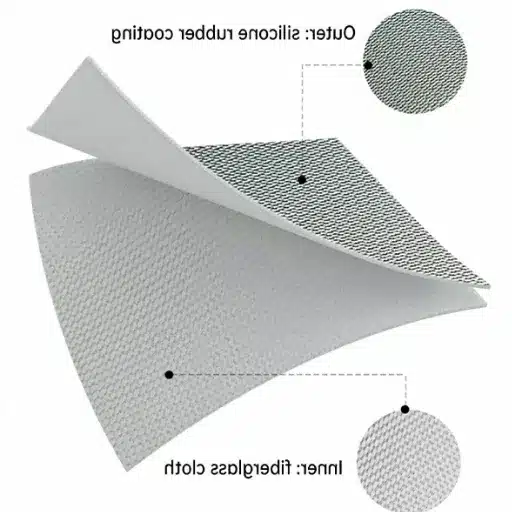
The manufacturing of silicone-coated airbag fabric follows a controlled sequence from yarn to finished roll. Each step influences the final performance of the deployed airbag.
Step 1: Base Fabric Preparation
Nylon 66 yarns are the industry standard for airbag fabric, typically in the 420 to 840 denier range for standard airbags and up to 1880 denier for high-load side-curtain designs. The yarns are woven into plain weave constructions at densities of 20-30 warp ends per centimeter. High-speed rapier looms operate at approximately 400 picks per minute; air-jet looms can reach 600 picks per minute.
After weaving, the fabric undergoes heat setting — a critical step for dimensional stability and permeability control. Heat setting fixes the yarn positions and relieves internal stresses from weaving. Without proper heat setting, the fabric will shrink during the coating cure cycle, altering pore size and coating adhesion.
Step 2: Coating Application
The most common application method for airbag fabric is knife-over-roll (blade) coating. The mixed silicone elastomer is held in a trough above the fabric. A precision blade meters the coating onto the fabric surface as the fabric passes beneath it. The blade gap, fabric tension, and coating viscosity are tightly controlled to achieve the target coating weight.
For some applications, dip coating or transfer coating may be used. Dip coating submerges the fabric through a silicone bath, while transfer coating applies the silicone to a release paper first, then transfers it to the fabric under heat and pressure.
During application, the fabric is held under controlled tension to prevent wrinkling and ensure uniform coating distribution. Inline beta gauges measure coating weight in real time, allowing operators to adjust blade position before out-of-specification material accumulates.
Step 3: Curing
The coated fabric passes through a continuous oven at 150-200°C. At these temperatures, the platinum catalyst activates and the hydrosilylation crosslinking reaction proceeds rapidly. A typical dwell time in a continuous oven is approximately one minute at 196°C. Batch curing in heated presses may use longer times at lower temperatures.
Cure completion is verified by physical testing: a fully cured silicone coating will not smudge or transfer when rubbed, and will exhibit the target hardness and tensile properties. Under-cured coating remains tacky and weak; over-cured coating becomes brittle and loses adhesion.
Step 4: Quality Verification
Finished rolls are sampled and tested against specification:
- Coating weight: Gravimetric measurement per ISO 3801
- Tensile strength: JIS K 6251 or ASTM D412, targeting 4-6 MPa
- Elongation at break: 700-1,600% for high-quality formulations
- Hardness: Shore A durometer, 5-20 for airbag applications
- Loss tangent (tan δ): Rheometry at 500 rad/s, ≥0.175 indicates proper elastomeric behavior
- Adhesion: Peel testing with 100% cohesive failure mode required
- Permeability: Gas retention testing under simulated deployment conditions
When Park Min-joo took over quality management at a Korean airbag fabric plant in 2023, she discovered that the coating weight test was being performed only at the roll edges, not across the full width. Edge-to-center coating variation of ±12 g/m² was going undetected. After implementing center-sampling and inline beta gauge calibration, her team reduced coating weight variation to ±3 g/m² — and reduced customer complaints about deployment inconsistency by 78% within one quarter.
Airbag Silicone Coating Specifications
Procurement engineers need precise specifications to qualify suppliers and verify incoming material. The following parameters are standard across the industry, though exact values vary by airbag type and OEM requirements.
Coating Weight by Application
| Airbag Type | Typical Coating Weight | Total Fabric Weight | Key Requirement |
|---|---|---|---|
| Driver frontal (standard) | 50-60 g/m² | 190-210 g/m² | Rapid deployment, compact fold |
| Passenger frontal | 55-65 g/m² | 200-220 g/m² | Larger fabric area, consistent permeability |
| Side curtain | 65-80 g/m² | 220-250 g/m² | Extended inflation retention |
| Knee airbag | 45-55 g/m² | 180-200 g/m² | Minimal module volume |
| OPW (one-piece woven) | 45-62 g/m² | 170-200 g/m² | Lightweight, seamless construction |
Mechanical Properties
- Tensile strength: 4-6 MPa (JIS K 6251 / ASTM D412)
- Elongation at break: 700-1,600%
- Tear strength: ≥30 kN/m for high-performance formulations
- Hardness: 5-20 Shore A (soft, flexible coatings preferred for foldability)
- Loss tangent (tan δ): ≥0.175 at 500 rad/s — indicates sufficient viscous energy dissipation for dynamic gas retention
Thermal and Environmental Properties
- Service temperature range: -50°C to +250°C
- Heat aging: 1,000 hours at 110°C, maintaining >80% of original bond strength
- Cold impact: -35°C with no cracking, flaking, or peeling
- Thermal cycling: -30°C to +80°C for 50-100 cycles without integrity loss
- Flammability: FMVSS 302 compliance required
Permeability and Performance
The critical functional test for airbag coating is gas retention. A standard test inflates a fabric panel to 20 psi and measures the time required to decay to 10 psi. For silicone-coated fabrics, this leak-down time must meet OEM-specific requirements, typically ensuring that the airbag maintains sufficient pressure for the duration of occupant interaction. Lower coating weights require tighter base fabric weave or optimized coating penetration to compensate.
Xylene vs. Methylbenzene Silicone Formulations
Not all silicone coatings use the same solvent and curing chemistry. The two dominant formulation types in current production are xylene-based and methylbenzene-based systems, with waterborne emulsions emerging as a sustainable alternative.
Xylene-Based Formulations
Xylene-based silicone coatings hold approximately 56% of the current market. They offer high adhesion to nylon 66 substrates and excellent heat resistance above 230°C. The xylene solvent provides good solubility for the organopolysiloxane polymer and facilitates uniform coating flow during application.
The primary limitation is volatile organic compound (VOC) emission. Xylene is a regulated solvent under multiple environmental frameworks, and exhaust treatment is required at coating facilities. Xylene-based systems also tend to be higher in viscosity, which can limit the minimum achievable coating weight.
Methylbenzene-Based Formulations
Methylbenzene (toluene)-based formulations account for approximately 44% of the market and are growing. They offer lower viscosity than xylene systems, enabling thinner coating application and approximately 6% weight reduction at equivalent performance. The lower viscosity also improves penetration into tight weave structures, which is advantageous for OPW fabrics.
Methylbenzene systems cure slightly faster in some formulations, improving production line throughput. However, they share the same VOC concerns as xylene, and similar exhaust treatment requirements apply.
Waterborne Silicone Emulsions
Waterborne silicone emulsions represent the emerging green technology in airbag coating. By replacing organic solvents with water as the carrier, these systems achieve 35-42% VOC reduction compared to solvent-based coatings. The environmental benefit aligns with automaker sustainability commitments and regulatory pressure from REACH and EPA frameworks.
Current limitations include longer drying times (water evaporation is slower than solvent flashing), potential foaming during application, and more demanding storage conditions to prevent emulsion breakdown. Several major silicone suppliers launched new waterborne formulations in 2024, and adoption is expected to accelerate as formulation technology matures.
Emerging Trends: EVs, Lightweighting, and Sustainability

The airbag silicone coating market is evolving in response to three major forces: electric vehicle growth, weight reduction imperatives, and environmental regulation.
EV-Specific Airbag Requirements
Electric vehicles present unique airbag challenges. Battery packs change vehicle mass distribution and crash dynamics. Frontal crash pulses in EVs differ from internal combustion vehicles due to the absence of an engine block and the presence of high-voltage battery systems. Some EV architectures position airbag modules closer to battery thermal management systems, exposing fabrics to different thermal profiles during normal operation and crash events.
Dual-layer silicone coatings are being developed for EV-specific applications. The first layer provides adhesion and thermal protection; the second layer offers enhanced heat resistance and electrical insulation properties. These dual-layer systems are currently in validation with several OEM programs.
Ultra-Thin Coating Development
The push for weight reduction extends to airbag systems. Target coating weights below 15 microns (approximately 15-20 g/m²) are under development for next-generation OPW fabrics. Achieving adequate gas retention at these weights requires either extremely tight base fabric weaves or novel nanocoating technologies. Research into PVA/silica nanoparticle composite coatings has shown promise in laboratory settings, though commercialization timelines remain uncertain.
Sustainability and End-of-Life
The automotive industry faces increasing pressure to address end-of-life vehicle (ELV) regulations. Silicone elastomer is difficult to separate mechanically from nylon 66 substrate, creating recycling challenges. Two approaches are emerging:
- Chemical recycling: Depolymerization of the nylon 66 substrate, with silicone residue handled as a process byproduct
- Direct incorporation: Grinding coated fabric scrap and incorporating it into polyamide molding compounds as a filler
Toray Industries has pioneered a chemical recycling route that converts silicone-coated airbag scrap into virgin-quality nylon 66 under their Ecouse AMILAN initiative. The program achieved commercial-scale operation in 2024 and represents a significant step toward circularity in airbag materials.
Waterborne silicone systems also contribute to sustainability goals by eliminating solvent emissions during manufacturing. Combined with recycled base yarns, waterborne coating technology could enable airbag fabrics with substantially reduced lifecycle environmental impact.
Smart Coating Concepts
Research programs at several suppliers are exploring functional coatings with embedded sensors. The concept involves incorporating microsensors into the silicone coating layer to detect deployment events, monitor coating integrity over time, or communicate with vehicle safety systems. These smart coatings remain at the prototype stage, with significant challenges in sensor durability, signal transmission through fabric folds, and cost. If commercialized, they could enable predictive maintenance of airbag modules and post-deployment diagnostics.
Sourcing Silicone Coated Airbag Fabric: A Buyer’s Checklist
For procurement managers and materials engineers qualifying new suppliers, the following checklist ensures that critical specifications are verified before sample approval and production commitment.
Specifications to Request
- Yarn specification: Denier, filament count, and tensile properties of the base nylon 66 yarn
- Weave construction: Ends and picks per unit length, weave pattern, and heat-setting parameters
- Coating formulation: Xylene-based, methylbenzene-based, or waterborne; single-layer or dual-layer
- Coating weight: Target, minimum, and maximum in g/m² per side
- Cured properties: Tensile strength, elongation, tear strength, hardness, and tan δ
- Adhesion: Test method and minimum peel strength with cohesive failure mode requirement
- Permeability: Leak-down test method and acceptance criteria
- Thermal aging: Test conditions and property retention requirements
- Flammability: FMVSS 302 or equivalent compliance documentation
- Environmental compliance: REACH, ELV, and applicable VOC documentation
Supplier Qualifications
- IATF 16949 certification: Mandatory for automotive supplier quality management
- OEM approvals: Verify existing approvals from target vehicle manufacturers
- Production capacity: Minimum order quantities and lead times for prototype and production volumes
- Testing capability: In-house laboratory testing versus third-party verification
- Traceability: Lot tracking from raw yarn through coating to finished roll
- Sample turnaround: Typical lead time for prototype samples (≤3 weeks is standard)
- Custom formulation capability: Ability to adjust coating weight, adhesion promoter, or cure profile for specific requirements
Regional Considerations
Asia-Pacific accounts for approximately 41% of global airbag silicone demand, followed by North America at 27% and Europe at 26%. China leads production volume with over 21 million airbag units manufactured annually. India and Mexico are emerging as growth markets with new coating line investments. Sourcing strategy should account for regional supply chain reliability, logistics costs, and tariff considerations.
When the procurement team at a European automotive supplier evaluated Asian silicone-coated airbag fabric sources in 2024, they found that coating weight specifications varied by ±15 g/m² between suppliers who all claimed to meet the same drawing. The discrepancy traced to different measurement methods — some suppliers reported dry coating weight, others reported wet deposition, and one included the adhesion promoter mass in the coating weight figure. Standardizing test methods and requiring third-party verification eliminated the variation and reduced incoming inspection rejections by 62%.
For buyers with non-standard requirements — custom coating weights, specialized adhesion promoters for alternative substrates, or prototype volumes for new airbag architectures — the ability to work directly with a supplier’s engineering team is essential. Custom coating development typically requires 2-3 formulation iterations and full validation testing before production approval. Suppliers with in-house compounding and coating line flexibility can accelerate this timeline significantly.
Conclusion
Silicone coating for airbag fabric represents one of the most precisely engineered applications of elastomer technology in the automotive industry. The shift from neoprene to silicone was not a marketing decision — it was driven by measurable performance advantages in thermal resistance, coating weight, aging stability, and deployment consistency. For procurement managers and materials engineers, understanding the chemistry, application process, and specification parameters enables better supplier qualification, clearer drawing requirements, and fewer production surprises.
The technology continues to evolve. Waterborne formulations reduce environmental impact. Ultra-thin coatings address weight reduction targets. Dual-layer systems meet EV-specific thermal challenges. And chemical recycling initiatives move the industry toward circular material flows. Buyers who stay current with these developments — and who specify precisely what they need — will find suppliers capable of meeting demanding requirements.
For technical specifications, custom coating development inquiries, or to discuss how our engineering team can support your airbag fabric program from concept to certified delivery, contact our technical sales team.
Sources: Fortune Business Insights — Automotive Airbag Fabric Market, MarketsandMarkets — Automotive Airbag Silicone Market, Design News — Airbags: Materials Make a Difference, Textile School — Airbag Woven Fabrics