
What Are Airbags Made Of? Nylon 66 & Silicone Guide
Airbags are manufactured using fabric made of durable nylon 66, which is generally impregnated with silicone so as to regulate the way gases penetrate it during activation. the base fabric is normally polyamide fabric and ranges from 180-300 gsm. it is also designed to sustain temperatures above 300 degrees Centigrade when deployed as a airbag within the steering wheel, instrumentation, or other fabrics without losing appearance over the years.
As a Tier 1 supplier quality engineer situated at Shanghai, Chen Wei was scanning the first batch of silicone-coated fabric intended for a new airbag side-curtain program when he saw something that was clearly overlooked. Permeability test results of the first and second trials showed a variation of 12% which, clearly exceeded the respective ±3% of the OEM’s in-process tolerances. Moreover, the mixing facility changed the viscosity in the middle of the batch without updating their process control log. This reason alone was enough to postpone every vehicle within the program by six weeks and force the supplier to pay close to $400,000 in recovery charges. Throughout the supply chain of airbag fabrics, specification variance remains the dominant condition rather than an optional requirement—it is a safety necessity.
In case you have ever been curious and inquired about what materials are used in making airbags, this is where you will find the performance requirements, manufacturing arrangement and accreditation norms that must be met by the current airbag fabrics. Let us analyze the composition, structure and properties of nylon 66, the application methods used for the controlled protection of airbags as well as the management systems of testing for each consignment which is to be placed in the automobile. We value your feedback! Get in touch with us to share your thoughts or ask for help.
Key Takeaways
- Airbag fabric is woven nylon 66 (not polyester) with a typical denier of 420D–630D and weight of 180–300 gsm, chosen for its heat resistance and strength-to-weight ratio.
- Silicone coating dominates 70%+ of the market because it outperforms neoprene in thermal stability and permeability consistency.
- A standard driver airbag must withstand 300–500°C inflator gas and tensile forces of 200–400 N/5cm while deploying in 20–40 milliseconds.
- One Piece Woven (OPW) technology eliminates sewn seams in side-curtain designs, reducing labor and failure points.
- End-of-life recycling remains a challenge because silicone-coated nylon 66 cannot be mechanically separated for standard textile recovery.
What Are Airbags Made Of? Fabric Composition Explained

At its minimum, an airbag may be depicted as a sophisticated fabric pouch. The elements, shaping fabric of the airbag comprise of three ingredients: the base cloth, the functional layer, and the employed folding agent.
The base is composed of almost non-existing nylon 66 which is a polyamide synthetic clay product manufactured by DuPont starting in the 1930s. It was chosen for airbag use due to its properties of high tensile strength, controlled stretch and heat resistance. It has an approximate melting point of 265 degrees Celsius. This seems quite close to the 300-500 C° gases temperatures that are produced by the inflator. No fear as the fabric is not damaged since the inflatable bag works only for a very few milliseconds lasting for only 20-40 milliseconds ensuring no fabric thermal degradation can occur to jeopardize any part of the design.
Indeed, the coating plays a crucial function. When inflated, the gas rapidly fills in the bag and invests it with high velocity characteristics. A non-porous bag would have behaved as a stiff balloon. Such a bag cannot be used for correct impact energy dissipation. If it is more pores, it will deflate earlier than it can protect an individual. The coating, usually silicone, sometimes neoprene, is responsible for controlled gas permeability. In addition, it prevents the hot gas from the bag from burning the fabric fibers of the yarns.
At the end of the day, a dusting of lubricating powder either talc or food-grade cornstarch is included during assembly. It is needed for the consistently compressed cloth in the steering wheel not to adhere when the bag is deployed after many years. Without it, the bag might remain folded and refuse to open.
Airbag Material Science: Why Nylon 66 Dominates
Not all synthetic fibers perform equally under the extreme stress of airbag deployment. The choice of nylon 66 over alternatives is the result of decades of materials engineering and real-world crash testing.
Nylon 66 vs. Nylon 6 vs. Polyester
Nylon 66 and Nylon 6 are both types of polyamides (nylon) but have different molecular structures. Specifically, the polyamide composed of nylon 66 contains one of the most symmetric linear aliphatic chains. Considering this clear structural feature alone, it also shows that nylon 66 bonds inter- molecularly better than nylon 6. This is the reason why nylon 66 finds application in a wider range, vis-a-vis has a higher operating temperature, a higher tensile strength but the moisture content of materials made of this composite is very low in comparison to materials made from nylon 6. In an airbag application, even the slightest oversights can compromise the entire system.
Materials like Polyester, however, are not suitable in some critical properties ix. Their melting point is lower than that of the nylon 66 and more importantly, the percentage elongation at break is very small. The heated mixture components are ejected against the fabric, whereas the fabric as well as is very dense becomes resisting the foils being ejected. Polyester is more slackable and it would slightly displace under that load where nylon 66 breaks. Information is clear and unsurprising, polyester as a compliant is not essential as far as of the fabric of airbags is concerned.
Yarn Specifications
Nylon 66 airbag fabric begins with yarns that are not off-the-shelf textile fibers. They are high-tenacity industrial filaments produced through a carefully controlled melt-spinning process. Typical specifications include:
- Denier range: 420D to 630D depending on airbag type and manufacturer specification
- Tenacity: 8.0–9.5 grams per denier
- Filament count: 70–140 individual filaments per yarn bundle
- Yarn construction: Continuous multifilament with minimal twist to preserve strength
The denier selection depends on the airbag’s size and deployment dynamics. Driver airbags use lighter fabrics (420D–470D) because they are smaller and deploy into a relatively open space. Passenger airbags and side curtains use heavier constructions (560D–630D) to manage larger volumes and higher structural loads. For personalized assistance or more details, please contact us via our support page.
Fabric Weight and Construction
The weight of a woven fabric (plain weave) typically ranges from 180gsm to 300 gsm. The market is mostly controlled by two weaving methods. They are:
Plain weave (cut-and-sew): the conventional format uses the traditional over and under weave pattern obeys. In this case, while the woven material is cut and sown together into segments, it is usually the most affordable. Nonetheless there are vulnerability points with sleeked edges. In the dark seam strength damage must also be treated separately and not conflated with fabric structure’s damage.
One piece woven (OPW): It is a relatively new method of weaving in which all the components of the airbag, its overall shape, are formed into a single textile. The fabric in this case is virtually an airbag and does not contain any components that can be sewn into the main body. This implies less intensive labour, zero risk of tearing at the joints, and uniform patterns throughout the fabric under analysis. The penetration rate thereon is increasing at about 8 – 10 % every year albeit drivers airbags remain rather simpler and hence cut and sew is the most appropriate technology.
Coating Technology: Silicone vs. Neoprene
The coating is what transforms a strong woven fabric into a functional airbag material. It controls gas retention, protects yarns from thermal damage, and determines how the bag unfolds.
Silicone Coating (70%+ of Market)
Silicone elastomer coatings have become the industry standard over the past two decades. They are applied using knife-over-roll or dip-coating processes, with typical coating weights of 20–60 gsm per side. Silicone offers several decisive advantages:
- Thermal stability: Silicone maintains elastomeric properties across a wide temperature range, from -50°C to +250°C
- Low friction: The surface allows smooth, predictable unfolding during deployment
- Consistent permeability: Silicone coatings provide uniform gas retention across the fabric surface
- Aging resistance: Unlike neoprene, silicone does not harden or crack during the 10–15 year service life of a vehicle
Park Min-joo likes checking the mass of the coating by an electronic lean gauge in every ¼ hour during siliconizing. On the morning of one Tuesday in March, the machine was watching, combined its optics because a decrease of 0.8ugr/cm2 occurred at TSN-3. Right away she stopped the machine. The root cause: the frontal reveal of the chamber caused a part of the doctor blade to incur a 2,000 meters, insufficient for a designated filter layer. This is because after coating, airbag fabric cannot be bond, stitched, or reapplied hence, that entire roll would have to be wasted at 18g per square meter. Managers at other levels of operations had minimized losses by implementing waste control measures that had incomes to the level of 18g per square meter. Managers at other level in a year had saved the total costs of 360 000 and the first line from producing bad material which would have cost the company much more in the end.
Neoprene Coating (Declining Share)
Neoprene (polychloroprene) was the original airbag coating material. It provides good adhesion to nylon and acceptable thermal protection. However, it suffers from three significant limitations:
- Aging and hardening: Neoprene becomes brittle over time, especially in hot climates
- Higher friction: The surface does not unfold as smoothly as silicone during deployment
- Environmental concerns: Chlorinated rubber chemistry raises end-of-life disposal issues
Neoprene’s market share has dropped from approximately 45% in 2010 to under 25% today. It persists primarily in legacy vehicle programs where changing coating chemistry would require expensive re-certification.
Uncoated Fabric
A small percentage of airbags, primarily certain side-curtain designs, use uncoated fabric. These rely on extremely tight weave construction to control permeability. The advantage is lower weight and cost. The disadvantage is reduced thermal protection and stricter weaving tolerances. Any variation in thread count or yarn tension directly affects deployment dynamics.
Whether you need product information, customized support, or partnership opportunities, LY TRUSTLINK is ready to assist you with fast and reliable service.
Critical Performance Specifications
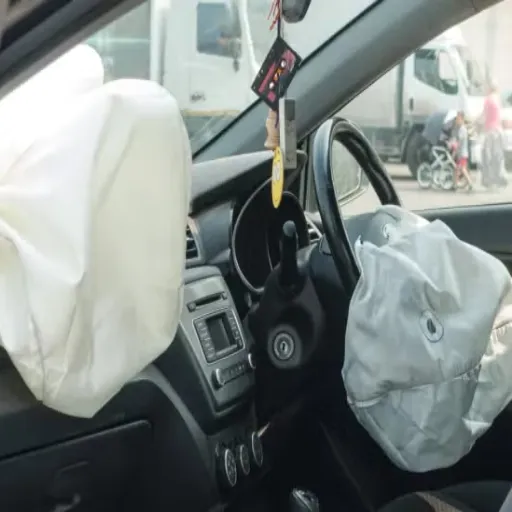
Airbag fabric is one of the most stringently specified technical textiles in commercial production. Every parameter is measured, recorded, and statistically tracked.
Mechanical Properties
Tensile strength is the most critical mechanical property. In the warp direction, standard driver airbag fabric must achieve 200–400 N/5cm. Tear resistance is equally important. A propagating tear during deployment would be catastrophic. Testing follows ASTM D5034 and D2261 protocols.
Elongation at break typically falls between 25% and 40%. Too little elongation and the fabric tears. Too much and the bag deforms excessively, changing its protective geometry.
Thermal Performance
The inflator gas can reach 300–500°C in the first milliseconds after the deployment commences. It is important that the fabric can withstand such harsh conditions without any harm done to its materials, such as melting, charring or weakening.
In addition to short term exposure, long-term thermal ageing becomes a necessity as well. Automobiles can be parked outside and see direct lighting for multiple years. As an estimate, some dashboards can record surface temperatures as high as 85°C. In such situations, such a fabric must not lose its useful properties. For that purpose, accelerated aging testing is used where the specimens are exposed to 85–105°C for a few hundred hours – thus subjecting the materials to conditions that would exist after 10–15 years of use.
Permeability and Gas Retention
The permeability is expressed in cubic cm per minute of air passed through one square cm area at a specific pressure drop. Its values lie within the range of 0.5–5.0 cc/cm²/sec depending on the airbag regions.
In case of driver airbags the permeability needs to be on a moderate level. The bag has to expand very quickly to provide as little time for injury. Beyond that, it will collapse following maximum power so there is no air cushion for which there may be more injuries. However, in case of side-curtain airbags a lessening of permeability is required as the occupation time is longer to withstand actions on the opposite side of the vehicle in the event of rollover.
Understanding how technical fabrics perform under extreme conditions starts with the right specification. Explore our technical fabric engineering resources for procurement teams evaluating high-performance materials.
How Are Airbags Manufactured? From Polymer to Module
Airbag fabric manufacturing is a multi-step process where deviation at any stage compromises the final product.
Step 1: Yarn Production
Production begins with nylon 66 polymer chips. These are melted, extruded through spinnerets to form filaments, and then drawn (stretched) to align polymer chains. Drawing increases tenacity significantly. The drawn yarns are heat-set to stabilize their dimensions and then wound onto cones. Quality control at this stage measures denier, tenacity, elongation, and hot-air shrinkage. Any off-spec yarn is rejected before it reaches the weaving floor.
Step 2: Weaving
A high-speed weft insertion system or a powerful jet of air is generally employed in the development of textiles meant to fulfill a certain technical purpose. Usually, the focus is on applying and controlling tension consistently. Changes in warp tension show up in the fabric as variations in porosity. Plain weaves have roughly 20–30 warp ends/cm. OPW looms are even more complicated for the reason that there is a requirement to make for case the technology for the weaving of three dimensional bags.
The finished greige fabric is then subjected to inspection in order to find important defects such as broken yarns, missing weft or any other dirt etc. Automated inspection systems are using optical scanners to check defected less areas by analyzing and finding the requirements to take measures against such defects after such problems are discovered.
Step 3: Coating and Finishing
The woven fabric moves to coating lines where silicone emulsion is applied. Curing ovens set the coating at temperatures between 150°C and 200°C. This cross-links the silicone elastomer and bonds it to the nylon substrate. Coating weight is verified using gravimetric sampling or inline beta gauges.
Step 4: Cutting, Sewing, and Assembly
For cut-and-sew airbags, coated fabric is laid out in multiple plies and cut using steel-rule dies or laser systems. Sewing uses high-strength nylon or aramid thread. Seam patterns are engineered to distribute stress evenly. Every seam is pull-tested on a statistical sampling basis.
OPW airbags skip the sewing stage for the main body but may still require sewn reinforcement patches or inflator attachment points.
Step 5: Folding and Module Integration
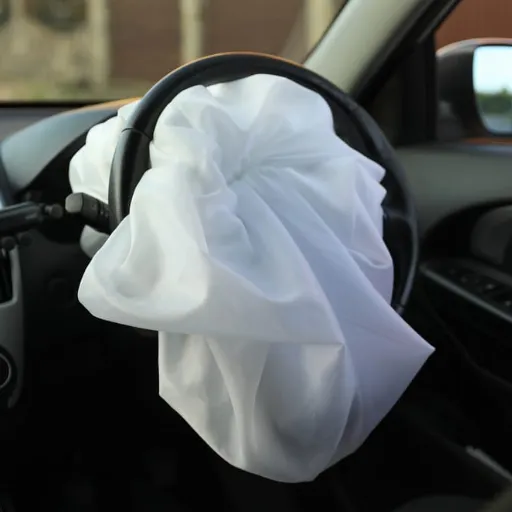
This is where most people encounter airbag fabric for the first time, after a deployment, when the white powder covers their dashboard. The fabric is precisely folded using automated equipment. Lubricant powder is applied to prevent the coated surfaces from adhering. The folded bag is inserted into the module housing along with the inflator. The module is then sealed and shipped to the vehicle assembly plant.
Testing, Standards, and Quality Assurance
No textile product undergoes more rigorous testing than airbag fabric. The stakes are literal life and death.
Global Safety Standards
Multiple regulatory frameworks govern airbag performance:
- FMVSS 208: The US Federal Motor Vehicle Safety Standard specifying occupant crash protection requirements (NHTSA)
- ECE R94/R95: European regulations for front and side impact protection
- ISO 12097: International standard specifically addressing airbag component testing (ISO)
- SAE J2181: Society of Automotive Engineers protocol for inflatable restraint system validation (SAE International)
Fabric-Specific Testing Protocols
Before any roll of fabric is approved for production, it must pass a battery of tests:
- Tensile testing: Measures breaking force in warp and weft directions
- Tear propagation: Assesses resistance to tear growth under load
- Heat aging: Simulates years of dashboard exposure in compressed timeframes
- Permeability measurement: Verifies gas retention within specification windows
- Seam strength: Ensures sewn joints meet or exceed base fabric performance
- UV degradation: Tests for polymer chain breakdown under ultraviolet exposure
OEM-Specific Requirements
Automotive production requires high quality standards, which include inspection guidelines that specify the composition and the material properties of its various parts. Specific well defined and self-regulated tests are elucidated by their car makers. These are Toyota, Volkswagen Group, General Motors and many others. It is also important that before adding one meter of fabric, suppliers must be the holders of IATF 16949 certification and submit the necessary Production Part Approval Process (PPAP).
Statistical Process Control (SPC) must be maintained at all times. Values of specific characteristics like the thickness, permeability, and tensile strength of the coating are taken frequently. And at the most skillfully assigned limits for control, any characteristic beyond its specification range necessitates immediate intervention and segregation of the concerned material.
Types of Airbags and Their Material Differences
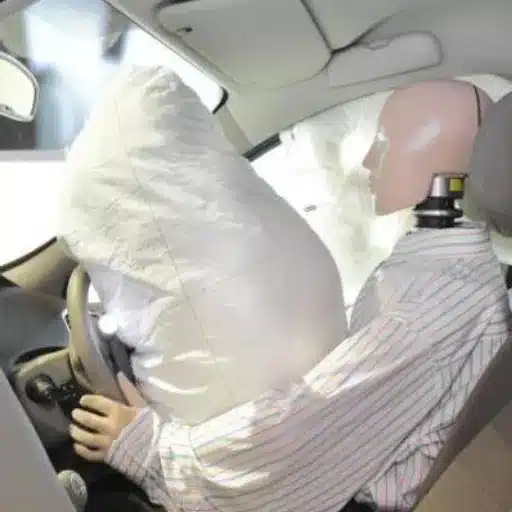
Not all airbags use identical fabric. Design requirements vary significantly by position and function.
Driver Airbags
The steering wheel airbag is the most mature design. It uses the lightest fabric (typically 420D–470D nylon 66) because the deployment volume is relatively small. The fabric is subjected to the highest heat concentration because the inflator is mounted directly behind it. Silicone coating is universal in modern driver airbags.
Passenger Airbags
Dashboard-mounted passenger airbags are significantly larger. They require more fabric and often use two-stage inflators. Two-stage systems deploy partially in less severe crashes and fully in high-speed impacts. The fabric must perform correctly under both pressure profiles. Heavier constructions (500D–560D) are common.
Side Curtain and Torso Airbags
Side curtains protect occupants during side impacts and rollovers. They are long and narrow, often spanning the full length of the passenger compartment. OPW technology is particularly advantageous here because a seamless woven tube is stronger than a sewn assembly. These airbags require the lowest permeability because they must remain inflated for several seconds during a rollover.
Knee and External Airbags
Knee airbags are smaller modules designed to prevent leg injuries. External airbags, still emerging, deploy outside the vehicle to protect pedestrians. Pedestrian protection airbags require larger fabric volumes and different stress patterns because they deploy into open air rather than against a seat or dashboard.
The Powder Inside: Talcum, Cornstarch, and Lubricants
On some cars, the driver can sometimes see what appears to be a grainy white dust on the paneling on the interior of the car. No, it isn’t smoke; it is the lubricant that made the airbag pack up so neatly without sticking for use over the years. This is a feature of some airbags that drivers have in their car. Given that airbags are one of the most effective security features in a vehicle, a lot of malpractices are being carried by many drivers. And that is the reason why the attention was paid to unsolved questions.
Talcum powder and food-grade corn starch are the most widespread lubricants. The typical powdered driver airbag holds about 5–15 grams of powder. There is a precise amount. If too little is used, the material will stick. If too much is used, the powder will block visibility from the sensors that determine whether the bag has been fully inflated or otherwise.
There is also one more reason for the powder. When a bag inflates quickly, the friction between the layers of fabric may generate some static. The powder assists in minimizing this risk. However, in some instances, one might argue that liquid lubricants or silicone-based dry films are better than adhesives. Nevertheless, powder dominates in this area since it is little demanded in terms of cost and performance.
The health worry caused by inhaling talcum powder and the associated risks like ovarian cancer, has led some companies to abandon this product and instead adopt cornstarch which is relatively safe or other non-talc alternatives. However, form a material or functional perspective, all the three does an equal standard lubrication job.
Sustainability and End-of-Life Considerations
The greater importance of airbag fabric in terms of the environment is sought by the marketers of various manufacturers and regulatory authorities.
More often than not, most airbags are either thrown or burned upon retrieving them. The silicone nylon 66 composite cannot be reclaimed purely by mechanical recycling techniques as it has been coated. In fact shredding operation for this composite is impossible, as it is not separable by the fibers, thanks to the silicone treatment. Waste-to-energy incineration and mechanical lines are the most common uses.
As for Maria Santos, she has to manage the process of recycling airbags upon dismantle of automobiles for this company. She has approximated statistics from her facility that says in a year they recycle 3,000 deployed airbags. The silicone impacted Nylon 66 is an adhesive material on top of the fabric rather than a component of it, and so it cannot be undeveloped for traditional textile recycling. It is sent to incineration as it is as large pieces. “For example, we have high-function technical textiles that gets burnt during incineration”. Santos said. She added, “This industry requires coating chemistries that are either recyclable or biodegradable in the coming years. Through this course, in the absence of such chemistries, every air bag that gets thrown away, decommissioned or activated becomes an environmental liability.
There is a lot of work being conducted in relation to other coating types. Silicone coatings that come out in the form of a water-based mix decreases the amount of solvents used in the production process. While the bio-nylon 66’s (castor oil based) has been commercialized in some form, it will be some time before the automotive makers as a hole qualify with its slow qualification timelines. Few coatings manufacturers are considering developing TPU types of coatings which have potential of being melted and refitted into the whole coating process quite easily. However, it has been for many years that no one can be able to produce such a system at an acceptable cost-performance ratio for instance airbags which can be sold on a large scale.
The industry has made one significant sustainability advance. The practice of recovering more and more processing waste such as manufacturing scrap, overprints, defective rolls, and start-up materials which are either being burnt or disposed has increased and it is being down-cycled into industrial insulation or acoustic blankets. Even though it is not a 100% reusable practice, this system ensures that less materials goes to curbing.
Conclusion
Airbags are not merely soft fabric bags. Whenever the question arises what compounds airbags, it should be noted that such are materials with a high degree of elaboration where every single requirement, starting from orientation of the nylon 66 polymer chain through to the amount of silicon applied onto the screen and the permissible level of leakage, has a direct impact on the chances of how much an individual can survive during a crash. Such a material has to sustain an inert condition for 10–15 years of machine vibration, temperature changes as well as illumination by sunlight, and also heat up and fully function in a time span of 40 milliseconds, which would throw it into situations of heat and power way above what any normal fabric would ever face.
If one considers the airbag as a product and its procurement process or seeks to assess the viability of collaboration with another technical textiles partner, the airbag will repay its own cost. It goes without saying that the very same kendtic control practices that include airbags quality preocurement framework for material compinentes, precise control of technical requirements, specification saety, uniformity of detail, statistically determined quality control of the material under study, and the provision of several certificates must be the starting point for any high fold technical textile application.
Ready to specify technical fabrics that meet exacting standards? Contact our engineering team to discuss custom material requirements, testing protocols, and certification documentation for your next project.