
Airbag Material Properties: Specs, Standards & Testing
The most important characteristics of an airbag are its tensile properties, the tensile strength, the friction, and the pore size. They shall be evaluated by standard methods of tests specified in ASTM and ISO, and each cannot meet a specification differently. This guide breaks down every value in an airbag fabric data sheet and what they each signify, differentiating between the use of the data and how to read it in a supplier audit.
| Property | Standard | Typical Acceptance Range |
|---|---|---|
| Tensile strength (warp) | ASTM D5034 | 2,000–3,000 PSI |
| Tear strength | ASTM D1424 | 80–130 N |
| Air permeability (coated) | ASTM D737 | < 1 cm³/sec/cm² |
| Heat resistance (peak) | ISO 6941 | 800–900 °C |
| Elongation at break | ASTM D5034 | 180–250 % |
| Coating weight | ISO 3801 | 40–80 g/m² |
Why Reading the Spec Sheet Correctly Matters
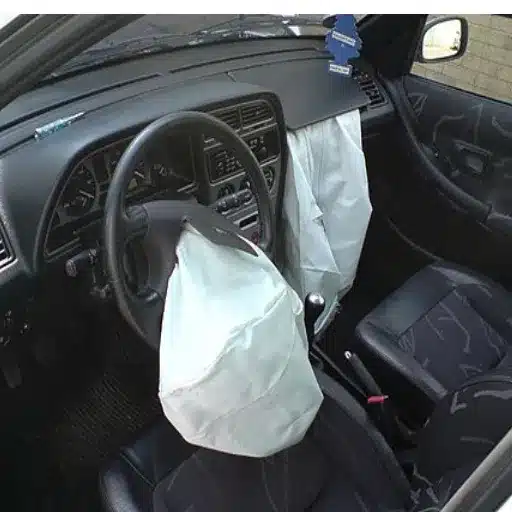
A 500 millisecond response is not a good place to recognize a discrepancy within a spec. Once the pyro ignites behind the firing pin, the material has approximately a heart beat to absorb the pressure of the gas, not tear along the separation, handle a 900 °C fire and reach final pressure at this exact rate. Skip any one of these, and an inflated airbag will burst or fail to deploy air, in time.
Sourcing team does appreciate that. Yet, in practice, it often intimidates them how many figures there are on such sheets incoming from the suppliers. This is because most of the info on the internet proves to be too academic, either proving difficult to understand since they were an intended audience of other materials scientists, or too shallow, as it consists of tables with no additional information. However, none of these can be of any assistance to a quality engineer in the tier 1, having to evaluate three offers that are expected by the end of the week according to an RFQ. We value your feedback! Get in touch with us to share your thoughts or ask for help.
This guide fill the hole critically that exists. What reveals is the six facets responsible for the airbag fabric performance, how to evaluate each aspect, what thresholds are stipulated by typical automotive OEMs, and what harm is inflicted in case the norm is violated. And finally, clashes of the products cease to be so evident, and a spec sheet now serves as a decision map.
Key Takeaways
- Measurements of the properties of airbag materials usually include tensile strength, air permeability, resistance to tear, heat resistance, percentage elongation and ageing.
- These methods are standardized by the Group’s or International Solid Waste Management Test Methods (ISWM-449, 450, 930). These methods also are incorporated into FMVSS DOT 208 system performance requirements.
- Nylon 6,6 is by far the most used in automotive airbag production at over 95%, which is higher than any other polymer in use, simply because it requires much less energy for melting compared to polyester.
- A standard waterproof airbag fabric, often weighs 175 g/m2 and such an equivalent fabric in its uncoated worn form ranges between 244-257 g/m2 and the choice of the coating controls the air permeability, flexibility and fold volume.
- A readable, comprehensive and safe airbag fabric requirement always identifies its test procedure with each number, provides a range of acceptance rather than the solitary value and gives the aging performance relationships according to SAE J2052.
What Are Airbag Material Properties?
Airbag material properties are those properties of the coating or uncoated woven fabric, which, when inflation is achieved at 30 to 50 milliseconds, will determine the way in which the inflated cushion behaves. Those are the properties, amongst others, concerned with four different levels of functionality: integrity (tensile and tear strength), function (air permeability, elongation), durability (heat resistant features, and coating stability), and safety (otherwise due to aging phenomena). All these factors are tested to be performance compliant prior introduction of the fabric to the automotive application.
Every design requirement has one simple objective. That is, to protect the passenger. When we speak of a tensile flaw, we mean the separator has broken to pieces. When we speak of errors in permeability, we mean the bag does not expand because of negative pressure. Once we talk in terms of thermal failure, we imply the development of an incineration hazard. A failure in fire protection means that the car burns to the ground. The car’s airbag is in perfect conformity until a pair of safe and secure thirty-four-year-old cars crashes head-on and the combination bent steel chassis. Those are not mere numbers in a textbook about material points, but a guarantee that a particular fabric will protect under a set of flexing and tensile conditions at a stage not in two or five years, but perhaps in ten.
The Six Critical Properties of Airbag Fabric
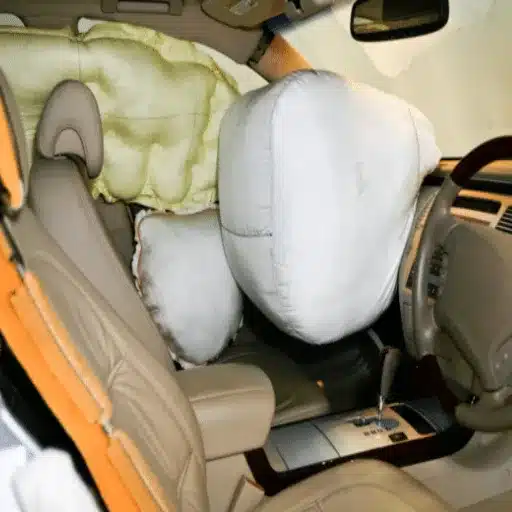
Tensile Strength and Elongation at Break
The tensile strength is the measure of the maximal force that can be absorbed by the fabric before its tearing. For material that takes up standard airbag manufacture the warp fashion normally ranges from 2000 up to 3000 pounds per square inch according to the standards of ASTM D5034 and covers grab test as well as ASTM D5035 which involves strip test. The height of the elongation at the time of tearing the fabric – expressed as a percentage of the amount of stretch – lies within the range of 180 to 250 percent.
Both these values are important because the loading is not a fixed one. The inflator will release gas at a high rate which leads to a transient pressure increase and it is the duty of the fabric to bear such excess pressure without tearing across the seam. If the strength parameter is less than 1, the airbag system will explode due to overpressure. Should the elongation be limited, one will not be able to insert the gas volume curve and the material will bear damage caused by concentrated stress about the corners of the airbags.
One of the most common miscalculations in procurement is to pit suppliers who give “tensile strength 85 MPa” against a competitor who provides the same quote with 2,500 PSI without taking into consideration that the former number defines the Nylon 6,6 polymer in its bulk shape, and the latter defines the woven fabric. This is not the same test and the two are not related. It is imperative to provide woven laminates with the Micron level testing as per standard test method, ASTM D5034 and stipulating the testing parameters on specimen size, cutting and clamping.
Tear Strength and Edge Integrity
Tear strength prevents a small defect from propagating into a catastrophic failure. The Elmendorf test (ASTM D1424) and trouser tear test (ASTM D2261) are the dominant methods. Airbag-grade nylon 6,6 typically delivers 80 to 130 N tear strength on LY TRUSTLINK’s Premium Airbag Fabric Solutions data sheet, which aligns with the industry research range of 18 to 30 kgf (roughly 176 to 294 N for fabric strip tests).
There is a tradeoff most data sheets do not mention: above approximately 30 kgf, tear strength gets so high that the fabric loses foldability. The cushion no longer compresses into the steering hub or instrument panel module within design volume. So the goal is not maximum tear strength; it is the operating window between “rupture risk” and “won’t fold.”
Want to see how these specifications translate into a real production data sheet? Explore the Premium Airbag Fabric Solutions reference table for Standard and Premium grade ranges.
Air Permeability and Deployment Dynamics
When the passenger hits it, the pillow is inflated with gas and air permeability plays a key role in maintaining the inflated state. At 125 Pa and in accordance with ASTM D737, a coated airbag material typically has a value of less than 1 cm³/sec/cm², a material in a high performance advanced grade coated form less than 0.5 cm³/sec/cm².
Gas flow control is simple. The medium is full of gas. Pressure of this gas is controlled from inside the cushion so that the cushion reaches full capacity. The passenger goes back into the bag forcing the air that was in the bag during the unloading process. This air is forced back out through properly designed vents and through the fabric used for the bag. When the gas flows through the fabric, additional resistance is generated. This takes place within specific faces of the fabric which contributes to its overall strength, binding of the constituent elements and hence to the resistance of the fabric to outside influences. If the permeability is excessively high, the admissible internal pressure begins to decrease before the changes take place in the occupant’s movement in the chair. If the permeability is excessively low, pressurization occurs beyond the allowable value to which the seams can withstand and the retaining cushion splits.
It is the property in which coated and uncoated fabrics differ the most. For this reason, airbags for side curtains that inflate when turning over and remain inflated for about 5 to 10 seconds typically use fabrics that are coated as the volume of outflow is very low and the permeability approaches zero. As the front passenger airbags inflate to large volumes, enclosing extremely low peak pressure, they may be manufactured using uncoated fabrics considering even the high or elevated air leakage is acceptable.
Heat Resistance and Thermal Stability
During the burst of gas, the temperatures around the inflator are likely to hit as high as 800- 900° C, while temperatures inside the dashboard module available at a consistent 80 – 105° C during summer seasons. The ability to withstand high temperatures must comply with the assessment of ISO 6941 (flammability) as well as thermogravimetric analysis (TGA) using the known industry studies.
This is one reason why nylon 6,6 is still the airbag material, not the other two. Polyester has the same melting point as nylon 6,6, but it requires around 30% less energy, than nylon 6,6 to reach the melting point. But unlike nylon 6,6, polyester reaches its failure temperature at a much faster rate under the inflator’s sudden heat. For coated systems, the silicone layer along with the glass overlay actually acts as one or two thermal barriers, physically cutting off the molten fiberglass from contacting the structural material.
Daniel Chen, whose scope of work included management of quality resources of his company, rejected a major portion of fabric (8 tons) received from the supplier, when the batch documentation only described the continuous service temperature (80oC) with no testing for the peak applicational temperature. The fabric was supposed to be of acceptable quality. It was all rested on the not so correct data sheet. He had every right to reject it. When the test method deviates from failure mode, or is inconsistent with the spec, it is a failure of the spec.
Aging and Environmental Degradation
The airbag fabric is to be used comfortably following its fold into a steering wheel assembly for a long period of 10 to 15 years withstanding temperature cycles, moisture, the windshield UV exposure, and emission from the neighboring polymers. The heat and wet aging of the material is accomplished in accordance with the accelerated cycle test method involving thermal and wetting cycles, and accelerated with the simulation of climate change with ultraviolet radiation.
A usual criterion for acceptance: no more than a 20% reduction of ultimate and tear resistance after aging of 10 to 12 years by an equivalent of accelerated time scale test. Information provided by LY TURST LINK model catalog is valid for around 10 years for Standard grade and 12 years and even more, for Premium grade. The failure due to ageing is almost never immediate and does not result in dramatic failure. Silicone coatings can lose tackiness and adhere the folded fabric to itself, plasticizers can strip out of the coating films and oxidation can make the yarn that forms the fabric brittle.
This is the least likely standard compliance inspection measure in property delivery because new data can take at least 3 to 6 months. For supplier specifications on redlines, the first indication that something has gone wrong is the lack of a redline/aging report. If a manufacturer/vendor cannot present the SAE J2052 data sufficiency, then it means that they have not done the testing and the material is not recommended for automotive applications.
Coating Performance
It should be taken into consideration that the coating is a special form that varies in chemistry and properties from a pure liquid or solid. Silicone is the most prevalent form of coating, particularly the cross-linked polydimethylsiloxane (PDMS) layer, which is applied at 40 to 80 g/m² and conforms to the ISO 3801 standard. On a production data sheet, not only the coating’s thickness is the case, the elongation at break in the inner layer is typically over 400 percent, and the tear strength in the outer layer is over 30 kN/m.
This coating exhibits a triple effect: it ensures zones of higher heat resistance in case of an inside explosive gas pressure swell instead of shore hardness up to 95-98 units, reduces air permeability achieved by various types of cement and gas barrier coat, and a desiccant in order to avoid cup expanding of the cushioner in ten years. The presently-used silicone enables the separation of these three effects in a double layer structure; with the first layer of high extensional properties adhering to the fabric and thus preventing the subjection of the fabric to deployment, while the second (outer) layer is of a tougher nature and provides resistance to abrasion and aging of the constructions.
Nylon 6,6 vs. Polyester: Side-by-Side Comparison
Roughly 95 percent of automotive airbags worldwide use nylon 6,6 base fabric. The reasons sit in the property table.
| Property | Nylon 6,6 (Airbag-Grade) | Polyester (Airbag-Grade) |
|---|---|---|
| Density | 1.14 g/cm³ | 1.38 g/cm³ |
| Melting point | ~255 °C | ~260 °C |
| Energy to melt | Baseline | ~30 % less |
| Tenacity | 4.5–8.5 g/denier | 4.5–7.5 g/denier |
| Moisture absorption | 4–4.5 % | 0.4 % |
| Typical fabric weight | 175–200 g/m² (coated) | 175–200 g/m² (coated) |
The decisive entry is energy-to-melt. When the inflator gas hits the fabric, the question is not “what is your melting point”, it is “how much energy do you absorb before you fail thermally.” Nylon 6,6 wins that test by a margin large enough that polyester is essentially limited to non-deployment textile applications.
Polyester’s lower moisture absorption is a real advantage for dimensional stability, and it appears occasionally in cost-sensitive applications. But for any cushion expected to survive an inflator gas burst, nylon 6,6 is the default. Read our deep dive on why nylon 6,6 is the airbag industry standard for the molecular-level reasoning.
Coated vs. Uncoated: Property Tradeoffs
The coating decision drives more downstream properties than any other single choice.
| Property | Coated Fabric | Uncoated Fabric |
|---|---|---|
| Typical weight | 175 g/m² | 244–257 g/m² |
| Air permeability | < 1 cm³/sec/cm² | High (controlled via weave density) |
| Folded volume | Smaller | Larger |
| Flexibility | High | Stiffer |
| Heat shield | Built into coating | Requires separate heat shield |
| Cost | Higher per square meter | Lower per square meter |
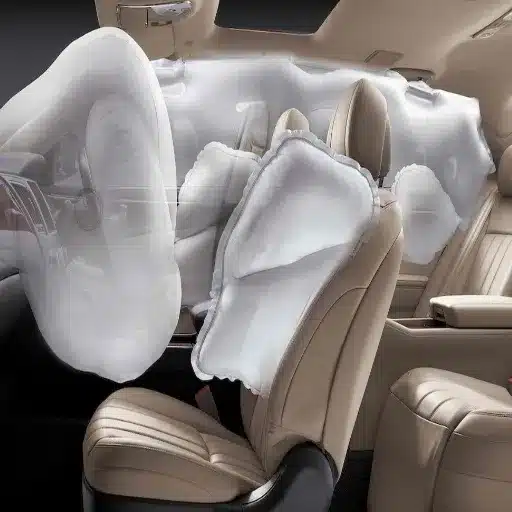
The majority of driver’s part of the interior is fitted with a coated airbag. Nearly all the airbag cushions in this application are designed to fold inside the steering hub in the absence of a large circumferential volume required for an unfolded, uncoated airbag cushion. The rate of airbag inflation must be so rapid that only an edge-locked continuous airbag is capable of producing near-zero permeability. However, in the case of the airbags of the passenger side, the pressure is less and the fabric used in making the airbag need not be treated with any airtight treatments.
Side curtain airbags have coatings in almost all cases. They have a prolonged inflation dwell period of several seconds hence very minimal leakage is aimed at due with the coating further doubled as a shield against exposure to hot gas penetration. If you have any questions or need further assistance, don’t hesitate to get in touch with us.
Airbag Type vs. Property Requirements
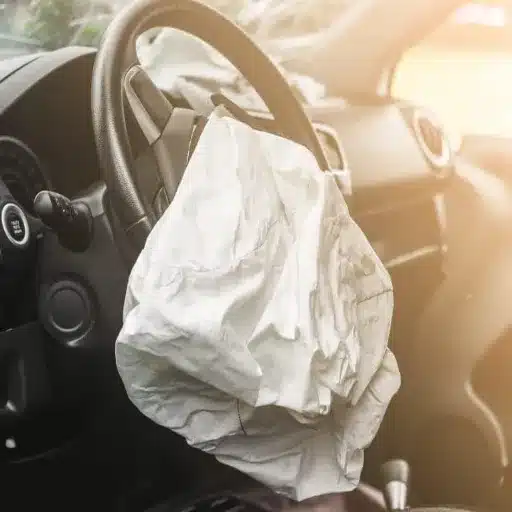
Different airbag types weight the same six properties differently. The matrix below summarizes the priority hierarchy for each cushion application.
| Airbag Type | Primary Properties | Notes |
|---|---|---|
| Driver frontal | Tensile, low permeability, fast deployment | Almost always coated; compact fold |
| Passenger frontal | Tear strength, gas retention | Often uncoated; larger inflation volume |
| Side curtain | Long-term gas retention, heat resistance | Coated; 5–10 second hold time |
| Knee airbag | Tear strength, compact fold | Smaller cushion, asymmetric deployment |
| OPW (one-piece woven) | Seam-integrated tear resistance | No sewn seams; tear at woven junctions matters |
| EV-specific | Lightweighting, low permeability | Trend toward 150 g/m² fabric for range optimization |
The electric-vehicle column matters increasingly. Priya Mehta, a restraint-systems engineer at an EV startup, recently described a redesign where every airbag in the cabin was respecified at 150 g/m² instead of the legacy 200 g/m². The reason was not safety, the reason was vehicle range. Eight kilograms saved across six cushions translates into measurable WLTP range improvement, and lighter fabric became a competitive imperative.
How Airbag Fabric Is Tested: Standards Reference
A defensible airbag fabric spec sheet references three layers of testing standards.
Material-level (fabric) standards:
| Property | Primary Standard | Equivalent |
|---|---|---|
| Strip tensile | ASTM D5035 | ISO 13934-1, ISO 1421 method 1 |
| Grab tensile | ASTM D5034 | ISO 1421 method 2 |
| Tear (Elmendorf) | ASTM D1424 | , |
| Tear (trouser) | ASTM D2261 | ISO 13937-2 |
| Air permeability | ASTM D737 | ISO 9237 |
| Coating weight | ISO 3801 | , |
| Heat / flame | ISO 6941 | , |
Component-level standards: SAE J2052 governs accelerated aging for restraint-system textiles.
System-level standards: FMVSS 208 (United States), ECE R94 (Europe), and GB standards (China) govern occupant crash protection, including airbag deployment behavior, at the vehicle level. FMVSS 208 is performance-based, meaning it does not specify a fabric. The OEM specifies the fabric to meet the system performance the regulation requires.
One testing detail rarely mentioned outside laboratories: coated airbag fabrics are slippery, and standard tensile jaws will let the specimen slip before it breaks. Pneumatic grips with specialty inserts are required to obtain a valid break, and the test report should document the grip type. If it does not, the strength number may be understated.
How to Read an Airbag Fabric Spec Sheet
A spec sheet that lists numbers without context is a marketing document. A spec sheet that supports procurement looks like the table below. This is a simplified version of the structure used on LY TRUSTLINK’s airbag fabric specifications page.
| Specification | Standard Grade | Premium Grade | Test Standard |
|---|---|---|---|
| Material | Nylon 6,6, Polyester | Nylon 6,6, Aramid | ASTM D2256 |
| Yarn denier | 420–840 dtex | 210–470 dtex | ASTM D1577 |
| Fabric weight | 175–200 g/m² | 150–175 g/m² | ASTM D3776 |
| Tensile (warp) | 2,000–2,500 PSI | 2,500–3,000 PSI | ASTM D5034 |
| Tear strength | 80–100 N | 100–130 N | ASTM D1424 |
| Air permeability | < 1 cm³/sec/cm² | < 0.5 cm³/sec/cm² | ASTM D737 |
| Heat resistance | Up to 800 °C | Up to 900 °C | ISO 6941 |
| Coating weight | 70–80 g/m² | 40–60 g/m² | ISO 3801 |
| Aging performance | 10 years | 12+ years | SAE J2052 |
Three procurement red flags to watch for:
- A spec value with no test standard listed beside it. The number is unverified.
- A single value rather than a range. Production fabric varies between lots; an honest data sheet acknowledges the variation.
- Missing aging performance. If a supplier has not run SAE J2052 on the actual fabric they are proposing, the qualification is incomplete regardless of how strong the tensile numbers look.
If you are at the supplier-shortlisting stage, our car airbag fabric supplier guide walks through the audit checklist that follows spec-sheet review.
Frequently Asked Questions
What are the most important properties of airbag fabric?
The six properties that determine airbag performance are tensile strength, tear strength, air permeability, heat resistance, elongation at break, and aging stability. Each is verified against ASTM or ISO test methods and tied to system-level FMVSS 208 compliance.
What is the tensile strength of airbag material?
Airbag-grade nylon 6,6 fabric typically delivers 2,000 to 3,000 PSI tensile strength in the warp direction, measured per ASTM D5034. Premium-grade material reaches the upper end of that range and supports demanding side curtain and OPW applications.
Why is nylon 6,6 the standard for airbag fabric?
Nylon 6,6 requires roughly 30 percent more thermal energy to melt than polyester at a similar melting point, which means it survives the high-temperature gas burst from an inflator without thermal failure. It also offers superior tenacity per unit weight.
How does air permeability affect airbag deployment?
Air permeability controls how the cushion holds pressure during occupant ride-down. Too high, and the bag deflates before the occupant decelerates. Too low, and the internal pressure spikes beyond the seam capability and the cushion ruptures. ASTM D737 at 125 Pa is the standard test.
What standards govern airbag fabric testing?
ASTM (D5034, D5035, D1424, D737) and ISO (1421, 13937-2, 6941, 3801) standards cover material-level fabric testing. SAE J2052 covers accelerated aging. FMVSS 208, ECE R94, and equivalent national regulations cover system-level deployment performance.
How long does airbag fabric last?
Properly specified airbag fabric maintains its mechanical properties for 10 to 12-plus years of vehicle service, validated by SAE J2052 accelerated aging. Service life depends heavily on coating quality, base yarn aging resistance, and the thermal environment of the cushion’s storage location.
Conclusion: From Spec Sheet to Supplier Decision
Each setting of airbag materials is meant to fulfill a performance substantiated tests and pass summary of time and mode of failure including relevant tests. The values of six properties, tensile strength, which are extensively used in paper thin airbag systems hinder passenger safety since they condition the performance of the airbag. In other words, when any of heat, air or tensile strength among other types of parameters is exceeded, the bag ruptures or raises in times of deployment or that an internal fire may occur thus turning the inflatablerestraint into a secondary danger.
Procurement engineers leave the marketing space created by these six attributes within a specifications manual where it belongs, and probes the material in this manual’s inserts rigorously minimizing the irrational responses for data treatment and natural selection of such manufacturers specifying that fabricated the material for automobile use. For such procuring personnel, the overwhelming marketing tool which is an integral part of the data sheet is fully bared and becomes a technical contract as it should have been in the first instance.
LY TRUSTLINK engineers airbag fabric to the full property spectrum documented above, with traceable testing per ASTM, ISO, and SAE methods and aging qualification per SAE J2052. To review a Standard or Premium grade data sheet against your program requirements, request a technical specification package or talk to our engineering team directly.