
Lightweight Waterproof Tarp for Camping: Materials & Sizes
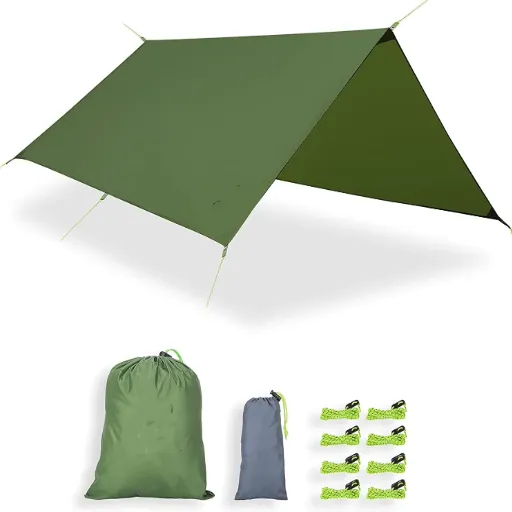
A lightweight waterproof tarp for camping comes down to a single trade-off: the fabric that carries best sheds rain least, and the fabric that sheds rain best carries heaviest. For ultralight backpacking, silnylon and silpoly win, at under 600 g for a full-size shelter. For car camping, base camp, and group shelters, a PVC-coated or laminated tarp wins on durability and sustained waterproofing, even at 4 to 6 kg. The right answer isn’t one material; it’s the material that matches how you camp.
Here is the part most buying guides skip. A lighter tarp is not automatically a better camping tarp. Weight is one number in a spec sheet, and a tarp chosen on weight alone is the tarp that lets you down in the third hour of a storm. What actually keeps you dry is hydrostatic head, seam construction, and denier, and those three specs rarely appear on a retail product page.
We build coated and laminated technical fabric for a living, so we can give you the version a gear round-up cannot: what “lightweight” really means, a material comparison by the numbers, a size table, the honest answer on whether PVC belongs in a pack, and how to source camping tarp fabric if you make gear rather than buy it.
Key Takeaways
- Weight is not the measure of a camping tarp; hydrostatic head is. A 3,000 mm rating handles sustained rain, and anything below that is shower cover only.
- Silnylon and silpoly win for backpacking at under 600 g per 3×3 m tarp, but nylon stretches when wet, so you re-tension the lines after rain.
- PVC is the wrong answer for a pack and the right answer for a camp. A 3×3 m PVC tarp weighs 4 to 6 kg, but it outlasts ultralight fabric for car camping, base camp, and group shelters.
- Size should match people plus gear: roughly 10×7 ft solo, 10×8 ft for two, 13×10 ft for three to four, and 15×15 ft or larger for groups.
- If you manufacture camping gear, the fabric is the product. Base fabric, coating, hydrostatic head, and seam type decide the performance your brand can claim.
What Makes a Camping Tarp “Lightweight”?
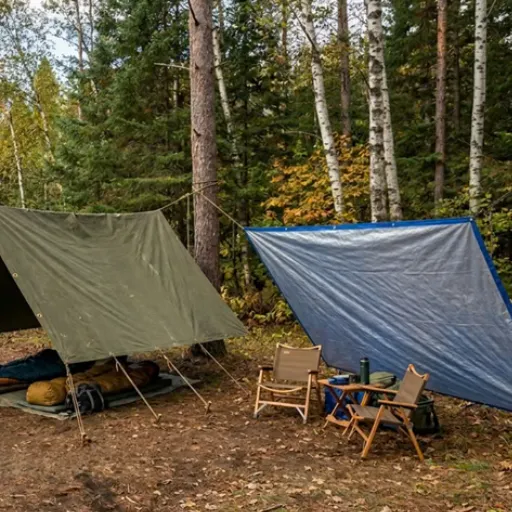
Lightweight is a relationship between weight and coverage, not a fixed number. A solo tarp that covers one person and weighs 300 g is light; the same tarp scaled to cover a family is not. The useful benchmark is weight per shelter: under 600 g for a solo or two-person backpacking tarp, and under 1 kg for a large family model.
The reason weight matters is that it’s the only spec you pay for twice. A heavy tarp costs you once at purchase and again on every kilometre of trail. That’s why backpackers accept a shorter service life for a lighter shell, and why car campers, who carry nothing, shouldn’t.
That trade-off is the whole design problem. Fabric engineers trade abrasion resistance, tear strength, and coating durability for grams, and the trade isn’t linear. Cutting the last 200 g off a tarp usually costs more durability than cutting the first 500 g, which is why the lightest tarps are also the most fragile.
Speaking of the full picture: our complete waterproof tarp guide covers how coating technology and fabric construction set waterproofing across every application, not just camping.
Lightweight Waterproof Tarp for Camping: Materials Compared
Six fabrics cover almost every camping tarp. The best material for a camping tarp is silnylon or silpoly for backpacking, at under 600 g per 3×3 m; PU-coated polyester for general camping; and PVC or laminated fabric for car camping and group shelters. In the silnylon vs PVC question, that is the whole answer: the right pick follows how you carry the tarp, not a single best fabric.
Every camping tarp is one of six fabrics, and each one occupies a different point on the weight-versus-durability curve. This table is the decision tool, because no retail page puts them side by side with the specs that matter.
| Material | Weight (3×3 m) | Hydrostatic head | Behavior | Best camping use | Typical life |
|---|---|---|---|---|---|
| Silnylon (20–30D) | ~0.5–0.8 kg | 1,500–3,000 mm | Stretches when wet | Ultralight backpacking | 3–8 years |
| Silpoly (20–30D) | ~0.6–0.9 kg | 1,500–3,000 mm | Holds shape when wet | Backpacking, 3-season | 5–10 years |
| Dyneema (DCF) | Lightest per strength | High | Stiff, low stretch | Ultralight, premium | 5–10 years |
| PU-coated polyester | ~0.8–1.2 kg | 2,000–5,000 mm | Holds shape | General camping | 3–7 years |
| PE (poly) | ~1.5–3 kg | Low–medium | Stiff, cheap | Car camping, ground cover | 1–3 years |
| PVC-coated / laminated | 4–6 kg | Highest sustained | Heavy, abrasion-proof | Car camping, base camp, group shelter, ground sheets | 5–10 years |
Three readings decide the choice. Silnylon is the backpacker’s default because it is light and packs small, but it sags in rain and rewards anyone willing to re-tension. Silpoly fixes the sag at a small weight cost, which is why it’s displacing silnylon among long-distance hikers. PVC sits at the far end: the heaviest option, and the one that still performs after a decade of sun, wind, and dragging across gravel. Contact LY TRUSTLINK for durable inflatable castle tarpaulin.
Hydrostatic Head: The Only Waterproof Number That Matters
Hydrostatic head is the height of a water column the fabric can hold before it leaks, measured in millimetres. Camping tarps run from about 1,500 mm to over 18,000 mm, and the practical line is 3,000 mm. Below it, you’ve got shower cover; at or above it, you’ve got rain protection that holds through a sustained storm. The test itself is standardized, set out under ISO 811 and AATCC 127, which is why a manufacturer can quote the number and a marketer cannot invent it. If you want the full breakdown of how that rating is produced and read, our explainer on the ARP waterproof rating walks through it line by line.
Seam construction is the quiet second half of waterproofing. A taped or welded seam keeps water out; a stitched seam leaks along the needle line no matter how high the fabric rating. Our tarpaulin seam and welding work uses heat-sealed bonds for exactly this reason: the seam is where most tarps fail first.
What Size Waterproof Tarp Do You Need for Camping?
Size follows people plus gear, not people alone. A tarp sized for two sleepers but not their packs becomes cramped the moment the weather turns. The table below uses common pitching angles and leaves room for a sheltered vestibule.
| Campers | Minimum size | Metric equivalent | Notes |
|---|---|---|---|
| Solo | 10 x 7 ft | ~3 x 2 m (or 3 x 3 m) | Round up for hammock or bivy use |
| Two | 10 x 8 ft | ~3 x 2.4 m | Add width if packing two large packs |
| Three to four | 13 x 10 ft | ~4 x 3 m | The bushcraft standard for two plus gear |
| Groups / family | 15 x 15 ft or larger | 4.5 m and up | Car camping and base camp only |
Two rules reduce sizing mistakes. First, round every edge up by about 20 cm for wind margin, because a tarp that just covers your site will flap. Second, match shape to the pitch: square and rectangular tarps give the most living space, diamond pitches shed wind better, and hexagonal tarps trade a little coverage for a lighter carry.
Is PVC Good for a Camping Tarp?
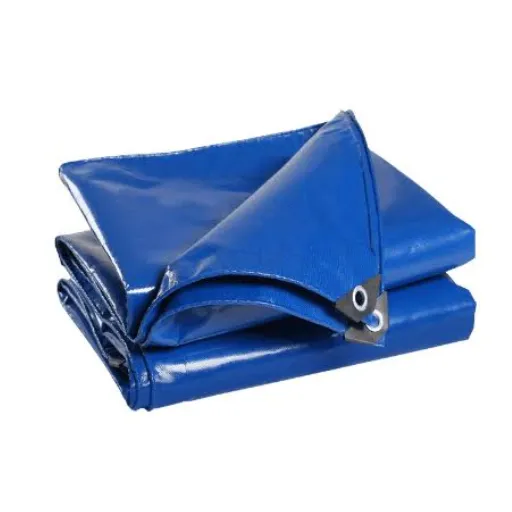
Yes, if you’re not carrying it. PVC is the wrong choice for ultralight backpacking, where a 3×3 m tarp weighs 4 to 6 kg and every gram is a penalty. But for car camping, base camp, group shelters, ground sheets, expedition supply, and event or emergency cover, PVC is often the correct engineering choice, because weight stops being the constraint and durability, UV life, and sustained waterproofing take over.
This is where most camping content gets it wrong in one direction or the other. Backpacking writers dismiss PVC outright, and tarp sellers push it for everything. The honest version sits in the middle, and it matters most for the reader who camps from a vehicle and wants one tarp that lasts a decade rather than three lighter ones that do not.
When Lightweight Specs Are the Wrong Spec
Four situations call for a heavier build, and choosing light fabric for them is a false economy.
- Heavy abrasion: a tarp used as a ground sheet or dragged over rock wears through a lightweight coating quickly.
- Prolonged UV exposure: a tarp left pitched for weeks degrades faster than a backpacking tarp used for weekends.
- Structural load: wind and snow loading on a large group shelter exceeds what a sub-1 kg fabric is rated to carry.
- Repeated setup and teardown: every fold and reefing stresses the coating, and thin coatings delaminate first.
For these jobs, a heavier PVC-coated or laminated tarp pays back over its life. Our guide to heavy-duty waterproof tarps covers the specifications behind that longer service life.
Choosing between coated and laminated construction? The two finishes behave very differently under load and UV. See how laminated fabric is engineered →
What a Lightweight Waterproof Tarp for Camping Costs
Price tracks material and size more than brand. The ranges below reflect typical retail pricing in 2026 and give you a benchmark to sanity-check a purchase or a quote.
| Tier | Typical size | Material | Price range |
|---|---|---|---|
| Budget | 3 x 3 m | PE or basic PU polyester | 30–30–60 |
| Mid | 3 x 3 m | Branded silnylon / silpoly | 110–110–200 |
| Premium / ultralight | 3 x 3 m | Dyneema (DCF) | 200–200–320+ |
| Large / group | 4 x 4 m and up | Vinyl / PVC or heavy coated | 150–150–300+ |
The cheapest line is rarely the cheapest decision. A 40PE tarp replaced every other season costs more over five years than a 160 tarp that lasts the same span, and it doesn’t account for the trips it spoils. Cost per season, not sticker price, is the number worth comparing.
That is how Colin learned it. He bought two budget poly tarps for his family’s summer car camping in June, and by August both had torn at the grommets from wind flutter. The next spring he replaced them with a single heavier laminated tarp, and it has covered four seasons of family trips since. The lighter up-front spend cost him two ruined weekends and a full replacement cycle.
How to Waterproof and Maintain a Camping Tarp
Keeping a lightweight waterproof tarp for camping in service is mostly a seam-sealing job, not a recoat. A new tarp is waterproof; a tarp in its third season usually is not. The fix is more often seam sealing than surface recoating, because water enters through seams and worn folds long before it penetrates the fabric face. Silicone seam sealer or a product like Gear Aid Seam Grip addresses the stitching and the corners, and a spray-on DWR such as Nikwax TX Direct restores water beading for several months at a time.
There is a hard limit worth knowing. Once a nylon tarp’s PU coating has degraded to a sticky or flaking film, no surface treatment brings it back, and replacement is the only reliable answer. Our guide on how to waterproof a tarp walks through the full procedure, including the DIY silicone-and-mineral-spirits option.
Storage decides how long a coating lasts. Fold a tarp dry, store it cool and dark, and keep it off concrete, which wicks moisture. A tarp stored wet grows mildew, and mildew damage is permanent.
Sourcing Camping Tarp Fabric: The OEM Path
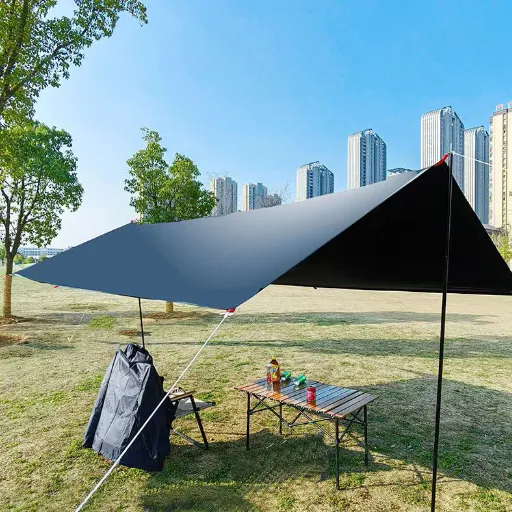
If you build gear rather than buy it, the tarp you sell is only as good as the fabric you specify. This is the part of the market no camping blog covers, and it’s the reason a camp brand’s reputation can rise or fall on a supplier’s roll of coated nylon. A camping tarp spec sheet starts with five decisions: base fabric denier, fabric weight in gsm or oz/yd², coating chemistry, hydrostatic-head target, and seam type.
The rest is manufacturing discipline. Coatings run from PU to PVC, TPU, and silicone, each with a different balance of weight, waterproofing, and UV life. Base fabrics range from 20D ultralight nylons to 1000D high-tenacity polyester for heavy duty shells. Seams are welded, heat-sealed, or taped, and the joint you choose changes both the cost and the waterproof rating your brand can claim. Tensile and tear performance is tested to standards like ASTM D5034, and fire retardancy for enclosed or commercial use to NFPA 701.
Elena, who sources fabric for a small outdoor brand, learned the difference between a spec and a guess the hard way. Her first supplier shipped a coated nylon that tested well in the lab but sagged after two wash cycles, and a season of returns followed. She rebuilt the spec around base denier, gsm, and a hydrostatic-head target, then asked for test reports per batch. Returns dropped, and the brand finally had a fabric story it could print on the hangtag.
Building a gear line? We engineer custom tarpaulin fabric to your exact denier, gsm, coating, and compliance requirements, from first sample to volume supply.
Frequently Asked Questions
What is the best material for a camping tarp?
For a lightweight waterproof tarp for camping, there is no single best material, only a best fit. Silnylon or silpoly is best for lightweight backpacking at under 600 g per 3×3 m tarp. PU-coated polyester suits general camping, and PVC or laminated fabric is best for car camping, base camp, and group shelters where durability outweighs weight.
Is PVC good for a camping tarp?
Yes for car camping, base camp, group shelters, ground sheets, and expedition use, where durability and sustained waterproofing matter more than weight. No for ultralight backpacking, where a 3×3 m PVC tarp at 4 to 6 kg is far too heavy to carry.
What size waterproof tarp do I need for camping?
Size by people plus gear: roughly 10×7 ft for one, 10×8 ft for two, 13×10 ft for three to four, and 15×15 ft or larger for groups. Round each edge up by about 20 cm for wind margin.
What hydrostatic head do I need for a camping tarp?
Aim for at least 3,000 mm. That rating holds through sustained rain, while lower ratings of 1,500 to 2,000 mm are shower cover only. Tarps for heavy exposure run 5,000 mm and above.
What is the difference between silnylon and silpoly?
Both are lightweight coated nylons and polyesters, but silnylon stretches up to about 4% when wet and needs re-tensioning in rain, while silpoly holds its shape at a small weight cost. Long-distance hikers increasingly choose silpoly for that reason.
Do I need a ground tarp under my tent?
A ground tarp protects the tent floor from abrasion and punctures and adds a moisture barrier. Use a heavy PE or coated fabric sized slightly smaller than the tent floor so it does not catch and channel rainwater.
How much does a lightweight waterproof camping tarp cost?
Budget 3×3 m tarps run 30to30to60, branded silnylon or silpoly 110to110to200, and ultralight Dyneema 200to200to320 or more. Compare cost per season rather than sticker price.
Can you buy camping tarp fabric in bulk?
Yes. Manufacturers can supply coated and laminated fabric by the roll in custom denier, gsm, coating, colour, and width, with per-batch tensile, tear, and hydrostatic-head test reports. Minimum order quantities apply and are confirmed at quotation.
Conclusion: Match the Tarp to the Trip
Choosing a lightweight waterproof tarp for camping comes down to four decisions. Match the material to how you carry it, letting silnylon and silpoly serve backpacking and PVC serve car camping and base camp. Check the hydrostatic head, and treat 3,000 mm as the floor for real rain.
Size the tarp by people plus gear, with a 20 cm wind margin on every edge. Then compare cost per season rather than sticker price, because the cheaper tarp is often the more expensive one.
Get those four right and the same tarp will keep you dry in the storm that decides whether the trip was worth it. If you build gear rather than buy it, the fabric underneath the design is what sets both the waterproofing you can claim and the lifespan your customers will feel. Our engineering team specifies and manufactures coated and laminated technical fabric to your exact denier, gsm, coating, and compliance requirements, from first sample to volume supply.
Ready to specify camping tarp fabric? Talk to our engineering team about custom tarp fabric, or read the best waterproof tarp guide by application for the full industry-wide spec framework.