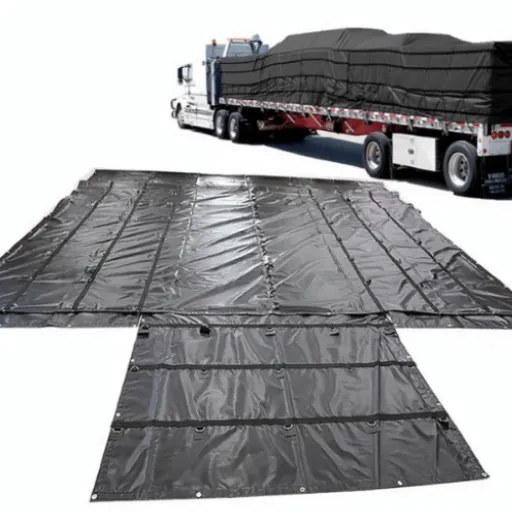

Truck Tarpaulin Price: What a Finished Tarp Actually Costs
A finished 24×27 lumber tarp in 18 oz runs about USD 320 at US retail in late 2026. The same size in 14 oz runs about USD 300. A 16×27 in 18 oz comes in near USD 250.
Those are real list prices, captured from two US retailers on 26 October 2026. They’re also the numbers most fleets never see, because searching for a truck tarpaulin price returns a wall of marketplace listings with a range and no reasoning.
Here’s what surprises buyers. The 18 oz tarp carries 28% more fabric than the 14 oz and costs only 7% to 11% more. That gap runs against everything a price-per-square-metre comparison teaches.
This guide gives you the per-piece prices, the two rules that explain them, and a cost-per-year model you can re-run against your own records. It’s written from the coating line, by the team that manufactures and batch-tests these fabrics. For the specification picture behind any of these numbers, start with the complete truck tarpaulin guide.
Key Takeaways
- The truck tarpaulin price for a finished 24×27 lumber tarp is about USD 320 in 18 oz and USD 300 in 14 oz at US retail; a 16×27 runs about USD 250 and USD 230.
- Moving from 14 oz to 18 oz adds 28% more fabric mass but only 7% to 11% more price, because most of a finished tarp’s cost is fixed per piece, not per square metre.
- Price per square metre falls as the tarp gets bigger, from USD 6.23 at 16×27 to USD 5.32 at 24×27 in 18 oz. A smaller tarp isn’t better value; it just spreads the same fixed cost over less fabric.
- Two 24×27 tarps per trailer differ by USD 40 between 14 oz and 18 oz. The heavier tarp only has to outlast the lighter one by 2.4 months to pay that back.
- A tarp quote isn’t the cost of tarping. Bungees, repair tape, corner protectors, fitting labour, and downtime sit outside the price and often exceed it over a five-year cycle.
How Much Does a Truck Tarpaulin Cost?
A truck tarpaulin price ranges from about USD 62 for a smoke tarp to USD 495 for a large lowboy tarp, with common flatbed sizes clustering between USD 230 and USD 325. Three things set the number: area covered, fabric weight, and construction.
Lumber tarps carry the truck tarpaulin prices that matter most, because they’re the volume sellers in flatbed fleets.
| Tarp size | Drop | Fabric | Price | Area | Cost per m² | Cost per kg |
|---|---|---|---|---|---|---|
| 16×27 | 4 ft | 14 oz | USD 229.99 | 40.1 m² | USD 5.73 | USD 12.07 |
| 20×27 | 6 ft | 14 oz | USD 269.99 | 50.2 m² | USD 5.38 | USD 11.33 |
| 24×27 | 8 ft | 14 oz | USD 299.99 | 60.2 m² | USD 4.98 | USD 10.49 |
| 16×27 | 4 ft | 18 oz | USD 249.99 | 40.1 m² | USD 6.23 | USD 10.21 |
| 20×27 | 6 ft | 18 oz | USD 299.99 | 50.2 m² | USD 5.98 | USD 9.80 |
| 24×27 | 8 ft | 18 oz | USD 319.99 | 60.2 m² | USD 5.32 | USD 8.71 |
Source: Flatbed Equipment Inc, list prices, 26 October 2026. Before tax and freight. Derived columns calculated from listed dimensions.
Steel tarps price differently because they’re built differently: four-sided with no end flap, which means more panels, seams, and D-ring rows for the same footprint.
| Tarp size | Drop | Fabric | Price | Area | Cost per m² |
|---|---|---|---|---|---|
| 16×27 | 4 ft | 18 oz | USD 274.99 | 40.1 m² | USD 6.85 |
| 20×18 | 6 ft | 18 oz | USD 287.99 | 33.5 m² | USD 8.61 |
| 24×18 | 8 ft | 18 oz | USD 324.99 | 40.1 m² | USD 8.10 |
Source: US Cargo Control, list prices, 26 October 2026.
Read the steel dimensions carefully. Steel tarps are specified by covered footprint, not the lumber convention. A 20×18 steel tarp covers 33.5 m² while a 20×27 lumber tarp covers 50.2 m².
Don’t line them up by the first number alone. The one clean like-for-like in this data is 16×27, which both types offer at 40.1 m². At that size and weight, steel costs 10% more than lumber.
The remaining types round out the range: a heavy-duty coil tarp at 6×6×6 ft runs USD 117.99, a smoke or nose tarp about USD 61.99, and RGN/lowboy tarps from USD 399 to USD 495 for 12 ft to 13 ft drops.
Smoke tarps deserve a mention. At USD 62 they’re the cheapest item on any tarp order and the one most often left off. A smoke tarp shields the front of the load from exhaust soot on a long haul. Skip it, and you may be re-covering freight at the destination for the price of a part you didn’t buy.
If you know your finished dimensions and weight, the fastest way past these market figures is a quote against your own spec. Request a per-piece quote and we’ll price the construction you need, with batch test data attached.
Why Price Per Square Meter Misleads Buyers
Price per square metre is the wrong unit for pricing a finished tarp. It’s the right unit for roll goods, and it’s why so many fleet buyers reach the wrong conclusion when comparing sizes.
A Bigger Tarp Costs Less Per Square Meter
The 16×27 works out to USD 6.23 per square metre at 18 oz. The 24×27 works out to USD 5.32. The bigger tarp is 15% cheaper per square metre.
| Tarp | Price | Area | Cost per m² |
|---|---|---|---|
| 16×27, 18 oz | USD 249.99 | 40.1 m² | USD 6.23 |
| 20×27, 18 oz | USD 299.99 | 50.2 m² | USD 5.98 |
| 24×27, 18 oz | USD 319.99 | 60.2 m² | USD 5.32 |
The cause is a fixed-cost floor. Cutting, seaming, hemming, fitting D-ring rows, reinforcing corners, inspecting, folding, packing, and shipping are largely fixed per piece. They don’t shrink when the tarp shrinks.
Daniel Ruiz, who buys tarps for a 40-trailer flatbed carrier in Ohio, made exactly this comparison in early 2026. He saw a 16×27 at USD 6.23 per square metre against a 24×27 at USD 5.32 and concluded the smaller tarp was the worse product.
He was comparing two different jobs. His 8 ft stacks needed the 24×27. The 16×27 was for a lane with shorter loads, and buying it saved USD 70 per tarp on a piece correctly sized for the work.
Compare tarps on price per piece at the size you actually need. Use cost per square metre only to compare the same size across two suppliers.
The Weight Paradox: 18 oz Costs 7 to 11 Percent More Than 14 oz
At the same size, the 18 oz tarp costs between 6.7% and 11.1% more than the 14 oz.
| Tarp size | 14 oz | 18 oz | Premium for 18 oz |
|---|---|---|---|
| 16×27 | USD 229.99 | USD 249.99 | +8.7% |
| 20×27 | USD 269.99 | USD 299.99 | +11.1% |
| 24×27 | USD 299.99 | USD 319.99 | +6.7% |
The 18 oz fabric carries about 28% more mass. It delivers a 7% to 11% price increase. That’s the fixed-cost floor again, working in your favour. Fabric is a minority of what you pay for; seaming, hardware, reinforcement, and handling are the majority, and they cost the same either way.
What does the extra money buy? In specification terms, 18 oz is roughly 610 GSM. That sits inside the standard-duty band for truck covers. At 14 oz, roughly 475 GSM, you’re below it.
Our published service-life table in the heavy-duty truck tarpaulin specifications guide starts at 550 GSM, where standard PVC runs 3 to 5 years in daily fleet duty. Below that threshold, you’re outside the band we publish figures for.
That’s the honest version of the claim. The 18 oz doesn’t jump you into the heavy-duty 750 to 900 GSM bracket, which runs 5 to 10 years. It moves you from below the standard band to inside it.
The procurement conclusion still holds, and it’s the opposite of what a per-metre comparison suggests. Up-specifying from 14 oz to 18 oz is the cheapest durability a fleet can buy.
Price by Tarp Type: What Construction Adds
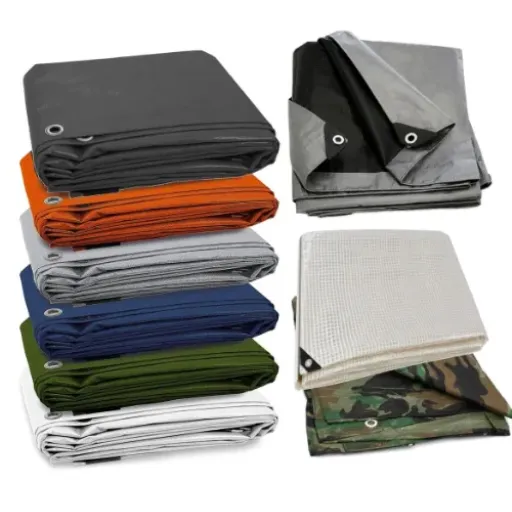
Fabric weight explains part of the price. Construction explains the rest.
Lumber tarps are the baseline: two drops, an end flap, two or three rows of D-rings, heat-sealed seams. They’re the cheapest per square metre of the flatbed types because the construction is simplest.
Steel tarps cost about 10% more for the same footprint. Four-sided construction with no end flap means additional panels, seams, and D-ring rows.
Coil tarps are fitted rather than draped. A 6×6×6 coil tarp at USD 118 is a small area at a high unit cost, because the shape needs more cutting and joining per square metre than a flat sheet.
RGN and lowboy tarps carry the highest single-piece prices at USD 399 to USD 495. A 12 ft or 13 ft drop means a large area, and these are the tarps most likely to need two people to deploy.
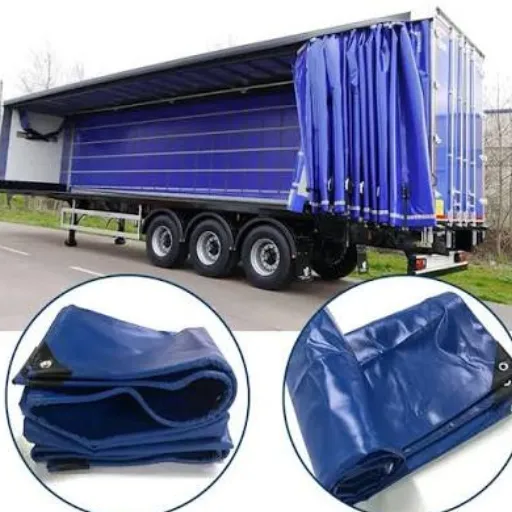
Side curtains are the exception to every table on this page. In every market we searched, curtainsider curtains are quoted per trailer, not listed at a price. That isn’t evasion. A curtain has to match the trailer’s dimensions, keder diameter, rail profile, and hardware kit, and it may carry fleet livery. Publishing a single number would be less useful than explaining why there isn’t one. If you’re specifying a curtain, see curtain-side specifications before you request quotes.
Factory-Direct vs Retail: The Landed-Cost Formula
Factory-direct tarps cost substantially less than US retail. Marketplace listings put finished 24×27 lumber tarps at roughly one-third to one-half of the retail figures above, at minimum order quantities around 100 pieces.
That gap is real, and it isn’t free. Four costs sit between the quoted price and the price at your dock.
Minimum order and working capital. An order of 100 tarps ties up capital in inventory you may not deploy for a year, and locks you into one specification before you have field data.
Lead time. Ocean freight plus production typically runs four to eight weeks. A tarp that fails in week three of a season can’t be replaced from that order.
Batch verification. You can’t inspect a container the way you can inspect a shelf. You need a pre-production sample, a batch test report covering tensile and tear, and a supplier who will answer what scrim sits under the GSM.
No local recourse. A retail purchase has a return path. An import dispute is a negotiation across time zones.
Aisha Bello, a procurement lead in Lagos, learned the fourth one the hard way. She sourced 120 tarps direct in 2025 at roughly 45% below local retail. The first batch performed well. The second, delivered six months later to the same specification, used a lighter scrim under the same GSM label and began tearing at the D-ring rows within a season.
The saving on paper was real. The cost of the second batch, the freight to replace it, and six weeks without coverage wasn’t.
We’re an exporter, so treat this section with the skepticism it deserves. But the arithmetic is the same whoever writes it. Don’t compare an FOB price to a retail price. Build the landed figure.
landed cost per piece = FOB price
 + ocean freight and insurance
 + import duty
 + inland haulage
 + inspection and sample cost
 + inventory carrying cost
Plug in your own freight and duty numbers. If the landed figure still beats local retail by a margin that covers lead-time and batch risk, import. If it doesn’t, buy locally and spend the difference on a better grade.
Import wins most often on fleet-standard sizes at volume. It wins least often on one-off sizes, urgent replacements, and specifications you haven’t proven in the field.
Cost Per Year: A Worked Fleet Example
Cost per year, not the sticker price, is the number that decides a specification. It’s the piece price divided by service life, plus labour to fit it, plus the cost of the truck standing still.
Start with the break-even, because it’s smaller than most buyers expect.
Two 24×27 tarps per trailer at 14 oz come to USD 599.98. The same two at 18 oz come to USD 639.98. The difference is USD 40.00 per trailer.
If the 14 oz set lasts three years, it costs USD 199.99 per year. For the 18 oz set to match that, it needs to last 3.2 years. That’s 2.4 months longer.
The heavier tarp only has to outlast the lighter one by 2.4 months to pay back the difference. Every month beyond that is return.
Now the sensitivity, because the conclusion depends on the lifespan gap and you should see it move.
| 18 oz service life | Annual cost, 18 oz | Annual cost, 14 oz at 3 yr | Saving per trailer | 20-trailer fleet |
|---|---|---|---|---|
| 3.0 years | USD 213.33 | USD 199.99 | −USD 13.34 | −USD 267 |
| 3.5 years | USD 182.85 | USD 199.99 | +USD 17.14 | +USD 343 |
| 4.0 years | USD 160.00 | USD 199.99 | +USD 40.00 | +USD 800 |
The honest reading: if both weights last the same time, the 18 oz costs USD 267 a year across a 20-trailer fleet. If the 18 oz lasts even six months longer, it saves USD 343.
That’s a narrow spread on a decision fleets often agonise over. It’s a small, calculable bet, and you should make it with your own replacement records rather than a rule of thumb.
Now add the costs no tarp quote includes.
| Line item | Typical figure | Why it’s missing from the quote |
|---|---|---|
| Bungees or straps | USD 43 to USD 60 per set | Sold separately |
| Repair tape | USD 15 to USD 45 per roll | Consumable |
| Corner protectors | Varies | Hardware, not fabric |
| Fitting labour | Crew time per changeover | Internal cost |
| Downtime | Truck not earning | Operational cost |
| Cargo claim exposure | Single event can exceed years of savings | Risk cost |
The accessory line isn’t trivial. A trailer needs a set of bungees at USD 43 to USD 60, and those wear out faster than the tarp. Over five years you may buy three sets of bungees for one set of tarps.
For the roll-goods version of this model, covering fabric priced by the square metre, see how PVC coated fabric is priced. For service-life data by material and duty cycle, see how long a PVC tarp lasts.
How to Compare Truck Tarpaulin Quotes
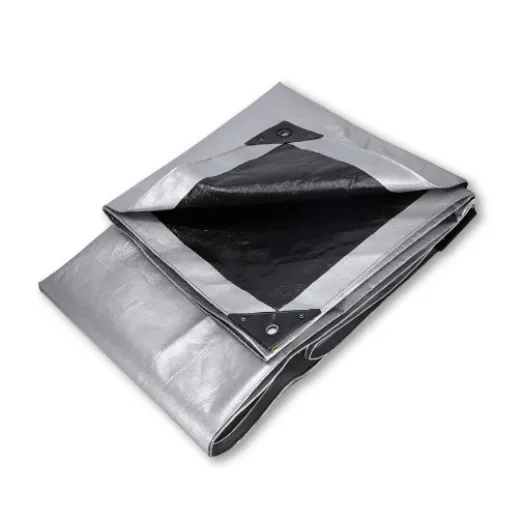
Two truck tarpaulin prices for the same “24×27, 18 oz” spec can differ by 30% and both be honest. They aren’t the same product, and the difference is visible if you ask the right questions.
Finished dimensions, not cut dimensions. Cutting, hemming, welding, and hardware consume 3% to 6% of the cut size. Always specify finished size and confirm the supplier is quoting the same.
Construction type. Two-drop lumber with end flap, four-sided steel with no flap, or three-piece set. These are different products at different prices.
GSM with a tolerance. Ask for the target and the permitted range. A “610 GSM” fabric at minus 5% is a different product from one at nominal.
Base scrim denier. 1000D at 20×20 threads per inch is the truck standard. A 500D scrim under the same GSM is a lighter, cheaper product.
D-ring rows and spacing. Two rows or three, and how far the first sits above the hem. This drives both cost and wind performance.
Hem, reinforcement, and seam method. Heat-sealed or RF-welded, reinforced corners, abrasion panels where banding contacts.
Incoterm and lead time. Get every supplier quoting the same delivery term, or you’re comparing FOB to delivered.
Three questions expose a quote that hasn’t been thought through. What scrim sits under the GSM? Can you send the batch test report with measured tensile and tear numbers? Which resin and plasticizer does the compound use?
A supplier who can’t answer those is quoting you a price for a word, not a product. In coated fabric, that opacity has a cost, and you usually discover it in year two.
If you want to see what a complete specification looks like before you send an RFQ, talk to our engineering team and we’ll send a production-line sample with its test data.
Frequently Asked Questions
How much does a truck tarpaulin cost?
A finished 24×27 lumber tarp costs about USD 320 in 18 oz and USD 300 in 14 oz at US retail. A 16×27 runs about USD 250 and USD 230. Steel tarps cost roughly 10% more at the same footprint.
Why is a 24×27 tarp cheaper per square meter than a 16×27?
Most of a finished tarp’s cost is fixed per piece. Cutting, seaming, hemming, D-ring rows, reinforcement, inspection, and packing cost nearly the same on both sizes. The larger tarp spreads that fixed cost across 60 m² instead of 40 m².
Is 18 oz worth the extra cost over 14 oz?
At 6.7% to 11.1% more, almost always yes for daily fleet duty. The 18 oz fabric is about 28% heavier and sits inside the standard-duty band where 14 oz sits below it. On two 24×27 tarps the difference is USD 40, repaid if the heavier tarp lasts 2.4 months longer.
How much does a lumber tarp cost compared with a steel tarp?
At the same 16×27 footprint and 18 oz, steel costs about 10% more: USD 274.99 against USD 249.99. Steel tarps are four-sided with no end flap, meaning more panels, seams, and D-rings. Don’t compare them across different footprints.
How much does a truck side curtain cost?
Every curtainsider curtain we found is quote-only, in every market searched. A curtain must match the trailer’s dimensions, keder diameter, rail profile, and hardware kit, and may carry fleet livery. Any single published number would mislead you.
How many tarps do I need for a 48 ft flatbed, and what will they cost?
Two tarps, overlapping one to two feet. For a 48 ft deck carrying lumber, two 24×27 tarps at 18 oz come to about USD 640 at retail. A 53 ft deck may need a third piece or longer tarps.
Is it cheaper to buy truck tarps factory-direct?
The FOB price is typically one-third to one-half of US retail, but only at minimum orders around 100 pieces. Add ocean freight, duty, inland haulage, inspection, and carrying cost before comparing. Import wins on fleet-standard sizes at volume, rarely on one-off or urgent replacements.
Why do two suppliers quote different prices for the same size?
Different scrim denier under the same GSM, different D-ring counts, different seam methods, different reinforcement, and different answers on whether the size is cut or finished. Ask about all five before treating two quotes as comparable.
Conclusion
The truck tarpaulin price on a listing is a starting point, not an answer. Four things move it, and only one is fabric weight.
Buy the piece, not the square metre. Price per square metre falls as tarps get bigger and as fabric gets heavier, because the fixed cost of making a tarp doesn’t scale with either. Compare on price per piece at the size you need.
Up-specifying is cheap. Moving from 14 oz to 18 oz costs 7% to 11% and buys 28% more fabric. On a two-tarp trailer that’s USD 40, repaid in 2.4 months of additional service.
Construction explains the rest. Steel costs about 10% over lumber at the same footprint because it has more panels, seams, and hardware. Coil and smoke tarps look expensive or cheap per square metre for the same reason: their shape, not their quality.
The quote isn’t the cost. Bungees, tape, protectors, labour, downtime, and claim exposure sit outside the price. A fleet that budgets only the tarp line is budgeting about half the real number.
Run the per-year calculation against your own replacement records before you commit to a grade. That’s the only figure that reflects how you actually operate, and it’s the figure that holds up in year three.
When you’re ready to price a specific construction rather than a category, send us the finished dimensions, the drop, and the weight. We’ll quote it against a batch-tested spec and send a production-line sample before you commit. Request your per-piece quote.