

Aquaculture Tarpaulin: Specs, Selection Guide
Aquaculture tarpaulin is a PVC-coated polyester technical fabric engineered specifically for water containment in fish farming and aquatic production systems. Unlike standard agricultural covers, fish farming tarpaulin must withstand constant hydrostatic pressure, chemical exposure, and UV degradation. The best aquaculture tarpaulin for your operation depends on four factors: GSM weight matched to tank size and hydrostatic load, heat-welded or RF-welded seam construction, UV stabilization rated for your climate, and compliance with food-safe or chemical-resistance standards relevant to your species and system.
A failed pond liner is never just a maintenance issue. It is a crop loss event. In 2023, Marcus Okafor, operations director for a commercial catfish farm outside Lagos, specified a 450 GSM polyethylene sheet for a new 6-meter grow-out tank based on a supplier’s recommendation of “heavy-duty” material. Within eight months, the seams split under hydrostatic pressure during the rainy season. The tank drained overnight. Twelve thousand fingerlings were lost, and the replacement cost — liner, labor, restocking, and four months of lost production — exceeded $18,000. The original “savings” of a few hundred dollars on a cheaper GSM had evaporated.
You have likely seen this pattern before. The aquaculture tarpaulin market is saturated with suppliers using inconsistent specifications, vague lifespan claims, and no engineering support. This guide provides the material data, selection criteria, and compliance standards you need to specify aquaculture tarpaulin with confidence. We will cover GSM and thickness selection, seam construction, application-specific requirements for biofloc and RAS systems, material comparisons, and the certifications that accelerate your procurement approval process.
Looking for reliable PVC-coated fabric suppliers? Reach out to LY TRUSTLINK for professional support and competitive manufacturing solutions.
Key Takeaways
- Match GSM to tank diameter and water depth: 650 GSM for standard biofloc tanks up to 5 meters, 750–900 GSM for large commercial systems, 450 GSM only for shallow nursery applications.
- Demand heat-welded or RF-welded seams; stitched seams wick water, harbor bacteria, and fail under hydrostatic load.
- Verify UV stabilization (3%+ inhibitors) and temperature ratings (-30°C to +70°C) for your climate zone.
- Specify food-grade compliance (FDA/NSF-ANSI 61) for human-consumption species and ammonia-resistant coatings for biofloc systems.
- Tarpaulin-lined ponds eliminate 30–50% water seepage common in unlined earthen ponds and deploy in hours, not weeks.
What Is Aquaculture Tarpaulin?
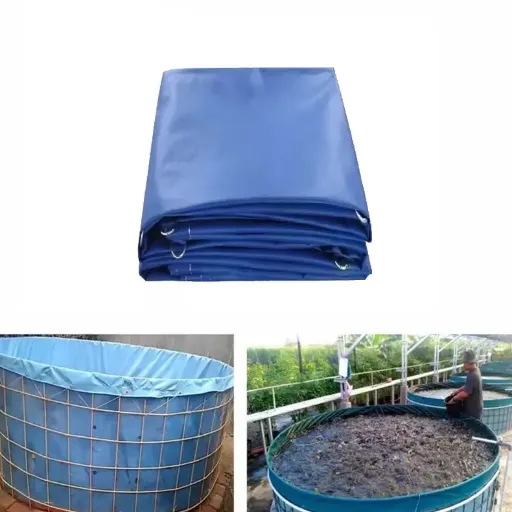
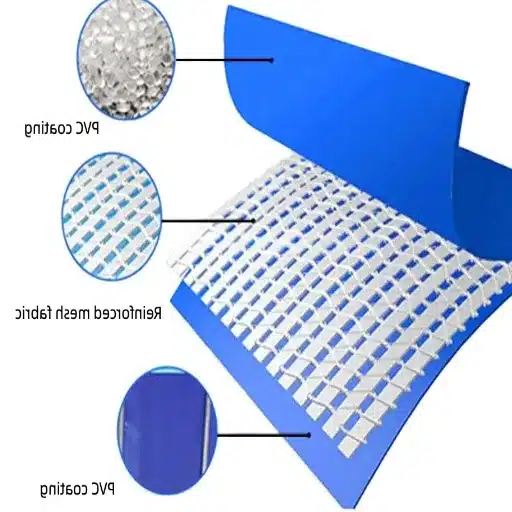
A PVC aquaculture tank liner — also called aquaculture tarpaulin — is a technical fabric consisting of a high-tenacity polyester base mesh coated with virgin-grade PVC, engineered for water containment in fish farming, shrimp production, and recirculating aquaculture systems. Unlike commodity polyethylene tarps used for construction site cover or general agriculture, aquaculture-grade tarpaulin is manufactured with specific tensile strength, chemical stability, and seam integrity standards necessary for permanent or semi-permanent immersion.
The core structure matters. A high-tenacity polyester scrim provides the mechanical backbone. Virgin PVC coating layers on both sides create an impermeable barrier. The result is a material that withstands hydrostatic pressure, resists UV degradation, and maintains flexibility across temperature extremes. Commodity PE tarps lack the scrim reinforcement and coating density required for pressurized tank applications. They degrade in months, not years.
For procurement teams evaluating suppliers, the distinction is critical. Aquaculture tarpaulin is not a generic cover. It is a structural membrane that contains your inventory. Specifying it correctly protects stock mortality rates, water consumption, and operational uptime. LY TRUSTLINK specializes in producing waterproof, weather-resistant, and long-lasting PVC coated fabrics for a variety of industries. Contact us for more information.
Aquaculture Tarpaulin Specifications That Matter
GSM and Thickness
GSM — grams per square meter — is the most frequently cited specification in aquaculture tarpaulin procurement. It directly correlates with material density, tensile strength, and service life. But GSM alone does not tell the full story. You must match it to tank diameter, water depth, and the hydrostatic load your system generates.
| GSM | Thickness | Typical Service Life | Best Application |
|---|---|---|---|
| 450 GSM | ~0.45 mm | 3–4 years | Nursery tanks, shallow systems (< 1 m depth), temporary installations |
| 550–600 GSM | ~0.5–0.55 mm | 4–5 years | Small commercial tanks, light-duty pond liners |
| 650 GSM | ~0.5–0.6 mm | 5–8 years | Standard biofloc tanks (3–5 m diameter), medium-duty commercial |
| 750–900 GSM | ~0.65–0.9 mm | 8–12 years | Large grow-out tanks (> 6 m diameter), deep water (> 1.2 m), high-pressure RAS |
| 1000+ GSM | ~0.9–1.0 mm+ | 8–12+ years | Industrial-scale systems, maximum durability requirements |
The 650 GSM grade is the most commonly specified for commercial biofloc operations. It offers the optimal balance of durability, flexibility, and cost for tanks in the 3–5 meter diameter range. For tanks exceeding 6 meters in diameter or depths over 1.2 meters, 750–900 GSM becomes essential. The hydrostatic pressure at the base of a 1.5-meter water column exerts approximately 15 kPa. A 10-meter tank at 1.3 meters depth generates hydrostatic loads exceeding 80 kPa. Your liner must be engineered for that load.
Tensile Strength and Tear Resistance
Tensile strength measures a fabric’s resistance to breaking under tension. For reinforced PVC aquaculture tarpaulin, typical values range from 2,500 to 4,000+ N/5cm depending on GSM and weave density. Tear resistance — measured as the force required to propagate a tear once initiated — typically falls between 350 and 650 N for quality grades.
The Panama Canvas weave method used in the polyester scrim enhances tensile performance by distributing load across intersecting yarns. Without this reinforcement, a PVC coating alone has poor physical tensile strength and will stretch or fail under hydrostatic pressure. When evaluating samples, request warp and weft tensile data, not just generic “strong” claims.
UV Stabilization and Weathering
UV radiation degrades unprotected PVC through photolytic breakdown of polymer chains. In tropical aquaculture zones, unprotected liners can show surface crazing and embrittlement within 18 months. Quality aquaculture tarpaulin incorporates 3% or higher UV inhibitor additives in the PVC compound. Some grades add a PVDF (polyvinylidene fluoride) topcoat for extreme UV environments, extending outdoor service life by 30–50%.
Temperature ratings are equally important. Standard grades perform from -30°C to +70°C. Cold-climate trout or salmon operations should verify cold-crack resistance below -30°C. Tropical tilapia and shrimp farms need the upper thermal limit and anti-oxidant stabilizers to prevent plasticizer migration in sustained heat.
For operations requiring custom GSM, coating formulations, or non-standard dimensions, request a custom aquaculture tarpaulin specification from our engineering team. Looking for reliable PVC coated fabric suppliers? Reach out to LY TRUSTLINK for professional support and competitive manufacturing solutions.
Seam Construction: The Critical Failure Point
Seams are where aquaculture tarpaulin systems fail. The material itself rarely tears in the field. Seams do. Understanding seam construction separates a reliable installation from a liability.
Heat-Welded and RF-Welded Seams
Heat welding uses hot air or wedge welding to fuse overlapping PVC layers into a molecular bond. RF (radio frequency) welding uses electromagnetic energy to excite polymer molecules at the joint interface, creating a weld that is often stronger than the parent material. Both methods produce watertight, permanent seams with no stitch holes for water to wick through.
For high-pressure biofloc systems and deep tanks, RF-welded seams are the standard. The bond integrity under cyclic loading — filling, draining, temperature expansion — exceeds that of thermal welding in most test protocols. When reviewing supplier samples, inspect the weld bead uniformity. A quality RF weld shows consistent bead width and no voids or cold spots.
Hot-Melt Sealing
Hot-melt sealed seams use a compatible adhesive compound applied under pressure and heat. This method is common for complex geometries — corner reinforcements, pipe boot integrations, and repair patches. Performance is strong but depends heavily on surface preparation and adhesive compatibility with the base PVC formulation.
Stitched and Taped Seams
Stitched seams pierce the fabric with needle holes. Even when taped on the reverse side, these holes create wick paths for water. In aquaculture, they also create micro-environments where bacteria colonize, leading to biofilm degradation of the surrounding PVC. Stitched seams are acceptable for agricultural shade covers. They are not acceptable for water containment.
Dr. Linh Tran, lead aquaculturist at a shrimp hatchery in Vietnam’s Mekong Delta, learned this during a facility expansion in 2022. Her initial supplier delivered 650 GSM liner with stitched seams to save on production cost. Within four months, biofilm accumulation at the stitch lines required aggressive cleaning that abraded the PVC coating. She replaced the entire system with RF-welded liner the following season. The new system has operated for three years without a single seam-related incident.
When evaluating samples, perform a simple seam peel test. A properly welded seam should require cutting to separate, not peeling.
Selecting Aquaculture Tarpaulin by Application
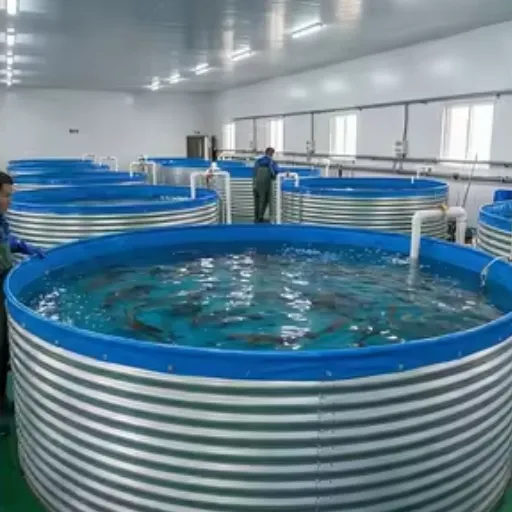
Biofloc Systems
Biofloc tank tarpaulin operates in one of the most chemically aggressive environments in aquaculture. Biofloc technology relies on dense bacterial floc to maintain water quality in high-stock-density tanks. This environment is chemically aggressive. Nitrogenous waste — ammonia and nitrite — attacks standard PVC plasticizers, causing embrittlement and surface cracking. Biofloc tank tarpaulin requires ammonia-resistant formulations with polymer-locked plasticizers that resist migration.
Anti-bacterial and anti-fouling surface coatings reduce biofilm adhesion, making tank cleaning faster and less abrasive. For tanks in the 3–5 meter diameter range, 650 GSM remains the standard. For larger systems exceeding 6 meters or depths over 1.3 meters, specify 750–900 GSM to handle the increased hydrostatic load and mechanical stress from aeration turbulence.
| Tank Diameter | Water Depth | Recommended GSM | Hydrostatic Load |
|---|---|---|---|
| < 3 m | < 1.0 m | 450–550 GSM | Low |
| 3–5 m | 1.0–1.2 m | 550–650 GSM | Medium (~10–20 tons) |
| 5–6 m | 1.2 m | 650–750 GSM | High (~20–35 tons) |
| > 6 m | > 1.2 m | 850–900+ GSM | Very High (80+ tons at 10 m) |
Recirculating Aquaculture Systems (RAS)
RAS operates at higher water velocities and more controlled chemistry than open pond systems. Liner requirements shift toward pressure containment and chemical resistance. Because RAS tanks are typically fully supported by galvanized or stainless steel frames, the tarpaulin functions as a membrane liner rather than a free-standing structure.
3D R-angle welding eliminates sharp corners where sludge accumulates and anaerobic zones develop. The rounded interior geometry improves hydraulic efficiency and reduces cleaning downtime. Specify hydrostatic pressure resistance of ≥50 kPa for RAS applications, with burst pressure ratings at least 3× operating pressure.
Pond Liners and Framed Tanks
For tarpaulin fish pond installations and galvanized steel frame tanks, ground preparation determines liner longevity. Sharp stones, tree roots, and construction debris puncture even heavy-grade tarpaulin over time. A protective geotextile underlayment — typically 200–300 GSM non-woven polypropylene — creates a buffered interface between soil and liner.
Anchoring methods vary by installation. Earthen ponds use trench-buried perimeter anchors or sandbag ballast. Galvanized frame tanks rely on rail systems or clamping bands that distribute tension evenly. Avoid point-load anchors that concentrate stress on single grommets or eyelets. Collapsible tarpaulin fish pond designs allow rapid deployment for seasonal operations or emergency backup capacity.
Hatcheries and Nursery Tanks
Hatchery operations for fry and post-larval stages use shallow, low-pressure tanks where 450–550 GSM is often sufficient. The critical requirement here shifts to food-grade material safety. Any liner in contact with species destined for human consumption must meet FDA compliance or NSF-ANSI 61 certification. Non-toxic, virgin-grade PVC without recycled content or heavy-metal stabilizers is mandatory.
Our aquaculture tarpaulin specifications include standard and custom GSM grades engineered for biofloc, RAS, and open-pond applications.
Material Comparison: PVC Tarpaulin vs. Alternatives
Aquaculture operators often evaluate PVC tarpaulin against HDPE, EPDM, and RPE liners. Each material has distinct performance characteristics. The right choice depends on your system type, budget horizon, and installation constraints.
| Property | PVC Tarpaulin | HDPE | EPDM | RPE |
|---|---|---|---|---|
| Tensile Strength | 2,500–4,000+ N/5cm | 1,500–2,500 N/5cm | 2,000–3,000 N/5cm | 1,800–2,800 N/5cm |
| Flexibility | High (remains pliable) | Moderate (stiffens) | Very High | Moderate |
| Seam Method | Heat/RF welded | Fusion welded | Adhesive/tape | Heat welded |
| UV Resistance | Excellent (with stabilization) | Good | Excellent | Good |
| Chemical Resistance | Excellent (ammonia, pH swings) | Good | Good | Good |
| Puncture Resistance | High (reinforced scrim) | Moderate | Moderate | Moderate |
| Repairability | Easy (PVC patch kits) | Difficult | Moderate | Moderate |
| Cost (per m²) | Mid-range | Low | High | Mid-high |
| Typical Lifespan | 5–12 years | 5–10 years | 15–20 years | 8–15 years |
HDPE offers lower upfront cost but lacks the polyester scrim reinforcement of PVC tarpaulin. It is prone to stress cracking at folds and seams under cyclic loading. EPDM delivers the longest lifespan — up to 20 years — but at significantly higher cost and with more complex seam installation. RPE (reinforced polyethylene) occupies a middle ground but lacks the chemical resistance and welding versatility of PVC for biofloc applications.
For commercial aquaculture operations prioritizing deployability, repairability, and chemical resistance, PVC tarpaulin typically delivers the strongest total cost of ownership. A 650 GSM PVC liner installed in a biofloc system at $12–18 per m², replaced once over a 10-year horizon, often undercuts the capital and installation cost of EPDM while outperforming HDPE on seam integrity and flexibility.
Certifications and Compliance Standards
Certifications are not bureaucratic checkboxes. They are the documentation your procurement team needs to approve a supplier, and they are the guarantee that your liner will not leach harmful compounds into your stock. The standards you require depend on your market, species, and export destinations.
FDA Compliance / NSF-ANSI 61: Required for any aquaculture tarpaulin in contact with species destined for human consumption in the United States. This certification verifies that the material does not leach regulated contaminants above permissible thresholds.
REACH / RoHS: European chemical safety standards that restrict hazardous substances including lead, cadmium, and specific phthalates in the PVC compound. Essential for exports to EU member states and for buyers with corporate sustainability mandates.
SGS Certification: A third-party verification of stated material properties — GSM, tensile strength, coating adhesion, and dimensional stability. SGS test reports provide procurement teams with independent validation of supplier claims.
ASTM Standards: ASTM D751 (coated fabrics testing) and ASTM D882 (tensile properties of thin plastic sheeting) provide standardized test methodologies for comparing material performance across suppliers. Request ASTM-compliant test reports when evaluating competitive bids.
NFPA 701 / B1 / M2: Flame retardancy certifications required for indoor aquaculture facilities, processing plants, or any installation where fire safety codes apply. Not all aquaculture tarpaulin is fire-retardant by default. Specify this property if your facility requires it.
Suppliers who cannot produce current certification documentation introduce compliance risk into your supply chain. Missing certifications create procurement delays, disqualify bids, and — in regulated markets — expose your operation to liability. Whether you need PVC-coated fabrics for truck covers, tents, tarpaulins, or outdoor products, LY TRUSTLINK is ready to support your business with reliable manufacturing expertise.
Installation, Maintenance, and Lifespan Optimization
Even the highest-grade aquaculture tarpaulin fails prematurely if installed or maintained incorrectly. The following protocols maximize service life and prevent the failure modes that cost operations time and stock.
Ground Preparation: Grade the site to eliminate sharp ridges and protrusions. Install a 200–300 GSM geotextile underlayment before deploying the liner. This single step prevents 80% of puncture-related failures in earthen pond applications.
Anchoring and Tensioning: Distribute mechanical stress evenly. For framed tanks, ensure the liner sits flush against the frame without point-loading at corners. For earthen ponds, bury the perimeter anchor trench at least 30 cm deep with a 15 cm overlap fold to prevent wind uplift and edge creep.
Cleaning Protocols: Rinse with freshwater after draining. Use mild detergent and soft brushes for algae or biofilm removal. Avoid abrasive pads, pressure washers above 1,500 psi, or solvents that degrade PVC plasticizers.
Inspection Schedule: Quarterly inspections should check seam integrity, surface abrasion, UV surface degradation (chalking or crazing), and anchor point stress. Annual inspections should include a full drain-down to inspect the base and lower walls, where sediment abrasion and exposure to anaerobic bacteria are highest.
Storage: If a liner is removed for seasonal use or rotation, roll it — do not fold. Folding creates crease lines that become stress concentrators and crack initiation points in cold storage. Store in a cool, dry location away from direct sunlight and ozone sources.
| Quality Tier | Expected Lifespan | Maintenance Level | Conditions |
|---|---|---|---|
| Premium (750+ GSM, welded seams, UV-stabilized) | 8–12 years | Regular cleaning, annual inspection | Optimal |
| Mid-range (650 GSM, welded seams) | 5–8 years | Basic maintenance, periodic inspection | Moderate exposure |
| Budget (450–550 GSM, stitched seams) | 1–3 years | Minimal | Temporary only |
The hidden cost of cheap liner extends far beyond replacement material. Labor for tank drain-down, liner replacement, and refill can exceed the material cost by 2–3×. Water loss during a failure event stresses surviving stock and disrupts feeding schedules. In your total cost of ownership calculation, the premium liner is almost always the economical choice.
We are more than a vendor — we are a reliable link in your supply chain. Our engineering team supports aquaculture operations from specification through certified delivery. Talk to an engineer about your project.
Conclusion
Specifying aquaculture tarpaulin is an engineering decision, not a purchasing convenience. The right material protects your stock, your water budget, and your operational continuity. The wrong material introduces failure modes that cascade into mortality events, compliance gaps, and unplanned capital expenditure.
To specify with confidence: match GSM to your tank diameter and hydrostatic load, demand RF-welded or heat-welded seams, verify UV stabilization and temperature ratings for your climate, and require certification documentation that satisfies your procurement and regulatory requirements. Select material for the operational life of your system, not the lowest line-item price.
The global tarpaulin market is projected to grow from 9.65 billion in 2024 to 13.72 billion by 2032, with aquaculture representing one of the fastest-expanding application segments. As the industry scales, the operations that thrive will be those that treat their containment infrastructure as seriously as they treat their breeding stock. Your liner is not an accessory. It is the membrane that holds your operation together.
For technical specifications, custom GSM requirements, or engineering consultation on your next aquaculture project, contact our team. We build aquaculture tarpaulin solutions to your exact operational requirements — from prototype samples to volume production with certified performance across every batch. Contact LY TRUSTLINK today to learn more about our high-performance PVC coated fabric solutions for industrial and commercial applications.