
Poly Tarp Waterproof: Engineering Guide to Polyethylene Tarpaulin Performance
Yes, a poly tarp is waterproof when new and intact. Polyethylene is inherently impermeable, and a factory-laminated PE tarpaulin typically delivers a hydrostatic head rating between 1,500 and 5,000 mm, enough to block sustained rain and short-term pooling. Real-world waterproofing, however, depends on three variables that most spec sheets never mention: coating integrity, seam construction, and UV exposure over time.
Last October, a regional logistics manager named Elena covered a flatbed of electronics with a standard blue poly tarp before a 1,200-mile run through the Gulf Coast. The tarp looked fine. Eight hours into the trip, a storm drove rain sideways across the load, a stitched seam split, and water damaged 12% of the cargo. The failure was not that poly tarps leak. It was that nobody had asked which poly tarp spec was waterproof enough for that route.
This guide gives procurement managers and operations engineers the numbers behind poly tarp waterproofing. You will learn how polyethylene tarpaulin is built, how to read hydrostatic head, mil, and GSM specs, how long the waterproofing actually lasts outdoors, and when upgrading to PVC tarpaulin is the rational engineering decision.
Key Takeaways
- A new, intact poly tarp is waterproof. Laminated polyethylene typically rates 1,500 to 5,000 mm hydrostatic head under AATCC 127 or ISO 811.
- Mil thickness and GSM weight are not interchangeable. For PE laminates, multiply mil by 17 to 20 to estimate GSM.
- UV exposure is the primary waterproofing killer. Standard non-stabilized poly tarps lose reliable waterproofing in 6 to 12 months outdoors.
- Seams and grommets fail before fabric does. Heat-sealed seams retain roughly 70% of base fabric hydrostatic head; stitched seams retain far less.
- Upgrade to PVC tarpaulin when exposure exceeds 12 months, hydrostatic head above 5,000 mm is required, or NFPA 701 compliance is mandatory.
Is a Poly Tarp Waterproof? The Engineering Answer
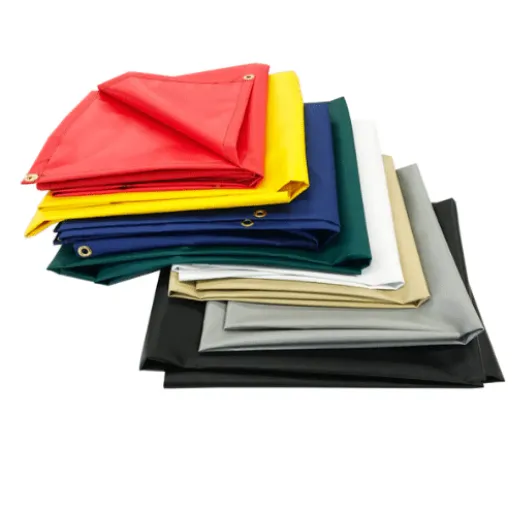
A poly tarp is waterproof if its laminate is intact, its seams are sealed, and its exposure history is short. Polyethylene itself does not absorb water. The woven HDPE scrim provides tensile structure, and the LDPE lamination on both faces forms a continuous impermeable film. Under controlled lab conditions, that construction blocks water pressure up to the rated hydrostatic head.
The distinction between water-resistant, waterproof, and heavy-duty waterproof matters for procurement. A tarp below 1,500 mm hydrostatic head sheds light spray but fails under pooling. A tarp between 1,500 and 5,000 mm handles steady rain and brief standing water. A tarp above 5,000 mm, typical of PVC-coated polyester, withstands prolonged ponding and wind-driven rain.
Marketing claims like “100% waterproof” mean nothing without a test method and a number. The relevant standards are AATCC 127 and ISO 811, both of which clamp a fabric sample and raise water pressure until three droplets penetrate. For a broader material-by-material view, see our guide on whether tarps are waterproof across all fabric types.
Specifying poly tarpaulin for a current project? Download our PE tarpaulin spec sheet for hydrostatic head, GSM, and UV stabilization data across our standard grades.
Poly Tarp Construction: What Makes It Waterproof
Woven HDPE Scrim: The Structural Backbone
The base of every poly tarp is a woven high-density polyethylene scrim. Weave counts are expressed as threads per inch in each direction. An 8×8 weave is light duty, 12×12 is medium, 14×14 is heavy, and 16×16 is super heavy. Higher weave counts resist tear propagation, which matters because a single puncture can unzip a loosely woven fabric under tension.
Denier measures the linear mass of the individual yarns. Common poly tarp deniers range from 800 to 1,800. Higher denier yarns carry more load and resist abrasion better, but they also add weight and stiffness. The right pairing depends on the application, not on a single “stronger is better” rule.
LDPE Lamination: The Waterproof Barrier
The waterproofing itself comes from low-density polyethylene laminated to both faces of the scrim. Coating weight typically runs 15 to 40 gsm per side. The lamination process uses heat and pressure to bond the film into the weave, sealing the gaps between yarns.
Delamination is the primary waterproofing failure mode. UV radiation, abrasion, and flex fatigue break the bond between film and scrim, creating micro-channels that wick water through the fabric. Once delamination starts, no surface treatment will restore the original hydrostatic head.
UV Stabilizers: The Lifespan Multiplier
Unstabilized polyethylene degrades rapidly in sunlight. Photo-oxidation attacks the polymer chains, causing chalking, embrittlement, and finally cracking. UV stabilizers such as hindered amine light stabilizers (HALS), carbon black, and BHT slow that process dramatically.
Stabilization performance is verified through QUV accelerated weathering per ISO 4892. A well-stabilized heavy-duty poly tarp should retain at least 80% of original tensile strength after 2,000 hours of QUV exposure, roughly equivalent to 18 to 24 months of subtropical sun.
Poly Tarp Waterproof Ratings: Hydrostatic Head, Mil, and GSM
Hydrostatic Head Testing (AATCC 127 / ISO 811)
Hydrostatic head measures how much water pressure a fabric resists before leaking, reported in millimeters of water column. The test applies water from below the sample at a controlled rate of rise, and the endpoint is the pressure at which three droplets appear on the upper surface.
Typical poly tarp ratings cluster in three bands:
| Classification | Hydrostatic Head | Real-World Equivalent |
|---|---|---|
| Water-resistant | Under 1,500 mm | Light spray, brief rain |
| Waterproof | 1,500 to 5,000 mm | Steady rain, short-term pooling |
| Heavy-duty waterproof | Above 5,000 mm | Prolonged exposure, ponding water |
Most laminated PE tarpaulin falls in the 1,500 to 5,000 mm band when new. PVC-coated polyester routinely exceeds 5,000 mm because the coating is continuous and the seams are welded rather than stitched.
Mil Thickness: What It Measures and What It Misses
Mil thickness measures the total film thickness in thousandths of an inch. Light-duty poly tarps run 5 to 6 mil, medium-duty 9 to 10 mil, heavy-duty 11 to 13 mil, and super heavy-duty 14 to 24 mil or more. Thicker film generally means more coating mass and longer waterproofing life, but mil alone says nothing about base fabric strength.
Buyers should also watch for the “true mil” problem. Some imported tarps are measured before coating or quote an inflated number that includes surface texture. Cross-check mil against GSM weight; the two should move together. If a 12 mil tarp weighs less than a competitor’s 10 mil tarp, the mil claim is suspect.
GSM Weight: The More Reliable Spec
GSM, or grams per square meter, measures total fabric weight. For PE laminates, a useful rule of thumb is to multiply mil by 17 to 20 to estimate GSM. A 6 mil tarp lands around 100 to 120 gsm, a 12 mil tarp around 200 to 240 gsm, and a 16 mil tarp around 270 to 320 gsm.
GSM is harder to game than mil because it is measured on a finished, conditioned sample. For B2B procurement, specifying both GSM and minimum hydrostatic head removes most quality ambiguity. Our application-specific waterproof tarp selection guide walks through GSM bands by use case in more detail.
How Long Do Poly Tarps Stay Waterproof? UV Degradation Timeline
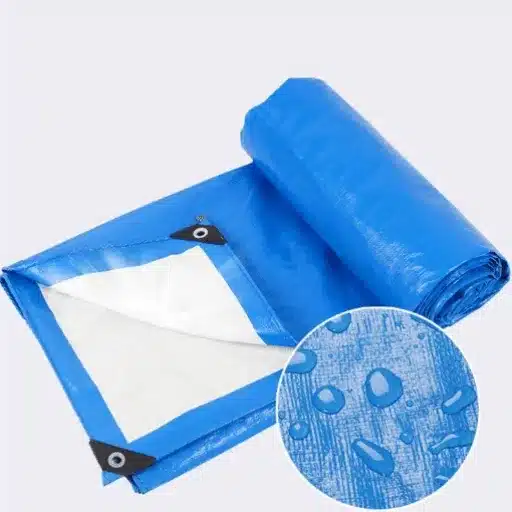
Waterproofing is not a permanent property. It is a time-decaying function of UV dose, thermal cycling, and mechanical wear.
A standard non-stabilized blue poly tarp loses reliable waterproofing in 6 to 12 months of outdoor exposure. UV-stabilized heavy-duty poly extends that to 1 to 3 years depending on climate. PVC tarpaulin, by comparison, maintains waterproofing for 5 to 8 years because the coating chemistry is more resistant to photo-oxidation and the seams are welded.
A Midwest agricultural cooperative learned this the expensive way. They standardized on a low-cost 9 mil non-stabilized poly tarp for hay storage in 2023. By the second season, half their covers showed visible chalking, and moisture readings inside the stack were running 4 points above target. After switching to a 200 gsm UV-stabilized grade, their covers held through 18 months of continuous exposure with no measurable moisture intrusion.
Watch for these signs of waterproofing failure:
- Chalking: a powdery white residue on the surface, indicating polymer breakdown.
- Micro-cracking: fine surface cracks that catch light, especially along fold lines.
- Delamination: peeling or bubbling where the laminate separates from the scrim.
- Seam separation: stitch lines that have loosened or heat seals that have lost adhesion.
- Grommet pull-out: eyelets that have torn free of their reinforcement patches.
Once two or more of these signs appear, the tarp is no longer a waterproofing asset. It is a moisture trap. For temporary restoration options, see our guide on how to waterproof a tarp with sprays, waxes, and sealants.
Poly Tarp Seam Construction: The Most Common Leak Point
Even a perfect laminate leaks if the seams are wrong. Field data consistently shows that seam lines, not fabric panels, are where water enters first. ASTM D751, the standard test method for coated fabrics, evaluates seam strength and coating adhesion precisely because these are the most common points of failure in the field.
Heat-Sealed Seams
Heat sealing uses controlled temperature and pressure to fuse the LDPE coatings of two panels. A properly executed heat seal retains roughly 70% of the base fabric hydrostatic head, so a 4,000 mm tarp delivers about 2,800 mm at the seam. This is the minimum acceptable construction for outdoor waterproofing duty.
Stitched and Taped Seams
Stitched seams punch hundreds of needle holes through the laminate. Each hole is a potential capillary path for water. Seam tape reduces the leak rate but does not eliminate it, and tape adhesive degrades under UV. Stitched and taped seams are appropriate for indoor covers and short-term outdoor use only.
Grommet Spacing and Reinforced Hems
Grommets concentrate stress. The industry standard for outdoor poly tarps is grommet spacing of 30 to 50 cm (12 to 24 inches) along reinforced hems. Wider spacing increases the load per grommet and accelerates pull-out. Reinforced hems use doubled fabric and, on better products, a rope or webbing insert to distribute tension.
When Marco, a flatbed fleet manager in Texas, specced his trailer covers with 60 cm grommet spacing to save cost, he started losing grommets after the third storm season. Re-specifying to 40 cm spacing with rope-reinforced hems cut his grommet failure rate to near zero and eliminated the cascade of seam tears that had been starting at pulled eyelets.
Have questions about tarp waterproof ratings, coatings, or long-term weather resistance? Reach out to LY TRUSTLINK for professional support and fast answers.
Poly Tarp Waterproof Performance by Application
Truck and Trailer Covers
Flatbed and trailer applications demand sustained wind-driven rain resistance at highway speed. Spec a minimum of 12 mil (200 gsm) UV-stabilized poly with heat-sealed seams and 40 cm grommet spacing. For multi-year fleet use, the math almost always favors PVC.
Construction Site Protection
Temporary site enclosures and pour protection see 4 to 16 weeks of exposure. A 10 to 12 mil stabilized poly tarp is appropriate. Where NFPA 701 fire retardancy is required by the site safety plan, poly tarpaulin is disqualified; switch to certified PVC.
Agricultural Covers
Hay, silage, and equipment covers see 6 to 18 months of exposure. A 14 mil (240 gsm) UV-stabilized poly tarp is the working standard. In high-UV climates, budget for annual replacement or upgrade to PVC.
Emergency Roof and Storm Protection
Post-storm roof covers need to perform for 30 to 90 days. A 10 to 12 mil stabilized poly tarp with battened edges is the right tool. Do not spec a blue non-stabilized tarp for anything longer than two weeks.
Temporary Outdoor Storage
Palletized materials in yard storage see sustained exposure with pooling risk on flat tops. Spec 12 mil or heavier, and design the stack with a pitched cap so water sheds rather than ponds. Standing water on a flat tarp accelerates hydrostatic failure regardless of the rating.
When to Upgrade from Poly Tarp to PVC Tarpaulin
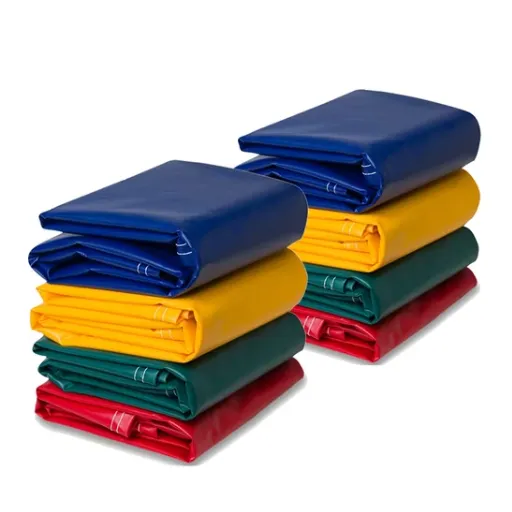
Poly tarpaulin is the right answer for short-term, moderate-exposure, cost-sensitive applications. It is the wrong answer when any of the following apply:
- Exposure duration exceeds 12 months continuously.
- Required hydrostatic head exceeds 5,000 mm.
- Cold-crack performance below -20°C is needed.
- NFPA 701 fire retardancy is a site or code requirement.
- The cover carries structural load (snow, ponding, wind tension).
- Total cost of ownership matters more than unit price.
A Pacific Northwest construction contractor ran the numbers in 2024. Their 14 mil poly tarps cost 40% less per unit than the PVC alternative, but they were replacing them every 14 months on exposed pour sites. Switching to a 650 gsm PVC tarpaulin with RF-welded seams raised upfront cost by 60% and cut annual cover spend by 35% because the PVC covers were still in service at year four.
For a deeper material-by-material breakdown, see our industrial heavy-duty waterproof tarp spec guide.
Need help deciding between poly and PVC for a specific application? Our engineering team runs spec reviews for fleet, construction, and agricultural buyers. Request a custom specification and we will recommend the material that fits your exposure profile and budget.
Poly Tarp Waterproof: Frequently Asked Questions
Are blue tarps waterproof?
Yes, when new. Blue tarps are typically non-stabilized polyethylene in the 5 to 7 mil range. They deliver adequate waterproofing for short-term emergency use, but UV degradation cuts that window to 6 to 12 months outdoors.
Is a 12 mil poly tarp waterproof?
A 12 mil poly tarp in good condition rates between 2,000 and 4,000 mm hydrostatic head, which qualifies as waterproof for steady rain and short-term pooling. Seam construction and UV history determine whether it stays waterproof in service.
Can poly tarps hold standing water?
Briefly, yes. Prolonged ponding accelerates hydrostatic failure because the water pressure is constant rather than intermittent. Design installations so water sheds; do not rely on the fabric to hold standing water for more than a few hours.
Why is my poly tarp leaking at the seams?
Stitched seams leak because needle holes create capillary paths. Heat-sealed seams leak when the seal temperature or pressure was insufficient during manufacturing, or when UV has degraded the seal line. Inspect seams with a spray test before relying on the tarp.
Can I repair a poly tarp and keep it waterproof?
Patching a small puncture with polyethylene repair tape restores local waterproofing if the surrounding laminate is sound. Patches cannot restore UV-degraded fabric or delaminated panels. If more than 10% of the surface shows degradation, replacement is the rational choice.
Conclusion
Poly tarp waterproofing is a measurable, time-decaying property, not a marketing claim. The engineering answer to “is a poly tarp waterproof” is: yes, when the laminate is intact, the seams are sealed, the UV dose is within the stabilizer’s design envelope, and the hydrostatic head rating matches the application.
For procurement managers, the takeaway is to specify by numbers. Require a hydrostatic head value tested to AATCC 127 or ISO 811, a GSM weight that matches the mil claim, and a UV stabilization package verified by QUV testing. Inspect seam construction before approving a supplier. And recognize the decision point where poly tarpaulin reaches its engineering limits and PVC becomes the correct specification.
LY TRUSTLINK manufactures polyethylene and PVC tarpaulin to spec for transportation, construction, agricultural, and marine buyers worldwide. If your current cover program is costing more than it should in replacements and cargo damage, request a custom specification and let our engineering team recommend a solution built for your environment.