
Airbag Nylon: Why Nylon 6,6 Is the Automotive Safety Standard
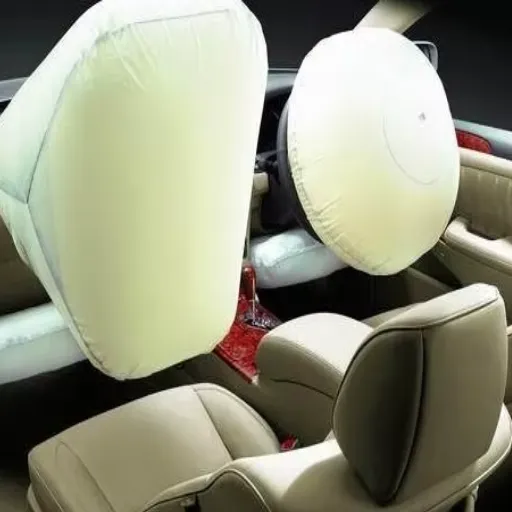
Airbag consists of a woven fabric, being mainly a high-tenacity nylon 6,6 synthetic (polyamide 6,6), specifically designed to meet the demand of high temperature, high pressure and mechanical load encountered during the initial blowup of the airbag. Virtually all automotive air bags contain airbag nylon, as no other macromolecule can offer the same technological performance as nylon at a comparable price due to its monomeric reactivity, strong intermolecular interactions and high crystalline perfection.
It was 2024 when Priya Sharma, the procurement leader for a giant in the auto industry in Pune, came across a pack of airbag fabric samples from a new supplier. Everything seemed perfect about this product, at least on paper. It was the right denier. The coating weight was what she ordered. The only bit of bad news came when her quality team subjected the fabric to a heat-aging test at 190°C for 1,000 hours, because this test loss was unacceptable as the fabric tension strength decreased by 35%. What was the problem, you said? What the procurement team had imagined as a solution had really proved to be the core obstacle. In wanting to reduce production costs, the supplier had used nylon 6 instead of nylon 6,6. That 40°C difference in melting point between the two types of materials, which was not that obvious at a glance, was the difference between a non-conforming product and a product likely to be recalled.
Stories similar to that of Priya’s are the heart and soul of the material knowledge when it comes to airbags and their proper functioning. An account that gives a scientific explanation of why nylon 6:6 was taken as a better choice than nylon 6 will be provided, an in-depth comparison between airbags material structural possibilities will be discussed and actual research data related alternatives will be provided, and what procurement teams need to demand or require from the suppliers of the constituent cordierite commercial cordierite incident airbags.
Key Takeaways
- Nylon 6,6 accounts for ~90%+ of global airbag fabric because its melting point (~256–265°C) is 40°C+ higher than nylon 6, enabling survival under 300–500°C deployment gases.
- High-tenacity nylon 6,6 achieves 7.9–9.5 g/denier tensile strength, significantly outperforming nylon 6 (6.5–7.5 g/denier) and polyester (5.5–7.0 g/denier).
- The 25–40% elongation at break of nylon 6,6 absorbs deployment energy and cushions occupants, while polyester’s 15–20% elongation creates brittleness risk.
- Denier selection (420D–840D) depends on airbag type: driver-side typically uses heavier 630D–840D, while passenger and curtain airbags often use 420D–630D.
- LY TRUSTLINK manufactures airbag nylon fabrics from 420D–840D high-tenacity nylon 6,6 with silicone or neoprene coating, prototype samples available within 2–3 weeks.
What Is Airbag Nylon?

The general material that makes up the airbag and is normally referred to as nylon airbags, is the high tenacity 6,6 nylon fabric. This specific type of highly engineered textile is known from other regular forms of nylon that for instance might be found in clothing, or for industrial or consumer uses.
The fabric used in airbags, which is nylon 66 airbag, is made using aText-nylon monofilament 66 type yarn with segments normally ranging from 420 to 840 deniers depending on the type of airbags and designed margins of safety. These text-nylon multifilament yarns especially high tenacity/low elongation yarns when in airbag forms scrambling @ 90 ppm. While these type of yarns are usually woven in simple or ripstop weaves at the range of 25×25 to 50×50 ends per inch – EPI, they are invariably given a silicone coating, which even though is the market leader at about 70% plus, can be replaced by neoprene coating.
For a complete breakdown of what airbags are made of, including inflator chemistry, coating types, and module assembly, see our guide on what airbags are made of.
Typical Airbag Nylon Specifications
| Property | Typical Value | Standard |
|---|---|---|
| Base material | Nylon 6,6 (polyamide 6,6) | — |
| Yarn denier | 420D–840D | — |
| Weave type | Plain or ripstop | — |
| Fabric weight | 211–294 g/m² | , |
| Tensile strength (warp) | 2,128–3,600 N | ISO 13934.1 |
| Tensile strength (weft) | 1,982–3,300 N | ISO 13934.1 |
| Tear strength (warp) | 133–330 N | ISO 13937.2 |
| Air permeability | 0.000015–0.000108 L/m²/s | Finished fabric |
| Fabric width | 150–154 cm | — |
At LY TRUSTLINK, our airbag nylon fabrics are engineered from high-tenacity nylon 6,6 in deniers ranging from 420D to 840D, with plain and ripstop weave options and silicone or neoprene coating to match your application requirements. Explore our nylon 66 airbag fabric specifications →
Nylon 6 vs Nylon 66: The Molecular Structure That Matters
The difference between nylon 6,6 and nylon 6 is not a minor specification variation. It is a fundamental difference in molecular architecture that directly determines whether an airbag fabric survives deployment or fails catastrophically.
Molecular Architecture
In the production of Nylon 6,6, two building blocks are utilized that are hexamethylenediamine and adipic acid. In this case, amine and acid monomers undergo polymerization in an alternating manner. Such an arrangement will form a visciously advancional salt creating a double salt bath. Due to Advances in methodologies crystals are grown almost through proportional use of the growth promoting agent.
For instance, Nylon 6 is produced by ring-opening polymerization of ε-Caprolactam. While Bourbon groups are ascribed weak crosslink, described molecular architecture for combines CH and J H bonds. However, water and alcohols, modes of proteosteric interactions, detsabilize this bonding to some extent.
Their lower burstiness can be turned into an advantage with new technologies available. The term burstiness is known from queueing theory, which, again, belongs to information theory. Queueing theory is in essence a branch of applied probability theory.
Why It Matters for Airbag Performance
| Property | Nylon 6,6 | Nylon 6 | Impact on Airbag Fabric |
|---|---|---|---|
| Melting point | 256–265°C | 215–220°C | Nylon 6,6 survives deployment gases at 300–500°C; nylon 6 risks thermal degradation |
| Tensile strength | 7.9–9.5 g/denier | 6.5–7.5 g/denier | Nylon 6,6 withstands higher inflation forces without rupture |
| Heat aging (1,000h @ 150°C) | Retains ~85% strength | Retains ~65–70% strength | Nylon 6,6 maintains integrity over 10–15 year vehicle lifespan |
| Moisture absorption | ~2.5% | ~4.5% | Lower moisture uptake in 6,6 ensures dimensional stability across climates |
| Crystallinity | 50–60% | 30–40% | Higher crystallinity = better thermal and mechanical performance |
The 40°C+ melting point advantage is not a marginal difference. During deployment, inflator gases reach 300–500°C for milliseconds. Nylon 6,6 softens but does not melt. Nylon 6 crosses its melting point and loses structural coherence. A fabric that melts loses tensile strength instantaneously. That is why the global airbag industry has converged on nylon 6,6 for approximately 90% of production volume.
Want to understand how airbag fabric specifications fit into the broader market? Our automotive airbag fabric market guide covers market size, growth projections, and key manufacturers globally.
Why Not Polyester? The Heat Resistance Gap
It is no secret that Polyester(PET) is a popular technical textile. This textile is primarily used in curtains, covers and tarps. This is true because it is light weight, strong, economical, and very resistant to UV.
However Polyethylene terephthalate fabric does not protect life in airbags because such effect is explained by airbag deployment physics.
Polyester’s Strengths, In the Wrong Context
Polyester offers excellent dimensional stability, very low moisture absorption (~0.4%), and lower raw material cost than nylon 6,6. It performs brilliantly in applications where UV exposure, water resistance, and long-term outdoor durability matter more than rapid heat survival.
Why Polyester Fails for Airbags
It’s not merely the ease of thermal deformation or lower melting point which goes critical. The melting point of The most is ‘ju’ which is equal to nylon 6,6. The issue is with the behavior under the conditions of thermal stress.
When subjected to hot deployment gases, Polyester does not show the behaviour of a stretch that Nylon 6,6 undergoes, it turns brittle. Only 15% to 20% percent of Polyester’s braking elongation is permissible as opposed to 25% to 40% in repect to Nylon. All that does not matter much, or rather does no good, when the polymeric structure is drawn by the force. Specially, any brittle fabric can tear out rather than molded. A single tragedy initiates a tear and it will spread to the whole surface within a fraction of a second.
In the case of nylon 6,6, the fabric releases the deployment energy by performing a moderate elongation which the fabric undergoes. As a result, the fabric deforms, allows the material to distribute stresses across the weave structure, and comes back to its original shape. Polyester lacks this specific property in terms. These is no such energy of the law of deformation which the nylon 6,6 consumes that was one of the reasons to call forth the tear in polyester.
It should be added that polyester very poorly tolerates hot gas treatment. The main reason is that even when the temperature is lower than the melting point of the polymer the gas of filtered propellant destroys the polymer. Unless it is nylon 6,6’s earned a higher mark for the indications even at the temperatures and conditions of those tests.
Recovery Differences
After deployment stress, nylon 6,6 recovers approximately 100% of its dimensions at strains up to 8%. Polyester exhibits permanent deformation. In an airbag system where the fabric must fold into a compact module and remain ready for the life of the vehicle, dimensional recovery matters.
While our PVC-coated polyester fabrics excel in transportation tarps and marine covers, airbag deployment physics demand the specific molecular properties of nylon 6,6. The two materials solve different engineering problems. The two materials serve different engineering problems.
Key Performance Advantages of Nylon 6,6 for Airbags
Beyond the molecular fundamentals, nylon 6,6 delivers five performance characteristics that make it irreplaceable for airbag applications. Each characteristic maps directly to a real operational requirement.
Superior Tensile Strength
Yarns made from high-strength, nylon 6,6, on the other hand, may have tenacities of 7.9-9.5 grams per denier. In plain woven fabric, this is equated to may tensile strengths of 2,128-3,600 N and weft breaking forces of 1,982-3,300 N in accordance with ISO 13934.1.
These figures are particularly important because the cloth cannot rupture at least at 200kPa of shockwave pressure. Specifically, the driver side airbag receives the greatest amount of force in a very small area. 840D is meant to be the medium in these high-tensile stress usages, it is appreciated for its increased yarn density and dimensional stability.
Higher Melting Point and Thermal Stability
The melting point of nylon 6,6 is considered to be 256–265°C. More importantly, with respect to continuous service, the material has excellent tensile and impact properties up to ~190°C. However, in the milliseconds that the gas temperatures are 300- 500°C, the fabric reaches a point where it softens a bit but does not disintegrate completely such that it allows the inflation of the bag to take place in a secure structural.
Nylon 6,6 degrades in a linear fashion as well. If 1,000 hours pass at 150°C, which corresponds to 10 years of vehicle interior heat load, material retains about 85% of its ultimate tensile strength. Original equipment manufacturers (OEMs) can rely on such the wear patterns which assist them to formulate and enforce the wear limits of the component.
Controlled Elongation and Energy Absorption
A breakage of 25-40% is unfounded and in no way a defect. This kind of elongation is the result of planned impact. The material is elastic enough not to let the kinetic energy of the vehicle go away all at once, which is also the reason why the person sitting inside the vehicle is not injured.
Moreover, the punching strength of the weaving materials is, to a great extent, dependent on its fibrous raw material – fibers. As a resonating instance, a busted piece of glass would instantly become a pile of though at the touch of a the hammer’s edge.
Excellent Coating Adhesion
The amide functional groups in nylon 6,6 bond effectively with silicone and neoprene coatings. This adhesion ensures that the coating remains intact through years of folding, temperature cycling, and eventual deployment. Coating delamination would create uncontrolled permeability zones, altering inflation dynamics and potentially causing deployment failure.
Need help selecting the right coating for your airbag application? LY TRUSTLINK applies silicone and neoprene coatings at 40–80 g/m² with precision control over uniformity and adhesion. Request a technical consultation →
Abrasion and Fatigue Resistance
An airbag fabric is folded into a steering wheel or dashboard module and remains folded for 10–15 years. During that time, it must resist abrasion from itself, from the talcum powder or cornstarch lubricant, and from vibration. Nylon 6,6’s fatigue performance ensures the fabric does not develop weak points at fold lines before it is ever deployed.
Yarn Specifications: Denier, Filament Count, and High-Tenacity Grades
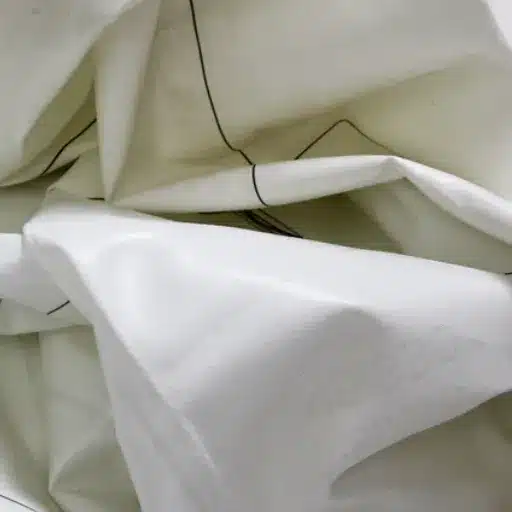
Understanding how yarn specifications translate to airbag performance helps procurement teams ask the right questions and specify the right material. The denier, filament count, and tenacity grade are not arbitrary numbers. They are engineering parameters with direct consequences.
Understanding Denier in Airbag Nylon
Denier measures the mass in grams of 9,000 meters of yarn. Higher denier means thicker, stronger yarn. The standard range for airbag nylon is 420D to 840D:
- 420D: Lightweight option for passenger-side and side-curtain airbags where packability and lower mass are priorities.
- 630D: Versatile mid-range suitable for multiple airbag types. Balances strength, weight, and cost effectively.
- 840D: Heavy-duty specification for driver-side airbags and high-stress applications where maximum tensile strength is non-negotiable.
When Marcus Chen, an airbag module engineer at a Detroit-based Tier 1 supplier, specified 630D nylon 6,6 for a new side-curtain design in 2023, his team saved 12% on fabric weight compared to the previous 840D specification. The lower mass reduced pack volume enough to fit the module into a tighter roof-rail space without compromising deployment performance. The key was matching denier to actual stress analysis rather than defaulting to the heaviest available option.
Filament Count and Twist
There are often 68 to 100 filaments in a 420D yarn and may have up to 120-140 filaments in an 840D yarn. More filaments cater for uniform stress distribution across smaller strands reducing wear and tear and fatigue failure resistance.
Airbag yarns are made with low twist. Increasing twist would reduce strength and precipitate weak spots. The yarn consists basically in a parallel bundle of filaments both weakly twisted and held together by sizing agents.
What “High-Tenacity” Actually Means
The standard nylon 6,6 achieves close to 6.0–7.0 gram per denier. On the other hand, high-tenacity grades can successfully reach 7.9–9.5 g/denier under greater drawing changes in the melt-spinning method. Consequently, the segmenting along which the chains transfer/transport is much more perfect-in the direction of the fibers; and knowledge is made to issue out the balance of assistance to a higher proportion of load-bearing crystallites.
The cost incurred is a slight reduction in extension. But in case of airbag use, the rise in power will take precedence over the decrease in extension. Earlier it was found that, critical airbags likely need high-tenacity grades as a prime quality.
At LY TRUSTLINK, our airbag nylon is manufactured from high-tenacity nylon 6,6 yarns across the full 420D–840D range. Every batch is tested for tensile strength, tear resistance, and heat aging before shipment. View our full specification table →
Weave Structures and Fabric Construction
The weave pattern determines how yarns interlock, which in turn affects strength distribution, tear propagation, and packability. Three weave structures dominate airbag nylon production.
Plain Weave
The simplest interlacing pattern is called plain weaving which is the default practice weaving where each warp yarn in turn passes over then under each of the weft yarns. In air bag formations, the 25×25, 50×50 and 50×50 construction normally reach just (50×50) ends per inch of suitable fabric weights depending on the construction end on denier choice and the type of application.
25×25 constructions are usually used for driver side airbags with power and compactness as a priority. These allow for higher density structures like 46×46 and 50×50 which are used for passenger side and curtain applications, where directed airflow is important.
In general, the easy and convenient plain weave enables good stiffness and strength in both the warp way and the woof direction. It compacts in very good manner with module applications. It is neat sense neat sense it works well with cut and sewn garment and woven in one piece garment.
Ripstop Weave
Ripstop features a mechanism of grid reinforcement where added strength is provided by the peppered tear stop in a multitude of structures. This system ensures that when a tear channel is initiated, it is contained if it inadvertently reaches the tear stop. It does not spread cross the whole panel.
The role and the added stabilizer tapes are used to prevent edge loss situations particularly in case of the passenger-side air bags as they possess a larger area of the flap turning into the airbag and a more complicated mode of stress during the crash deployment also ripstop in beneficial instead of plain fabric. Poplar ripstop types are available from LY TRUSTLINK for such applications where tear can’t be compromised.
One-Piece Woven (OPW)
OPW employs industry leading machines which facilitate the weaving of the whole airbag fabric, including its tubular areas that otherwise necessitate sewing, in an uninterrupted process. This obviates any chances of seam damages and also results in reduced labor.
OPW at present encapsulates almost 35-40% of the new airbag fabrics market and expects a CAGR of 8-10%. this technology involves implementing accurate 3D weaving management and is hosted by a few specialized weaving enterprises located in Japan, South Korea and in several European countries.
Airbag Nylon vs. Other High-Performance Fabrics
To fully appreciate why nylon 6,6 dominates, it helps to compare it against every serious alternative on the market.
| Property | Nylon 6,6 | Nylon 6 | Polyester (PET) | Aramid (Kevlar) |
|---|---|---|---|---|
| Melting point | 256–265°C | 215–220°C | 255–260°C | ~400°C (decomposes) |
| Tensile strength | 7.9–9.5 g/d | 6.5–7.5 g/d | 5.5–7.0 g/d | 15–25 g/d |
| Elongation at break | 25–40% | 30–45% | 15–20% | 3–5% |
| Density | 1.14 g/cm³ | 1.14 g/cm³ | 1.38 g/cm³ | 1.44 g/cm³ |
| Moisture absorption | ~2.5% | ~4.5% | ~0.4% | ~3.5% |
| Relative cost | Medium | Low | Low | High |
| Global airbag usage | ~90%+ | ~5–10% | <1% | Niche |
Nylon 6,6 vs. Aramid
Kevlar, an example of an Aramid fiber, has a higher modulus and strength than nylon 6,6 but a lower modulus or even less than that of the taxilor polyamide. Its uses under wear line such as ballistic protection, aerospace, select high performance, etc.
Three specific reasons not to use aramid in airbags are more important. First, the elongation at break of a fragment of aramids is only 3% to 5% which means that controlled energy can not be absorbed properly. Second, the cost of aramid is 3 to 5 times more than that of nylon 66, ie 20 to 25 sqm. Third, aside from the cost, aramid-nylon 66 proves to be a challenge as the surface tension of the adhered film is poorer than the other materials. If you have any questions or need further assistance, don’t hesitate to get in touch with us.
The Verdict
No alternative material currently offers the combination of heat survival, tensile strength, controlled elongation, coating adhesion, packability, and cost that nylon 6,6 delivers. This is not a matter of tradition or supplier inertia. It is a matter of polymer physics.
How to Specify Airbag Nylon for Your Application

Procurement teams evaluating airbag nylon should verify five specification categories before approving a supplier. Missing any one can create performance gaps that do not appear until qualification testing, or worse, until field deployment.
1. Denier Selection by Airbag Type
Match denier to the stress profile of the specific airbag:
| Airbag Type | Recommended Denier | Rationale |
|---|---|---|
| Driver frontal | 630D–840D | Highest stress concentration; smallest deployment volume |
| Passenger frontal | 420D–630D | Larger area distributes force; packability matters |
| Side curtain | 420D–630D | Long, narrow design; OPW often preferred |
| Knee / external | 630D–840D | Emerging designs with unique stress patterns |
2. Weave and Construction
Specify plain weave or ripstop based on tear resistance requirements. If OPW is required, confirm the supplier has specialized 3D weaving capability. Not all airbag fabric manufacturers can produce OPW panels.
3. Coating Type and Weight
Silicone coating at 40–80 g/m² is the default for heat resistance and deployment smoothness. Neoprene remains viable for cost-sensitive applications with lower thermal stress. Uncoated fabric is rare and requires careful permeability validation.
4. Certifications and Testing Documentation
Require IATF 16949 quality management certification. Request batch test reports covering tensile strength (ISO 13934.1), tear strength (ISO 13937.2), air permeability, and heat aging. For OEM qualification, PPAP documentation may be required.
5. Batch Traceability and Lead Times
Airbag fabric is not a spot-market commodity. OEM contracts require consistent quality across every production batch for years. Verify the supplier’s batch traceability system, statistical process control data, and confirmed lead times before placing volume orders.
For procurement teams building a supplier shortlist, our car airbag fabric supplier guide covers evaluation criteria, red flags, and RFQ templates specific to the automotive safety textile market.
At LY TRUSTLINK, our engineering team supports your specification from concept to certified delivery. We manufacture airbag nylon fabric material from 420D–840D high-tenacity nylon 6,6 with plain and ripstop weaves, silicone or neoprene coating, and full batch testing documentation. Request a sample order or technical data sheet →
Conclusion
Nylon fiber has become by far the most important polymer in airbag production. The construction of these lines is controlled by a new system which includes two diamines and two dicarboxylic acids to give a sensible polymer structure different from nylon thins. The deployment characteristics of lower molecular weight polymers, like the original diethyl polymer, BOPP, have no significant adverse affect on the desired performance in airbag applications. However, generation of potential fibres for very high temperature applications using these polymers is so costly that they are not employed.
The performance stack is cumulative. High-tenacity grades at 7.9–9.5 g/denier provide the tensile strength to contain explosive pressure. The 25–40% elongation absorbs energy and cushions occupants. The amide linkages bond coatings reliably for 10–15 year service life. And the lower density reduces out-of-position injury risk. No alternative polymer currently matches this combination at viable cost.
These OEMs are moving towards lighter vehicles, more intelligent air bags, and sophisticated deployment tactics for air bags and so the current specification for air bags is becoming tougher. It is not only advancements in materials science and engineering that are driving the redefinition of the baseline requirements but also the changes in the business environment. Airbag procurement managers that are able to comprehend the rationale behind the specification will be able to make sensible purchase decisions and prevent undesired substitutions that caused inappropriate purchases and rework on the mileage cup to Priya sharma’s team for further re-qualification due to performance deviation of the older drawing limits and changes in the material and performance targets.
For procurement teams evaluating airbag nylon specifications, the first filter should always be verified performance data. Request a technical data sheet. Order prototype samples. Run your own qualification tests. At LY TRUSTLINK, we provide 420D–840D high-tenacity nylon 6,6 airbag fabric with full testing documentation and prototype samples available within 2–3 weeks. Contact our engineering team to start your specification review →