
Tensile Structure Materials: PVC, PTFE & ETFE Spec Guide
The best tensile structure materials for commercial and architectural projects are PVC-coated polyester, PTFE-coated fiberglass, and ETFE film. Each is engineered for distinct load requirements, environmental exposures, and lifecycle expectations.
When the procurement team at Meridian Stadium selected a basic PVC membrane for their coastal canopy in 2018, they expected 15 years of service. Six years later, salt corrosion and UV degradation had reduced tensile strength by 6%. The replacement cost reached $2.3 million. The material was not defective. It was simply the wrong specification for the environment.
Most guides to tensile architecture are written by installation contractors. They cover structural geometry and frame engineering comprehensively. The actual membrane material, the component that determines whether your structure lasts 10 years or 30, receives comparatively little attention. This guide delivers the specification data, manufacturing insight, and procurement framework that technical buyers need to evaluate tensile structure materials with confidence.
We will examine the three primary membrane types, compare specifications side-by-side, explain what happens during manufacturing that determines field performance, and provide a procurement checklist derived from actual production experience. From large-span tensile roofs to architecturally striking fabric façades, LY TRUSTLINK delivers customized membrane systems that meet international quality and performance standards.
Key Takeaways
- PVC-coated polyester delivers 3,000–5,500 N/5cm tensile strength at the lowest initial cost, making it the standard for commercial canopies and event structures with 10–25 year design lives.
- PTFE-coated fiberglass achieves 6,000–10,000+ N/5cm, A2 non-combustible fire ratings, and 25–30+ year lifespans, the uncompromising choice for permanent stadium and airport installations.
- ETFE film transmits up to 85% of natural light and operates as single-layer panels or pneumatic cushions, enabling transparent atriums and facades where conventional membranes cannot.
- Material failure in tensile structures is rarely sudden. Creep, plasticizer migration, and coating delamination develop over years, preventable only through correct specification and batch-level quality control.
- Procurement teams should require batch test reports, NFPA 701 or EN 13501-1 certification documentation, and transparent lead times before approving any membrane supplier.
What Is a Tensile Structure?
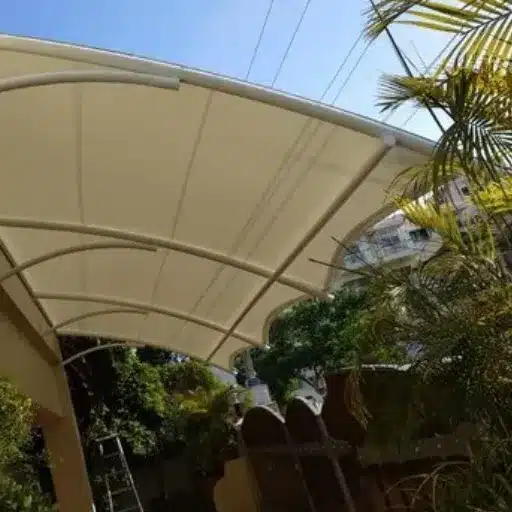
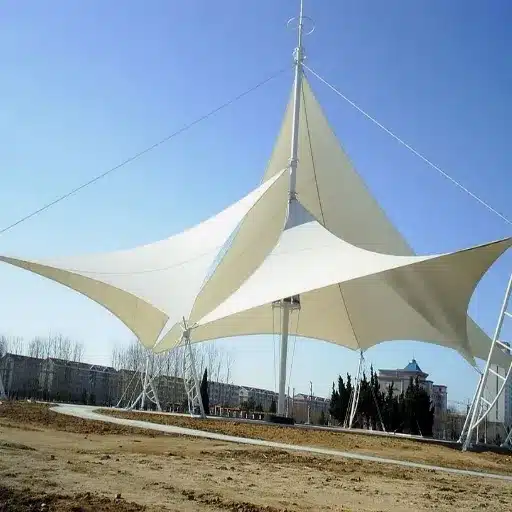
A tensile structure is a construction system stabilized primarily by tension forces rather than compression or bending. Flexible materials, fabric membranes and cables, are stretched and pre-tensioned to create stable, load-bearing forms.
This approach differs fundamentally from conventional construction. Traditional buildings rely on rigid elements. Beams, columns, and walls resist gravity through compression.
Tensile structures invert this logic. They harness the natural efficiency of tensioned materials to achieve larger spans with significantly less mass.
Tension vs. Compression: Why the Material Matters
The membrane carries the load. Steel masts and cables provide shape and boundary conditions. But if the fabric fails, the structure fails.
This reality places extraordinary demands on tensile structure materials. The membrane must resist biaxial stress, UV radiation, thermal cycling, moisture, and chemical exposure over decades. Specifications are not marketing points. They are survival parameters.
The Four Basic Components
Every tensile structure comprises four integrated elements:
- Membrane material: The primary load-bearing surface. Specifications here determine weather resistance, fire performance, and service life.
- Steel support system: Masts, arches, or frames that establish geometry and transfer loads to foundations.
- Tension cable system: Edge cables, ridge cables, and pretensioning elements that maintain structural balance.
- Anchoring system: Connection hardware and foundations that secure the assembly against wind uplift and live loads.
Double Curvature and Why Flat Membranes Fail
A tensile membrane achieves stability through double curvature. The surface curves in two opposing directions.
This anticlastic geometry ensures that any applied load, wind, snow, or point loading, is resolved into membrane tension rather than out-of-plane bending. Flat panels cannot do this. They flutter. They pond. They tear.
Every successful tensile structure begins with form-finding software that calculates the precise geometry required for equilibrium. The material must then be manufactured to exactly match that geometry. Patterning tolerance becomes a structural parameter, not a cosmetic preference.
Looking for an innovative membrane architecture that combines aesthetics with functionality? Contact LY TRUSTLINK to explore bespoke solutions designed around your project’s specific requirements.
The Three Primary Tensile Structure Materials
The global membrane structures market reached USD 9.16 billion in 2026. PVC-coated polyester alone commands 28.3% of material share by type. Three materials dominate architectural applications: PVC-coated polyester, PTFE-coated fiberglass, and ETFE film.
PVC-Coated Polyester
PVC-coated polyester is the workhorse of the tensile membrane industry. It balances cost, performance, and fabricability in a way that no other material currently matches for mid-term applications.
Base fabric construction. The structural core is a woven scrim of high-tenacity polyester yarn. Denier ratings typically range from 1,000D to 2,000D depending on the required tensile strength. The weave architecture, plain, basket, or leno, determines how the fabric behaves under biaxial load. Warp and fill tenacity must be specified separately because they rarely match exactly.
Coating system. The polyester scrim is encapsulated in a PVC plastisol matrix. Plasticizer chemistry determines low-temperature flexibility and long-term migration resistance. UV stabilizers are compounded into the coating to retard photodegradation. Without them, PVC becomes brittle and discolored within 3–5 years of outdoor exposure.
Topcoat options. A raw PVC surface collects dirt and degrades under UV exposure. Manufacturers apply protective topcoats: acrylic lacquers for economical grades, or PVDF (polyvinylidene fluoride) dispersions for premium architectural membranes. PVDF topcoats extend service life from 10–15 years to 15–25 years by providing a self-cleaning, chemically resistant finish.
Specifications. Typical PVC tensile membranes range from 650–1,200 GSM. Tensile strength runs 3,000–5,500 N/5cm depending on base fabric weight and weave. Fire ratings include B1 (EN 13501-1), M2 (French standard), and NFPA 701. Operating temperatures span -30°C to +70°C.
Best applications. Commercial canopies, car parking shades, event tents, temporary exhibition structures, and industrial enclosures where 100% opaque PVC blackout fabrics block light completely.
PTFE-Coated Fiberglass
PTFE-coated fiberglass represents the premium tier of architectural membrane fabric. It is specified when design life exceeds 25 years, fire safety is non-negotiable, or maintenance access is severely limited.
Base fabric construction. The structural core is woven fiberglass, typically E-glass. S-glass variants offer higher tensile strength but at increased cost. Glass fiber does not stretch. This property is both an advantage; dimensional stability is absolute, and a challenge, the fabric cannot accommodate installation strain through deformation.
Coating system. PTFE (polytetrafluoroethylene, Teflon) is sintered onto the fiberglass substrate in a multi-stage process. The resulting surface is hydrophobic and oleophobic. Rainwater sheets off, carrying surface contaminants with it. This self-cleaning mechanism means PTFE membranes require cleaning every 5–8 years rather than every 1–2 years for PVC.
UV immunity. PTFE reflects approximately 98% of UV radiation. Tensile strength loss after 10,000 hours of accelerated Xenon arc exposure is negligible. PVC, by comparison, can lose 6% or more of tensile strength after 6 years in high-UV coastal environments.
Specifications. PTFE membranes typically weigh 900–1,500 GSM. Tensile strength reaches 6,000–10,000+ N/5cm. Fire performance achieves A2 non-combustible classification under EN 13501-1. Service life now extends to 30–50 years with modern formulations, up from the original 25-year benchmark.
Best applications. Permanent stadium roofs, airport terminals, landmark cultural buildings, and any structure where lifecycle cost outweighs initial capital expenditure.
ETFE Film
ETFE (ethylene tetrafluoroethylene) is not a coated fabric. It is a transparent fluoropolymer film used either as a single layer or inflated into multi-layer pneumatic cushions.
Material properties. ETFE film thickness ranges from 100 to 300 micrometers. It weighs approximately 100 g/m², an order of magnitude lighter than PVC or PTFE membranes. Light transmission reaches 85%, making it the only tensile material capable of creating genuinely transparent building envelopes.
Pneumatic cushion systems. ETFE’s most distinctive application is the air-inflated cushion. Two or more ETFE layers are welded at their perimeter and inflated to maintain internal pressure. The resulting pillow provides thermal insulation and structural stability through air pressure rather than fabric tension. The Allianz Arena in Munich uses this system for its color-changing facade.
Specifications. ETFE is not load-bearing in the same sense as PVC or PTFE. It relies on air pressure or cable nets for support. Lifespan is 25–30 years. It is highly resistant to UV degradation and chemical attack. However, it is vulnerable to puncture and requires integrated inflation systems for cushion applications.
Best applications. Skylights, atriums, building facades, and botanical biomes where natural light and visual transparency are design priorities.
Material Comparison: Specifications at a Glance
| Property | PVC (Basic) | PVC-PVDF | PTFE | ETFE |
|---|---|---|---|---|
| Base fabric | Woven polyester | Woven polyester | Woven fiberglass | None (film) |
| Coating/topcoat | PVC / acrylic | PVC / PVDF | PTFE sintered | ETFE polymer |
| Weight (GSM) | 650–900 | 750–1,200 | 900–1,500 | ~100 |
| Tensile strength (N/5cm) | 3,000–4,500 | 4,000–5,500 | 6,000–10,000+ | N/A (film) |
| Tear strength | 400–700 N | 500–900 N | 300–600 N | Low |
| Fire rating | B1 / NFPA 701 | B1 / NFPA 701 | A2 non-combustible | B1 |
| Lifespan | 10–15 years | 15–25 years | 25–30+ years | 25–30 years |
| Light transmission | 4–10% | 4–15% | 5–15% | Up to 85% |
| Weldability | Excellent (RF) | Excellent (RF) | FEP tape only | Thermal fusion |
| Cost tier | $ | $$ | $$$ | $$$ |
When to Specify PVC
Specify PVC-coated polyester when the design life is 10–25 years, the budget is constrained, and the structure requires color matching or custom printing. PVC is also the correct choice when on-site welding is necessary, as RF welding at 380–420°C produces molecular bonds that are difficult to achieve with PTFE in the field.
When PTFE Is Non-Negotiable
PTFE-coated fiberglass becomes mandatory when fire codes require non-combustible materials, when maintenance access is impossible or prohibitively expensive, or when the design life exceeds 25 years. Airports, hospitals, and high-occupancy stadiums typically fall into this category. The 2–3x higher initial cost is recovered through eliminated replacement cycles.
Where ETFE Changes the Design Equation
ETFE is specified when transparency outweighs structural load-bearing requirements. It is not a substitute for PVC or PTFE in conventional tensile roof applications. It is a completely different building system that happens to use tensioned film. Designers choose ETFE when they need a building envelope that behaves like glass but weighs 1% as much.
Manufacturing Quality: What Determines Membrane Performance
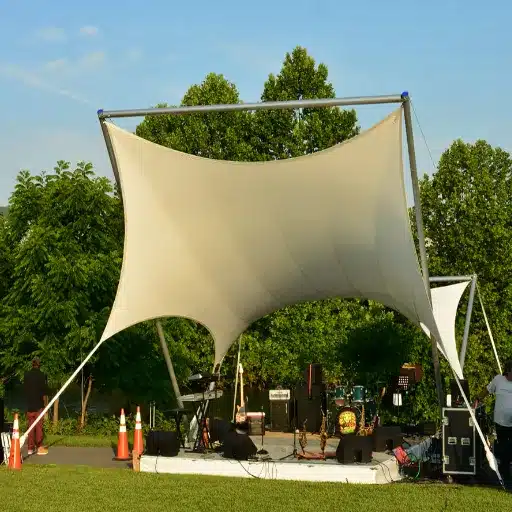
The gap between a membrane that lasts 10 years and one that lasts 25 is determined on the production line, not the installation site. Understanding these manufacturing variables separates informed procurement teams from those who rely solely on installer recommendations.
Base Fabric Weaving: Why Warp and Fill Tenacity Matters
High-tenacity polyester yarn is woven into scrim on rapier or air-jet looms. Warp yarns run the length of the roll. Fill (weft) yarns run across the width. Their tenacity values are rarely identical.
This directional asymmetry matters during patterning. A form-finding software model assumes isotropic material behavior. Real fabric is orthotropic. If the patterner does not account for warp-fill strength differential, the installed membrane will stress unevenly. Premium manufacturers provide biaxial test data showing tensile behavior in both directions.
Mini-story: When project manager Sarah Chen received the first production batch for a 2,000-square-meter logistics canopy in 2023, she noticed the fill-direction tensile strength was 18% lower than the warp value. Her installer had not requested biaxial data. The patterning assumed uniform strength. Within eight months, stress concentrations along the fill direction caused visible creep at the cable boundaries. The membrane had to be re-patterned and replaced, a $47,000 lesson in demanding directional test data before fabrication.
Coating Line Parameters
PVC coating is applied by knife-over-roll or spread-coating methods. The substrate passes under a doctor blade that meters liquid plastisol onto the fabric. The coated web then enters an oven where gelation and fusion occur.
Gelation temperature and dwell time determine coating uniformity. Incomplete fusion creates internal voids. These voids become failure initiation points under cyclic loading. Coating thickness must be controlled to within ±5% across the roll. Variation beyond this tolerance creates local stiffness differentials that telegraph through to the surface over time.
Topcoat Application
PVDF topcoats are applied as dispersed lacquers and cured at controlled temperatures. Thickness consistency is critical. Too thin, and UV protection is compromised. Too thick, and the coating becomes brittle. Reputable manufacturers maintain 25–35 micrometer dry-film thickness on architectural grades.
Weldability and Seam Engineering
Seams are the weakest points in any membrane. Field performance depends entirely on weld quality.
RF welding. PVC membranes are welded by radio-frequency energy at 380–420°C. The electromagnetic field excites polar molecules in the PVC matrix, generating internal heat. Pressure forces the melted surfaces together, creating a molecular bond stronger than the base material. Proper RF welding produces seams with 80–100% of parent material strength.
Hot-air bonding. An alternative for PVC uses heated air streams to soften overlapping surfaces before compression. This method is portable and effective for field repairs. However, bond strength typically reaches only 60–80% of RF-welded seams.
FEP tape welding. PTFE cannot be welded directly because its melting point exceeds the degradation threshold of the fiberglass substrate. Manufacturers instead use FEP (fluorinated ethylene propylene) adhesive tapes activated by hot-air or hot-wedge equipment. The resulting bond is reliable but requires precise temperature control and trained technicians.
Quality control checkpoints. Every production batch should undergo tensile testing per ASTM D751, tear resistance per ASTM D4533, accelerated UV aging per ASTM G154 (QUV) or ASTM G155 (Xenon arc), and seam peel testing. Accelerated aging of 3,000 hours in QUV roughly correlates to 5–7 years of subtropical exposure.
Want to understand how cold temperatures affect welded seams in the field? Read our analysis of cold-weather laminated fabric performance and the molecular behavior of plasticizers at sub-zero temperatures.
Procurement Framework for Technical Buyers
Selecting tensile structure materials is an engineering decision. It should not be delegated to the lowest bid without technical validation. The following framework provides a structured approach to membrane procurement.
Specifying by Application
Begin with load requirements and environmental exposure. A car parking canopy in Arizona faces radically different demands than an airport terminal in Scotland. Specify:
- Wind load: Determine from local building codes (ASCE 7, Eurocode 1, or equivalent). The membrane must withstand peak gusts without exceeding yield strain.
- Snow load: Anticipated accumulation and drift patterns influence both material strength and geometry. Flat or low-slope areas are vulnerable to ponding.
- Fire code: NFPA 701, EN 13501-1, or DIN 4102 compliance may be mandatory depending on occupancy and jurisdiction.
- UV exposure: Coastal and high-altitude environments accelerate photodegradation. Specify PVDF topcoat or PTFE for these locations.
- Chemical exposure: Industrial atmospheres, salt spray, and pollution degrade coatings prematurely. PTFE or premium PVDF systems are required in aggressive environments.
What to Demand from a Membrane Supplier
Procurement teams evaluating architectural membrane fabric suppliers should require the following documentation before contract execution:
- Batch test reports: Independent verification of tensile strength, tear resistance, and adhesion for the specific production lot.
- Certification documentation: NFPA 701, EN 13501-1, or other applicable fire performance test reports with current validity dates.
- Custom capability: Confirmation that the supplier can accommodate non-standard weights, coatings, dimensions, and color matching. Custom engineering support from concept to delivery indicates a manufacturing partner, not a commodity vendor.
- Sample program: Provision of A4 or larger sample swatches from the actual production batch for pre-approval.
- Lead time transparency: Confirmed production schedules, not estimates. Our engineering team supports your project from concept to certified delivery, with prototype samples available within 2–3 weeks and production lead times confirmed at order.
- Warranty terms: Clear definitions of coverage, exclusions, and claims procedures. A 10-year membrane warranty is standard for premium PVC-PVDF. PTFE warranties often extend to 25 years.
Cost Analysis: Initial vs. Lifecycle
Material cost is only one component of total project cost. Installation labor, engineering, foundations, and lifecycle maintenance often exceed the membrane itself.
For a 30-year analysis period, PVC requires 2–3 replacements. PTFE requires zero. The crossover point where PTFE becomes economically favorable typically occurs between years 18 and 22, depending on local labor costs and access difficulty.
Mini-story: Elena Vasquez, procurement director for a European logistics group, faced a decision in 2024 between PVC-PVDF at €14/m² and PTFE at €38/m² for a 12,000 m² distribution canopy. The PVC option saved €288,000 upfront. However, her lifecycle model included replacement at year 18, site closure for 6 weeks, and disposal costs. The PTFE option reached total cost parity at year 20 and delivered €340,000 savings by year 30. She specified PTFE. The operational continuity alone, no downtime for membrane replacement, justified the decision before any financial calculation.
Minimum Order Quantities and Prototyping
Standard membrane rolls are 2.5–5.1 meters wide and 50–100 meters long. For custom colors or specialized coatings, minimum order quantities typically start at 1,000–3,000 linear meters depending on coating width.
Prototyping is essential for non-standard applications. Request sample welds from your fabricator using the actual production material. Test seam strength, flexibility, and appearance before committing to full fabrication.
Request a consultation with LY TRUSTLINK today to discover how our custom tensile structure solutions can enhance your space while reducing long-term maintenance and construction costs.
Common Failure Modes and How to Avoid Them
Tensile membranes do not fail catastrophically without warning. They degrade predictably. Understanding these mechanisms allows procurement teams to specify materials that outlast their design life.
UV Degradation and Plasticizer Migration
PVC relies on plasticizers for flexibility. UV radiation breaks polymer chains and accelerates plasticizer migration to the surface. The material becomes stiff, then brittle, then cracks. This process is slow, typically 0.8–1.2% annual tensile strength loss for basic PVC in temperate climates, but cumulative.
Prevention: Specify UV-stabilized formulations with PVDF topcoat. Demand accelerated aging test data. For critical applications, our UV-resistant protective fabrics maintain structural integrity through multi-season exposure by integrating inhibitors directly into the polymer matrix.
Coating Delamination
Delamination occurs when the bond between coating and base fabric fails. Causes include incomplete fusion during manufacturing, chemical incompatibility between topcoat and substrate, or moisture ingress at cut edges.
Prevention: Require peel-strength test data from batch reports. Ensure all field cuts are sealed immediately. Avoid contact with incompatible chemicals, PVC is vulnerable to ketones and aromatic hydrocarbons.
Creep and Stress Relaxation
All polymers creep under sustained load. PVC exhibits 1–2% elastic deformation under working stress. Over 10–15 years, this becomes permanent deformation.
The membrane slackens. Ponding begins. Ponding increases load. The cycle accelerates failure.
Prevention: Specify pre-tensioning protocols during installation that account for predicted creep. PTFE fiberglass exhibits minimal creep due to the inelastic nature of glass fiber. This is one reason PTFE is specified for permanent structures.
Cold-Crack and Low-Temperature Brittleness
Standard PVC formulations lose flexibility below -10°C. Specialized cold-weather grades maintain pliability to -30°C or -40°C through modified plasticizer packages. Specification without regard to minimum service temperature invites fracture during installation or winter storms.
Prevention: Specify the minimum anticipated service temperature before material selection. Request cold-crack test data per ASTM D2136. For sub-zero applications, premium laminated fabrics with specialized plasticizers are the recommended standard.
Chemical Exposure
Industrial atmospheres containing sulfur dioxide, nitrogen oxides, or salt spray accelerate coating degradation. Coastal environments are particularly aggressive. The Meridian Stadium case, 6% tensile strength loss in 6 years, exemplifies this failure mode.
Prevention: Specify PVDF or PTFE for industrial and coastal zones. Basic acrylic-topcoat PVC is inadequate in these environments.
Ponding and Drainage Failure
Ponding occurs when water accumulates on the membrane surface rather than draining. It results from insufficient slope, loss of pre-tension, or blocked drainage paths.
Static water load exceeds design assumptions. Deformation increases. The cycle continues until failure.
Prevention: Ensure form-finding analysis includes drainage verification. Specify minimum slopes of 1:20 for PVC and 1:15 for PTFE. Install inspection and maintenance protocols that verify tension integrity annually.
Maintenance, Repair, and Lifecycle Extension
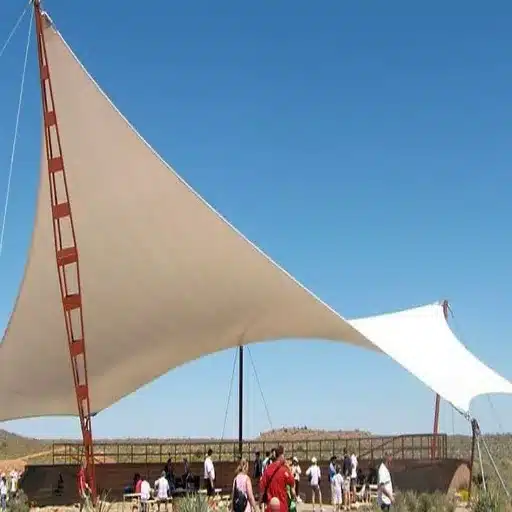
Even the highest-quality tensile structure materials require disciplined maintenance. Neglect transforms a 25-year asset into a 12-year liability.
Cleaning Protocols
Dirt accumulation reduces light transmission and traps moisture against the surface. Organic growth retains water and produces acids that attack coatings.
Clean PVC membranes annually using soft brushes and mild detergent solutions. Avoid pressure washers exceeding 50 bar, high-pressure streams can force water into seams and damage topcoat surfaces. PTFE membranes require cleaning every 5–8 years due to self-cleaning properties. Use deionized water to prevent mineral spotting.
Inspection Schedules
Conduct visual inspections every 6 months and detailed inspections annually. Look for:
- Surface cracking or chalking indicating UV degradation
- Discoloration or staining suggesting chemical attack
- Seam separation or edge cable migration
- Ponding or abnormal sagging
- Mechanical damage from wind-borne debris
Document findings with photographs and measurement. Trend analysis reveals degradation rates before they become critical.
On-Site Repair
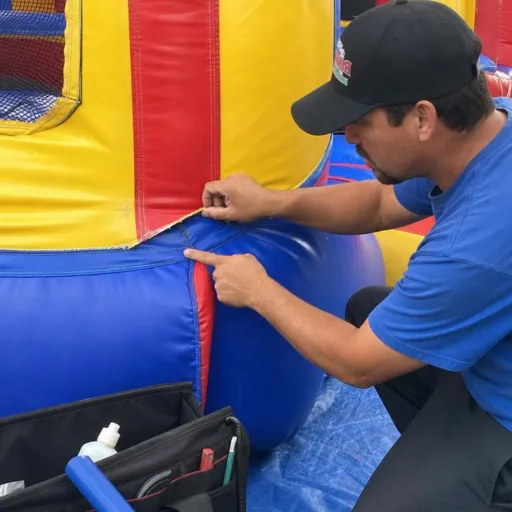
Small punctures and tears in PVC can be repaired with patch kits and RF welding equipment. The repair area must be clean, dry, and mechanically prepared. A properly executed field weld restores 80%+ of original strength.
PTFE repairs are more complex. FEP tape patches require trained technicians and controlled conditions. For significant damage, factory-fabricated replacement panels are often more economical than field repair.
Expected Replacement Timelines
| Material | Temperate Climate | Coastal/Industrial | High UV/Tropical |
|---|---|---|---|
| Basic PVC | 10–12 years | 7–10 years | 6–8 years |
| PVC-PVDF | 18–22 years | 12–15 years | 10–12 years |
| PTFE | 30–50 years | 25–30 years | 20–25 years |
These figures assume proper installation, maintenance, and design loads. Neglect reduces all values by 30–50%.
Frequently Asked Questions
What is the best material for tensile structures?
There is no single best material. PVC-coated polyester is optimal for commercial canopies with 10–25 year design lives and moderate budgets. PTFE-coated fiberglass is best for permanent installations requiring 25+ year lifespans and non-combustible fire ratings. ETFE film is best for transparent facades and atriums. The correct specification depends on load requirements, environmental exposure, fire codes, and lifecycle cost analysis.
How long do PVC tensile membranes last?
Basic PVC membranes last 10–15 years in temperate climates. PVC with PVDF topcoat extends this to 15–25 years. Coastal, industrial, or high-UV environments reduce these figures by 20–40%. PTFE-coated fiberglass achieves 25–30+ years in equivalent conditions.
Are PVC membrane structures fire resistant?
Quality PVC membranes meet B1 (difficult to ignite) under EN 13501-1 and pass NFPA 701 flame propagation tests. They are self-extinguishing. However, they are not non-combustible. PTFE-coated fiberglass achieves A2 non-combustible classification, which is required for many high-occupancy and transportation applications.
Can tensile structures withstand snow and high wind?
Yes, when properly engineered. Professional designers calculate wind loads per local building codes and specify membranes with appropriate safety factors, typically 2.5x working stress. Tensile structures have withstood recorded wind speeds of 130 mph. Snow loads are managed through geometry: double-curved surfaces shed snow more effectively than flat roofs. The material must be specified for the specific geographic load case.
How much does tensile membrane material cost per square meter?
PVC-coated polyester ranges from €8–16/m² depending on weight, topcoat, and order volume. PVC-PVDF architectural grades range from €12–22/m². PTFE-coated fiberglass ranges from €30–55/m². ETFE film ranges from €40–80/m² for material only. Installation, engineering, and structural costs are additional.
What GSM is recommended for commercial tensile canopies?
650–900 GSM is standard for commercial carports and walkway canopies. 900–1,100 GSM is recommended for permanent structures in high-wind or snow-load regions. Event tents and temporary structures may use lighter 500–650 GSM grades. Always match GSM to the engineer’s specified load requirements rather than selecting by habit.
Can damaged membrane fabric be repaired on-site?
PVC membranes can be repaired on-site using RF welding or hot-air patching. Properly executed repairs restore 80%+ of original seam strength. PTFE repairs typically require FEP tape welding by trained technicians. Small punctures are patchable. Large tears or structural damage usually require panel replacement.
What certifications should I require from a membrane supplier?
Require current test reports for tensile strength (ASTM D751), tear resistance (ASTM D4533), fire performance (NFPA 701 or EN 13501-1), and accelerated UV aging (ASTM G154 or G155). For architectural projects, request factory quality certifications such as ISO 9001. Batch-specific test data is preferable to generic datasheets.
Conclusion
Material selection for tensile architecture is an engineering decision. It is driven by load requirements, environmental exposure, fire codes, and lifecycle cost, not by aesthetics alone. The membrane is the component that determines whether your structure performs for 10 years or 30. Yet it is consistently the least understood element in the procurement chain.
This guide has examined the three primary tensile structure materials: PVC-coated polyester, PTFE-coated fiberglass, and ETFE film. Each serves a distinct application domain. Each carries specific manufacturing requirements that determine field performance. Each fails in predictable ways when incorrectly specified.
The procurement framework outlined here, requiring batch test reports, certification documentation, custom engineering capability, and transparent lead times, removes the ambiguity that leads to premature replacement. We manufacture custom architectural membrane fabrics engineered to your exact operational requirements: weight, coating, dimensions, and certification. Our multi-point quality inspection includes tensile strength, tear resistance, seam peel testing, and accelerated UV aging verification for every production batch.
Ready to specify the correct membrane for your project? Request a custom specification or talk to an engineer about your load requirements, environmental conditions, and compliance targets.