
ETFE vs PTFE: Specifier’s Selection Guide | LY TRUSTLINK
ETFE is the right choice when your project demands transparency, lightweight enclosure, and design freedom. PTFE is the right choice when you need maximum structural span, fire safety, and lifecycle durability. The two materials are not interchangeable. They serve fundamentally different roles in tensile architecture.
The real cost of getting this decision wrong is not the material invoice. It is the structural redesign, the unexpected maintenance burden, or the premature replacement that follows a mismatch between performance expectation and material reality. Specifiers who treat ETFE vs PTFE as a simple either/or choice often discover too late that one is a transparent film system and the other is a structural coated fabric.
This guide compares ETFE and PTFE for fluoropolymer membrane architecture, covering specifications, structural behavior, cost, and application. You will get a decision framework for choosing the correct material for skylights, facades, atriums, stadium roofs, and long-span canopies.
Key Takeaways
- ETFE is an extruded fluoropolymer film (50-300 micrometers) used in single-layer or pneumatic cushion systems; PTFE is a sintered coating on woven fiberglass fabric.
- ETFE transmits 90-95% of visible light and weighs approximately 100 g/m²; PTFE is opaque to diffusely translucent and weighs 900-1,500 gsm.
- PTFE achieves A2-s1,d0 non-combustible or ASTM E84 Class A fire ratings; ETFE typically reaches B-s1,d0 self-extinguishing.
- PTFE excels in large-span permanent structures with 25-35+ year lifespans; ETFE excels in transparent, lightweight envelopes where daylighting is the design driver.
- The total cost comparison must include structure, installation, air-handling systems for ETFE cushions, and lifecycle maintenance.
ETFE vs PTFE Membrane: What Is the Difference?
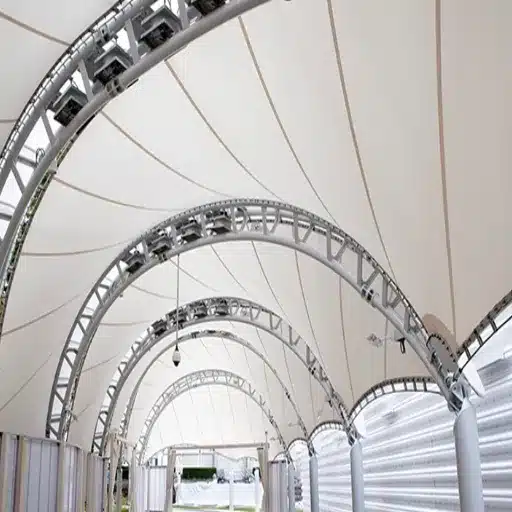
ETFE is an extruded fluoropolymer film used in transparent pneumatic cushions. PTFE is a sintered coating on woven fiberglass fabric used in structural tensile membranes. The key difference: ETFE is a lightweight glazing material, while PTFE is a load-bearing structural fabric.
When architects compare ETFE foil vs PTFE coated glass fabric, the difference starts with construction. ETFE (ethylene tetrafluoroethylene) is an extruded fluoropolymer film supplied in sheets 100-300 micrometers thick. It carries no woven substrate.
PTFE (polytetrafluoroethylene) is a coating system sintered onto a woven fiberglass base fabric, creating a true structural membrane. This distinction determines almost every downstream decision. ETFE behaves like a high-performance glazing material. It is lightweight, transparent, and flexible, but it relies on air pressure or cable support to create a stable building envelope.
PTFE behaves like an engineered tensile fabric. It is heavier, opaque, and structurally load-bearing, capable of spanning large distances under mechanical tension. For a broader technical overview of all membrane options including PVC, see our complete tensile structure materials guide.
| Property | ETFE Film | PTFE-Coated Fiberglass |
|---|---|---|
| Material form | Extruded fluoropolymer film | Woven E-glass fabric + PTFE coating |
| Typical weight | ~100 g/m² | 900-1,500 gsm |
| Light transmission | 90-95% visible light | 5-15% diffuse translucency |
| Tensile strength | 50-60 MPa isotropic (ASTM D882) | 6,000-10,000+ N/5cm warp (EN ISO 1421) |
| Elongation at break | 300-450% | 3-8% |
| Service temperature | -200°C to +150°C continuous | -180°C to +260°C continuous |
| Fire rating | B-s1,d0 (self-extinguishing) | A2-s1,d0 / ASTM E84 Class A |
| Typical lifespan | 20-30 years | 25-35+ years |
| Structural system | Air-pressure cushions or cable nets | Prestressed fabric with masts/cables |
When a design team asked us to review a 12,000 m² atrium roof last year, they had specified PTFE because they assumed all high-performance membranes were structurally equivalent. The project needed 85% daylight transmission. PTFE could not deliver it.
Switching to a three-layer ETFE cushion system met the daylight target and reduced steel tonnage by approximately 30%. The material choice was not about cost. It was about matching the material to the architectural intent.
ETFE vs PTFE Material Specifications Compared
A detailed ETFE vs PTFE membrane comparison requires understanding composition, strength, weight, and optical behavior at the material level.
Composition and Structure
ETFE film is produced by extruding a copolymer of ethylene and tetrafluoroethylene. The result is a thermoplastic film with high clarity, isotropic mechanical properties, and excellent impact resistance. Architectural grades are typically supplied as clear film, though tinted, fritted, and printed variants are available for solar control.
PTFE-coated glass fabric begins with a woven E-glass or S-glass scrim. The glass fibers provide tensile strength and dimensional stability. PTFE resin is applied in multiple sintering cycles, creating a chemically inert, hydrophobic surface. Modern PTFE membranes are almost always white, though limited color options exist.
LY TRUSTLINK manufactures custom tensile membrane materials with batch-level quality control and full certification documentation.
Tensile Strength and Structural Capacity
ETFE tensile strength of 50-60 MPa is respectable for a polymer film, but it is not a structural membrane in the traditional sense. ETFE cushions derive their shape from internal air pressure, not from fabric prestress. Single-layer ETFE installations require cable nets or perimeter frames to resist wind uplift.
PTFE-coated fiberglass delivers 6,000-10,000+ N/5cm in the warp direction. The glass fiber substrate does not stretch, which gives PTFE membranes exceptional dimensional stability under load. This is why PTFE is the standard for stadium roofs, airport terminals, and other long-span structures where structural performance is non-negotiable.
Weight and Structural Load Implications
At approximately 100 g/m², ETFE is roughly 1% of the weight of glass per unit area. This lightness reduces dead load and can significantly lower steel requirements. For retrofit projects or structures with weight constraints, ETFE can be the only viable option.
PTFE at 900-1,500 gsm is an order of magnitude heavier than ETFE. It still compares favorably to conventional roofing, but it requires a more substantial support structure. The weight penalty is justified when the project needs the structural capacity and fire performance that PTFE provides.
Light Transmission and Optical Performance
ETFE transmits 90-95% of visible light in clear form. This makes it the closest polymer alternative to glass for transparent roofs and facades. UV transmission is also high unless the film is specifically modified. For botanical gardens, biomes, and wellness spaces, this full-spectrum transmission can be an advantage.
PTFE transmits only 5-15% of light as a soft, diffuse glow. It cannot create transparent envelopes. However, that diffusion eliminates glare and creates even interior illumination. For assembly spaces where direct sunlight is undesirable, PTFE is often preferred.
Temperature Range and Weather Resistance
ETFE performs from -200°C to +150°C continuous service. It softens above 180°C. PTFE operates from -180°C to +260°C continuous and remains stable under short-term thermal spikes. For industrial environments, high-temperature exhaust zones, or regions with extreme thermal cycling, PTFE has a clear advantage.
Both materials resist UV degradation. PTFE reflects approximately 98% of UV radiation and shows negligible strength loss after 10,000 hours of accelerated weathering. ETFE retains high transparency over decades with minimal yellowing.
Fire Ratings and Building Code Compliance
PTFE-coated fiberglass typically achieves A2-s1,d0 under EN 13501-1 or Class A under ASTM E84. The inorganic glass substrate cannot burn, and the PTFE coating contributes virtually no fuel or smoke. This makes PTFE suitable for high-occupancy buildings, transportation hubs, and any project where non-combustibility is mandated.
ETFE is rated B-s1,d0 in most configurations. It is self-extinguishing and melts away from flame rather than spreading fire. It produces no flaming droplets. While this performance is strong, it does not meet the strictest Class A or A2 requirements.
Self-Cleaning Behavior and Maintenance
Both surfaces are hydrophobic. Rainwater beads and carries away dust. PTFE’s extremely low coefficient of friction gives it superior anti-soiling properties; cleaning intervals of 5-8 years are typical. ETFE also self-cleans well, but cushion systems add mechanical maintenance for blowers, pressure sensors, and control systems.
Structural Systems: Pneumatic Cushions vs. Prestressed Fabric
ETFE Cushion Systems
Most architectural ETFE is installed as pneumatic cushions. Two to five layers of film are welded at the perimeter and inflated to maintain 200-700 Pascals of overpressure. The air cavity provides thermal insulation and structural stability. Cushions are typically 1-5 meters wide and can reach lengths of 30+ meters, depending on the support frame.
The cushion system requires a continuous air supply. Modern installations use redundant blowers and pressure monitoring. If the film is punctured, the cushion deflates gradually rather than failing catastrophically. Individual cushions can be replaced without dismantling the entire roof.
PTFE Membrane Systems
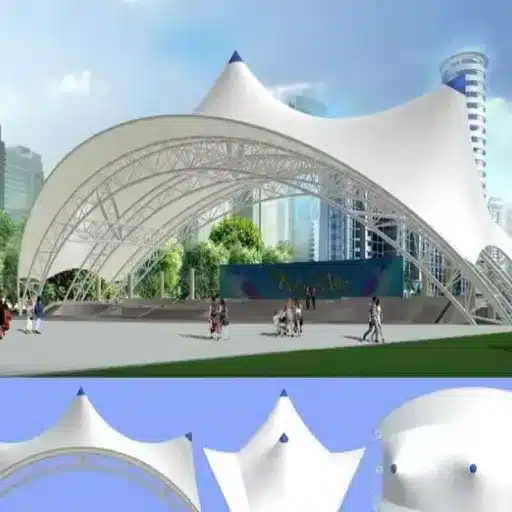
PTFE is installed as a pretensioned fabric membrane. The fabric is cut into panels, seamed with FEP tape, and tensioned over a supporting structure of cables, masts, and boundary connections. The shape is determined through form-finding to create double-curved surfaces that are stable under wind and snow loads.
PTFE systems do not require active mechanical maintenance like air blowers. Once tensioned, the membrane is a passive structural element. This simplicity is a significant advantage for projects with limited maintenance access.
When the Structural System Drives Material Choice
When deciding ETFE cushion vs PTFE membrane, the structural system is often the deciding factor before material cost even enters the conversation. If your project requires a transparent envelope with curved geometries and minimal structure, ETFE is the logical path. If your project requires a permanent roof over a large unobstructed area with minimal long-term intervention, PTFE is the logical path.
ETFE vs PTFE Cost Analysis: Material, System, and Lifecycle
ETFE Material and Installed Cost
ETFE film material typically costs €40-80/m² for single-layer applications. Installed single-layer systems range from 200−450/m2.ETFEcushionsystems,includingaluminumextrusions,airsupply,andcontrols,rangefrom200−450/m2.ETFEcushionsystems,includingaluminumextrusions,airsupply,andcontrols,rangefrom800-1,500/m² installed.
The higher installed cost of cushions reflects the system complexity, not just the film. However, the reduced steel tonnage and faster installation can offset part of that premium on suitable projects.
PTFE Material and Installed Cost
PTFE-coated fiberglass material typically costs €30-55/m². Installed systems range from $400-900/m² depending on project scale, geometry, and support structure complexity.
PTFE has a higher upfront cost than PVC-coated polyester, but its longer lifespan narrows the lifecycle gap for permanent projects. For projects where budget is the primary constraint, PVC-coated polyester membrane structures offer a cost-effective alternative with shorter design life.
Structural Support Cost Differences
ETFE’s light weight can reduce steel requirements by 20-40% compared to equivalent glass or heavier membrane systems. PTFE requires a robust cable and mast network capable of carrying higher dead loads and pretension forces. On large-span projects, PTFE structural costs can equal or exceed material costs.
Maintenance and Replacement Economics
PTFE membranes typically require cleaning every 5-8 years and can last 25-35+ years. ETFE film requires similar cleaning intervals but cushion systems need annual blower maintenance and periodic pressure system checks. ETFE film replacement cycles are typically 20-30 years, though individual cushions can be replaced earlier if damaged.
Total Cost of Ownership
For a 25-30 year design life, PTFE often delivers the lowest total cost of ownership in large-span permanent applications despite higher initial cost. ETFE can deliver lifecycle savings in transparent envelope applications where the alternative would be structural glass or where reduced steel tonnage is significant.
The specification team for a Middle Eastern transportation hub recently compared PTFE and ETFE for a 25,000 m² roof. PTFE’s installed cost was lower, but the client required 60% daylight transmission in the circulation zones.
ETFE cushions in those zones combined with PTFE over the concourse delivered both performance and budget control. The decision was not ETFE vs PTFE across the entire roof. It was ETFE in the right places and PTFE in the right places.
When to Specify ETFE vs PTFE: A Quick Decision List
Use this consolidated list to match the material to the project priority:
- Specify ETFE when: transparency, lightweight enclosure, curved geometries, or pneumatic systems are required.
- Specify PTFE when: large structural spans, non-combustibility, 25+ year lifespan, or minimal maintenance access are required.
The sections below expand each condition with project examples and specification guidance.
When to Specify ETFE
ETFE is the correct specification when:
- Transparency is the primary design driver. As a transparent tensile membrane material, ETFE gives atriums, skylights, facades, and botanical biomes 90-95% light transmission.
- Weight reduction enables structural savings. Retrofits, lightweight roofs, and long-span transparent envelopes often become feasible only with ETFE.
- Curved or irregular geometries are required. ETFE film conforms to complex shapes that rigid glazing cannot achieve economically.
- Pneumatic system maintenance is acceptable. Projects with facilities management teams can support the ongoing blower and control requirements.
- Sustainability and recyclability are priorities. ETFE is a thermoplastic and can be recycled through established fluoropolymer recovery routes.
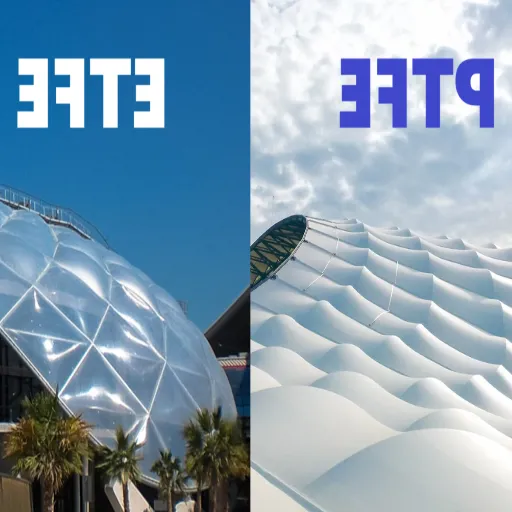
The Eden Project in Cornwall and the Beijing National Aquatics Center (Water Cube) demonstrate ETFE at scale. The Water Cube uses more than 3,000 ETFE cushions to create a lightweight, highly transparent envelope with minimal structural intervention.
Want to explore whether ETFE fits your transparent envelope project? Request ETFE film specifications from our engineering team →
When to Specify PTFE
PTFE is the correct specification when:
- Large structural spans are required. PTFE-coated fiberglass can span 100+ meters with cable support.
- Fire codes demand non-combustibility. A2-s1,d0 or ASTM E84 Class A ratings are achievable with PTFE.
- Longest design life is the priority. PTFE delivers 25-35+ years with minimal degradation.
- Maintenance access is limited. Once tensioned, PTFE requires no active mechanical systems.
- Harsh environments are present. PTFE resists UV, salt spray, industrial pollutants, and temperature extremes.
- Diffused natural light is preferred. PTFE creates soft, shadow-free illumination without transparency.
Munich Olympiapark, Denver International Airport, and Shanghai Pudong Football Stadium all use PTFE-coated fiberglass for permanent roofs. Munich’s roofs, now over 50 years old, remain a benchmark for long-term PTFE performance. If your project requires A2-s1,d0 fire ratings and 25+ year design life, request PTFE membrane specifications from our engineering team.
Procurement Checklist: What to Demand from Your Membrane Supplier
Whether you specify ETFE or PTFE, your architectural membrane supplier should deliver documentation that supports approval, procurement, and long-term asset management. Demand the following:
- Batch-specific test reports. Tensile strength, tear resistance, adhesion, and coating weight should be verified per production lot.
- Fire compliance documentation. EN 13501-1, ASTM E84, NFPA 701, or DIN 4102 certificates should match the project jurisdiction.
- UV aging data. Accelerated weathering reports (ASTM G154 or ISO 4892) should confirm long-term performance claims.
- Structural engineering support. The supplier or fabricator should assist with seam design, patterning, and connection detailing.
- Custom capability. Non-standard widths, colors, fritting patterns, or coating weights should be available for prototype and production.
- Lead time transparency and warranty terms. Confirm production schedules, shipping logistics, and warranty coverage in writing.
LY TRUSTLINK manufactures custom tensile membrane materials with batch-level quality control and certification documentation. We support projects from concept samples through certified production delivery.
Frequently Asked Questions
Is ETFE stronger than PTFE?
In pure material terms, ETFE has higher tensile strength per unit mass. However, PTFE-coated fiberglass is the stronger structural system because the woven glass substrate carries large tensile loads. ETFE relies on air pressure or cable support for structural stability.
Which is more transparent: ETFE or PTFE?
ETFE transmits 90-95% of visible light. PTFE transmits only 5-15% as diffuse light. ETFE is the only option for genuinely transparent membrane envelopes.
Is ETFE cheaper than PTFE?
ETFE film material is comparable to or slightly higher than PTFE film material. However, ETFE cushion systems have higher installed costs due to air supply and control systems. For large-span permanent roofs, PTFE often has lower total cost of ownership.
Can ETFE replace PTFE?
ETFE can replace PTFE only in applications where transparency, light weight, and flexibility are the priorities. ETFE cannot replace PTFE for large structural spans, non-combustibility requirements, or high-temperature environments.
What is the fire rating of ETFE vs PTFE?
PTFE-coated fiberglass typically achieves A2-s1,d0 or ASTM E84 Class A. ETFE typically achieves B-s1,d0. Both perform well in fire, but PTFE meets stricter non-combustibility standards.
Are PTFE and ETFE both PFAS?
Yes. Both are fluorinated polymers and fall under the broad PFAS category. Their environmental and regulatory status should be evaluated against current and emerging regional regulations.
Which material is better for outdoor architectural use?
Neither is universally better. ETFE is better for transparent roofs, facades, and atriums. PTFE is better for large permanent roofs, high-fire-safety buildings, and harsh environments.
Conclusion
The ETFE vs PTFE decision is not a question of which material is superior. It is a question of which material system matches your project’s performance requirements. ETFE delivers transparency and lightness through pneumatic or cable-supported film systems. PTFE delivers structural capacity, fire safety, and longevity through pretensioned coated fiberglass.
Specifiers who get the best outcomes treat the choice as part of an integrated envelope strategy. They match daylight targets, span requirements, fire codes, maintenance access, and budget parameters to the material whose strengths align with those priorities.
For a deeper technical overview of the ETFE vs PTFE decision and all tensile membrane options, see our complete tensile structure materials guide. If you are evaluating ETFE vs PTFE for a specific project, contact our engineering team for specifications, samples, and a procurement consultation.
Sources: