
PVC Tarpaulin for Water Slides: Grades, Seams & Specs
The correct PVC tarpaulin for water slides is a PVC-coated, high-tenacity polyester fabric at 18 oz (610 gsm) as the accepted baseline, and 20 oz (650 gsm) or heavier for slides that run wet most of the season. The spec that matters is not the marketing label but three measurable numbers: coating weight, base-fabric denier, and seam method.
That answer sounds simple. In practice, it is where most slide failures begin.
A rental operator we spoke with bought two slides from the same factory in the same order. One survived four seasons. The other was retired after eighteen months, not because the fabric tore, but because it was stored damp once and never recovered. The difference was not the grade on the invoice. It was the coating treatment and the care protocol nobody explained to him.
Cargo tarps fail by tearing. Water-slide fabric fails by mildewing from the inside, delaminating at the seam, or cold-cracking on the fold. If you specify PVC tarpaulin for water slides without understanding those three failure modes, you are buying on price and paying on replacement.
This guide covers the full specification stack: the grades that qualify, the coatings that keep mold out, the welding methods that hold water, the standards a commercial buyer should verify, and the sourcing checklist to bring to a supplier. Whether you operate water slides or manufacture them, you will finish with the exact numbers to put in a purchase order.
Key Takeaways
- 18 oz (610 gsm) is the commercial floor; 20 oz (650 gsm) is the wet-duty standard. Panels that run wet most of the season should not use 15 oz (≈510 gsm), which is a residential grade.
- Specify 1000D high-tenacity polyester scrim (up to 1000 × 1300D on heavy units) with a tear strength of 300–500 N and tensile strength of 2000–3000 N/5 cm.
- Seams must be heat-welded, not glued. Glued seams age and crack under constant immersion; legitimate water-product manufacturers weld.
- Mold, not abrasion, retires most slides. An anti-mildew (anti-fungal) coating plus a strict dry-storage protocol is what separates a 6–8 year asset from a 2 year one.
- Verify ASTM F2374-24 (wet use), EN 14960, NFPA 701, and EN 71-3/REACH, not a vague “commercial grade” claim on a listing.
What Is PVC Tarpaulin for Water Slides?
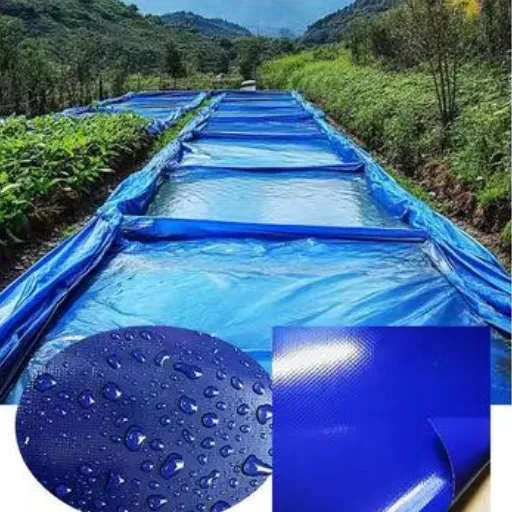
PVC tarpaulin for water slides is a three-layer engineered fabric: a high-tenacity polyester scrim sandwiched between two coats of PVC. The scrim carries the load. The PVC shell carries the water.
This is the same family of material used in commercial bounce house fabric, but wet-duty slides push it harder. Constant water exposure, chlorine and salt, and the flexing of an inflated structure combine into a duty cycle that dry play equipment never sees.
The construction matters because it determines which failure mode you get. A woven scrim gives the fabric tensile and tear strength, so it resists puncture on the slide bed and load at the anchor points. The PVC coating gives it the waterproof barrier. Remove either layer and the fabric fails. An uncoated Oxford weave leaks; an unsupported PVC film tears.
Manufacturers measure weight in grams per square meter (gsm) and thickness in millimeters, but buyers and listings still trade in ounces per square yard. The conversion is simple: ounces per square yard × 33.9 = grams per square meter. So 18 oz is 610 gsm, and 20 oz is 650 gsm.
What Grade of PVC Tarpaulin Do Water Slides Need?
Grade is the single most consequential decision, and it is where budgets are quietly cut. Here is how the grades line up on one axis.
| Grade | Weight | Thickness | Typical Use | Expected Lifespan |
|---|---|---|---|---|
| 15 oz | ≈510 gsm | 0.4 mm | Residential / backyard | 2–3 years |
| 18 oz | 610 gsm | 0.55 mm | Standard commercial slides | 5–7 years |
| 20 oz | 650 gsm | 0.60 mm | Wet-duty slide beds, high-traffic | 6–8 years |
| 22 oz+ | ≈700–750 gsm | 0.70–0.9 mm | Giant slides, aqua parks, high-abrasion zones | 8+ years |
Two rules sit above the table.
First, anything at 0.4 mm or lighter is a residential grade, regardless of how it is labeled. If a listing markets a “water slide” at 0.4 mm, it is outside commercial scope. More than 80 percent of commercial inflatable suppliers use 0.55 mm or thicker for that reason.
Second, thickness is not a proxy for quality past a point. A 0.9 mm skin is stiffer, harder to fold, and more prone to cold-stiffening in winter. The right question is not “how thick” but “how thick for this panel.” Slide beds, entry aprons, and anchor points take more abuse than side walls, and a good manufacturer will build up those zones with extra layers rather than over-building the whole unit. For adjacent wet-duty products, see our pool tarp and vinyl liner selection guide.
Specifying a slide and want the exact thresholds? Our PVC inflatable fabric specifications guide lays out denier, gsm, and tear-strength minimums panel by panel.
Coatings & Construction: Why Wet-Duty PVC Differs
A dry bounce house and a water slide can share the same scrim and still need different coatings. Wet duty changes the chemistry.
Anti-mildew (anti-fungal) treatment
This is the coating decision that most affects total cost of ownership, and it is the one most often invisible on a spec sheet. A biocide treatment inhibits the mildew colonies that metabolize the plasticizers keeping PVC flexible. Untreated PVC stored damp can lose its suppleness within a season; treated fabric holds it far longer. If your supplier cannot name the anti-mildew treatment, treat it as absent.
UV stabilization
Solar radiation breaks down untreated polymers, causing discoloration and flaking. For a slide that sits outdoors all summer, UV inhibitors must be compounded into the PVC, not sprayed on the surface.
Chemical resistance
Chlorinated pool water and saltwater attack additives in the PVC over time. Formulations meant for wet duty resist both, which protects the graphics and the plasticizers simultaneously.
Water column
A coated water-slide fabric should hold a water column above 3000 mm. Uncoated Oxford weaves typically manage 1000–2000 mm, fine for a shower curtain, not for a slide that sits under running water.
Scrim and performance targets
Look for 840D to 1000D high-tenacity polyester, with the heaviest construction using a 1000 × 1300D weave. Tear strength should land between 300 and 500 N, and tensile strength between 2000 and 3000 N/5 cm. A well-built slide fabric also clears 100,000 flex cycles without cracking; that number is what tells you the material will survive years of inflation and deflation, not one season.
Temperature range
Water-slide PVC should stay flexible from about −30 °C to +70 °C. Below that range the fabric cold-cracks on the fold; above it, the plasticizers migrate and the surface turns tacky.
Seam Welding for Constant Water Exposure
A slide’s seams are where a good fabric becomes a bad product. Two seams failing turns an expensive asset into a patchwork.
Water inflatables are almost entirely heat-welded, not glued. Glued seams hold for a while and then age, crack, and lift under prolonged immersion and sun. Legitimate water-product manufacturers do not rely on adhesive for structural seams.
There are two welding methods, and they do different jobs:
- Hot-air welding. A heating element brings compressed air to roughly 600–700 °C and directs it through a flat nozzle onto the seam gap between two overlapping PVC panels. Pressure rollers then press the melted layers into one fused seam. Hot-air welding suits long, continuous, flexible seams and thicker material. Its failure mode is temperature drift along a long run, which leaves one weak meter in the middle of an otherwise sound seam.
- High-frequency (RF) welding. Radio energy fuses the PVC under pressure, producing a uniform, fully airtight seam with no needle punctures. It is the method of choice where the seam must hold air, and it tolerates less error in the power and dwell settings; under-welded RF seams look perfect until they peel under load.
For a water slide, the welded structures that matter most are the watertight baffles, the drainage channels, and the welded D-rings and anchor points. These are the seams that see constant contact with water and the highest stress. Ask which method is used where, and why. A supplier who cannot answer is a supplier who has not thought about it. Our tarpaulin welding guide covers the process in more depth.
Safety Standards Commercial Buyers Must Verify
A product listing claiming “commercial grade” is a claim, not a certification. Commercial buyers should verify four things.
- ASTM F2374-24 governs inflatable amusement devices and explicitly covers wet use. This is the standard that brings water slides into scope for commercial operation.
- ASTM F2729-18 applies to consumer or backyard inflatables, a different standard, and not the one you want on a rented commercial unit.
- EN 14960 is the European standard for inflatable play equipment, relevant to any unit bound for the EU or UK.
- NFPA 701 covers flame retardancy of the fabric itself.
Chemical compliance matters on top of the structural standards, especially for children’s products. EN 71-3 and REACH set limits on heavy metals and phthalates. A slide that meets the structural standard but fails chemical compliance is not saleable in a regulated market, and a supplier who cannot produce a test report is a supplier whose claim is unverified. Adhesion testing is specified under EN ISO 2411, which is worth asking about if delamination has ever been a problem in your fleet.
The Mold-Free Care Protocol
Here is the operational truth: mold retires more commercial water slides than abrasion ever does. One season of poor storage can cut a 6–8 year fabric down to two years of service. The good news is that almost all of it is preventable.
Cleaning comes first, and what you use matters more than how hard you scrub.
- Bleach and chlorine cleaners destroy the plasticizers. Run bleach across slides and watch designs fade within two to three applications. Do not use them.
- Vinegar, diluted 1:4 with water, kills roughly 82 percent of mold species without harming the PVC. For a wipedown after a season, this is the tool.
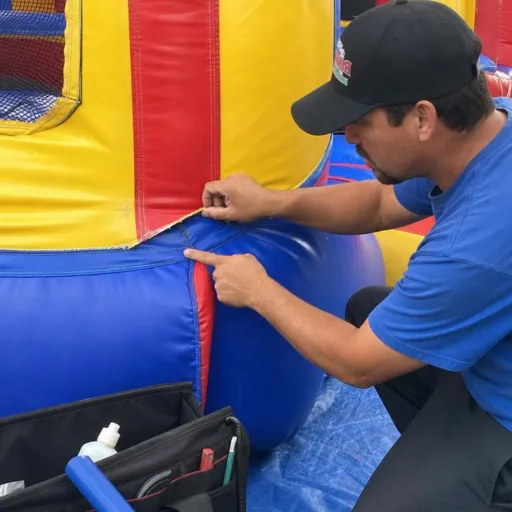
- Pressure washers above roughly 1200 PSI delaminate welded seams. One operator we worked with washed down a slide at 2000 PSI and lifted three seams in an afternoon, a repair bill that dwarfed the cleaning time it saved.
Drying is the step that gets skipped and the step that causes the failure. Drain every chamber, re-inflate the unit and run the blower for two to five hours with the ports open, then sun-dry for another two to four hours. Store it fully dry, loose-folded rather than crease-folded under weight, below 50–60 percent relative humidity, on pallets under a breathable cover. Between seasons, an anti-microbial spray based on benzalkonium chloride gives 30–60 days of residual mold inhibition, but it complements a dry unit rather than replacing one. See our mold prevention guide for the full routine.
Running a wet fleet through a humid season? The care protocol above is the difference between a two-year and an eight-year asset. If you are sourcing fabric to build slides, talk to our engineering team about anti-mildew formulations built for your climate.
Sourcing Water-Slide PVC Tarpaulin: What to Put in the RFQ
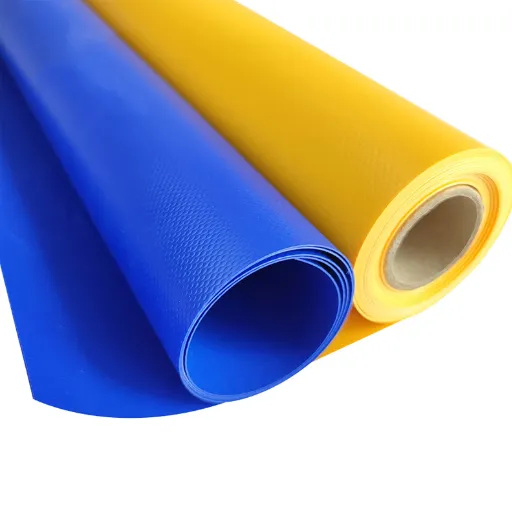
If you manufacture or distribute water slides, the sourcing conversation should start from specs, not from a price list. Bring these to every supplier and you will separate the ones who understand wet duty from those who do not.
- Coating weight: 18 oz (610 gsm) minimum, 20 oz (650 gsm) for wet-run panels.
- Base fabric: 1000D high-tenacity polyester scrim, with the weave density stated.
- Coatings: anti-mildew treatment named, UV stabilization compounded, flame retardant grade stated.
- Performance: tensile and tear strength targets, water column above 3000 mm, flex-cycle figure.
- Seam method: hot-air or RF, and which structures use which.
- Certification: test reports for ASTM F2374-24, EN 14960, NFPA 701, and EN 71-3/REACH where applicable.
- Roll format: width, length, and color consistency across the batch.
The reason to lead with specs is operational risk. A slide that delaminates mid-season is not a product inconvenience; it is a rental business that stops earning and a safety file that suddenly has a gap in it. A supplier who can band the right numbers is a supplier whose shipments you can predict.
One buyer we worked with had been quoted fabric at 22 percent below his premium supplier, a saving that looked like margin until we read the spec. The low quote was 15 oz, 0.4 mm, single-coated, with no named anti-mildew treatment. Over the unit’s life, the difference was not a discount. It was a second unit. When you compare quotes for water-slide fabric, compare the grade and the coating before you compare the price.
Frequently Asked Questions
What material is used for inflatable water slides?
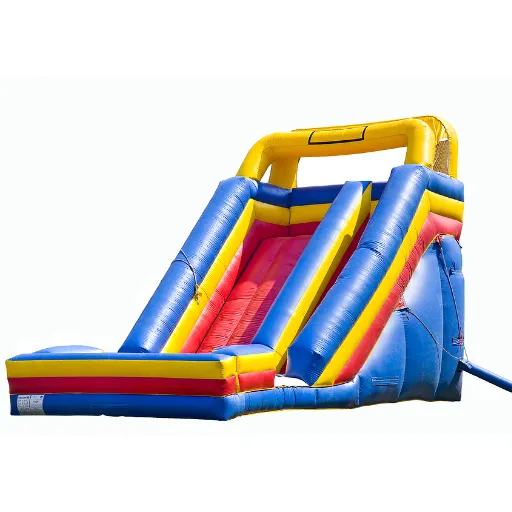
Inflatable water slides are made from PVC-coated polyester tarpaulin, a high-tenacity polyester scrim coated on both sides with PVC. Commercial units use 18 oz (610 gsm) at minimum, with 20 oz (650 gsm) recommended for slide beds that run wet most of the season.
What is the best PVC for water slides?
For a commercial water slide, the best fabric is a 1000D high-tenacity polyester scrim with a 20 oz (650 gsm) PVC coating, an anti-mildew treatment, UV stabilization, and heat-welded seams. This outperforms lighter 15 oz (0.4 mm) residential grades on every wet-duty metric.
How thick should inflatable water slide PVC be?
Commercial water slides should use 0.55 mm (18 oz) at minimum and 0.6 mm (20 oz) for high-traffic or wet-run panels. Anything at 0.4 mm or thinner is a residential grade and falls outside commercial scope.
18 oz vs 20 oz PVC for water slides, which is better?
20 oz (650 gsm) is better for slides that run wet most of the season, because it resists abrasion and tear more strongly than 18 oz. 18 oz (610 gsm) remains a valid choice for dry-duty or lightly used commercial fleets where unit weight and cost matter.
How many gsm is inflatable water slide material?
Standard commercial water-slide fabric is 610 gsm (18 oz), and heavy-duty wet-duty fabric is 650 gsm (20 oz) and above. Giant slides and aqua-park units often use 700–750 gsm.
Why does my inflatable water slide smell?
A musty smell usually signals mildew growing inside the fabric or its chambers, caused by storing the unit damp. Mildew feeds on the plasticizers that keep PVC flexible. Clean with diluted vinegar, then dry the unit completely before storage.
Can you use bleach on an inflatable water slide?
No. Bleach and chlorine cleaners attack the plasticizers in PVC and fade printed designs within two to three applications. Use pH-neutral soap or white vinegar diluted 1:4 with water instead.
Are inflatable water slides safe?
A commercial water slide built to ASTM F2374-24 (wet use) with documented EN 14960, NFPA 701, and chemical-compliance testing is safe when operated within its wind and supervision limits. Safety depends on the standard, not on the marketing term “commercial grade.”
How long do inflatable water slides last?
A well-built, well-cared-for commercial slide lasts 5–7 years at 18 oz and 6–8 years at 20 oz. Poor storage, bleach cleaning, and high-pressure washing can cut that to two years regardless of grade.
How do you keep a water slide from getting moldy?
Drain every chamber, run the blower for two to five hours, sun-dry for another two to four hours, and store the unit fully dry below 50–60 percent relative humidity. An anti-mildew coating and a benzalkonium chloride spray give 30–60 days of residual protection between seasons.
Conclusion
The specs that decide whether a water slide lasts are the ones least visible on a product page. Coating weight sets the floor: 18 oz (610 gsm) to qualify, 20 oz (650 gsm) for wet duty. Scrim denier and tear strength decide how it takes abuse. The anti-mildew treatment and the seam method decide whether it is still in service in year six.
Choose the grade for the duty cycle, weld the seams, verify the standards (ASTM F2374-24, EN 14960, NFPA 701, EN 71-3), and run the mold-free care protocol as a routine, not an afterthought. That combination is what lets you inflate a slide, rent it out, and stop worrying about it.
If you are sourcing PVC tarpaulin for water slides, our engineering team can build the fabric to your exact grade, coating, and certification requirements. Request a sample and spec sheet to evaluate against your operation, and see how our water-slide formulations compare for your fleet’s duty cycle.