

Fish Farming Tarpaulin: Manufacturer’s Guide | LY TRUSTLINK
A failed seam in a 25,000-liter biofloc tank does not just leak water. It kills an entire crop of tilapia, destroys the bacterial colony your farmer spent six weeks cultivating, and turns a profitable harvest into a total loss.
You already know that aquaculture is scaling fast. Global pond liner demand is expected to reach $2.23 billion in 2026, driven by a 9.2% CAGR, with the Asia-Pacific aquaculture geomembrane segment growing even faster at 12.8% according to The Business Research Company and Alibaba industry data. But not every containment material is engineered for the hydrostatic pressure, UV exposure, and daily handling that intensive fish farming demands. The difference between a tank that holds for ten years and one that fails in eighteen months comes down to three fabric decisions most buyers never think to ask about: base fabric weight, seam welding quality, and coating chemistry.
In this guide, we break down exactly how to specify a fish farming tarpaulin for your operation or product line. You will learn how PVC coated tarpaulin compares to HDPE geomembrane, how to select the right GSM for your tank capacity, why welding standards matter more than thickness, and what biofloc systems require from a liner.
What Is a Fish Farming Tarpaulin?

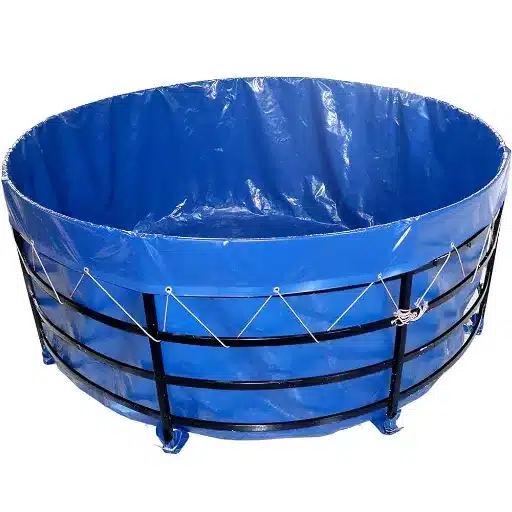
A fish farming tarpaulin is a flexible, reinforced PVC or polyethylene sheet engineered to contain water, fish stock, and biofloc cultures in framed or excavated aquaculture systems. Unlike rigid geomembrane panels, these fabrics are designed to fold, transport, and conform to support structures while maintaining a watertight seal under constant hydrostatic load.
Not every fish farming tarpaulin is built to the same standard, however. A true aquaculture tarpaulin is a textile: a high-tenacity polyester base mesh sandwiched between layers of virgin-grade PVC film. It is manufactured in rolls, cut to shape, and then welded into three-dimensional tanks. An HDPE geomembrane, by contrast, is an extruded plastic sheet used primarily for in-ground pond liners and large dams. It offers excellent puncture resistance but lacks the flexibility needed for collapsible, above-ground biofloc tanks.
This distinction shapes everything from installation time to total cost of ownership. When Emmanuel Okafor, a Lagos-based aquaculture equipment distributor, switched his product line from PE tarpaulin to 650 gsm reinforced PVC in 2023, he cut customer replacement claims by nearly 60% over three years. His original PE suppliers had promised waterproof performance at half the price, but the material cold-cracked during handling and failed at the eyelets within months. The PVC fish farming tarpaulin line paid for itself in reduced warranty costs and repeat orders.
Need help specifying the right aquaculture fabric for your climate? Explore our technical fabric specifications and testing standards →
PVC Coated Tarpaulin vs. HDPE Geomembrane: Which Material Wins?
Material selection for aquaculture containment starts with a simple question: Is the pond excavated and permanent, or is the tank framed and portable? The answer determines whether you need a geomembrane or a fish farming tarpaulin.
Tensile Strength and Puncture Resistance
HDPE geomembrane excels in ground-contact applications. It is chemically resistant, UV stable, and offers high puncture resistance against rocks and roots. According to ASTM International testing protocols such as ASTM D4833, a 1.0 mm HDPE liner can withstand puncture forces that would tear lighter fabrics. For large earthen ponds, this is the standard.
However, HDPE is rigid. It does not fold repeatedly without stress-cracking, and it cannot be welded into complex three-dimensional shapes with the same seam strength as PVC coated fabric. A fish farming tarpaulin made from 650 gsm PVC typically delivers tensile strength above 2,500 N/5cm, with tear resistance exceeding 300 N/5cm. That is sufficient to support the hydrostatic pressure of a 1.5-meter water column in a round biofloc tank.
Flexibility, Weldability, and Frame Compatibility
PVC coated tarpaulin is the only practical choice for framed, collapsible tanks. The material remains pliable from -30°C to +70°C, conforms to galvanized steel supports, and can be high-frequency welded into round or square profiles. HDPE requires thermal wedge welding and a flat substrate. It simply cannot be fabricated into the portable tank systems that biofloc farmers demand.
Cost Per Square Meter and Total Cost of Ownership
Price is not the same as value. Bulk HDPE geomembrane currently ranges from 0.30to0.30to1.70 per square meter, while aquaculture-grade PVC coated fabric ranges from 0.50to0.50to1.60 per square meter. The initial material cost is comparable. But installation labor, frame compatibility, and lifespan shift the economics.
| Factor | PVC Coated Tarpaulin | HDPE Geomembrane |
|---|---|---|
| Best Use | Framed/collapsible tanks, biofloc systems | In-ground ponds, dams, excavated reservoirs |
| Tensile Strength | >2,500 N/5cm (650 gsm) | High puncture resistance, lower flexibility |
| Weldability | High-frequency welding for 3D shapes | Thermal wedge welding, flat seams |
| Flexibility | Pliable, foldable, frame-conforming | Rigid, limited folding cycles |
| Lifespan | 5–10 years with UV stabilization | 10–20 years in ground contact |
| Cost | 0.50–0.50–1.60 / sqm | 0.30–0.30–1.70 / sqm |
For distributors and system integrators, the real advantage of a fish farming tarpaulin is that it ships flat and assembles on-site. A 25,000-liter round tank can be installed by two workers in under an hour with no civil works. That portability is why the agricultural tarpaulin sub-segment, valued at roughly $1.28 billion in 2025, is growing at 7% CAGR and outpacing traditional geomembrane demand in certain aquaculture markets.
How to Select the Right GSM for Your Aquaculture Tank
Grams per square meter (GSM) is the most misunderstood specification in aquaculture tarpaulin procurement. It is not just about thickness. GSM reflects the combined density of the polyester base fabric and the PVC coating, which together determine puncture resistance, seam strength, and how the material behaves under hydrostatic pressure.
350–500 GSM: Light-Duty and Temporary Ponds
This weight range is suitable for small backyard ponds, seasonal nursery tanks, or temporary water storage. The material is lightweight and easy to handle, but it lacks the structural backbone for commercial biofloc systems. Think of it as a seasonal solution, not a production asset.
650 GSM: The Biofloc Industry Standard
650 gsm has emerged as the default specification for commercial biofloc fish farming tanks. It offers the optimal balance of tensile strength, weldability, and handling weight. At approximately 0.50–0.55 mm thickness, a 650 gsm aquaculture tarpaulin resists abrasion from aeration stones, withstands the stress of galvanized frames, and maintains dimensional stability across temperature swings.
For standard tank sizes, 650 gsm is almost always the correct choice for a fish farming tarpaulin:
| Diameter | Height | Capacity | Recommended GSM |
|---|---|---|---|
| 3 m | 1.2 m | 9,000 L | 650 |
| 5 m | 1.2 m | 25,000 L | 650 |
| 6 m | 1.5 m | 30,000 L | 650–750 |
850–1,100 GSM: Heavy-Duty Commercial Systems
When you move into industrial-scale operations, harsh climates, or species that require deeper water columns, upgrade your fish farming tarpaulin to 850 gsm or higher. A 1,050 gsm reinforced tank liner delivers warp tensile strength around 2,800 N/5cm and weft strength near 2,700 N/5cm, based on a 1000D×1000D polyester scrim. This is the specification chosen by OEM manufacturers building tank systems for export to markets with extreme UV exposure or rough handling during transport.
Welding and Seam Integrity: The Hidden Failure Point

If you inspect failed fish farming tarpaulin tanks, the rupture almost never occurs in the middle of a panel. It happens at the seam. That makes welding methodology the single most important manufacturing variable in aquaculture containment.
Why Glued Seams Fail Under Hydrostatic Pressure
Glued seams rely on adhesive bonds between PVC layers. Over time, plasticizers in the adhesive can degrade, and the bond weakens under the constant outward pressure of a water column. Mechanical stress from frame tension, temperature cycling, and handling accelerates the failure. In a fish farming tarpaulin where water quality depends on stable volume, a slow seam leak is catastrophic.
High-Frequency (HF) Welding Standards
High-frequency welding uses electromagnetic energy to melt PVC molecules at the joint interface, creating a molecular bond that is stronger than the surrounding material. According to DIN 53352 and DIN 53354 testing standards for coated fabrics, a properly executed HF weld should meet or exceed the tensile strength of the base fabric. At LY TRUSTLINK, we specify HF welding with minimal joint count; the best tank designs use a single circumferential seam reinforced with an additional PVC strip.
Reinforcement and Joint Minimization
Every weld is a potential failure point. The fewer joints, the better. Agricultural standards such as IS 15351:2015 specify that a quality fish farming tarpaulin should carry no more than one central welding seam, with that seam fully reinforced. Some manufacturers cut costs by stitching panels together and then gluing over the stitches. That approach saves material but doubles the failure risk.
Need ASTM-compliant welding for your tank production line? Contact our fish farming tarpaulin engineering team for technical specifications and OEM pricing →
Biofloc Fish Farming Tanks: Technical Requirements
Biofloc technology is reshaping aquaculture. It allows high-density fish and shrimp production in controlled environments with minimal water exchange. But it also places unique demands on containment materials. The liner is not just a waterproof barrier; it is part of the production ecosystem.
Food-Grade, Non-Toxic PVC Specifications
Fish and shrimp are sensitive to chemical leaching. A biofloc fish farming tank must be fabricated from food-grade, non-migratory PVC polymer. Phthalate-free formulations are increasingly preferred, particularly for systems producing fish for human consumption. Any glue, residual solvent, or off-gassing from low-grade plastic can suppress bacterial floc formation or stress the stock.
UV Stabilization and Anti-Mildew Treatment
Biofloc tanks operate in humid, nutrient-rich environments that promote algae and fungal growth. A properly formulated fish farming tarpaulin integrates UV inhibitors directly into the polymer matrix during extrusion, not as a surface spray that washes away. Anti-mildew and anti-fungus additives are equally critical; without them, the fabric surface becomes a breeding ground for pathogens that compete with the beneficial biofloc bacteria.
Round vs. Square Tank Design
Shape matters for water circulation. Round tanks create a continuous circular flow that keeps solids suspended and distributes oxygen evenly. That is why round PVC tarpaulin tanks dominate the biofloc market. Square tanks with metal frames are available and save space, but they create dead corners where waste settles and anaerobic pockets can form.
In 2022, a shrimp farm in the Mekong Delta worked with our engineering team to standardize its entire operation on 750 gsm HF-welded round tanks with galvanized steel frames. The farm had started with ten makeshift concrete ponds but struggled with uneven oxygen distribution and predator intrusion. By switching to portable round aquaculture tarpaulin tanks, they scaled to one hundred units within eighteen months and reduced mortality rates by standardizing water flow patterns across every tank.
OEM and Custom Manufacturing for Aquaculture Equipment

Not every aquaculture operation fits a catalog size. System integrators, equipment distributors, and large-scale farms often need custom dimensions, colors, and integrated fittings.
Custom Weights, Colors, and Fittings
LY TRUSTLINK manufactures fish farming tarpaulin rolls in weights ranging from 350 gsm to 1,100 gsm, with custom widths and colors available for bulk orders. We can pre-weld drain valves, aeration ports, and inspection windows directly into the tank liner, reducing your on-site assembly time. A European RAS system integrator recently sourced custom blue 850 gsm PVC with pre-welded DN110 drain fittings; the pre-fabrication cut their average assembly time by 30% per tank.
MOQ and Prototyping Lead Times
Custom specifications do not require massive volume commitments. We typically provide prototype samples within 2–3 weeks, with production lead times confirmed at order. That flexibility matters for distributors testing new market demand or farms piloting novel species.
Quality Control: Tensile, Tear, and Adhesion Testing
Every production batch is tested for tensile strength, tear resistance, and coating adhesion before shipment. We test to relevant DIN and ASTM standards, ensuring that what leaves our facility matches what your customer expects in the field. The best fish farming tarpaulin suppliers treat consistency across batches as non-negotiable, because your product line carries live stock.
Ready to source custom aquaculture fabric for your product line? Request a quote for OEM manufacturing and prototype samples →
Frequently Asked Questions
What is the best material for a biofloc fish tank?
For framed, above-ground biofloc systems, a 650 gsm PVC coated tarpaulin with HF-welded seams is the industry standard. It balances portability, weldability, and durability. For large, permanent earthen ponds, HDPE geomembrane is generally the better choice.
How long does a PVC fish farming tarpaulin last?
Lifespan depends on GSM and environmental exposure. A 560 gsm liner lasts roughly 4–6 years, while a 650–750 gsm UV-stabilized tank typically lasts 7–10 years. Heavy-duty 850+ gsm systems can exceed 10 years with proper maintenance.
What GSM do I need for a 25,000-liter tank?
A 5-meter diameter tank holding 25,000 liters should use a minimum of 650 gsm PVC coated fabric. If the tank will be relocated frequently or exposed to intense UV, upgrade to 750 gsm or 850 gsm.
Is PVC tarpaulin safe for fish and shrimp?
Yes, provided it is manufactured from food-grade, non-migratory PVC without toxic adhesives or plasticizers. Always verify that the supplier uses phthalate-free formulations and tests for chemical leaching.
Can I use a tarpaulin fish pond outdoors in extreme heat?
Quality aquaculture tarpaulin is rated for continuous use from -30°C to +70°C. In regions with extreme heat or high UV index, select a liner with integrated UV inhibitors and consider shade netting to extend service life.
Conclusion
Selecting the right fish farming tarpaulin is an engineering decision, not a commodity purchase. The containment fabric you specify directly impacts water retention, stock health, and the total cost of ownership across the life of the system.
Remember the three critical variables: choose the GSM that matches your tank capacity and handling environment, insist on high-frequency welded seams with minimal joints, and verify that the PVC formulation is food-grade and UV-stabilized for biofloc conditions. Get those three decisions right, and your tanks will outlast multiple harvest cycles. Get them wrong, and you are one seam failure away from a total crop loss.
For technical specifications, custom OEM manufacturing, or prototype samples for your aquaculture product line, consult our engineering team today.


