
Bounce House Fabric Wholesale: MOQs, Pricing & Vetting
Bounce house fabric wholesale means buying PVC-coated polyester tarpaulin in bulk roll form directly from the mill, typically at 2,000 square meters or more. The commercial grade you should be ordering is 18 oz (about 610 gsm) on a 1000D polyester scrim with tear resistance of at least 240 to 280 N. Expect to pay roughly USD 1.04 to 1.05 per linear meter at 2,000 meters and up, or USD 8 to 10 per square meter for 18 oz material.
Those three numbers, grade, quantity, and price basis, are where most sourcing mistakes begin. Get any one of them wrong and you commit thousands of dollars before the first unit is sewn.
This guide is written from the manufacturer’s side of the deal. It covers what to put on a request for quotation, how to compare quotes that are priced on different bases, what minimum order quantities are actually realistic, and how to tell a mill from a trading desk before you wire a deposit.
Key Takeaways
- Commercial-grade bounce house fabric is 18 oz / ~610 gsm on a 1000D scrim, with tear resistance of 240 to 280 N. Below 500 gsm (about 15 oz), you are buying residential-grade material.
- Quotes are priced per linear meter or per square meter, and the two aren’t interchangeable. A 2.5 m x 50 m roll is 125 m², so the same roll costs roughly five times more at a per-square-meter price than at a per-linear-meter price.
- Realistic MOQs run 2,000 to 4,000 m² for production roll goods. Prototype and sample quantities are usually negotiable.
- Verify the mill, not the listing. Ask for certifications in the supplier’s own name, request a factory walkthrough, and confirm specs on the exact production lot.
- Price alone is the weakest signal in a wholesale quote. Lead time, lot-to-lot consistency, and documented test reports are what protect your production schedule.
What Bounce House Fabric Wholesale Actually Involves
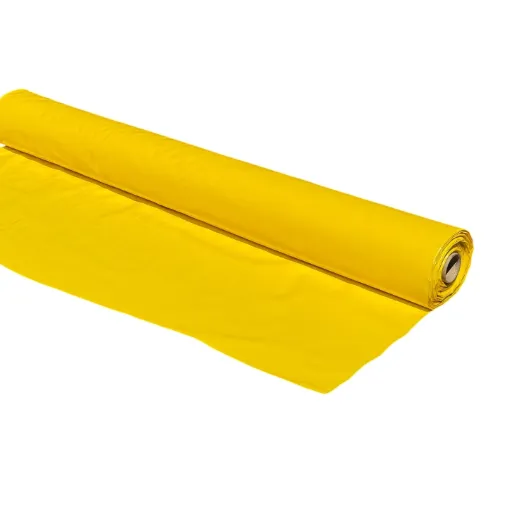
Bounce house fabric is a laminated or knife-coated composite. A woven high-tenacity polyester scrim supplies the mechanical strength, and a PVC coating supplies the waterproof, air-tight, weldable surface. Buying it wholesale means purchasing that composite in roll form, by the container or by the pallet, from the company that makes it.
The distinction that matters is who you are buying from. A mill runs coating and lamination lines and specializes in a narrow product range. A trading company resells and carries a broad catalog.
Both will quote you a price. Only one of them can answer a question about coating weight tolerance without calling someone else.
That difference shows up late and expensively. A distributor we work with placed a 3,000 m² order through a broker at a price roughly 20 percent below every mill quote he had received. The material arrived on schedule.
It also arrived at roughly 14 oz rather than the 18 oz he had specified, with a coating that failed the peel test at the seams. He had no recourse, because the certification documents he was shown belonged to a different factory than the one that actually ran the order.
Wholesale sourcing is a bulk bet, and the bet is on the supplier as much as the fabric.
Specifying material for a new inflatable product? Our engineering team reviews your load, weld method, and target market, then recommends a coating weight and scrim construction to match. Talk to an engineer about your specification.
The RFQ: What to Specify Before You Ask for a Price
An incomplete request for quotation is the most common reason wholesale quotes come back incomparable. If you ask three mills for “a price on bounce house fabric,” you’ll receive three prices for three different materials.
Write the specification down, in full, and send the same document to every supplier.
The Eight Fields Every RFQ Needs
- Application. Bounce house, water slide, wet/dry combo, or dry-only unit. Wet applications need heavier coating and anti-mildew treatment.
- Base scrim. Denier and weave count, for example 1000D x 1000D at 18 x 18. This is the single most important structural variable.
- Weight with tolerance. State the target in gsm and the acceptable band, for example 610 gsm plus or minus 20 gsm. A mill that can’t commit to a tolerance can’t guarantee consistency across lots.
- Coating type. Knife-coated, hot-melt laminated, or extrusion-coated. Inflatable applications generally call for hot-melt coating with a thicker adhesive layer, because air retention and seam peel strength depend on it.
- Surface treatment. Anti-UV, anti-mildew, flame retardant, or gloss/semi-gloss finish. Name the standard rather than the adjective.
- Certifications. The specific standards you must satisfy, not a general request for “safety certificates.”
- Roll dimensions. Width, length, and core size. Standard widths run 1.0 to 3.2 m; confirm the width you need before the roll is slit.
- Color. Reference a specific RAL or Pantone number. “Red” has cost buyers entire production runs.
A quote that answers all eight fields is a quote you can compare. A quote that answers four is a conversation.
At this stage, one soft CTA belongs in the conversation: ask each supplier for a sample from the production line, not a swatch from a sample library. Production-line samples reveal coating texture, weld behavior, and actual GSM. Library swatches reveal nothing. Our PVC inflatable fabric specification guide walks through the full parameter set if you want a reference document to work from.
Pricing: Per Meter Versus Per Square Meter
This is the trap that catches experienced buyers.
Observed wholesale pricing for 18 oz PVC tarpaulin sits at about USD 1.04 to 1.05 per linear meter at volumes of 2,000 to 3,000 meters and above. Priced per square meter, 18 oz material runs about USD 8 to 10, 15 oz about USD 6 to 8, and 20 oz about USD 10 to 12, depending on certifications and surface treatment.
Both figures are correct. They are also roughly a factor of five apart, because they measure different things.
| Fabric grade | Weight | Approx. cost per m² | Typical application |
|---|---|---|---|
| 15 oz | ~510 gsm | USD 6 to 8 | Light commercial, promotional units |
| 18 oz | ~610 gsm | USD 8 to 10 | Standard commercial bounce houses |
| 20 oz | ~650 gsm | USD 10 to 12 | Premium commercial, water slides |
A standard 2.5 m x 50 m roll contains 125 m². At USD 1.04 per linear meter, that roll costs about USD 52. At USD 1.04 per square meter, the same roll costs about USD 130.
If you compare those two quotes without checking the basis, you’ll conclude that one supplier is dramatically cheaper. You’ll be comparing a linear meter to a square meter.
Marketplace listings make this worse rather than better. In a single afternoon of browsing, you can find 18 oz fabric quoted at USD 0.60 per m² at 30,000 m² and up, USD 1.00 per m² in the 2,500 to 29,999 m² band, USD 2.50 per roll with a 40-roll minimum, and USD 1.05 per linear meter at 2,000 meters. Every one of those numbers can be legitimate. None of them can be compared to another without first converting to a single basis.
An inflatable manufacturer in the Midwest learned this the hard way. He built a per-unit cost model on a quote that read “USD 1.05.” He assumed square meters, budgeted accordingly, and placed a 2,000-meter order.
The invoice was roughly five times his model. The quote had been per linear meter all along. He was fortunate that the material was right, because he had already quoted his own customers based on a cost that did not exist.
Rule to work by: in bounce house fabric wholesale, confirm the unit before comparing a single number. Then confirm whether meters means linear meters or square meters. Then confirm whether the price includes or excludes freight, duty, and certification testing.
MOQs, Roll Sizes, and Lead Times
Minimum order quantities for bounce house fabric wholesale are real, but they’re less rigid than the headline numbers suggest.
Most mills set an MOQ of 2,000 to 4,000 m² for production roll goods. A first order of 2,000 m² is roughly 20 rolls at 2.5 m x 50 m. Some suppliers quote a minimum of 40 rolls, some quote per color, and lighter minimums exist for specific constructions, occasionally as low as 1,000 m².
Sample and prototype quantities are almost always negotiable. Most mills will send an A4 or 1 m x 3 m sample by express courier, and some will deduct the sample fee from the first production order. If you are prototyping a new unit design, ask for the sample path explicitly. It’s a normal request, not a favor.
Two practical notes on ordering:
- Roll width drives your cutting yield. Confirm the available widths before you commit to a panel layout. A width that fits your layout cleanly can reduce waste by more than the price difference between two suppliers.
- Color minimums are usually separate from fabric minimums. A 2,000 m² order split across four colors may become four small orders with four minimums. Consolidate where you can.
What to Expect on Lead Time
Production lead time for roll goods typically runs around 30 days from payment, with longer windows around peak season and for non-standard constructions. Ocean freight adds transit time on top, and that’s the line item buyers most often forget when they build a launch schedule.
Ask for the lead time in writing, tied to a deposit date, and ask what happens if it slips. A supplier who won’t put a date in writing is telling you something useful.
Ready to test the difference on your own line? We send production-line samples, not library swatches, so you can weld and load-test the exact construction before you commit to a container. Request a sample order.
How to Vet a Bounce House Fabric Wholesale Supplier
Vetting is where the real work happens, and it’s mostly a matter of asking questions that a trading desk can’t answer.
The Five Questions That Separate Mills From Trading Desks
- Does the supplier specialize? A mill focuses on a narrow range, coated fabrics and tarpaulins, and knows it deeply. A trading desk carries everything and specializes in nothing.
- Can they answer technical questions instantly? Ask for the coating weight tolerance and the weld method. A mill answers from knowledge. A broker puts you on hold.
- Are the certifications in their own name? This is the decisive test. A test report issued to another company proves nothing about the material you will receive. Ask for the certificate, and check the named entity.
- Will they walk the production floor on a video call? Over 75 percent of reputable suppliers will do this on request. A supplier who can’t show you a coating line isn’t running one.
- Are they fluent in OEM and ODM? Custom weights, coatings, and dimensions are routine for a manufacturer and awkward for a reseller.
Certifications to Request
For commercial inflatables and children’s products, the relevant standards are specific. Ask for the ones that apply to your market:
- ASTM F963 and EN 71 for toy safety, where the unit is marketed to children.
- NFPA 701 for fire retardancy, required by code in many indoor venues. Review the standard at nfpa.org.
- REACH for EU export, covering restricted substances. The European Chemicals Agency publishes the current substance list at echa.europa.eu.
- RoHS where electronic components are integrated into the unit.
A supplier that names these standards fluently and produces certificates in its own name is a supplier you can build a product line on. Our commercial grade bounce house material guide explains how to tell a genuine compliance document from a decorative PDF.
Quality Control: Verifying the Exact Production Lot
Fabric test data describes a sample. It doesn’t automatically describe the roll sitting in your warehouse.
Bind the supplier to the lot. Three mechanisms do that:
- Retained samples. Have the mill retain a sealed sample from your production run, and retain a matching sample yourself. A dispute about GSM or coating weight becomes a measurement instead of an argument.
- Lot-numbered test reports. Ask for test data referenced to your production lot number and date, not a generic report from a previous campaign.
- An inspection plan. Agree in advance on sampling frequency and acceptance criteria. A simple AQL sampling plan, with agreed GSM tolerance and peel-strength minimums, converts quality from a promise into a procedure.
In-process monitoring matters too. Ask whether the mill monitors coating weight continuously during production or only tests at the end. Continuous monitoring catches drift while it’s still correctable. End-of-line testing catches it after you own the problem.
A rental operator who standardized on lot verification described the change plainly. Before, every container was a small gamble, and roughly one in ten rolls went into repair stock. After, he could trace a failure back to a specific lot and a specific coating run, which turned an argument about quality into a conversation about a replacement.
His scrap rate didn’t drop because the fabric got better. It dropped because he could finally prove when it hadn’t.
Red Flags That Should End the Conversation
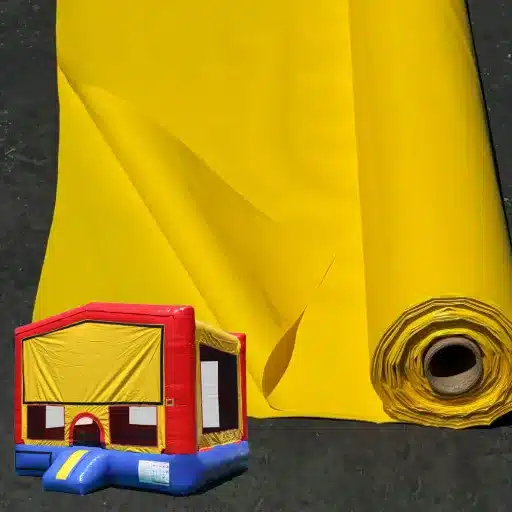
Some signals justify walking away, regardless of the price.
- A price far below the market band. If a quote is 30 percent under every mill you have contacted, either the material is lighter than specified, the certification is borrowed, or the money is funding something other than fabric.
- No certifications in the supplier’s own name. A report issued to a third party tells you nothing about your order.
- Vague pricing with add-ons that appear later. Freight, testing, and packaging that surface after the order is placed are a sign the original number was never real.
- Unwillingness to show the factory. Photos and videos of a production floor should be easy to provide. Resistance is informative.
- No written lead time or written warranty. A supplier who will not commit in writing is not committing at all.
Any one of these is a question. Two or more is a decision.
Frequently Asked Questions
What is the MOQ for bounce house fabric?
Most mills set minimums between 2,000 and 4,000 m² for production roll goods, with some quoting 40 rolls or a per-color minimum. Prototype and sample quantities are usually negotiable, and a first order of 2,000 m² is roughly 20 rolls at 2.5 m x 50 m.
How much does bounce house fabric cost per meter?
18 oz PVC tarpaulin runs about USD 1.04 to 1.05 per linear meter at 2,000 to 3,000 meters and up. Per square meter, expect about USD 8 to 10 for 18 oz, USD 6 to 8 for 15 oz, and USD 10 to 12 for 20 oz. Always confirm which basis a quote uses before comparing it.
What is the difference between a factory and a trading company?
A factory runs its own coating and lamination lines and specializes in a narrow product range. A trading company resells and carries a broad catalog. The fastest test is to ask a technical question about coating weight tolerance and see whether the answer arrives immediately or after a delay.
What is the commercial grade standard for bounce house fabric?
Commercial grade means 18 oz, about 610 gsm, on a 1000D polyester scrim with tear resistance of at least 240 to 280 N and documented flame retardancy. Material below 500 gsm sits at the residential-grade line.
How do I know if a bounce house fabric supplier is legitimate?
When sourcing bounce house fabric wholesale, ask three questions: for certifications in the supplier’s own name, for a factory walkthrough on a video call, and for a production-line sample rather than a library swatch. A real mill answers all three without hesitation.
What should I put on an RFQ for inflatable fabric?
Eight fields: application, base scrim denier and weave count, weight with tolerance, coating type, surface treatments, required certifications, roll dimensions, and a specific RAL or Pantone color reference.
Conclusion: Buy the Supplier, Not Just the Fabric
Bounce house fabric wholesale comes down to four disciplined steps. Specify the grade in writing, using the eight RFQ fields, so every quote you receive describes the same material.
Anchor the price against a known basis, and confirm whether you’re comparing linear meters or square meters before you believe any number.
Verify the mill rather than the listing, using certifications in the supplier’s own name and a factory walkthrough. Then test the batch, with retained samples, lot-numbered reports, and an agreed inspection plan.
The unit price on the quotation is the least durable part of the deal. Coating weight that holds across every lot, a lead time you can plan a launch around, and documentation your own customers will accept are what determine whether a wholesale order was a good decision six months later.
If you are specifying bounce house fabric for a new product line or replacing a supplier who has drifted, our engineering team will review your application, recommend the grade and coating to match, and send samples from the production line before you commit. That is how a supply relationship starts on the right footing: send us your specification and request a quote.