
PVC vs Oxford Fabric for Bounce Houses: Compliance Guide
If your inflatable is sold into a regulated market, PVC tarpaulin is the material that carries the full compliance stack, and Oxford fabric is not. Commercial PVC covers the ASTM F2374-22 structural baseline, the EN 14960 requirements used across the UK and EU, NFPA 701 fire retardancy, and the CPSIA and REACH chemical limits that apply to children’s products. PU-coated Oxford rarely reaches all of them, and PVC-coated Oxford sits in an awkward middle where the label says one thing and the test report says another.
That gap matters more than the price difference. A bounce house that fails a compliance check does not fail gracefully. It gets held at a port, pulled from a rental fleet, or rejected by an insurer, and the buyer absorbs the cost.
Most comparisons of PVC and Oxford fabric for bounce houses stop at durability and price. This one starts where procurement actually gets stuck: which certificates each material can honestly carry, which standards your market requires, and how to write a specification that a supplier cannot quietly substitute against.
We manufacture coated fabric rather than finished inflatables, so this is written from the mill side of the transaction. We test every production batch for tensile strength, tear resistance, and coating adhesion, and we issue test reports that buyers forward to their own auditors. That perspective shapes what follows. Contact LY TRUSTLINK for durable inflatable castle tarpaulin.
Key Takeaways
- PVC tarpaulin is the only widely available bounce house fabric that supports the full compliance stack: ASTM F2374-22, EN 14960, NFPA 701, CPSIA, and REACH. PU-coated Oxford typically supports none of the structural requirements.
- EN 14960 is the standard that governs inflatable play equipment in the UK and EU, and it is the requirement most US-focused suppliers never mention. If you export, it applies to you.
- PVC-coated Oxford is the compliance trap. It is a woven cloth with a PVC coating, so a listing can call it “PVC,” but it carries no scrim-based structural certification.
- CPSIA and REACH chemical limits are about the coating formulation, not the fabric construction. Lead-free and phthalate-free PVC is available and documented, but you have to specify it.
- A specification that names the scrim denier, coating type, weight in oz/yd² and gsm, and the test method is the single most effective protection against substitution.
What Each Material Can and Cannot Be Certified For
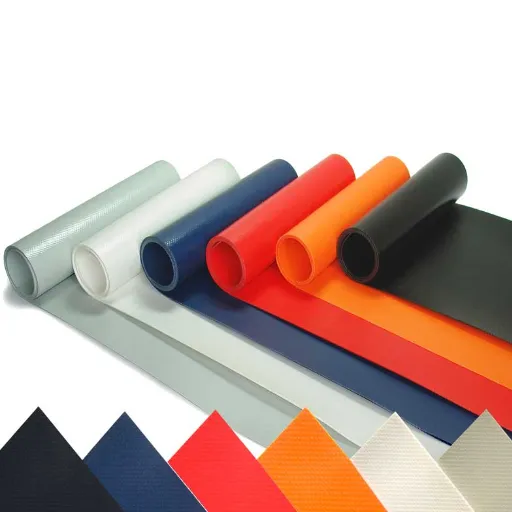
Compliance is not a badge you attach to a product. It is a set of tests performed on a specific material construction, and each material either supports those tests or it does not.
PVC tarpaulin is a polyester scrim, usually 1000D high-tenacity, coated on both faces with PVC. That construction produces two properties the standards care about: high tensile strength, because the scrim is continuous and load-bearing, and welded seams, because two PVC-coated faces fuse into a bond that is often stronger than the surrounding material. Structural standards test exactly these properties.
Oxford fabric is a woven polyester or nylon cloth, usually 210D to 840D, coated with polyurethane for water resistance. It is lighter, it flexes more, and it is joined by stitching. A stitched seam perforates the fabric, and those perforations become the failure point under load. That is a structural limitation, and no coating formulation removes it.
The practical consequence is straightforward. PVC can be certified against structural standards because it was engineered to pass them. Oxford can be certified as water-resistant and, in some formulations, as fire-retardant, but it cannot honestly claim the structural ratings that commercial PVC carries.
If you are weighing the two materials purely on durability and lifetime cost rather than compliance, our PVC vs Oxford fabric for bounce houses comparison works through the spec table and the five-year cost model in detail. This article stays on the compliance question.
The Standards That Govern Inflatable Fabric Worldwide
Four families of requirements apply to bounce house fabric, and they’re frequently confused with one another. Each one tests something different, and each one is answered by a different document.
| Requirement | What it governs | What it tests | Document to request |
|---|---|---|---|
| ASTM F2374-22 | Inflatable amusement devices in the US | Design, anchoring, load capacity, envelope integrity | Structural test report on the material construction |
| EN 14960 | Inflatable play equipment in the UK and EU | Safety, test methods, inspection regime | Declaration of conformity plus test report |
| NFPA 701 | Fire behaviour of textiles | Flame spread and after-flame time | Certificate number and the material-specific test report |
| CPSIA | Children’s products in the US | Lead and phthalate limits | Statement of compliance for the specific production batch |
| REACH / EN 71-3 | Restricted substances in the EU | Substance limits and element migration | Formulation declaration for the coating |
Keep this table next to your purchase order. Each row is a different document from a different test, and a supplier who can only produce one of them is telling you something about the other four.
ASTM F2374-22: the US structural standard
ASTM F2374-22 is the standard practice for inflatable amusement devices in the United States. It addresses design, manufacture, and operation, including anchoring, load capacity, and the structural integrity of the inflatable envelope.
For a fabric supplier, the relevant point is that the standard presupposes a material that can hold a load across a welded or bonded seam. A 1000D scrim with an 18 oz PVC coating is the construction that supports those ratings. Lighter woven cloth with stitched seams does not.
EN 14960: the UK and EU standard
EN 14960 is the European standard for inflatable play equipment, and it is the requirement most suppliers quoting US standards never mention. If you sell bouncy castles in the UK, Ireland, or the EU, this is the standard your customer, your insurer, and your market surveillance authority will reference.
EN 14960 covers safety requirements, test methods, and inspection regimes. It is stricter than most buyers expect on anchoring and on the structural performance of the inflatable envelope, and a unit built to a US-only specification may not satisfy it without changes.
This is the compliance gap that catches exporters. A fabric that passes ASTM F2374 testing on structural grounds is a good starting point, but the finished unit must also satisfy the EN 14960 test methods for that market.
A UK operator learned this the expensive way.
Deniz runs an inflatable hire business in Leeds and bought a container of combo units from a supplier who advertised “CE and ASTM certified.” The units were well built and the PVC was genuine.
At his first annual inspection under EN 14960, three units failed on anchorage point specification rather than on material. The fabric was fine. The hardware and the anchoring design weren’t, because the supplier had built to a US specification and assumed the certification would travel. Deniz spent a season’s margin retrofitting anchor points that should have been specified at order.
NFPA 701, CPSIA, and REACH: fire and chemical compliance
NFPA 701 is the fire-retardancy standard for textiles used in public occupancies. Both PVC and Oxford can be formulated to pass it, but the certificate is material-specific. Ask for the certificate number and the test report, not the word “fireproof.”
CPSIA governs children’s products in the United States, and it sets limits on lead and on phthalates. REACH applies to the EU and covers a broader list of restricted substances. EN 71-3 covers migration of certain elements. These are chemical rather than structural requirements, which means they attach to the coating formulation. Virgin-grade PVC with a lead-free stabiliser system and a phthalate-free plasticiser meets them. Recycled or unspecified PVC may not.
Bottom line: ASTM F2374-22 and EN 14960 test structure. NFPA 701 tests fire behaviour. CPSIA, REACH, and EN 71-3 test chemistry. A compliant fabric must answer all three families, and the answers live in different reports.
How Material Choice Changes Your Compliance Path
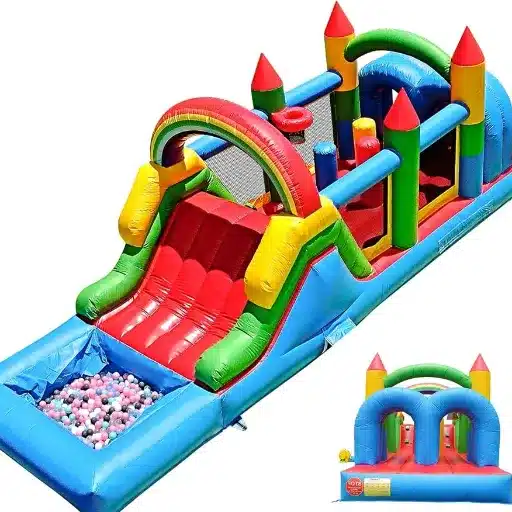
The material you choose determines how much evidence you have to assemble, and how defensible it is.
Choose commercial PVC tarpaulin and you inherit a construction that was designed for structural testing. The spec sheet states the scrim denier and the coating weight, the seam method is welded, and the test reports show tensile and tear values from recognised methods. Your compliance file is short, because the material does most of the work.
Ready to see the actual numbers? Request our PVC inflatable fabric specification sheet → and compare the scrim, coating, and test values against what your current supplier provides.
Choose PU-coated Oxford and you inherit a construction that was designed for cost and portability. It can carry water-resistance ratings and, with the right formulation, fire retardancy. It can’t carry the structural ratings, because the stitched seam is a permanent limitation.
For a residential unit sold in a non-regulated channel, that’s an acceptable trade. For anything inspected, insured, or exported, it isn’t.
Choose PVC-coated Oxford and you inherit ambiguity, which is the most expensive option of the three. Explore tailored tarpaulin solutions for inflatable castles with LY TRUSTLINK.
PVC-Coated Oxford: The Compliance Gap That Sinks Importers
PVC-coated Oxford is Oxford cloth with a PVC coating instead of polyurethane. It is stiffer, more water-resistant, and more puncture-resistant than standard Oxford, which is why a listing can honestly print “PVC” on a unit built from it.
What it isn’t is commercial PVC tarpaulin. It has no 1000D scrim, it’s usually joined with stitched seams, and it typically ships without the tensile, tear, or certification documentation that a structural standard requires. The label is technically true and operationally misleading.
Priya imports inflatables for a children’s play brand in the United States and places orders two seasons ahead. In early 2026 she received a container of “commercial PVC” bouncers priced 22% below her previous supplier. The material felt dense and passed her visual check. When she asked for the CPSIA test report ahead of a retail listing, the supplier sent a certificate for a different product line and went quiet on the tensile data.
The units were PVC-coated Oxford. Priya couldn’t list them in the retail channel she had planned because she couldn’t document compliance, and she couldn’t return them without paying freight back to Asia. She cleared the container at a discount through a secondary channel that didn’t require the paperwork and wrote off the difference.
The lesson isn’t that PVC-coated Oxford is a bad material. For a residential unit that sees a birthday party a few times a year, it’s often perfectly adequate. The lesson is that “PVC” on a listing is a claim about a coating, not a certification of a construction, and importers are the ones exposed when the two are confused.
Building the Spec Sheet Your Buyer and Your Auditor Both Need
A specification is the instrument that prevents substitution. Vague specifications get filled with whatever the supplier has on the floor. Precise ones get quoted accurately or declined.
Every inflatable fabric specification should state six things:
- Base fabric and denier, “1000D high-tenacity polyester scrim.” Denier is the yarn thickness and it determines load-bearing capacity. A weight figure without a denier figure is incomplete.
- Coating type and faces, “PVC, knife-coated both faces” or “PU, single face.” This is the sentence that separates commercial PVC from PVC-coated Oxford.
- Weight in both units, “18 oz/yd² (approximately 610 gsm).” Quote both, because US buyers specify in oz/yd² and metric markets specify in gsm, and a single-unit specification invites confusion.
- Seam method, “heat or RF-welded.” This is the difference between a molecular bond and a line of holes.
- Test methods and values, “tensile per ASTM D751, tear per EN ISO 1421, values reported per production batch.” Naming the method makes the number comparable across suppliers.
- Certifications with numbers, NFPA 701 certificate number, CPSIA and REACH statements, EN 14960 relevance for the target market.
When your design is non-standard, the specification becomes a development brief. Talk to our engineering team about custom fabric manufacturing → for custom weights, coatings, and reinforcement schedules, with prototype samples before a production commitment.
For importers and OEM buyers specifically, the lead-free and phthalate-free PVC guidance for inflatables explains what CPSIA and REACH actually require at the formulation level, and what documentation to demand.
What Compliance Failure Actually Costs
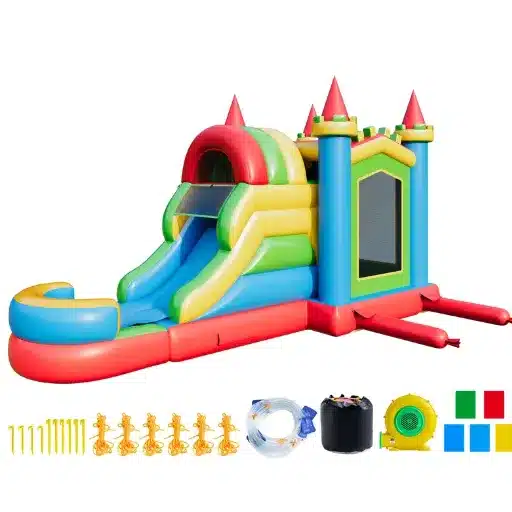
Compliance failure is usually framed as a legal risk. In practice, it is a cash-flow event, and the arithmetic is rarely close.
Marcus runs a rental fleet across three counties and added four lower-cost units to a summer line in 2025. The units carried a “commercial PVC” listing and passed his intake inspection. Two of them failed on a seam within nine weeks of regular weekend use, and the seam was stitched rather than welded, which meant a replacement panel rather than a patch.
Because he couldn’t produce a material certificate, his insurer declined part of the claim on the grounds that the equipment couldn’t be shown to meet the applicable standard. He replaced the four units the following season, and the total cost across purchase, lost bookings, and uninsured repairs exceeded what the commercial PVC units would have cost outright.
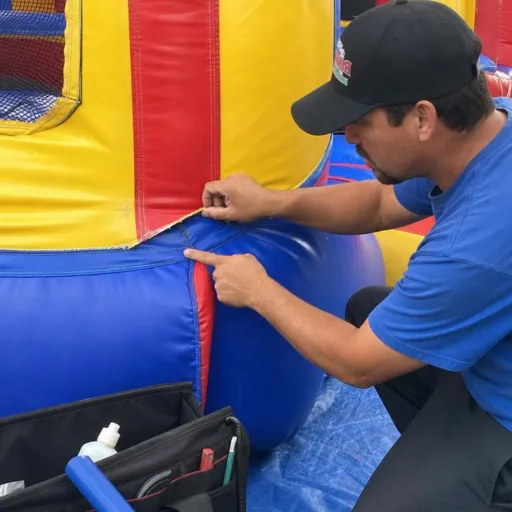
Compare the two positions directly. A commercial PVC unit carries a modest upfront premium, produces documented compliance that insurers and inspectors accept, and repairs with a vinyl patch in roughly a quarter of an hour. A lower-tier unit carries a lower invoice, no documentation to forward, and a repair path that often ends in replacement.
Get suitable inflatable castle tarpaulin for your next project from LY TRUSTLINK.
FAQ: PVC vs Oxford Fabric for Bounce Houses
Is PVC or Oxford fabric better for a bounce house?
For any commercial, inspected, or exported bounce house, PVC tarpaulin is better. It supports the ASTM F2374-22 and EN 14960 structural requirements, welds into seams stronger than the base material, and carries testable tensile and tear values. Oxford fabric suits residential, indoor, and occasional use where portability and price matter more than certification.
Is Oxford fabric waterproof enough for outdoor use?
Oxford fabric is water-resistant rather than waterproof, and PU-coated grades typically rate around 1,000 to 2,000 mm of water column. Prolonged wet use degrades the coating. PVC tarpaulin is fully waterproof and is the practical choice for water slides, splash zones, and equipment stored outdoors.
Does my bounce house need EN 14960 certification?
If you sell, hire, or operate inflatable play equipment in the UK, Ireland, or the EU, yes. EN 14960 is the applicable standard for that market and covers safety requirements, test methods, and inspection. A unit built only to a US specification may need changes to anchoring and structural detailing before it satisfies EN 14960.
Is PVC-coated Oxford the same as PVC tarpaulin?
No. PVC-coated Oxford is a woven cloth, typically 300D to 840D, with a PVC coating instead of a PU one. Commercial PVC tarpaulin is a 1000D scrim with PVC on both faces. The coating is similar, the construction is not, and the structural certification follows the construction.
How do I verify that bounce house fabric is lead-free and phthalate-free?
Ask for the CPSIA statement and the REACH declaration, in writing, for the specific material and production batch. The coating formulation determines the result, and virgin-grade PVC with a lead-free stabiliser system and a phthalate-free plasticiser is the specification to request.
What is the most common compliance mistake importers make?
Ordering against a vague specification. When the purchase order says “commercial PVC” without naming the scrim denier, coating faces, weight in oz/yd² and gsm, seam method, and test methods, the supplier is free to fill it with PVC-coated Oxford. A precise specification prevents the substitution before the container ships.
Conclusion: Specify the Fabric, Document the Compliance
The PVC versus Oxford decision for a bounce house is a compliance decision before it is a cost decision. PVC tarpaulin is the material that supports the ASTM F2374-22 and EN 14960 structural requirements, carries NFPA 701 and CPSIA documentation, and repairs rather than fails. Oxford fabric is a legitimate residential material, provided it is specified honestly and the buyer accepts the shorter service life.
The material to watch is PVC-coated Oxford, which is neither commercial PVC nor standard Oxford, and which is regularly sold under the PVC label. The defence is a specification that names the scrim and the coating, an inspection of the seams, and a request for the test report before the order is placed.
For the full material comparison and lifetime cost model, read the PVC vs Oxford fabric comparison for bounce houses. For the broader material stack and grade tiers, start with the bounce house fabric guide.
Start with our commercial PVC inflatable fabric range → or request a sample order and full specification sheet. If your market requires EN 14960, tell us at enquiry and our engineering team will confirm which constructions and certifications apply. A fabric specified correctly at the order stage is the difference between equipment that clears inspection and equipment that clears a discount channel.