
Types of Tensile Structures: A Structural Engineer’s Classification Guide
The main types of tensile structures are surface-stressed membranes, cable-net structures, pneumatic structures, and hybrid tensile-compression systems. Every tensile structure carries load primarily through tension rather than compression or bending, but each family generates and maintains that tension differently. Choosing the right system depends on span, load, permanence, and material behavior.
Too often, project teams select a shape before they select a structural system. A conical canopy and a cable-net stadium roof may look dramatically different, but the real distinction lies in how forces travel through the fabric, cables, and supports. Confuse the two during specification, and you end up with a membrane specified for loads it was never engineered to carry.
This guide classifies tensile structures by structural behavior, not just appearance. You will learn how each system works, where it performs best, and which membrane materials match which applications. Whether you are an architect developing a concept, an engineer validating a scheme, or a procurement manager comparing supplier options, the framework below will help you specify with confidence. From large-span tensile roofs to architecturally striking fabric façades, LY TRUSTLINK delivers customized membrane systems that meet international quality and performance standards.
Key Takeaways
- The four structural families are surface-stressed membranes, cable-nets, pneumatic structures, and hybrid tensile-compression systems.
- Surface-stressed membranes rely on pre-tension and double curvature; cable-nets distribute load through high-strength steel cables.
- Pneumatic structures use air pressure to maintain form and suit temporary or rapidly deployable enclosures.
- Material selection follows system selection: PVC-coated polyester suits cost-sensitive semi-permanent work, while PTFE-coated fiberglass is preferred for permanent landmark roofs.
- Asia-Pacific leads membrane structure demand at roughly 39% of the global market, driven by stadium, airport, and transit infrastructure.
What Is a Tensile Structure System?
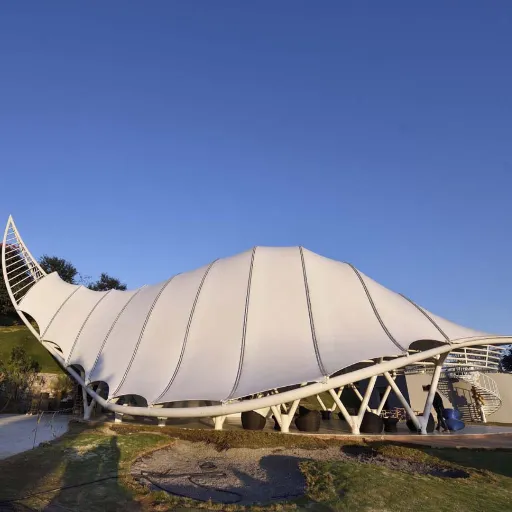
A tensile structure is a structural system in which the carrying elements work almost exclusively in tension. Unlike conventional buildings that resist gravity through columns in compression and beams in bending, tensile structures pull forces into cables, fabric membranes, or pressurized skins and transfer them to masts, rings, or anchorages at the boundary.
This distinction matters because it governs every downstream decision. The geometry of a tensile structure is not arbitrary decoration; it is the direct result of force flow. Shape, material, and support layout are interdependent. Change one, and the others must be recalibrated.
The Role of Pre-Tension and Double Curvature
For a tensile surface to be stable, it must be pre-tensioned. Pre-tension pulls the membrane taut so that external loads — wind uplift, snow weight, or a person walking across a canopy — are met with tensile resistance rather than slack deformation.
Double curvature gives the surface its stiffness. There are two curvature types:
- Anticlastic curvature: the centers of curvature lie on opposite sides of the surface, creating a saddle or hypar shape. This geometry is inherently stable under mechanical tension.
- Synclastic curvature: the centers of curvature lie on the same side, creating a dome or bubble shape. This geometry usually requires air pressure or continuous boundary tension to remain stable.
A flat membrane has no curvature and no stiffness. It will flutter, pond water, and fail under load. That is why every viable tensile structure — regardless of type — introduces curvature and pre-tension from the start.
A Structural Classification Framework
While many articles list shapes such as cones, saddles, and barrel vaults, this guide organizes tensile structures by how they carry load:
- Surface-stressed membrane structures: the membrane itself is the primary load-bearing element.
- Cable-net and cable-beam structures: a network of cables carries the load, often with a membrane infill.
- Pneumatic structures: air pressure maintains the tensioned form.
- Hybrid tensile-compression systems: tension elements combine with compression masts, rings, or tensegrity frames.
Each family has a distinct engineering logic, cost profile, and maintenance regime.
Request a consultation with LY TRUSTLINK today to discover how our custom tensile structure solutions can enhance your space while reducing long-term maintenance and construction costs.
Surface-Stressed Membrane Structures
Surface-stressed membranes are the most common type of tensile structure in architectural practice. The fabric itself carries the tensile forces. Cables, masts, and boundary frames simply define the edges and anchor the pre-tension.
These structures divide into anticlastic and synclastic forms.
Anticlastic Forms: Saddles, Hypars, and Waves
Anticlastic surfaces curve in opposite directions. Think of a saddle: it dips front-to-back and rises side-to-side. This opposition creates stiffness without added material.
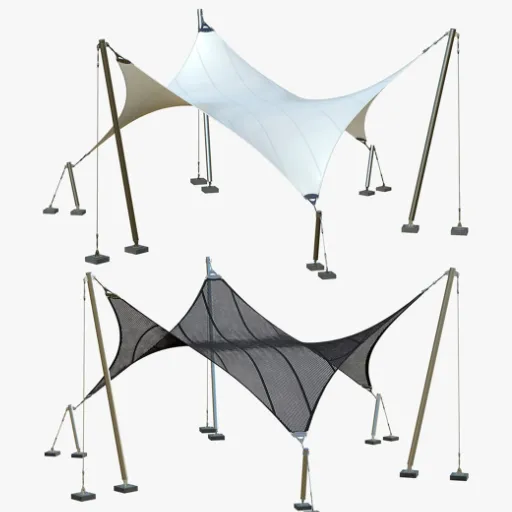
Hypar — short for hyperbolic paraboloid — shapes are the classic example. They need only four anchor points, two high and two low, to create a dramatic, stable canopy. Because rain and snow shed naturally toward the low points, hypars perform well in climates with heavy precipitation.
Wave forms extend the hypar principle along a linear path. They are common in walkway covers, transit station canopies, and retail promenades where the roof must run continuously while remaining visually light.
Synclastic Forms: Cones and Domes
Synclastic surfaces curve in the same direction, like a dome or a cone. These forms distribute load radially and can cover large circular or polygonal areas with a single peak.
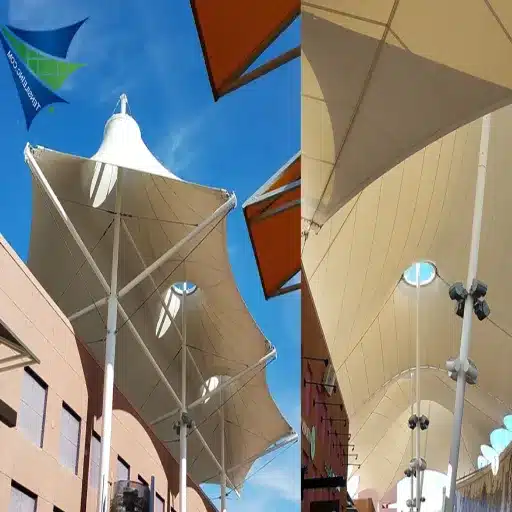
Conical tensile structures use a central mast or ring with the membrane radiating outward to a perimeter support. They are efficient for point-loaded canopies over amphitheaters, temple courtyards, and entrance plazas. Dome forms are less common in pure membrane construction because they generally need internal air pressure or a dense cable grid to remain stable.
Pretensioned vs. Mechanically Tensioned Membranes
A pretensioned membrane is stretched during installation and held in place by fixed boundary conditions. Most permanent canopies fall into this category.
A mechanically tensioned membrane uses adjustable hardware — turnbuckles, ratchets, or tension rods — to add or release tension over time. This approach suits temporary installations, seasonal structures, and fabric facades that need periodic retensioning.
Materials and Typical Spans
Surface-stressed membranes typically use one of three coated fabrics:
- PVC-coated polyester: 600–1,500 gsm, 15–20 year service life, cost-effective, wide color range. LY TRUSTLINK membrane fabric is supplied in PVC-coated weights from 350–900 gsm with waterproofness rated to 20,000 mm water column pressure.
- PTFE-coated fiberglass: 30+ year service life, self-cleaning, high translucency, premium cost.
- Silicone-coated fiberglass: high-temperature performance, niche industrial use.
Typical clear spans for surface-stressed membranes range from 5 m for a small shade canopy to 50 m for a large exhibition roof. Beyond that, cable support becomes necessary.
Pneumatic Structures
Pneumatic structures maintain their shape through air pressure rather than mechanical tension alone. A continuous supply of air creates a pressure differential between the interior and exterior, stiffening the membrane into a load-bearing surface.
There are two main categories.
Air-Supported Structures
An air-supported structure uses low internal pressure — typically 0.3–1.0 kPa above atmospheric pressure — to hold up a single membrane skin anchored around its perimeter. The entire building volume is pressurized, so entry and exit must pass through airlocks.
These structures are lightweight, rapidly installed, and economical for large clear spans. They are common for sports domes, temporary exhibition halls, emergency shelters, and bulk storage enclosures. The trade-off is energy dependence: if inflation stops, the structure deflates.
Air-Inflated Structures
Air-inflated structures use higher pressure inside discrete elements such as cushions, tubes, or beams. ETFE cushions are the best-known example. Multiple foil layers are welded into pillows and inflated with low-pressure air, creating transparent, insulated panels.
Unlike air-supported structures, air-inflated systems do not pressurize the entire occupied volume. They are used for skylights, facades, and atrium roofs where transparency and thermal performance matter.
Advantages and Limitations
Pneumatic structures excel when speed, portability, and large unsupported spans are priorities. They also offer excellent natural daylight transmission when ETFE is used.
Their limitations are puncture vulnerability, energy consumption, and acoustic performance. A single puncture in an air-supported roof will not cause immediate collapse, but it does require prompt repair to maintain pressure. For permanent installations, redundant blowers and monitoring systems are standard.
Cable-Net and Cable-Beam Structures
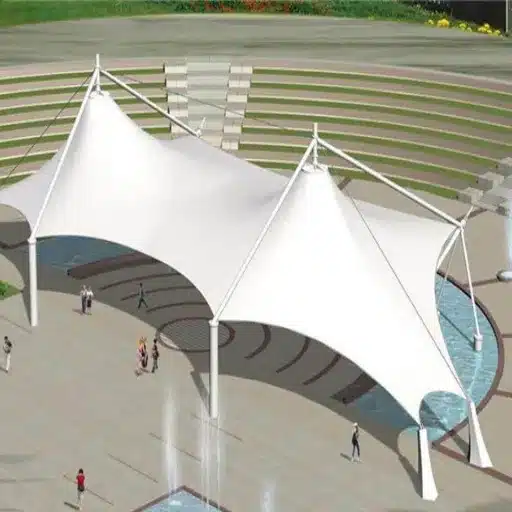
Cable-net structures separate the structural work from the weatherproofing. High-strength steel cables form a three-dimensional network that carries the primary loads; a lightweight membrane or cladding infill provides enclosure.
This separation allows much longer spans than surface-stressed membranes alone.
Single-Layer Cable Nets
A single-layer cable net consists of two families of cables crossing in opposite directions, following the principal curvature directions of the desired surface. The mesh is then clad with membrane panels or glass.
Single-layer nets are efficient and visually transparent. They are used for long-span roofs, facades, and pedestrian bridges where minimizing visual mass is important.
Double-Layer Cable Nets with Membrane Infill
Double-layer nets add a second cable plane, creating a three-dimensional truss action. The increased depth improves stiffness and load distribution. These systems are common in stadium roofs where wind and snow loads are severe and spans exceed 100 m.
Cable-Stayed and Suspension Variants
Cable-stayed structures use masts as compression elements and radiating cables as tension elements. Suspension structures hang the roof deck from draped cables supported at each end. Both variants appear in tensile architecture, often combined with membrane panels for weather protection.
Load Transfer: From Membrane to Foundation
In a cable-net roof, forces travel through a clear hierarchy:
- Wind or snow acts on the membrane cladding.
- The membrane transfers local loads to the cable grid.
- The cable grid carries loads to boundary masts or perimeter rings.
- Masts and rings transfer compression and tension into foundations.
Each connection — cable-to-cable, cable-to-mast, cable-to-fabric — is engineered for the specific force vector it receives. A clamp sized for a 50 kN cable will fail on a 200 kN cable. Detailing is where cable-net design becomes exacting.
Hybrid Tensile-Compression Systems
Hybrid systems combine tensile elements with compression elements in a single structural concept. The compression members handle the forces that tension cannot resolve efficiently, while the tension members keep the structure light.
Masted Structures with Compression Rings
A masted structure uses one or more vertical or raked masts to push upward, tensioning the membrane through cables or edge ropes. A compression ring at the mast head distributes the membrane forces into the mast.
This arrangement is common for conical canopies with tall central peaks. The mast takes compression, the membrane takes tension, and the perimeter takes the outward pull.
Tensegrity Systems
Tensegrity — tensional integrity — structures use a discontinuous network of compression struts held in place by continuous tension cables. The struts never touch each other; they float within a web of tension.
While visually striking, tensegrity systems are structurally complex and rarely used for primary weather enclosures. They appear more often in sculptures, temporary installations, and specialized architectural statements.
Boundary Masts and Flying Masts
Boundary masts support the membrane at its edge, allowing large clear spans without intermediate columns. Flying masts are mast elements supported from above by cables, creating the illusion of a floating roof plane.
These hybrid configurations are chosen when the architecture demands clean, open space beneath the canopy and the structural discipline demands an efficient load path.
When Hybrid Systems Outperform Pure Tension
Hybrid systems become advantageous when:
- The required span exceeds what a pure membrane can carry economically.
- The site requires minimal ground footprint and few columns.
- The design requires dramatic vertical expression, such as a tall central mast.
- Wind or seismic loads create force patterns that pure tension cannot resolve.
The added complexity of hybrid systems increases engineering and fabrication cost, but the resulting spans and architectural freedom often justify the investment.
Tensile Structures by Shape
Shape is not the same as structural system, but shapes help architects and clients communicate intent. Below are the most common geometric forms and the systems that typically produce them.
| Shape | Typical Structural System | Common Applications |
|---|---|---|
| Conical / cone / pavilion | Surface-stressed membrane or masted hybrid | Entrance canopies, amphitheaters, temples, playgrounds |
| Hyperbolic paraboloid (hypar / saddle) | Surface-stressed membrane | Shade structures, facades, walkways, plazas |
| Barrel vault / arch | Surface-stressed membrane or cable-net | Walkways, parking structures, sports halls |
| Wave / undulating | Surface-stressed membrane or cable-net | Transit stations, retail promenades, landscape canopies |
| Dome / synclastic | Pneumatic or cable-net with membrane infill | Sports domes, exhibition halls, atriums |
| Free-form / custom | Hybrid or cable-net | Iconic buildings, cultural institutions, bespoke installations |
When a client asks for a “sail shade” or “tent roof,” the first engineering task is to translate that shape into a structural system. A hypar shade sail and a cable-net stadium roof may share a saddle-like appearance, but their engineering, cost, and maintenance differ significantly.
How to Choose the Right Tensile System
Selecting among the types of tensile structures requires matching the structural behavior to the project constraints. The following decision framework organizes the most important variables.
Span Requirements by System Type
- Surface-stressed membranes: 5–50 m typical clear span.
- Cable-net structures: 30–150 m and beyond.
- Pneumatic structures: highly variable; air-supported domes can exceed 200 m.
- Hybrid systems: 20–100 m, depending on mast and cable arrangement.
Permanent vs. Temporary Applications
Permanent structures demand materials with proven long-term performance. PTFE-coated fiberglass, stainless steel cables, and robust corrosion protection are standard. PVC-coated polyester suits semi-permanent installations with design lives of 15–20 years.
Temporary structures prioritize speed and cost. PVC membranes, air-supported domes, and mechanically tensioned fabric systems can be installed and removed within days or weeks.
Climate and Load Considerations
Wind is often the governing load for tensile structures. The curved, lightweight surfaces do not respond to wind like rigid buildings. Uplift can exceed downward pressure. Engineering teams use wind tunnel testing or computational fluid dynamics for critical projects.
Snow load dictates minimum roof slopes and pretension levels. Flat or shallow slopes encourage ponding, which increases local load and can lead to failure. A well-designed tensile roof sheds snow through curvature and tension.
UV exposure degrades polymer coatings over time. For high-UV climates, PTFE or PVDF-topcoated PVC is preferred. For temporary use in moderate climates, standard PVC may be sufficient.
When specifying materials for cold environments, laminated fabric cold-weather performance becomes a separate consideration. Cold-crack resistance and flexible plasticizers determine whether a cover survives repeated freeze-thaw cycles without brittle failure.
Budget Considerations by Complexity
Cost increases with span, curvature complexity, and engineering detail. Simple hypar shade sails are economical. Double-curved free-form roofs with custom steelwork and precision-fabricated panels are not.
Repetition reduces cost. A design that repeats identical modules — such as a barrel vault composed of identical bays — lowers fabrication and installation expense compared to a one-off sculptural form.
Material Implications of Each System
The structural system influences the membrane choice:
- Surface-stressed membranes require biaxially stable fabrics with high tear resistance and reliable weldability.
- Cable-net structures can use lighter membranes because the cables carry the primary loads.
- Pneumatic structures demand airtight, fatigue-resistant materials such as ETFE foil or heavy PVC.
- Hybrid systems require compatible interfaces between flexible membranes and rigid steel or aluminum components.
Understanding laminated fabric construction helps clarify how base fabric, coating, and bonding technology contribute to these performance differences.
Notable Examples by System Type
Real projects illustrate how each tensile system performs at scale.
Surface-Stressed Membrane: Denver International Airport
The terminal roof at Denver International Airport, designed by Fentress Architects and completed in 1995, uses a tensile membrane roof supported by a cable-stayed mast system. The PTFE-coated fiberglass membrane spans large open areas while transmitting daylight. The project demonstrated that tensile roofs could function at airport scale.
Cable-Net: Munich Olympic Stadium
Frei Otto’s cable-net canopy for the 1972 Munich Olympics remains a defining precedent. The net of steel cables supports acrylic-coated glass fiber panels, creating a sweeping transparent roof over the stadium and park. It proved that cable-net structures could achieve both structural efficiency and architectural poetry.
Pneumatic: Khan Shatyr Entertainment Center
Foster + Partners’ Khan Shatyr in Astana, Kazakhstan, is a 150 m-tall tensile structure in the form of a transparent tent. ETFE panels cover a cable network, and the internal environment is tempered for year-round use. The project shows how pneumatic-tensile hybrid thinking can create inhabitable space in extreme climates.
Hybrid / ETFE: Allianz Arena and Water Cube
The Allianz Arena in Munich and the Beijing National Aquatics Center — the Water Cube — both use ETFE cushion systems. At Allianz, the cushions form a color-changing facade. At the Water Cube, they create a bubble-like structural pattern with high transparency and low weight.
These examples share a common lesson: the structural system and the material are chosen together, not independently. Looking for innovative membrane architecture that combines aesthetics with functionality? Contact LY TRUSTLINK to explore bespoke solutions designed around your project’s specific requirements.
Frequently Asked Questions
What are the main types of tensile structures?
The four main types are surface-stressed membranes, cable-net structures, pneumatic structures, and hybrid tensile-compression systems. Surface-stressed membranes carry load through the fabric itself; cable-nets use steel cables; pneumatic structures rely on air pressure; and hybrid systems combine tension elements with compression masts or rings.
How do tensile structures work?
Tensile structures work by pre-tensioning a membrane or cable network so that external loads are resisted by tensile forces. These forces are transferred through the fabric or cables to boundary supports, masts, and foundations. Double curvature gives the surface stiffness and prevents deformation under load.
What is the difference between anticlastic and synclastic curvature?
Anticlastic curvature has centers of curvature on opposite sides of the surface, like a saddle. It is stable under mechanical tension and resists load efficiently. Synclastic curvature has centers on the same side, like a dome. It usually requires air pressure or continuous boundary tension to remain stable.
Can tensile structures withstand snow and wind?
Yes, when properly engineered. Tensile structures are designed with specific wind loads, snow loads, and pretension values. Curvature prevents ponding, and wind tunnel testing or computational analysis verifies performance. Material selection — such as PTFE-coated fiberglass for permanent roofs or PVDF-topcoated PVC for cost-sensitive projects — supports long-term durability.
What is the best material for tensile structures?
There is no single best material; the choice depends on design life, climate, budget, and transparency requirements. PTFE-coated fiberglass offers the longest lifespan and lowest maintenance for permanent landmarks. PVC-coated polyester provides a balanced combination of cost, color choice, and 15–20 year performance for semi-permanent and commercial work. ETFE foil is preferred for transparent facades and atriums.
Conclusion
The types of tensile structures are not defined by appearance alone. Surface-stressed membranes, cable-nets, pneumatic structures, and hybrid systems each carry load through tension, but they differ in span capability, complexity, and material demands. Selecting the right system means matching structural behavior to project requirements: span, climate, permanence, and budget.
For procurement and design teams, the next step is material specification. LY TRUSTLINK membrane fabric is engineered for architectural and industrial tensile applications, with PVC-coated options from 350–900 gsm, waterproofness to 20,000 mm water column pressure, and compliance with international fire retardancy standards including NFPA 701. For light-controlled environments, our blackout architectural fabric provides 100% opacity with the same manufacturing consistency.
If you are evaluating tensile structure materials for an upcoming project, contact our engineering team for specifications, sample orders, or a custom manufacturing consultation. We supply the technical fabrics that make your structural concept buildable.
Sources
- Business Research Insights — Membrane Structures Market Size, Growth Report By 2035
- Coherent Market Insights — Membrane Structures Market
- Form TL — Membrane Structures: Principles, Details and Projects
- LY TRUSTLINK — Membrane Fabric
- LY TRUSTLINK — Blackout Tarpaulin
- LY TRUSTLINK — What Is Laminated Fabric?
- LY TRUSTLINK — The Advantages of Laminated Fabric in Cold Environments