
12 Tensile Architecture Examples: Engineering Lessons
The most influential tensile architecture examples include the Munich Olympiapark, The O₂ in London, Denver International Airport, the Burj Al Arab, and the Beijing Water Cube. Each project demonstrates how tension-based structural systems create large spans, dramatic forms, and efficient enclosures using materials such as PTFE-coated fiberglass, ETFE foil, and PVC-coated polyester.
That single principle, using tension rather than compression, has reshaped how architects cover stadiums, airports, facades, and public spaces. Tensile architecture is not only a design statement. It is an engineered response to specific load, climate, and procurement challenges.
In this guide, we examine 12 landmark tensile architecture examples. For each example, you will learn the structural system, the material specification, and the engineering lesson that still informs projects today. Whether you are an architect selecting a membrane, a developer evaluating span options, or a procurement manager sourcing fabric, these case studies provide a practical reference for decision-making. Request a consultation with LY TRUSTLINK today to discover how our custom tensile structure solutions can enhance your space while reducing long-term maintenance and construction costs.
Key Takeaways
- Tensile architecture uses tension, in cables, membranes, or air cushions, to create lightweight structures that span large distances without internal columns.
- PTFE-coated fiberglass dominates permanent, high-profile roofs because of its 25-30+ year lifespan and self-cleaning surface.
- ETFE foil cushions enable maximum daylight transmission and complex curved forms, as seen at the Allianz Arena and Eden Project.
- PVC-coated polyester remains the practical choice for commercial canopies, temporary pavilions, and cost-sensitive permanent structures.
- Every successful tensile project matches material selection to climate loads, design life, and maintenance capacity.
- Landmark failures and successes alike teach the same lesson: material specification matters as much as architectural vision.
The 12 Tensile Architecture Examples Covered Here
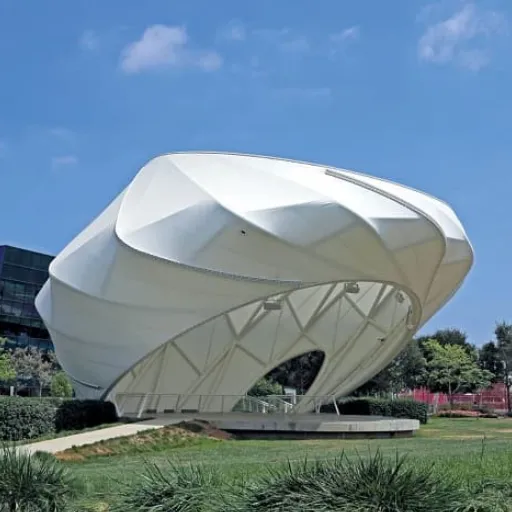
This guide examines 12 landmark tensile architecture examples and tensile membrane structure examples that have shaped the field:
- Olympiapark Munich — cable-net canopy legacy
- The O₂ Arena, London — large-span PTFE tensile roof
- Denver International Airport — PTFE membrane at scale
- Burj Al Arab, Dubai — tensile facade as icon
- Allianz Arena, Munich — ETFE cushion facade
- Beijing National Aquatics Center “Water Cube” — ETFE bubble structure
- Eden Project, Cornwall — geodesic ETFE biomes
- Khan Shatyr Entertainment Center, Astana — extreme-span ETFE tent
- Mercedes-Benz Stadium, Atlanta — operable petal roof with membrane
- Qatar 2022 Stadiums — cooled tensile roofs in extreme heat
- PVC-coated polyester commercial canopies and car parks
- Temporary and deployable tensile pavilions
If you are comparing membrane options for a specific project, contact our engineering team to evaluate PVC, PTFE, and ETFE against your design life and climate requirements. For a deeper look at the material science behind each example, see our complete guide to tensile structure materials.
What Defines a Great Tensile Architecture Example?
A great membrane architecture example does three things well. It integrates structure and architecture. It specifies materials honestly. And it responds to climate and performance requirements over the full design life.
When Marcus Chen, a procurement director for a regional airport expansion, first reviewed tensile roof proposals, he was struck by how differently each supplier specified the membrane. One proposal quoted a generic “heavy-duty PVC” with no GSM or top-coat detail. Another specified PTFE-coated fiberglass with test data for tensile strength, tear resistance, and UV aging.
The difference was not just price. It was the difference between a roof he could defend to his board and one he could not.
Integration of Structure and Architecture
In tensile design, the structural logic is visible. Cables, masts, and membranes are not hidden behind cladding. They are the architecture. This means the engineer and architect must solve form, force, and appearance simultaneously, as tensile structures explained by Designing Buildings makes clear. When the integration succeeds, the result looks inevitable.
Material Honesty and Specification Rigor
Each material in tensile architecture behaves differently. PTFE-coated fiberglass is inert and long-lived but rigid in detailing. ETFE is lightweight and transparent but requires active air systems. PVC-coated polyester is weldable and colorful but needs periodic top-coat maintenance. Great projects specify the material that matches the operational requirement, not just the visual ambition. Our guide to specifying architectural membrane fabric breaks down PTFE, ETFE, PVC, and silicone options by tensile strength, fire rating, and design life.
Climate Response and Long-Term Performance
Wind uplift, snow load, UV exposure, and thermal cycling all test a tensile structure. The best tensile architecture examples embed these loads into the form-finding process from the start. Pretension, curvature, and edge detailing are designed so the membrane performs predictably across decades, not just on opening day.
Tensile Architecture by Structural System
Before examining these tensile architecture examples, it helps to classify the structural systems involved. Most tensile structures fall into one of five categories, as defined by TensiNet, the European network for tensile membrane structures.
- Anticlastic (saddle) membranes curve in opposite directions at every point. This double curvature gives the surface stiffness under wind and snow loads.
- Synclastic (cone or dome) membranes curve in the same direction, often supported by a central mast and perimeter ring.
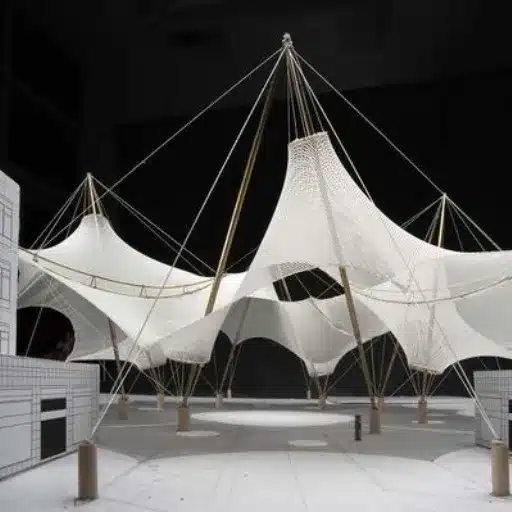
- Cable-net structures use a grid of tension cables to carry the primary loads, with a lighter membrane providing weather protection.
- Pneumatic and ETFE cushion systems rely on air pressure to stabilize thin films, creating translucent pillows or domes.
- Hybrid tensile-compression systems combine masts, arches, or rings in compression with cables and membranes in tension.
Understanding these categories makes it easier to evaluate the tensile membrane structure examples that follow.
Iconic Tensile Architecture Examples

These famous tensile structures and other iconic tensile architecture have defined the field from the 1972 Munich Olympics to the climate-responsive stadiums of Qatar 2022. Together, these tensile architecture examples illustrate how material, form, and climate interact across six decades of projects.
Olympiapark Munich — Cable-Net Canopy Legacy
Location: Munich, Germany
Year: 1972
Architect / Engineer: Günter Behnisch, Frei Otto, Fritz Leonhardt
System: Cable-net roof with acrylic glass panels
The 1972 Munich Olympic Stadium remains the reference point for modern tensile architecture. Its cable-net roof spans the main stadium, swimming hall, and public spaces as a single floating canopy, documented on ArchDaily. The roof covers approximately 75,000 m² and uses roughly 436 km of high-strength steel cable supported by 58 masts.
Frei Otto’s design process relied on physical form-finding. Hanging chains and soap-film models helped define the minimal surfaces that carried load efficiently. The transparent acrylic panels allowed daylight into the venues while protecting spectators from rain.
Engineering lesson: The Munich roof proved that cable-net tensile structures could achieve both structural efficiency and public scale. It also established form-finding, letting forces determine shape, as a core design method.
The O₂ Arena, London — Large-Span Tensile Roof
Location: London, UK
Year: 2000 (originally Millennium Dome)
Architect / Engineer: Richard Rogers Partnership, Buro Happold
System: Cable-net structure with PTFE-coated glass-fibre fabric panels
The O₂ Arena began as the Millennium Dome, a 365 m diameter structure supported by 12 masts and anchored by cables. The roof uses more than 100,000 m² of PTFE-coated glass-fibre tensile fabric structures stretched across a cable-net system.
The diameter, one metre for each day of the year, was symbolic, but the engineering was pragmatic. The cable net carries wind and snow loads across the full span, while the PTFE membrane provides weather protection and diffused daylight.
Engineering lesson: PTFE-coated fiberglass performs well at very large scales. Its self-cleaning surface and 25–30+ year lifespan justify the higher material cost for permanent public buildings.
Denver International Airport — PTFE Membrane at Scale
Location: Denver, Colorado, USA
Year: 1995
Architect: Fentress Architects
System: PTFE-coated fiberglass membrane roof
Denver International Airport used tensile roof design to create a regional identity. The terminal roof consists of peaked white forms evoking the snow-capped Rocky Mountains. The terminal membrane covers approximately 375,000 sq ft, with additional curbside canopies totaling 75,000 sq ft.
The PTFE membrane was chosen for its durability, translucency, and resistance to UV degradation at high altitude. The two-layer fabric assembly also provided acoustic control within the great hall, which rises to 126 ft at its highest point.
Engineering lesson: Tensile roofs can become a landmark while solving practical problems: daylighting, acoustics, and weather protection in a single integrated envelope.
Burj Al Arab, Dubai — Tensile Facade as Icon
Location: Dubai, UAE
Year: 1999
Architect: Tom Wright, W.S. Atkins
System: PTFE-coated fiberglass tensile facade
The Burj Al Arab is famous for its sail-shaped silhouette. The seaward facade uses a PTFE-coated fiberglass membrane tensioned between the hotel’s steel exoskeleton. The membrane provides solar shading and visual continuity with the maritime theme.
Dubai’s intense UV exposure and high temperatures made material selection critical. PTFE’s thermal stability and resistance to UV degradation allowed the facade to maintain its appearance in a harsh desert climate.
Engineering lesson: Tensile membranes work on vertical facades as well as roofs, provided the support structure, edge detailing, and material are specified for the local climate.
Allianz Arena, Munich — ETFE Cushion Facade
Location: Munich, Germany
Year: 2005
Architect: Herzog & de Meuron
System: ETFE foil cushion facade
The Allianz Arena’s facade consists of 2,760 diamond-shaped ETFE cushions. Each cushion is inflated with low-pressure air and illuminated from behind, allowing the building to glow in different colors depending on the event.
ETFE was chosen for its light weight, high transparency, and ability to form complex curved cushions. The system is substantially lighter than a glass curtain wall, reducing the structural support required.
Engineering lesson: ETFE cushions turn a building envelope into a media surface. However, the system requires active air-supply infrastructure and maintenance planning.
Beijing National Aquatics Center “Water Cube” — ETFE Bubble Structure
Location: Beijing, China
Year: 2008
Architect: PTW Architects, CSCEC, Arup
System: ETFE foil cushions over a steel space frame
The Water Cube used more than 3,000 ETFE cushions arranged in a repeating bubble pattern inspired by foam geometry. The cushions cover a steel space frame and provide natural daylighting while reducing energy consumption by approximately 30% compared with a conventional enclosure.
The bubble geometry was not only aesthetic. It distributed structural forces efficiently and created a self-draining, lightweight roof.
Engineering lesson: ETFE systems excel when daylighting and visual lightness are priorities. The support structure must be designed around the cushion geometry from the beginning.
Eden Project, Cornwall — Geodesic ETFE Biomes
Location: Cornwall, UK
Year: 2001
Architect: Grimshaw Architects
System: ETFE foil cushions over steel geodesic domes
The Eden Project consists of interlinked geodesic domes housing different climate biomes. ETFE foil cushions clad the steel frames, creating lightweight enclosures that transmit enough sunlight for plant growth while maintaining internal temperature and humidity.
The material’s light weight, approximately 1% the weight of glass, reduced the structural load on the domes and simplified construction in a former clay pit.
Engineering lesson: For controlled environments, ETFE provides a balance of transparency, thermal performance, and structural efficiency that glass cannot match at the same weight.
Khan Shatyr Entertainment Center, Astana — Extreme-Span ETFE Tent
Location: Astana, Kazakhstan
Year: 2010
Architect: Foster + Partners
System: ETFE roof suspended from a central mast and cable network
Khan Shatyr is a 150 m high tensile tent spanning 200 m at its base. The transparent ETFE roof is suspended from a central steel mast and tensioned by cables, creating a climate-controlled interior environment in a city where winter temperatures drop below -30°C.
The ETFE roof allows solar gain during cold months while the interior volume buffers temperature swings. This is tensile architecture used as a microclimate machine.
Engineering lesson: In extreme climates, tensile enclosures can moderate interior conditions, but material selection and detailing must address thermal movement, snow shedding, and wind loads.
Mercedes-Benz Stadium, Atlanta — Operable Petal Roof with Membrane
Location: Atlanta, Georgia, USA
Year: 2017
Architect: HOK
System: Retractable petal roof with translucent membrane panels
Mercedes-Benz Stadium features an eight-petal retractable roof supported by a steel cable network. The petals open and close like a camera aperture, allowing natural ventilation and daylight when open and weather protection when closed.
The roof was engineered to withstand hurricane-force winds. The combination of rigid steel petals and flexible membrane panels demonstrates how tensile and conventional systems can be integrated.
Engineering lesson: Operable tensile roofs add mechanical complexity, but they also extend the usable life of a venue by allowing it to function in multiple modes.
Qatar 2022 Stadiums — Cooled Tensile Roofs in Extreme Heat
Location: Qatar
Year: 2022
Architect / Engineer: Various, including Fenwick-Iribarren Architects and Schlaich Bergermann Partner
System: PTFE and membrane roofs with integrated cooling
Several Qatar 2022 World Cup stadiums used tensile roofs to shade spectators and reduce cooling loads. At Stadium 974, shipping containers formed the structure beneath a tensile roof. At Al Janoub Stadium, a retractable tensile roof complemented a permeable facade. These tensile architecture examples show how membrane geometry can become a climate-control device in extreme heat.
The membranes were selected for their ability to reflect solar radiation while allowing controlled airflow. This reduced the energy required to maintain comfortable conditions in extreme heat.
Engineering lesson: In hot climates, tensile roofs are solar-control devices. Reflective surfaces, optimized geometry, and ventilation integration determine whether the system reduces or adds to cooling demand.
PVC-Coated Polyester in Commercial Canopies and Car Parks
Not every membrane architecture example is a global landmark. PVC-coated polyester dominates the commercial canopy market, from car park shades and retail walkways to sports court covers and school shelters. These structures typically use anticlastic or synclastic membrane forms supported by steel masts and cables.
At a shopping center in Phoenix, Arizona, facilities director Elena Vasquez inherited a car park canopy that had been installed five years earlier. The original membrane had faded and cracked because it lacked a UV-stable top-coat. When she replaced it with a PVC-coated polyester specified at 900 GSM (grams per square meter) with a PVDF (polyvinylidene fluoride) lacquer top-coat, the new canopy maintained its color and mechanical properties through five summers of 45°C heat.
The specification cost 18% more upfront but eliminated a replacement cycle she had expected every four years. For procurement managers weighing the total cost of ownership, our PTFE vs PVC membrane comparison explains how design life, maintenance, and climate loads affect long-term value.
PVC-coated polyester is specified because it offers design flexibility, weldability, and a wide color range at a lower material cost than PTFE or ETFE. With a PVDF top-coat, lifespans reach 15-25 years, and damaged panels can be repaired or replaced.
Engineering lesson: For commercial projects with moderate spans and defined maintenance budgets, PVC-coated polyester delivers predictable performance. The key is specifying the correct GSM, coating system, and seam welding method for the local wind load.
Temporary and Deployable Tensile Pavilions
Expo pavilions, festival stages, and emergency shelters frequently use tensile membranes because they can be prefabricated, transported, and erected quickly. PVC-coated polyester is common in this sector because of its light weight, packability, and ease of welding on-site.
The German Pavilion at Expo 67 in Montreal, designed by Frei Otto, is the historical reference. Its cable-net and membrane roof demonstrated that tensile architecture examples could be both temporary and architecturally significant.
Engineering lesson: Tensile systems decouple enclosure from permanence. For temporary or mobile structures, material selection prioritizes speed, repetition, and compact transport over maximum lifespan.
Every tensile structure presents unique challenges. Reach out to LY TRUSTLINK for expert guidance on material selection, structural optimization, and project feasibility.
Engineering Lessons from These Tensile Architecture Examples
These 12 tensile architecture examples share common decision patterns. Understanding them helps specifiers avoid common mistakes.
Material Selection Rationale by Project Type
- Permanent landmarks with 25+ year design life: PTFE-coated fiberglass is the default for roofs and facades exposed to severe weather.
- High-transparency atriums, biomes, and facades: ETFE cushions provide daylight and curved forms but require air-system maintenance.
- Commercial canopies, car parks, and temporary structures: PVC-coated polyester offers the best balance of cost, color choice, and repairability.
| Material | Best For | Lifespan | Key Properties |
|---|---|---|---|
| PTFE-coated fiberglass | Permanent landmarks, roofs, facades | 25-30+ years | Self-cleaning, UV-stable, high tensile strength |
| ETFE foil cushions | High-transparency facades, atriums, biomes | 25-50 years (foil) | Lightweight, transparent, requires air system |
| PVC-coated polyester | Commercial canopies, temporary structures | 15-25 years (with PVDF top-coat) | Weldable, colorful, cost-effective, repairable |
Our complete guide to tensile structure materials covers the specifications behind each option.
Climate Response Strategies
Each climate drives different detailing. Desert projects emphasize UV resistance and thermal stability. Cold-climate projects address snow shedding and material embrittlement. Coastal projects focus on salt corrosion and wind uplift. The form of the membrane — its curvature, pretension, and edge geometry — must be tuned to the dominant load case.
Structural Innovation Milestones
From Frei Otto’s soap-film models to today’s computational form-finding, tensile architecture has advanced through better prediction of force and shape. Modern projects use nonlinear finite element analysis to optimize stress distribution before fabrication. This reduces material waste and improves safety.
Cost and Scale Considerations
Tensile structures are rarely the cheapest first-cost option, but they often reduce overall project cost by minimizing structural steel, shortening construction time, and reducing foundation loads. Lifecycle cost analysis should include membrane replacement, top-coat renewal, and inspection access.
James Okonkwo, a project developer in Lagos, learned this distinction during a sports complex bid. The lowest first-cost proposal used a conventional steel roof with standard cladding. The tensile option was 12% higher initially.
Over a 20-year analysis, however, the tensile roof’s reduced foundation work, faster erection, and lower maintenance brought the total cost below the conventional option. The decision became straightforward once the comparison included lifecycle performance.
Emerging Trends in Tensile Architecture
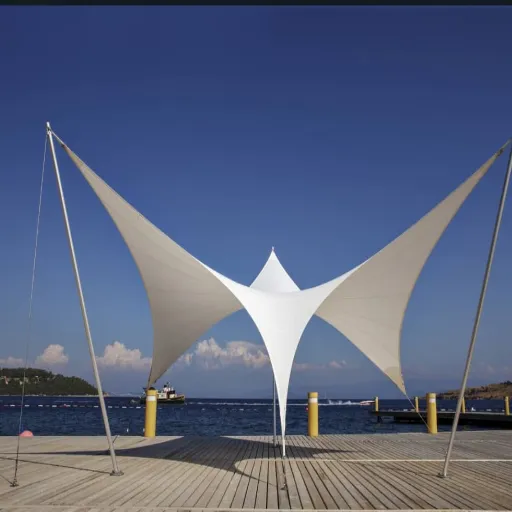
The next generation of tensile architecture examples is pushing beyond static membranes toward adaptive, responsive systems.
Biomimetic and Algorithmic Form-Finding
Designers are using algorithms inspired by natural structures, such as soap films, spider webs, and bone growth, to generate efficient tensile forms. These tools reduce material use while increasing structural performance.
Adaptive and Responsive Membranes
Researchers are developing membranes that change opacity, ventilation, or shape in response to sunlight, temperature, or wind. These systems turn the building envelope into an active climate-control layer.
Sustainable and Recyclable Materials
Recyclable membranes, bio-based coatings, and low-carbon production processes are becoming priorities. At LY TRUSTLINK, our sustainability program includes recyclable options, water-based coatings, and zero-waste-to-landfill manufacturing. Learn more about LY TRUSTLINK’s tensile architecture expertise and how we support projects from specification through installation. For projects where environmental performance is specified, material sourcing and end-of-life planning are as important as initial performance.
Frequently Asked Questions About Tensile Architecture Examples
What is the most famous tensile architecture example?
The Munich Olympic Stadium roof, designed by Frei Otto for the 1972 Olympics, is widely considered the most famous tensile architecture example. Its cable-net canopy introduced form-finding as a design method and demonstrated that tensile architecture could work at a public, civic scale.
What materials are used in iconic tensile fabric structures?
The three primary materials are PTFE-coated fiberglass, ETFE foil cushions, and PVC-coated polyester. PTFE is used for permanent roofs and facades. ETFE is used for high-transparency enclosures. PVC-coated polyester is used for commercial canopies, temporary pavilions, and cost-sensitive permanent structures.
How long do tensile membranes last?
PTFE-coated fiberglass membranes typically last 25 to 30 years or more in permanent roof and facade applications. ETFE foil can last 25 to 50 years depending on climate and maintenance. PVC-coated polyester with a PVDF top-coat typically lasts 15 to 25 years.
What is the difference between PTFE and ETFE?
PTFE is a coated fiberglass fabric used for opaque or translucent roofs and facades. It is rigid in detailing, self-cleaning, and extremely durable. ETFE is a transparent foil used in inflated cushion systems. It is lighter than glass and highly transparent, but it requires active air supply infrastructure.
Is tensile architecture expensive?
Tensile structures are rarely the cheapest first-cost option, but they often reduce overall project cost by minimizing structural steel, shortening construction time, and reducing foundation loads. Lifecycle cost analysis should include membrane replacement, top-coat renewal, and inspection access.
Conclusion
Tensile architecture examples span from the 1972 Munich Olympiapark to the climate-responsive stadiums of Qatar 2022. What connects them is a disciplined relationship between form, force, and material.
The most successful projects do not treat the membrane as a cosmetic afterthought. They specify materials — PTFE, ETFE, or PVC-coated polyester — based on design life, climate loads, and maintenance capacity. They integrate structure and architecture from the earliest sketches. And they acknowledge that a tensile structure’s performance is determined long before it is tensioned on site.
For procurement managers and project developers, these case studies offer a clear message: the right membrane specification reduces operational risk over decades. If you are evaluating tensile architecture examples or famous tensile structures for an upcoming project, request custom membrane specifications from our engineering team for your specific application.