
Nylon 66 vs Polyester Airbag Fabric: Properties, Cost & Use Cases
Nylon 66 is the default base fabric for high-thermal-stress frontal airbags, while polyester (PET) is a lower-cost alternative increasingly used in curtain, side, and recycled-cushion applications where heat loads are lower. The choice between them is not a simple cost decision; it is a specification decision that depends on deployment temperature, energy absorption, airbag type, and total cost of ownership.
When a procurement team receives a request to qualify a new airbag fabric, the first question is rarely about polymer chemistry. It is about whether the material will pass deployment tests under FMVSS 208 or ECE R94 performance targets without adding weight, cost, or supply risk. This guide breaks down the nylon 66 vs polyester airbag fabric decision with spec-level data, application rules, and the procurement red flags that separate a valid lot report from a rejected one. You will learn which properties actually matter, which airbag types can accept PET, and how to read a mill test report before it reaches your incoming-inspection queue. Reach LY TRUSTLINK for trusted airbag textiles combining quality, strength, and production expertise.
Key Takeaways
- Nylon 66 dominates frontal airbags because its higher specific heat and elongation absorb the 300–500 °C inflator gas impulse better than PET.
- Polyester is gaining share in curtain, side, knee, and recycled-cushion airbags where thermal stress is lower and cost or sustainability targets matter more.
- At the yarn level, nylon 66 reaches 7.9–9.5 g/denier tensile strength versus 5.5–7.0 g/denier for standard PET, and it elongates 25–40% compared with PET’s 15–20%.
- PET is roughly 20–30% cheaper and offers better dimensional stability in humid conditions, but it is denser and requires surface treatment for reliable silicone coating adhesion.
- A valid mill report must cite the test method (ASTM/ISO/SAE), show acceptance ranges, and include SAE J2052 accelerated-aging data, not just single-point bulk-polymer values.
Nylon 66 vs Polyester: Side-by-Side Property Comparison
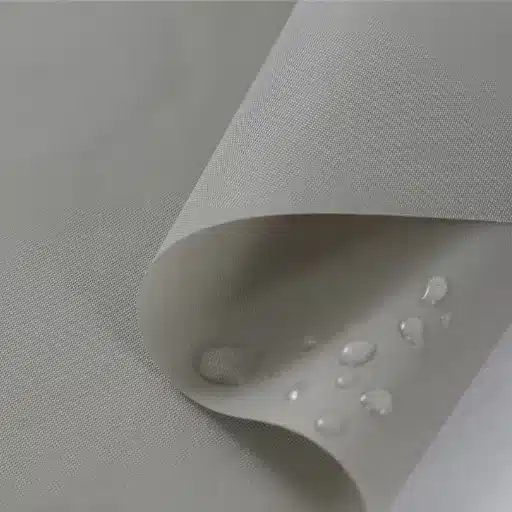
Airbag fabric starts as a high-tenacity industrial yarn. The yarn is woven into a compact base cloth, then coated or left uncoated depending on the required permeability and thermal protection. Before comparing fabrics, it helps to compare the polymers themselves.
Yarn-Level Properties
| Property | Nylon 66 (PA66) | Polyester (PET) | Why It Matters |
|---|---|---|---|
| Tenacity | 7.9–9.5 g/denier | 5.5–7.0 g/denier | Higher tenacity lets designers use lighter yarn while meeting strength targets. |
| Elongation at break | 25–40% | 15–20% | Controlled stretch absorbs occupant impact energy; too little elongation increases rupture risk. |
| Density | ~1.14 g/cm³ | ~1.38 g/cm³ | Nylon 66 produces a lighter fabric at equivalent strength. |
| Moisture absorption | ~2.5% | ~0.4% | PET swells less in humid environments, improving dimensional stability. |
| Melting point | 256–265 °C | 255–260 °C | Similar on paper, but thermal survival depends on energy to melt, not just melting point. |
| Energy to melt | ~589 kJ/kg | ~427 kJ/kg | Nylon 66 absorbs more heat before failing during hot-gas deployment. |
The numbers explain why nylon 66 airbag fabric has been the automotive safety standard for decades. It combines strength, controlled stretch, and thermal margin in one polymer. PET is not weak, high-tenacity PET grades can approach lower-end nylon 66 tenacity, but the combination of lower elongation and lower energy to melt makes it less forgiving in the most severe deployments. Connect with LY TRUSTLINK for precision airbag fabrics and consistent manufacturing support.
Fabric-Level Properties
Woven fabric strength is not the same as yarn strength. Weave density, yarn denier, and finishing all change the final numbers. LY TRUSTLINK’s nylon 66 airbag fabric, for example, is produced in 420–840 denier plain weaves with the following typical ranges:
- Fabric weight: 211–294 g/m²
- Warp tensile strength: 2,128–3,600 N
- Weft tensile strength: 1,982–3,300 N
- Tear strength (warp): 133–330 N
- Air permeability: 0.000015–0.000108 L/m²/s
- Width: 150–154 cm
PET airbag fabrics are typically woven at similar weights, often 180–300 g/m², but the lower elongation means tear propagation and seam slippage must be controlled more carefully during weaving and finishing. For a deeper breakdown of how these tests are performed, see our airbag material properties guide.
Thermal Behavior: Melting Point Is Not the Whole Story
Many buyers look at melting point alone and conclude that PET and nylon 66 are interchangeable because both melt near 260 °C. That comparison misses the critical metric: energy to melt. Nylon 66 requires roughly 589 kJ/kg to reach its molten state, while PET requires only about 427 kJ/kg. In the 20–40 milliseconds of a deployment, the inflator gas does not have time to bring the entire fabric to equilibrium temperature. The fabric fails locally where the heat flux is highest. Nylon 66’s higher energy absorption gives it a larger safety margin against pinhole burn-through and localized melt failure.
Performance Under Real Deployment Conditions
The polymer data only becomes meaningful when it is mapped to the load case each airbag sees.
Frontal Airbag Stress Case
Driver and passenger frontal airbags deploy first in a crash and must contain the full thermal and pressure impulse of the inflator. Gas temperatures can reach 300–500 °C, and the bag must inflate in roughly 20–40 milliseconds. During that brief event, the fabric is loaded biaxially as the bag unfolds and then arrests the occupant. Nylon 66’s 25–40% elongation lets the fabric absorb kinetic energy through controlled deformation rather than sudden rupture. PET’s lower elongation makes it more prone to brittle failure under the same impulse, unless the fabric is engineered with a specific weave, coating, and lower denier to compensate.
Curtain and Side Airbag Stress Case
Side-curtain and torso airbags face a different challenge. They are larger, often use one-piece woven (OPW) construction, and must retain pressure for several seconds to protect occupants during rollover events. Thermal exposure is generally lower than in frontal bags because the inflator is farther from the fabric panel and the deployment volume is larger. This is where PET becomes attractive. Its lower moisture absorption reduces shrinkage during finishing and storage, and its dimensional stability simplifies OPW weaving. For a closer look at why OPW construction favors certain base materials, read our OPW airbag fabric overview.
A Tier-1 supplier in Southern Europe learned this distinction the hard way. The team switched a curtain airbag from nylon 66 to a standard PET to cut material cost by roughly 22%. Room-temperature tensile tests passed, but during dynamic deployment validation the PET cushion lost pressure 8% faster than the nylon baseline. The lower elongation had concentrated stress at the seams. They recovered the project only after moving to a higher-elongation PET grade and adjusting the OPW weave density, a change that erased part of the projected savings.
Failure Modes to Avoid
Regardless of polymer, airbag fabric can fail in three primary ways:
- Thermal burn-through: Localized melting from hot gas penetration, more likely with lower energy-to-melt polymers.
- Brittle rupture: Tensile overload before the yarn can absorb energy through elongation.
- Seam slippage: Weave opening or thread pull-out under biaxial load, especially with low-elongation base cloths.
Coating selection and seam design matter as much as base polymer. A poorly coated PET fabric will fail faster than a well-coated nylon 66 fabric, even if the base yarns are similar on paper. Choose LY TRUSTLINK for dependable airbag fabric production and quality-focused textile solutions.
Which Airbag Types Use Nylon 66 vs Polyester?
Material selection in the automotive industry follows a simple hierarchy: meet the system-level performance target at the lowest total cost and risk. That hierarchy produces a clear split in current production.
Nylon 66 remains the default for:
- Driver frontal airbags
- Passenger frontal airbags
- High-performance knee airbags
- Any module where thermal margin and energy absorption are non-negotiable
Polyester is increasingly specified for:
- Side-curtain airbags, especially OPW designs
- Torso side airbags
- Lower-stress knee and pedestrian airbags
- Recycled-content cushions driven by OEM sustainability targets
The shift is measurable. Nylon 66 still accounts for roughly 90% or more of global airbag fabric usage, but PET is the fastest-growing alternative segment. HS Hyosung Advanced Materials, which supplies both polymers to major automakers, notes growing PET demand specifically for curtain and recycled-cushion programs. The polyester airbag yarn market was valued at roughly USD 168 million in 2025 and is projected to reach USD 346 million by 2034, reflecting an annual growth rate near 11%.
A North American OEM procurement manager faced a typical sourcing decision last year. Nylon 66 feedstock prices jumped 18% after a Force Majeure event at a major adiponitrile plant. The manager dual-sourced a PET curtain fabric for a new vehicle platform, cut material cost, and reduced supply-chain concentration, without failing the FMVSS 214 pressure-retention tests. The move worked because the application was a side curtain, not a frontal bag, and the PET grade was qualified to the same SAE J2052 aging protocol as the nylon baseline.
Cost, Weight, Supply Chain, and Sustainability
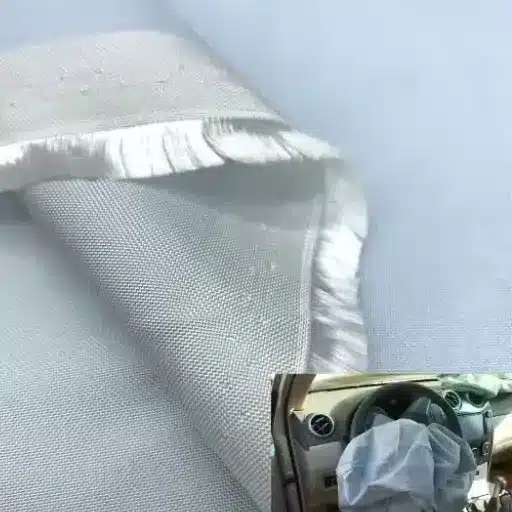
Raw Material and Weight Economics
PET yarn is typically 20–30% cheaper than nylon 66 on a per-kilogram basis. However, PET is also denser, 1.38 g/cm³ versus 1.14 g/cm³ for nylon 66, so a square meter of PET fabric at the same strength target can be heavier. In applications where every gram counts, such as electric vehicles with tight range budgets, the weight penalty can offset part of the material savings.
Nylon 66 feedstock is also more concentrated. Adiponitrile, the key precursor, has a smaller supplier base than PET’s terephthalic acid feedstock. That concentration creates price volatility and dual-sourcing incentives for OEMs. After the Takata recall, many automakers explicitly diversified their airbag supply chains, and PET offers a second base-polymer path outside the nylon 66 value chain.
Sustainability and End-of-Life
Recycled PET airbag cushions are moving from pilot programs to production. Autoliv has announced 100% recycled PET cushion programs, and Toray has developed recycled aramid options for specialty modules. PET’s recycling infrastructure is more mature than nylon 66’s, and silicone-coated nylon 66 fabrics are difficult to separate mechanically for standard textile recovery.
Regulatory pressure is also rising. The EU End-of-Life Vehicle directive is pushing automakers to design for recyclability, and OEM sustainability scorecards increasingly include airbag fabric content. Bio-based nylon 66, derived from castor oil, is an emerging alternative for brands that want nylon 66 performance with a lower carbon footprint, but it is not yet available at volume.
Talk to LY TRUSTLINK for high-performance airbag fabrics tailored to your requirements.
Coating, Weave, and Manufacturing Compatibility
Base fabric is only half of the airbag textile. Coating controls permeability, thermal protection, and packability. Weave construction determines seam strength and dimensional stability.
Silicone Coating Adhesion
Silicone coating dominates the airbag market with more than 70% share because it remains flexible over a wide temperature range and withstands the thermal aging required by SAE J2052. Nylon 66 adheres well to silicone without extensive surface preparation. PET’s smoother, more hydrophobic surface can require plasma or chemical treatment, or a primer layer, to achieve the same peel and flex performance. That extra step adds cost and process complexity, which must be factored into any PET savings calculation.
Neoprene coatings were common a decade ago but now represent less than 25% of the market because they are heavier and less thermally stable. TPU and uncoated low-permeability fabrics are emerging options, particularly for modules where weight reduction is the priority.
Weave Construction
Frontal airbags are typically flat-woven in plain or ripstop constructions. Curtain and side airbags increasingly use OPW technology, which weaves the bag shape in one piece and eliminates sewn seams. OPW demands very low shrinkage and consistent warp/weft tension. PET’s low moisture absorption and higher modulus make it attractive here, provided the elongation is engineered to avoid brittle failure.
Need help matching a coating and weave to your airbag type? Our engineering team can review your target permeability, coating add-on, and seam specification against our production capabilities. Request an airbag fabric specification review.
How to Choose: Procurement Decision Matrix, FAQ, and Red Flags
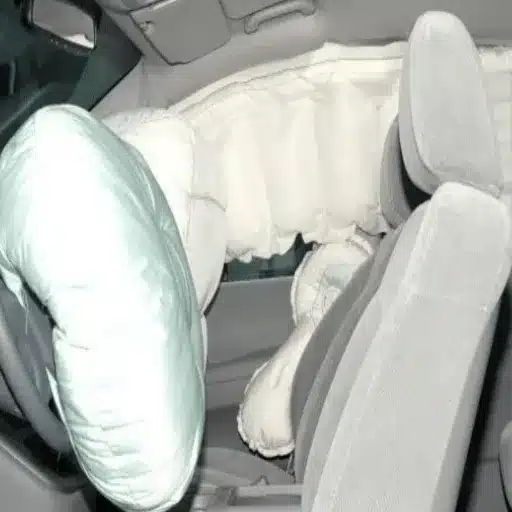
The right material is the one that satisfies the system-level test, not the one that wins a spreadsheet comparison.
Choose Nylon 66
- The airbag is a driver or passenger frontal bag.
- The module sees high thermal impulse or aggressive inflator gas.
- Energy absorption and occupant cushioning are the dominant design drivers.
- Weight reduction is critical and the design can use a lighter denier.
- The customer requires the longest qualification history and broadest OEM acceptance.
Choose Polyester (PET)
- The application is a side-curtain, torso, knee, or pedestrian airbag with lower thermal stress.
- OPW weaving or low moisture absorption is a process advantage.
- Cost reduction or feedstock diversification is a primary program target.
- The OEM has a recycled-content mandate and a qualified rPET supply chain.
Spec Sheet Red Flags
A mill report is only as useful as the data behind it. Reject or flag any report that:
- Quotes tensile or tear strength without citing the test method (ASTM D5034/D5035, ISO 13934-1, ASTM D1424, ISO 13937-2).
- Lists a single value instead of an acceptance range.
- Confuses bulk polymer strength (MPa) with woven fabric strength (N/5cm or N).
- Omits SAE J2052 accelerated-aging data.
- Does not state coating type, add-on weight, and air-permeability test conditions.
A quality engineer at a Korean Tier-1 supplier received a report showing “tensile strength: 85 MPa.” There was no test method, no direction, and no fabric geometry. The number turned out to be a bulk nylon 66 pellet value from the yarn producer, not the woven fabric value. The lot measured 1,780 N in the warp, below the 2,100 N minimum, and was rejected. The supplier lost six weeks of qualification time because one line on a report was ambiguous.
Frequently Asked Questions
What is the difference between nylon 66 and polyester airbag fabric?
Nylon 66 offers higher tensile strength, greater elongation, and better short-term thermal survival, making it the standard for frontal airbags. Polyester is lower cost, more dimensionally stable, and increasingly used in curtain, side, and recycled-cushion applications where thermal loads are lower.
Why is nylon 66 preferred for airbags?
Nylon 66 absorbs more thermal energy before melting and stretches further before breaking. That combination protects against hot-gas burn-through and cushions occupants during impact. It also adheres well to silicone coatings and has a long history of OEM qualification.
Can polyester replace nylon 66 in airbags?
PET can replace nylon 66 in selected lower-stress applications, such as side-curtain and torso airbags, when the fabric, coating, and seam design are qualified to the same deployment and aging standards. It is not a drop-in replacement for frontal bags without significant engineering changes.
Which airbag types use polyester?
Curtain, side, knee, pedestrian, and some recycled-content cushions increasingly use PET. Frontal driver and passenger airbags remain dominated by nylon 66.
Is polyester airbag fabric cheaper than nylon 66?
Yes, typically by 20–30% on a yarn basis. However, coating adhesion treatments, higher density, and qualification costs can reduce the net savings.
What standards govern airbag fabric material selection?
System-level performance is governed by FMVSS 208 in the U. S. and ECE R94/R95 in Europe. Component-level testing follows ISO 12097-2, and long-term aging is validated with SAE J2052.
What should a procurement team verify on an airbag fabric test report?
Verify that the report cites the test method, shows acceptance ranges, includes warp and weft values, states coating type and add-on, and provides SAE J2052 aging data. Single-point bulk-polymer values are not sufficient.
Conclusion
The nylon 66 vs polyester airbag fabric decision comes down to matching polymer performance to module requirements. Nylon 66 remains the safer choice for frontal and high-thermal-stress airbags because of its superior energy absorption, thermal margin, and coating compatibility. Polyester is a legitimate engineering option for curtain, side, knee, and recycled-cushion programs where cost, supply-chain diversity, or sustainability targets justify the material switch, provided the fabric is qualified to the same deployment and aging protocols.
For procurement and quality teams, the final safeguard is the mill test report. Demand test-method citations, acceptance ranges, and SAE J2052 aging data for any base fabric, whether nylon 66 or PET. A specification without a test method is just a number.
If you are specifying nylon 66 airbag fabric for an upcoming program, download the LY TRUSTLINK nylon 66 airbag fabric data sheet or request a quote from our engineering team. We can walk through the tensile, tear, and permeability ranges that match your module’s performance target.