
How Long Do Bounce Houses Last? Lifespan by Grade, Use Cycles & Care
How long do bounce houses last? A commercial-grade bounce house lasts about 3 to 10 years, and an 18 oz PVC unit typically lands at 5 to 7 years under regular rental use. Residential nylon and Oxford units last 6 to 18 months, stretching to 3 years with light use. But the honest answer is that a bounce house’s lifespan is measured in use cycles, not calendar years, and that is why the internet tells you everything from six months to fifteen.
If you search “how long do bounce houses last,” you will find a range wide enough to be useless. One rental blog says five years. A manufacturer says ten. A retailer quietly admits that the bargain inflatable in their showroom may not survive a single busy season. None of them tell you the number that actually matters: how many times the unit can inflate, get jumped on, get torn down, and do it again.
We manufacture the PVC fabric these units are built from, so we can give you the version most resellers cannot. This guide gives you a lifespan-by-grade table, the use-cycle math that turns a marketing claim into a replacement date, the factors that quietly destroy inflatables, and the specific signals that tell you a unit is finished. By the end, you will be able to look at any bounce house, commercial or residential, and predict how long it will last and what it will cost you per year.
Key Takeaways
- Commercial PVC bounce houses last 3 to 10 years; 18 oz PVC, the industry baseline, runs 5 to 7 years under regular rental use and up to 10 with careful handling.
- Residential nylon and Oxford units last 6 to 18 months under regular use, up to about 3 years with light use and indoor storage.
- Lifespan is set by use cycles, not years. An 18 oz unit rated for roughly 600 cycles used 72 times a year gives you about 8 seasons; a 15 oz unit rated near 200 cycles gives you under 3.
- Grade, UV exposure, storage moisture, and duty cycle decide the outcome, and damp storage is the single most common reason a unit dies early.
- Replace when two or more failure signals appear: leaks that return after patching, thinning material, seam separation, worn anchor points, or mold that will not clean out.
Bounce House Lifespan by Material Grade
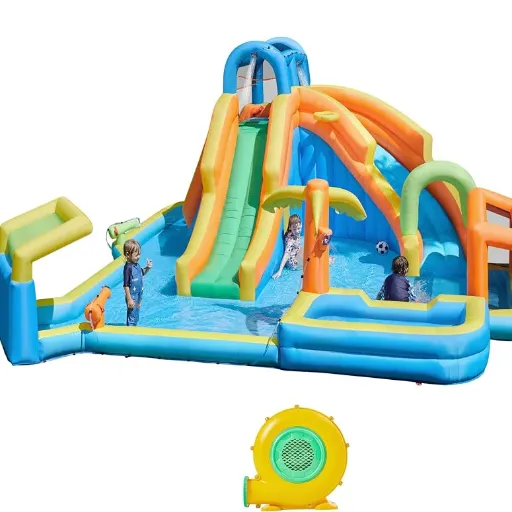
The single most useful thing you can know about a bounce house is its fabric weight, measured in ounces per square yard (oz). Grade sets the ceiling on lifespan before a single child steps inside. Everything else, storage, sun, and how often you rent it, only decides how fast you reach that ceiling.
Here is what the grades actually deliver in the field.
| Grade | Typical lifespan | Rated use cycles | Realistic use case |
|---|---|---|---|
| Residential nylon / Oxford (500D–800D) | 6–18 months (to 3 years with light use) | Not cycle-rated | Backyard, occasional private use |
| 15 oz PVC (light commercial) | 2–3 years | ~200 cycles | Light rental, indoor events, low-frequency use |
| 18 oz PVC (commercial baseline) | 5–7 years (to 10 with careful handling) | 500–2,000+, and 3,000+ with maintenance | Full commercial rental fleets |
| 20 oz+ PVC (heavy duty, water slide grades) | 6–8 years (water slides often 3–6) | Heavy duty | High-frequency rental, wet or dry units |
The spread is not marketing noise. It reflects how much PVC coating sits on the polyester scrim and how well the seams are welded. A residential unit uses a light nylon or Oxford shell with minimal coating. A commercial 18 oz unit sandwiches a high-tenacity polyester scrim, often 1000D by 23 by 23, between thick layers of PVC and seals every seam with high-frequency welding rather than stitching. That construction is what buys the extra years.
Why Grade Sets the Ceiling
If a supplier cannot tell you the ounce rating and the denier of the scrim, they cannot tell you how long the unit will last, because they do not know. This is why we tell buyers to treat “commercial grade” as a specification to verify, not a label to trust. A unit described as commercial but built on a residential fabric weight will fail on a commercial duty cycle.
The good news is that grade is a choice you make once, at purchase. Choosing an 18 oz unit over a 15 oz unit costs more up front and returns it several times over in avoided replacements. If you want the detail on what separates the two, our guide to commercial grade bounce house material breaks down the spec thresholds, and the 15 oz vs 18 oz PVC vinyl comparison walks through the trade-off directly.
Planning a rental fleet? The lifespan you get is largely decided by the fabric grade you buy. Compare commercial-grade bounce house material specs →
Lifespan in Use Cycles, Not Years
Here is the shift in thinking that separates a professional from an amateur. A bounce house does not wear out with time. It wears out with use. Every inflation, every jump session, every setup and teardown stresses the seams and the jump surface. So the correct way to think about lifespan is a simple division problem:
rated use cycles ÷ actual rentals per year = seasons of service
A commercial 18 oz unit carries a cycle rating of roughly 500 to 2,000 uses, and up to 3,000 with disciplined maintenance. That is the number to build your expectations around.
Think about what that means in practice. A unit rated for about 600 cycles, used 72 times a year, gives you roughly 8 seasons of service. Push that same unit to 120 rentals a year during peak season and the math drops toward 5 seasons. A lighter 15 oz unit rated closer to 200 cycles gives you under 3 seasons before it needs major maintenance, no matter how carefully you store it.
This is why two operators can buy superficially similar-looking units and have completely different experiences. The one who chose the heavier fabric and tracked the cycle count knows exactly when to budget for replacement. The one who bought on price finds out the hard way, mid-season, with a booking calendar full of customers.
Duty-Cycle Profiles
Where your operation falls on the duty cycle changes the answer as much as the fabric does:
- Heavy duty (rented every weekend, year-round): expect 3 to 5 seasons on a mid-grade unit.
- Moderate duty (schools, churches, seasonal fleets): expect 5 to 7 years.
- Light duty (indoor or occasional use): expect 7 to 10 years.
Match your expected lifespan to your duty cycle in the table above, and you have a far more accurate answer than any generic “ten years” claim on a sales page.
What Actually Shortens a Bounce House’s Lifespan
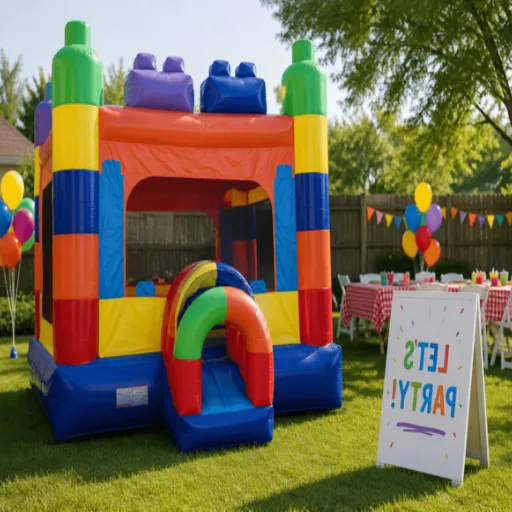
A bounce house rarely dies of old age. It dies of something specific, and most of those somethings are preventable. Knowing the four biggest ones is the difference between a unit that serves five seasons and one that is retired in two.
UV and Sun Exposure
Ultraviolet light is the slow killer of outdoor PVC. It breaks down the plasticizers that keep the vinyl flexible, and over time the material fades, stiffens, and eventually cracks. Residential nylon and Oxford degrade noticeably after only 200 to 500 hours of direct sun, which a single summer of outdoor use can consume. Quality PVC includes UV stabilizers that resist this for 3 to 5 years of outdoor exposure, but no coating is immune, and units kept indoors or under shade measurably outlast identical units left in the open.
Moisture and Storage
Damp storage is the single most common lifespan killer we see, and it is entirely avoidable. When a unit is folded away wet, moisture is trapped against the fabric and stitching. Mold and mildew can begin within 48 hours, which is why the EPA recommends drying damp materials within 24 to 48 hours to prevent mold growth. Left alone, mold permanently stains vinyl, rots thread, and delaminates the coating from the inside, damage that no amount of cleaning will reverse. The rule is simple: dry fully before storage, every time, ideally over 48 to 72 hours, and confirm the interior is dry too, because PVC traps water in pockets that a quick wipe will miss.
A real example. A mid-sized operator we work with, running six combo units for school and church events, lost two units in a single off-season. The cause was not wear. After a wet September, both were folded and stacked while still damp. By spring, both had mold through the seams and a delaminated coating. The repair quote came back at roughly a third of replacement value each, which is when replacing becomes the rational choice. The fix that would have saved both units cost nothing: a full dry-out before storage.
Cold, Heat, and Ground Surface
Temperature matters more than most operators realize. PVC stiffens and becomes brittle below about 40°F (4°C). Unfolding a frozen unit and inflating it cold can crack the coating outright, so a unit stored in an unheated space should be allowed to acclimate in a warm area for around 24 hours before use. On the other end, dragging a unit across concrete or rough asphalt erodes the base and seams; a ground tarp is a small cost that adds real life.
Use Intensity, Load, and Seams
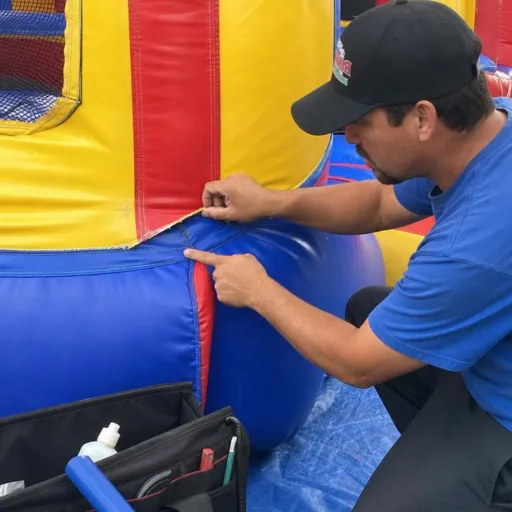
Every setup and teardown cycle works the seams, and seams are where commercial inflatables most often fail. Heat-welded PVC seams outperform stitched seams because the bond is molecular rather than thread-based, and stitched seams on nylon or Oxford are the first thing to go under commercial load. Overloading the unit beyond its rated occupant count adds shock loading to every seam and anchor point at once, which accelerates wear everywhere.
How to Make a Bounce House Last Longer
You cannot change the fabric grade you already own, but you can control nearly everything that shortens a unit’s life. The operators who consistently get 7 or more seasons from a mid-grade unit are not lucky. They follow a handful of habits.
- Dry completely before every storage cycle. Inflated and deflated, over 48 to 72 hours. This is the highest-return habit on the list.
- Store cool, dark, and dry. Around 50 to 80°F, humidity under 50%, off a concrete floor that wicks moisture, in a breathable bag rather than sealed plastic.
- Clean after every event. Mild soap, soft brush, full rinse, full dry. Skip bleach, ammonia, and pressure washers, which strip coatings and stress seams.
- Apply a UV protectant after cleaning to slow the fading and stiffening that sun causes.
- Repair small tears immediately. A 2-inch tear ignored becomes a 12-inch blowout, and the repair cost scales with the delay.
- Rotate stored units every couple of months to prevent compression marks and stress creases from forming in the same folds.
- Use a ground tarp on every rough surface, and inspect seams, anchor D-rings, netting, and the blower before and after each use.
The Maintenance Budget
A useful planning figure: set aside roughly 7 to 10 percent of a unit’s replacement value per year for maintenance. If you replace an $1,800 unit every six years, that is about $210 to $300 a year, which should cover cleaning supplies, patches, occasional seam work, and a replacement blower at some point. Budget it, and a mid-season failure stops being a crisis.
Cost per Year: The Lifespan Math That Matters
Lifespan only becomes a business decision when you attach a cost to it. The formula is simple: unit cost ÷ usable seasons = cost per year.
Take a light 15 oz unit priced at 1,200.Ifitdelivers2to3seasons,yourcostperyearisroughly1,200.Ifitdelivers2to3seasons,yourcostperyearisroughly400 to 600.Nowtakean18ozunitat600.Nowtakean18ozunitat1,800 that delivers 6 seasons. Your cost per year is about $300, and you spend less time managing failures, cancellations, and repair downtime along the way. The cheaper unit was the more expensive decision.
This is the calculation most buyers skip, and it is the one that reveals why the upfront price is a poor guide to value. When you divide by expected seasons rather than looking at the sticker, the heavier fabric wins on total cost of ownership almost every time. If you want to run the same numbers against your own fleet, the weight and durability trade-off is laid out in our 15 oz vs 18 oz PVC vinyl comparison and the material thresholds in ou bounce house material guide.
Comparing suppliers on more than price? Request a specification sheet → with oz, denier, tear strength, and compliance data so you can verify the grade before you buy.
When to Replace a Bounce House
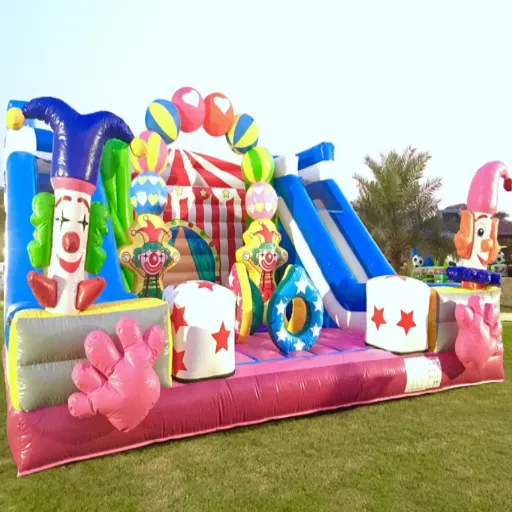
Replace the unit, rather than repair it, when two or more of these signals are present at the same time:
- Air leaks that keep returning after you have patched the same area more than once.
- An excessive patch count, where repairs start outnumbering clean fabric.
- Thinning or see-through material, especially on the jump surface and at fold lines.
- Seam separation or coating delamination along a load-bearing seam.
- Worn anchor points or D-rings that no longer hold tension securely.
- Mold that cleaning does not remove and that has penetrated the stitching.
- A permanently stiff, brittle, or discolored feel that signals the plasticizers are spent.
- Any loss of structural stability, or a repair estimate approaching replacement value.
Two or more of these together means the unit has reached the end of its reliable service life, and continuing to rent it out risks a failure in front of a customer. For commercial fleets, inspection and maintenance should follow ASTM F2374, the standard practice for inflatable amusement devices, which is the benchmark many state regulators now require. One isolated signal can usually be repaired, which is where our guide to repairing a bounce house comes in.
Frequently Asked Questions
How long do bounce houses last?
A commercial-grade bounce house lasts about 3 to 10 years, with an 18 oz PVC unit typically giving 5 to 7 years of regular rental use. Residential nylon and Oxford units last 6 to 18 months under regular use, up to about 3 years with light use. Lifespan depends on grade, use cycles, UV exposure, and storage.
How long does a commercial bounce house last?
Most well-maintained commercial PVC units last 3 to 10 years. An 18 oz unit used 30 to 50 times a year typically gives 3 to 5 seasons before major maintenance, while a lightly used or indoor-stored unit can exceed 10 years. The deciding factors are fabric grade, duty cycle, and whether it is stored dry.
How many rentals before I should replace a bounce house?
Use the rated cycle count. An 18 oz unit rated for 500 to 2,000 cycles, and up to 3,000 with maintenance, can be divided by your annual rentals to estimate service life. A 600-cycle unit used 72 times a year gives roughly 8 seasons; a 15 oz unit rated near 200 cycles gives under 3.
How long does a bounce house last outdoors in the sun?
Sun exposure is the leading cause of gradual material failure. Residential nylon and Oxford degrade noticeably after 200 to 500 hours of direct sun, while UV-stabilized PVC resists fading and cracking for 3 to 5 years of outdoor use. Shaded or indoor storage measurably extends life.
Does storing a bounce house wet ruin it?
Storing a unit damp is the most common cause of early replacement. Mold and mildew can start within 48 hours, staining the vinyl and rotting the stitching from the inside. Always dry the unit completely, inside and out, for 48 to 72 hours before storage.
How do I make a bounce house last longer?
Dry it completely before every storage cycle, store it cool, dark, and dry, clean it after each use, apply a UV protectant, repair small tears immediately, and use a ground tarp on rough surfaces. These habits routinely turn a 3-season unit into a 7-season one.
Is it cheaper to repair or replace a bounce house?
Repair when you have a single localized failure. Replace when two or more failure signals appear together, or when a repair estimate approaches replacement value, since the next failure is usually not far behind.
The Bottom Line on Bounce House Lifespan
The lifespan of a bounce house is not a fixed number waiting to be found on a spec sheet. It is the product of three things you can control. The grade you choose sets the ceiling, the cycles you put the unit through decide how fast you reach it, and the care you give it, especially drying and storage, decides how much of that ceiling you actually get.
Choose commercial-grade PVC for anything beyond backyard use. Track your rentals against the unit’s cycle rating so replacement is a budget line rather than a surprise. Keep the unit dry, shaded, and promptly repaired. Do those three things, and a mid-grade commercial unit will serve you for years, at a cost per season that the cheaper alternative never matches.
If you are sourcing inflatables for a rental operation, a school, or a manufactured product line, the fabric underneath the design is what determines everything above it. Our team engineers PVC inflatable fabric to your exact oz, denier, and compliance requirements, and can support your project from first sample to volume supply.
Ready to specify the right fabric? Talk to our engineering team about commercial inflatable fabric → or explore the full bounce house fabric guide for the complete material stack.