
Nylon Airbag Fabric: Buyer’s Guide to Specs & Sourcing
Used for manufacturing airbags, nylon fabrics are extremely strong printed polyamides of the type 6.6 that helps introduce gas inside the airbags at high speeds. The nylon fabric is ideal for airbags in automotives and various safety systems as it combines strength with light weight, toughness and heat stability better than alternatives which are usually polyester and aramid fibers that are usually composites of fibers.
There was once a purchasing manager in a Tier-2 automotive supply factory who told us their biggest mistake was not selecting the wrong supplier. It was giving an incorrect denier of nylon. The 420D nylon for the left airbag that they have successfully developed for the passenger’s side; however, failed to pass the analysis of permeability since the it had been wrongly stitched and what needed to be a 420D uncoated fabric on a 840D uncoated fabric construction. Revising itself for that is three months of work; the amount of loss is six to seven figures worth; and it all because of one measuring mistake.
You have felt the same confusion at least once. It can be a challenging task to understand, let alone comply with established guidelines, when one or more factors including but not limited to denier ranges, quality grades, and the masking properties are required to be fulfilled. Of the subject’s knowledge also becomes a source of uncertainty within that context. This article aims to present a technical guide for providing information on nylon airbag fabric for automotive applications. This will cover four key aspects stipulating the need- examples of how to calculate coating, testing for transfer of water into the fabric, and an easily actionable purchasing list. If you have any questions or need further assistance, don’t hesitate to get in touch with us.
Key Takeaways
- Nylon 6.6 remains the dominant base material for airbag fabric due to its 265°C melting point and superior energy absorption under rapid deployment stress.
- Denier selection depends on airbag position: 420D for driver-side coated bags, 840D for passenger-side uncoated, and 1880D for side-curtain applications.
- Coating choice (silicone, neoprene, TPU, or uncoated) directly impacts heat resistance, weight, gas retention, and total cost of ownership.
- Buyers must verify FMVSS 208/302 compliance, IATF 16949 certification, and PPAP readiness before qualifying any supplier.
- A structured procurement checklist eliminates specification errors and accelerates supplier validation from months to weeks.
What Is Nylon Airbag Fabric?
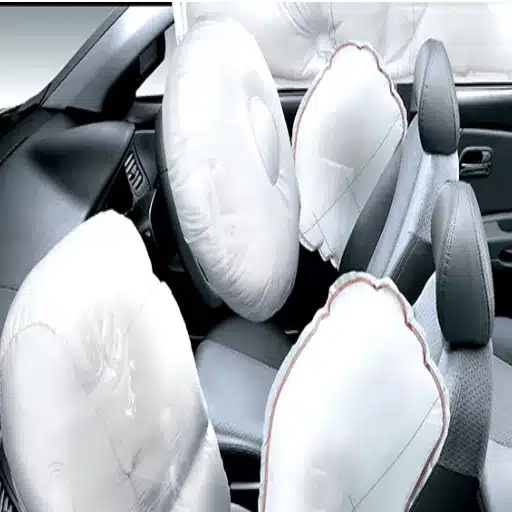
Nylon bag fabric is a special type of woven fabric that is made up of high tenacity polyamide material which is the nylon-66. The fabric has to have structures that can withstand rapid expansion due to any kind of gas and allowed to inflate after that gas. It must be able to deflate after a certain time. The fabric for automobile airbags is generally made of 175 to 294 g/m2 weight substrate with 420 to 840 denier yarns.
Why Nylon 6.6 Dominates
Nylon 6.6 outperforms every alternative on the metrics that matter for occupant safety. Its melting point of 256–265°C provides a critical thermal buffer against the 300°C+ gas burst during deployment. Polyester, by comparison, melts at approximately 40% lower temperature and allows hot gas penetration that would compromise fabric integrity. Learn more about the molecular structure that makes nylon 6.6 the automotive safety standard.
The material also delivers superior tensile strength. Nylon 6.6 industrial yarns achieve tenacities of 7.9 to 9.5 grams per denier (gpd), depending on filament count and draw ratio. This translates to warp-direction tensile strengths exceeding 3,600 N for 420D constructions and over 3,000 N for 840D weaves. No other commercially viable polymer matches this combination of strength, elasticity, and thermal stability at industrial scale.
Coated vs. Uncoated Variants
Most nylon airbag fabrics receive an elastomeric coating to regulate gas permeability and provide thermal protection. Silicone coatings dominate modern driver-side applications at 20–40 g/m², while neoprene remains common for industrial and cost-sensitive automotive uses at 40–80 g/m². Uncoated variants require heavier base fabric to achieve equivalent gas retention, making them suitable for passenger-side bags where lower gas pressure and longer inflation times reduce thermal stress.
The global automotive airbag fabric market reached approximately USD 2.6 billion in 2024 and is projected to grow at a 4.4% CAGR through 2031. Airbags account for roughly 18% of all automotive textiles, with annual output exceeding 145,000 tons worldwide. View our full range of engineered airbag fabric solutions.
Key Specifications Every Buyer Must Evaluate
Specifying nylon airbag fabric requires precision across four interdependent parameters. Change one, and the others shift. Understanding these relationships prevents the kind of costly validation failure that derailed the procurement team we described earlier.
Yarn Denier and Fabric Weight
Denier selection is the most common source of specification error. With the fabric of the denier grade, the thickness of the yarn or the fabric can be determined directly. Moreover, the fabric weight, tensile strength, and compressibility all these factors check with the denier value. Commonly, this is the three most used denier grades in automotive applications:
420D nylon airbag fabric is mostly used in the manufacture of the driver’s airbag as well as in the production of light bags. When coated with silicone at 20 – 40 grams per square meter, it weighs about 175 grams per square meter. A lower denier count was utilized to ensure that the fabric can be folded neatly within the steering wheel and able to resist tear stresses associated with a frontal impact.
840D nylon airbag fabric is the material of choice for making passenger’s airbags and in applications where no coating is involved. The additional mass of the yarn compensates for the absence of a coating in that the overcompensation created inherent gas retention by having a more tightly woven fabric. Compressed finished fabric weights are comprised between 244g/m2 and 294g/m2 inclusive while the 840D construction can also be seen in curtain airbags where application of higher pressure and gas volumes elimination require extremely hard packed textile.
Side-impact and exceed normal applications of 1880D and higher ensure stronger performance thanks to the necessity to withstand extreme tear resistance. Along with the increase in thickness of the such constructions, the folding may likewise suffer reduction. Yet, it provides the protection in form of rolling over or the system of airbag for pedestrians which is fitted externally.
Keep in mind the following: In cases of placing orders, do check with your supplier whether the denier value quoted is expressed in dtex (decitex) or D (denier). This can be converted easily, 840D equals not need to approximately 933 dtex but such a mixing of units within the same data base has been responsible for more than one fail results.
Tensile and Tear Strength
The tensile strength is a characteristic that indicates the strength of a fabric in terms of its ability to withstand the linear load until the moment when it ruptures. When it comes to the airbag nylon’s use in automobiles, the warp tensile strength is commonly both greater than 2000N for the 420D coating constructions and as much as 3600 for 420D Premier 2 x 2 plain weaves. The numbers for the weft direction are somewhat lower owing to the usual variation of those processes.
Most importantly, the tear strength is equally important. The tear strength of seam lines and fold points inside the deployed airbag is higher than that of the other areas within the airbag. Thus, in the ISO 13937.2 method for testing the tear strength of the polyamide nylon 6,6 fabric at the 420D quality level warp tears strength on an average is very low at 133 N and the weft values are even lower at 137 N. For the operations associated with the higher density nylons or application of ripstop configuration there are designs that achieve up to 300 N tear strengths.
When going through the data provided by suppliers with normal information, find out about the method used. Failure to provide relevant standards outlined in the ISO 13934.1 or the ASTM D5034 condition is misleading. Obviously, temperature, humidity, grip dimensions all affect the outcome. Don’t hesitate to connect with us—our team is ready to help you with any questions you may have.
Air Permeability and Deployment Performance
Once air inflation occurs, this air drifts to escape from the fabric. The escape of gas through the fabric depends on the permeability of the fabric. Excessive permeability is undesirable as kinetic energy is taken up too late. If the rate of permeability is insufficient, the person will hit back against a hard surface. According to the limits of the industry specification, the air permeability should not exceed 10 L/dm2/min in a porous surface under a differential pressure of 500 Pa.
Coating type, calendar pressure and weave density can increase permeability. Typical permeability of Silicone coated 420D fabric with 20g/m² coating is between 0.5 – 2.0 L/dm²/min. Moreover, uncoated 840D fabrics with 32 ends/cm can achieve between 8 and 11 L/dm²/min within tolerance limits. Familiarizing oneself with these standards will prove useful when trying to select and match suitable fabrics for air bags to suit a specific application scenario.
Airbags for drivers and passengers are even faster, they open about a hundred times faster, in 50 milliseconds following an impact. The aim is that the pull out of the airbag or its inflation leads to showcase that the material does not crack at the point of pressure application. And that this practically immediate strength is maintained throughout the cushioning process. Every engineering specification including thickness, colour, type of dyes, adhesives, laminates, reinforcement and more contributes in attempting to satisfy the 50-millisecond unburst strength.
Heat Resistance and Thermal Aging
Airbag fabric shall remain undamaged when exposed to temperatures of over 300°C while putting an airbag in operation. This hot exhaust gases are expelled at speed of peaked over 300 m per second. Also, this fabric will easily fall into ruins even before passing a full cushioning cycle without additional thermal guard.
Nylon 6.6 with a strong base allows to withstand higher temperatures due to the high melting temperature. The coating system maintains this thermal stability. Silicone coating serves as a thermal insulator because it prevents the hot gas zone from coming in contact with the nylon surface. Neoprene coating does the same but in a thicker richer form.
In addition, there are considerations for long-term thermal aging. These tissues remain folded in the vehicles for 10–15 years before they are ever inflated. Tests that force the aging process particularly cause situations of exposure of dashes and pillars at temperatures between 105–120°C for tens of years. Particularly, a nylon airbag fabric must have weathering properties against tensile at these temperatures and an OEM also through the use of test protocols would be able to comment on the structures performance after the set time interval.
Coating Selection: Silicone, Neoprene, TPU, or Uncoated?

The coating on a nylon airbag fabric is not merely a finish. It is a functional layer that determines thermal protection, gas retention, weight, foldability, and cost. Selecting the wrong coating for the application creates the same risk as selecting the wrong denier.
Silicone Coating
Latest advancements in polymer technology in the automobile sector have seen an increased use of the silicon metal as it is superior his temperature resistant properties. Silicon Coating is applied in a range of 20- 40 g/sm and is thinner and lighter in contrast with the neoprene counterparts. This titanium outlasts these extreme climates reaching temperatures of-40°C to 200°C.
For example, investigators stated that in the case of irreversibly dyed lawn, there is a restriction and specific requirements to prevent adverse effect of climate on nylon fabric as an airmen. It is coated with tack of polyacrylic and… adhesion by primer.
Weight saving is acknowledged in vehicle design, casling high most apparath does not allow significant addition of weight. Ems Further enhance the value of silicone coated pa airbags for example in the bonnet, in which case the designer must minimize the total mass of the system.
In any case, Silicon is not perfect. The abrasion resistance in this material-fabric is worse than the one in the newer models of neoprene in the Rosloc range by Theraflo due to the fact that the substrates (fabric layers inside the composite) touch each other when the system is folded or rolled up. At the same time, the price of square meter is higher than for neoprene of the same rating, albeit less so in large quantities. Start your next successful cooperation with LY TRUSTLINK by contacting our team for personalized assistance and professional guidance.
Neoprene Coating
Neoprene originated as the substance used for inflating jackets and it still maintains its place in harsh environments like its use in lifting bags for oil extraction offshore and for price competitiveness related tasks in ground motor vehicles. For the neoprene with mass per unit area about 40–80 g/m² resistance to tearing is higher; it protects against abrasion better than in the case of exposure to high temperatures. It provides no means to fear for its ability to function in cases where the load is high compared to the thermal stress that is received.
In the case of industrial use and offshore construction equipment, air-filled bags, water, air, membranes etc. to be deployed in a controlled space, reinforced neoprene-layered air bags forms durability that sand coated types of silicone air bags cannot provide. The catch is in the mass. For instance, the weight of a 420D neoprene coated fabric will be about 220-260 g/m² whilst for the same silicone coated 420D fabric it will be less than 190-210 g/m².
TPU Coating
Thermoplastic polyurethane (TPU) coatings occupy a specialized niche where weldability and airtightness take priority over automotive deployment characteristics. TPU-coated nylon fabrics are ultrasonically and RF-weldable, creating leakproof seams without stitching. This makes them ideal for medical inflatables, aircraft escape slides, and high-pressure industrial containment systems.
TPU film thickness typically ranges from 0.05–0.30 mm depending on pressure requirements. The coating adheres well to nylon 6.6 when the base fabric is pretreated with specialized primers. For buyers sourcing nylon airbag fabric for non-automotive inflatable applications, TPU represents a capability that silicone and neoprene cannot replicate.
Uncoated
Weave density and calendaring are the two primary mechanisms used to manage the permeability of uncoated nylon airbag fabric. As a rule of thumb, this approach is effective with respect to front passenger bags because the compressing gas does not heat up due to lower internal pressure. Uncoated 840D fabrics having a weight of 244-257 g/m² score equally high performance and the weight of coating is completely eliminated.
Thirdly, there is also an eco-friendly dimension. Uncoated fabric facilitates recycling of the fabric at the end of its life, as there is no extra spray coating in its structure. Recycled nylon 66 under the name Ecouse AMILAN™, however, from silicone-coated airbag fabric scrap, uncoated fabrics do not contain such materials, and simplify recycling of such airbag scraps even further, Within this trend, buying uncoated textiles satisfies a company’s circular economy objectives.
Engineering Insight: In the search for the best coating materials for the EV platform, the European Tier-1 supplier chose silicone for driver airbag, an uncoated 840D for passenger airbags and TPU for the new external protection system for pedestrians. Three different strategies to coat one platform. All tailored to the thermal, mechanical and regulation needs of the use.
Compliance and Certification: What Buyers Must Verify
Nylon airbag fabric operates in one of the most regulated material environments in manufacturing. A missing certification or expired test report can disqualify a supplier from an OEM approval process that took years to establish.
Automotive Safety Standards
FMVSS 208 governs occupant protection in crashes in the United States in terms of airbag deployment performance, inflation characteristics, and occupant injury criteria, among others. FMVSS 302 is about the conditions of the combustion of the fabric, including the flammability standards. In case of airbag fabric made of nylon for the US to fit and serve the airbag must be accompanied by test results in relation to these two standards (performance standards).
European markets require ECE R94 (frontal impact) and ECE R95 (side impact) type approval. In these regulations, A purpose of the airbag assembly is to lessen effectiveness of the crash of the impact test dummy. Damage measures are not applicable to the restraint system alone such as the airbag as an element of the overall structural system.
Standards applicable for marine industries and industrial areas are dynamic. In marine transportation, for example, there are said to be several revisions. For instance, marine airbags for lifting shall meet the standards as detailed in IMCA Recommendations of D-016 Reinforced Fabricated Rubber Lifting Bags. Search And Rescue Gear Depending On The Requirements Of … varies with particular example. The range of equipment includes inflatable rescue boats, which are used in SOLAS.
Work to acquire potential customers and achieve repeat sales involves knowledge of the market; the appropriate regulations governing the use of hose must be considered.
Quality Management Systems
IATF 16949 is the automotive quality management standard that supersedes ISO/TS 16949. Certification is non-negotiable for any supplier intending to ship into automotive supply chains. The standard covers every stage of production, from yarn incoming inspection through weaving, coating, finishing, testing, and lot traceability.
When evaluating a supplier’s IATF certificate, verify three details:
- Scope of certification: Does it explicitly include airbag fabric manufacturing, or is it limited to general textile production?
- Expiration date: Automotive OEMs typically require certificates valid through the entire contract period.
- Certification body: Ensure the certificate was issued by an IATF-recognized registrar (SGS, TÜV, Bureau Veritas, or equivalent).
ISO 9001 provides a baseline quality framework for non-automotive applications. While less rigorous than IATF 16949, it still demonstrates systematic process control. For industrial and marine buyers, ISO 9001 certification is a reasonable minimum threshold.
How to Read a Supplier’s Certification Scope
It is important to pay close attention to the scope of a supplier’s certification as it indicates the things that a manufacturer is able to make rather than the things they actually manufacture. It is not enough that a certification states “woven textile manufacturing” as nothing in this title indicates they can make airbag fabrics. Looks for specific terms such as “production of double and single layer airbag textiles using” “curtain coated and uncoated nylon 6.6 fabrics for automobiles” or similar ones.
In submitting test reports, one has to comply with various asthma standards such as ASTM D2256 in assessing the tensile strength of yarn, ASTM D1424 in determining the tensile strength of the film, and ISO 6941 in determining the flammable level of textiles among others. It is essential that the reports are not more than two years old as this is bound to result in a number of factors that influence the test results. Over time, the results of the test demonstrate consistency in the operation of a system. Whereas the most recent test results reflect the current level of achievement.
Sourcing Nylon Airbag Fabric: A Procurement Checklist
2023 Park materials, Are a “Jhelum segiunti” Auto manufacturer’s seating department, senior purchasing chen indeed received quotations 840D system 1 nylon machine woven fabric within the air bag application. The 3 quotations received were around similar pricing and all 3 had claimed automotive experience. Chen went with the L1 quotation.
Infact, six months after the first product failed incoming inspection of inspection, the first production lot failed incoming inspection. A fabric’s weft-direction tear strength came out at 98 N, which was less than the 130 N minimum as shown on the drawing. According to the supplier, they tested in accordance with the updated print. Chen certified a new supplier for four months instead, which made it impossible to go to production and release the platform making the company to lose out on a follow on business running into seven figurers.
The following checklist would have caught the issue at the RFQ stage:
Supplier Capability Assessment
- Does the supplier maintain full vertical integration (yarn → weaving → coating → finishing), or do they outsource critical stages?
- What loom types operate in their facility? Rapier looms at 400 m/min provide the warp tension accuracy (±1 cN) that airbag weaving demands.
- What coating capacity exists? Knife-over-roll, dip, or extrusion coating? Each method produces different surface characteristics.
- Can the supplier provide A-basis samples with full test data from an accredited laboratory?
Sample Validation Protocol
- Request samples from three different production lots, not three pieces from the same roll.
- Conduct independent testing at your own laboratory or a third-party facility. Verify tensile strength, tear strength, permeability, and coating adhesion.
- Subject samples to your specific aging protocol. A fabric that passes fresh testing may fail after thermal cycling.
Custom Specification Development
- Define fabric construction by denier, ends per inch, weave pattern, coating type, and coating weight.
- Specify width tolerances (typically ±2 cm for rolls up to 154 cm wide).
- Establish lot traceability requirements. Automotive OEMs typically require yarn lot numbers, production dates, and operator identification recorded per roll.
Logistics and Lead Time
- Standard lead times for off-the-shelf nylon airbag fabric range from 4–6 weeks.
- Custom constructions require 8–12 weeks for tooling and first-article approval.
- Prototype samples typically ship within 2–3 weeks.
Contact our engineering team to discuss your specific nylon airbag fabric requirements, request sample material, or initiate a custom specification review.
Emerging Trends in Nylon Airbag Fabric
The airbag fabric industry is evolving in three directions that procurement teams should track.
Lightweighting for Electric Vehicles
The push for increased range from electric vehicle platforms is such where the design engineers are extremely conscious of every gram of weight and even having a slightest weight reduction is greatly beneficial. This development is causing some customers to move towards thinner and coated fabrics to be positioned in the interior when the coated variety was being replaced. In particular, suppliers and OEMs are considering fabrics with 350D and even 280D nylon 6,6 denier threads for future use in driver airbags, along with the introduction of more advanced calendaring processes that achieve the same property gains as coating without adding on this weight.
However, the most intriguing part is the fact that the quest for increased weightless have forced vehicle designers to use reduced cover materials in line with the enhanced safety requirements. Those suppliers capable of some internal testing and of giving freedom to experiment in their research departments will be the first one to make possible that transition. The buyers shopping around for the next development platforms should look for those that have adequate knowhow in the prototype to production cycle of development operations.
Recycled and Sustainable Materials
The push for integrating sustainability into corporate procurement areas is increasing. Through its activities of sustainability business, taking a lead and provision, Toray Industries has come up with Ecoouse AMILAN™ in 2023 which is recycled nylon 66 which is obtained from silicone coated air bag fabric waste. The material performance is equivalent to that of virgin nylon but no manufacturing byproducts get into the dump site.
Coatings used in the laboratory are majority solvent based and these are used to manufacture silicone emulsions. Other compound co-related risks that emerge in use of this product are associated with damage to human health, dangerous), inflammability. In terms of sustainability, uncoated as coating anemone made up hampered by the environmental regulations in place. SLS has embraced the sustainability practice of ZWLZ manufacturing effective 2023 with the provision of 100% recyclable: solutions in uncoated substrates designed for use where sustainability is of concern.
Expanded Application Scope
Airbag technology has transformed and spreading to covering safety beyond people who are inside a vehicle when a collision occurs. Secondary airbags now are inflatable in such a way that they are attached on the exterior of the car. Airbags in the seat belts are others that protect the upper part of one’s body at the rear part of the vehicle. The intention to construct automated systems is now modifying the positions and shapes of the airbags which used to be in the earlier vehicles.
Whenever contracting any of the devices entail certain criteria and unique demands be made. External airbag systems would for example, call for some improvement on abrasion and UV resistance capabilities. Combined airbags on seatbelts, on the other hand, would need to have appropriate donor airbag packaging. The criteria that have been applied to the design of driver frontal airbags cannot stay unaltered when applied to new cases that could be present.
For a deeper technical exploration of nylon 6.6 material science, read our detailed analysis of why nylon 6,6 is the automotive safety standard.
Conclusion
Specifying nylon airbag fabric is not a matter of selecting a standard grade from a catalog. It is an engineering decision that requires matching material properties, denier, coating, permeability, and heat resistance, to the specific demands of the application and the regulatory framework governing it.
The five principles that should guide every procurement decision:
- Match denier to position: 420D for driver-side coated, 840D for passenger-side uncoated, 1880D for side-curtain and specialty applications.
- Select coatings by thermal demand: Silicone for high-temperature automotive, neoprene for industrial abrasion resistance, TPU for weldable airtight systems, uncoated for weight-sensitive and sustainable applications.
- Verify compliance before requesting samples: Confirm IATF 16949 scope, FMVSS/ECE test report validity, and PPAP readiness.
- Test across multiple lots: A single good sample proves nothing about production consistency.
- Evaluate R&D capability: Next-generation EV and autonomous vehicle platforms will require custom developments that only vertically integrated suppliers can deliver.
The cost of a specification error is not measured in the price of defective fabric. It is measured in delayed platform launches, lost OEM approvals, and operational downtime that compounds for months. Getting the specification right the first time is the most cost-effective procurement decision you can make.
Request a custom quote for your nylon airbag fabric requirements, or download our full specification sheet to evaluate our standard and premium grades against your application needs. Our engineering team supports your project from specification review through certified delivery.